
These Two Roles Share Just 9% of Their Skills, the Lowest Overlap We've Found
A UX Designer and a Technical Product Manager sit in the same sprint planning meeting, review the same Figma file, and ship to the same roadmap. You'd expect their skill sets to overlap the way two adjacent job titles usually do. They don't. Across every top-30 skill list InterviewStack.io has compared in this series, these two roles now share the least: a 9% Jaccard overlap, below the previous low of 11% set by DevOps Engineer and Mobile Developer. We pulled every active UX Designer posting (3,717) and Technical Product Manager posting (1,001) on the InterviewStack.io job board as of August 2026 and compared skills, salary, seniority, and location head to head.
The gap isn't just in tooling. Technical Product Manager's median US base salary runs $24,900 ahead of UX Designer's, on top of a role that already posts a third as many openings. These are base salaries drawn from job postings; equity, bonus, and sign-on pay aren't captured, so total compensation at senior levels likely runs higher than either figure below.
A note on data quality: InterviewStack.io's role classifier matches on the word "designer," and a look through a random sample of the underlying UX Designer postings turns up titles like "Substation Designer," "Equipment Drafter/Designer," "Landscape Designer," "Packaging Designer," and "Beverage Designer," industrial, civil, and CAD roles that share a keyword with UX Designer but not the job. These titles rarely mention Figma, wireframes, or user research, so they shouldn't meaningfully distort the skill-frequency comparison below (the 9% overlap finding is driven by postings that do use those terms). They can, however, inflate the raw UX Designer posting count and pull its seniority, work-mode, and geography splits toward onsite/industrial norms, so read the volume, onsite-share, and entry-level figures for UX Designer with that in mind.
| UX Designer | Technical Product Manager | |
|---|---|---|
| Median US base salary | $129,600 | $154,500 |
| Active postings | 3,717 | 1,001 |
| Top skill | Figma (29.9%) | Product Management (49.4%) |
| Remote share | 16.9% | 28.3% |
| Entry-level share | 3.7% | 2.0% |
| Skill overlap (Jaccard) | 9% shared (pairwise) | 9% shared (pairwise) |
Key Findings
- UX Designer and Technical Product Manager share a 9% Jaccard skill overlap, the lowest measured across every InterviewStack.io role comparison to date.
- Only 5 skills clear the 5%-shared-frequency threshold in both roles: Agile, User Experience, Automation, Project Management, A/B Testing.
- Technical Product Manager's median US base salary ($154,500, n=307) is $24,900 (19.2%) above UX Designer's ($129,600, n=735).
- UX Designer posts 3.71x more active openings: 3,717 versus 1,001.
- Technical Product Manager offers meaningfully more flexibility: 28.3% remote and 29.3% hybrid, versus UX Designer's 16.9% remote and 21.3% hybrid (56.2% onsite).
- Entry-level share is thin on both sides: 3.7% for UX Designer, 2.0% for Technical Product Manager.
- UX Designer postings that also cite Design Strategy (n=39) or Product Management (n=60) as a skill pay $180,000 and $179,800 respectively, larger premiums than any pure design skill in the dataset.
- Technical Product Manager's own headline skill, Product Management, adds only $7,100 over the role's baseline; Program Management adds $23,400, the largest premium in the role's salary data.
Two Jobs That Share a Roadmap, Not a Skill Set
UX Designer work is craft-first: research a problem, translate it into wireframes and prototypes, run usability tests, and defend the interface to engineering and product. Its exclusive skills, Figma, Wireframes, Design Systems, Prototyping, User Research, Accessibility, cluster around the physical act of shaping what a user sees and touches.
Technical Product Manager work is translation and prioritization: turn business goals and technical constraints into a roadmap, write user stories, negotiate scope with engineering, and answer for scalability once a feature ships. Its exclusive skills, Product Management, APIs, Product Strategy, Stakeholder Management, SQL, sit between the business and the codebase, not between the user and the screen. The two roles collaborate constantly. They almost never do the same task.
What Little Overlap Do These Roles Actually Share?
Five skills clear the bar in both roles' postings, and even those don't split evenly. Agile shows up in 13.4% of UX Designer postings and 27.6% of Technical Product Manager postings, more than twice the rate. User Experience runs the other way: 21.8% for UX Designer versus 11.6% for Technical Product Manager. What matters more than the frequency split is what these five skills are worth once priced:
| Shared skill | UX Designer premium (own $129,600 baseline) | Technical Product Manager premium (own $154,500 baseline) |
|---|---|---|
| User Experience | +$26,800 (n=187) | +$12,900 (n=41) |
| Agile | +$20,400 (n=103) | -$4,500 (n=80) |
| A/B Testing | +$17,000 (n=55) | +$10,500 (n=27) |
| Automation | +$6,000 (n=62) | -$4,500 (n=57) |
| Project Management | -$11,500 (n=93) | -$13,500 (n=30) |
User Experience ties Product Strategy for third among Technical Product Manager's 25 priced skills, and A/B Testing lands fifth, both ahead of most of its own exclusive list, the rare overlap that exists punches above its weight on the product side. Agile runs the opposite direction: a real premium for UX Designer, below baseline for Technical Product Manager. Project Management, the one skill both roles' postings mention at nearly identical rates (10.5% versus 10.1%), pays below baseline for both, evidence that "shared" doesn't mean "valued the same."
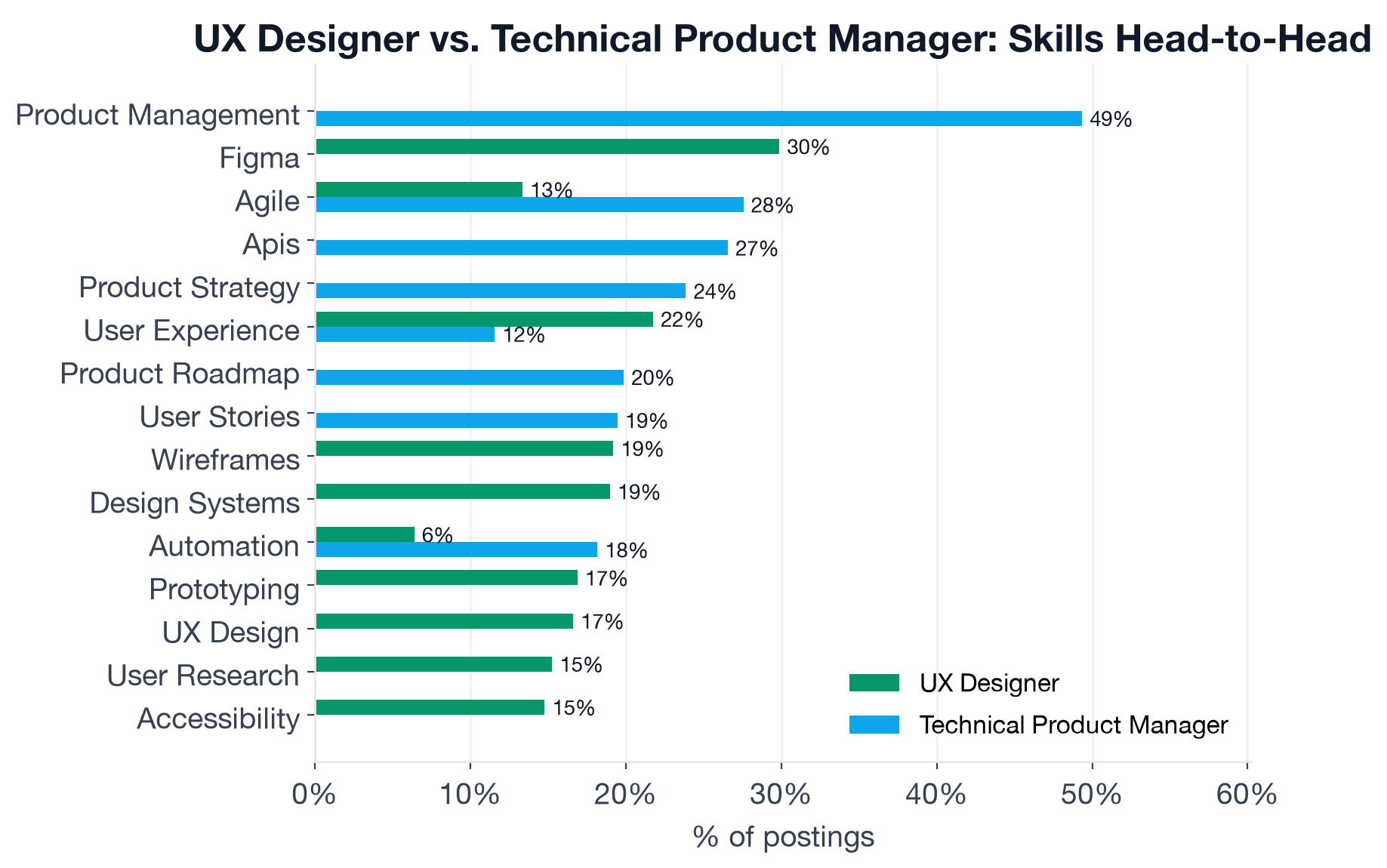 UX Designer's top skills cluster around design craft (Figma, Wireframes, Prototyping); Technical Product Manager's cluster around product delivery (Product Management, APIs, Product Strategy). The two bar sets barely touch.
Where Do the Two Skill Sets Pull Apart?
UX Designer's exclusive cluster: Figma (29.9%), Wireframes (19.2%), Design Systems (19.0%), Prototyping (16.9%), UX Design (16.6%), User Research (15.3%), Accessibility (14.8%), Product Design (12.6%), Interaction Design (11.4%), Usability Testing (11.4%), a coherent craft stack for producing and validating an interface.
Technical Product Manager's exclusive cluster: Product Management (49.4%), APIs (26.6%), Product Strategy (23.9%), Product Roadmap (19.9%), User Stories (19.5%), Stakeholder Management (14.7%), Scalability (13.5%), SQL (12.5%), Monitoring (12.1%), Scrum (11.3%), a coherent delivery-and-strategy stack for deciding what gets built and proving it holds up in production.
Neither cluster borrows from the other. A UX Designer moving into a Technical Product Manager role isn't refining an adjacent skill, they're picking up a mostly new one: SQL, APIs, and scalability aren't design adjacent, they're engineering adjacent. The reverse holds just as true.
UX Designer vs Technical Product Manager: Which Role Pays More in 2026?
Technical Product Manager's median US base salary is $24,900 higher than UX Designer's, a 19.2% premium measured against the UX Designer baseline. These are base salaries drawn from job postings, so equity, bonus, and sign-on pay aren't reflected, and total compensation at senior levels is likely higher than what's shown here.
The more interesting story is where the money sits inside each role. Technical Product Manager's own headline skill, Product Management (49.4% of postings), adds just $7,100 over the role's $154,500 baseline, and APIs is essentially flat (+$500). The real premiums live one layer up in scope: Program Management (+$23,400, n=27), Go To Market (+$14,900, n=39), and Product Strategy (+$12,900, n=83) all outpace the literal title skill.
UX Designer breaks the usual pattern seen elsewhere in this series, where a role's own defining skills price at or below baseline. Here, several of its actual exclusive skills carry real premiums: Product Design (+$35,400, n=140), Interaction Design (+$32,500, n=126), User Research (+$30,200, n=139), Design Systems (+$30,400, n=163), and Wireframes (+$30,400, n=147) all clear the $129,600 baseline by a wide margin. Figma, the most common skill by far, is the exception, adding only $9,400. The premium in UX Designer work isn't the tool, it's the judgment layered on top of it.
The single biggest UX Designer premiums sit outside the design stack entirely: postings that also cite Design Strategy (n=39 of 735) pay a $180,000 median, and postings citing Product Management (n=60) pay $179,800, roughly $50,000 over baseline. It's a small slice of the sample, but the direction matches the divergence findings above, the postings that reach across the UX-to-product divide pay the most.
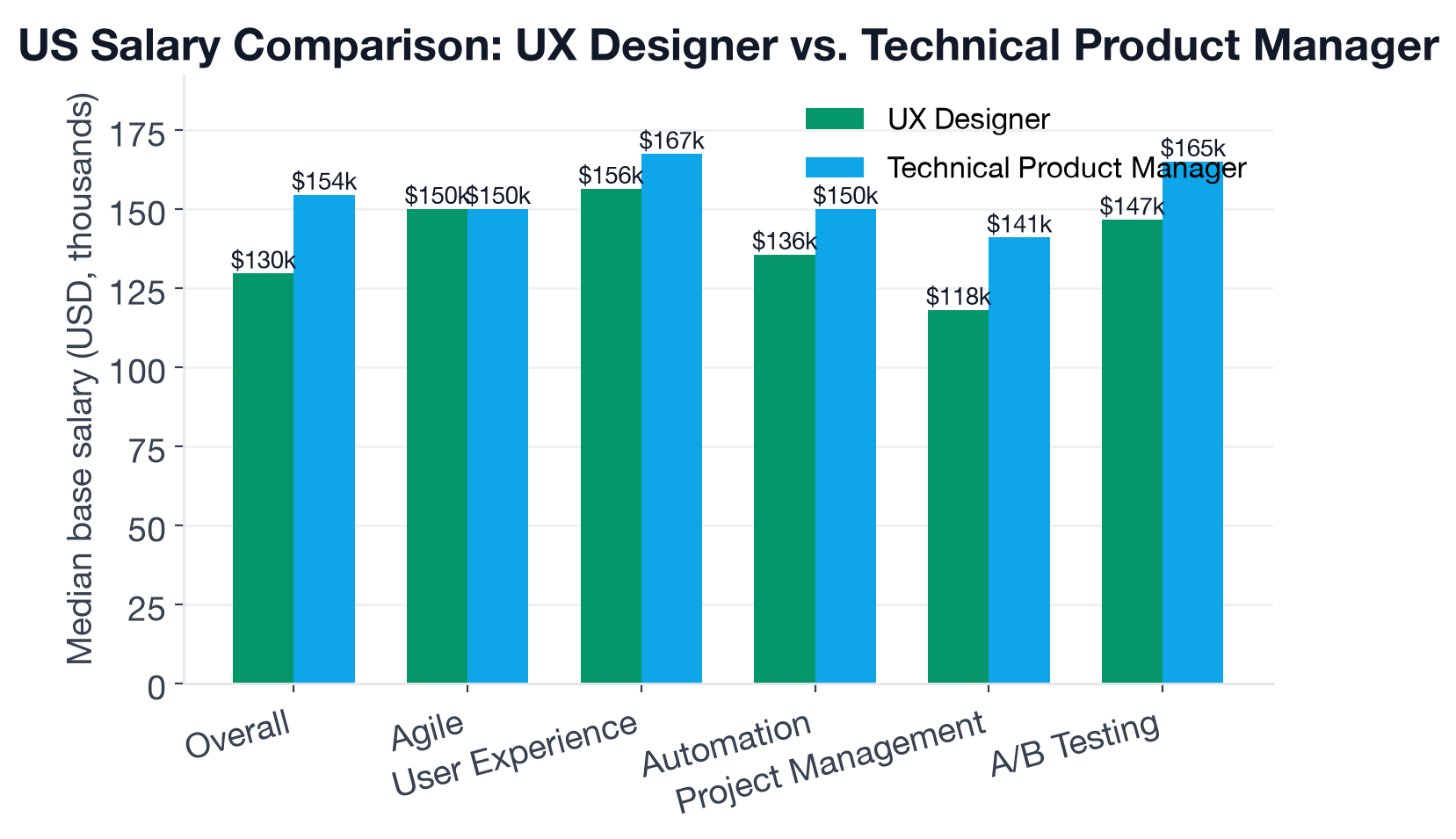 Technical Product Manager's US base salary median sits $24,900 above UX Designer's; both roles' own headline skills price near or below their baseline, with the real premiums one layer removed.
Which Role Is Easier to Break Into?
UX Designer posts 3.71x more openings (3,717 versus 1,001, a figure that includes the adjacent industrial and CAD "designer" titles noted above), but that volume edge doesn't translate into an easy entry point. Entry-level share is 3.7% for UX Designer and 2.0% for Technical Product Manager, both overwhelmingly mid-level-and-up markets (66.9% and 63.6% mid-level), and Technical Product Manager carries meaningfully more staff-level hiring (10.1% versus 6.3%), consistent with a role that leans on accumulated judgment rather than a portfolio.
Geography and flexibility diverge more sharply. Technical Product Manager is more US-concentrated (51.0% versus 38.1%) and considerably more remote-friendly: 28.3% remote and 29.3% hybrid, versus UX Designer's 16.9% remote and 21.3% hybrid, with 56.2% of UX Designer postings staying fully onsite. If flexibility matters as much as pay, that gap is worth weighing alongside the $24,900 salary difference.
Do Either of These Roles Actually Require AI Skills?
Not by posting language, mostly. No generative AI, LLM, or machine learning skill appears in UX Designer's top-30 list at all; the cutoff sits at 5.35%. Technical Product Manager mentions these skills more often, generative AI in 7.1% of postings, LLMs in 7.8%, machine learning in 9.3%. Read that gap carefully: job titles in this dataset ("Principal Technical Product Manager, Agentic AI," "Technical Product Manager, Consumer + AI") show most of it reflects PMs hired to own an AI-powered product surface, not a requirement to personally build models. Priced, LLMs actually sits $14,500 below Technical Product Manager's own baseline (n=25, a thin sample), so posting language isn't rewarding AI ownership here either.
Neither gap says much about who uses AI tools day to day. The State of AI in Design 2026 report puts daily AI use among designers at 75%, weekly at 91%, mostly for research synthesis and rapid prototyping rather than a named deliverable, exactly why it's nearly invisible in UX Designer's skill extraction. Product professionals report similarly high adoption: Productboard's 2025 survey found 94% use AI daily or often, largely for PRD drafting and feedback synthesis. Both roles have crossed into ambient AI use as a baseline expectation; the posting-language gap measures what each role is asked to own, not who's allowed to open ChatGPT.
Match the Role to the Work You Actually Want
Choose UX Designer if you:
- Want to spend your day producing a concrete artifact, wireframes, prototypes, a design system, rather than a roadmap document.
- Already have research, prototyping, or visual-design experience, it transfers directly into the 29.9%-Figma, 19.2%-Wireframes core of this role.
- Want more openings (3.71x the volume) and can trade some pay and flexibility for it, 56.2% of postings are onsite.
Choose Technical Product Manager if you:
- Want to own outcomes across engineering, business, and design, the exclusive skill list (Product Strategy, Stakeholder Management, Scalability) is explicitly cross-functional.
- Have or want technical fluency, APIs and SQL show up in roughly a quarter and an eighth of postings, this isn't a role you can do from Figma alone.
- Want the higher median pay ($154,500) and meaningfully more remote/hybrid options (57.5% combined versus 38.1%).
FAQ
Q. How much skill overlap is there between UX Designer and Technical Product Manager?
Very little. The two roles share a 9% Jaccard overlap on their top-30 skill lists, the lowest overlap InterviewStack.io has measured across any role comparison to date (the previous low was 11%, between DevOps Engineer and Mobile Developer). Only five skills clear the 5%-shared-frequency threshold in both roles' postings: Agile, User Experience, Automation, Project Management, and A/B Testing.
Q. Does UX Designer or Technical Product Manager pay more in 2026?
Technical Product Manager has the higher median US base salary: $154,500 versus $129,600 for UX Designer, a gap of $24,900 (a 19.2% premium over the UX Designer baseline), based on 307 and 735 US salary data points respectively. Equity, bonus, and sign-on pay are not captured in either figure.
Q. Which role has more job postings, UX Designer or Technical Product Manager?
UX Designer, by a wide margin. The dataset analyzed 3,717 active UX Designer postings versus 1,001 for Technical Product Manager, a 3.71x volume advantage for UX Designer.
Q. What skills does Technical Product Manager require that UX Designer doesn't?
Product Management (49.4% of postings), APIs (26.6%), Product Strategy (23.9%), Product Roadmap (19.9%), and User Stories (19.5%) are the clearest Technical Product Manager exclusives, none of which appear at meaningful frequency in UX Designer postings.
Q. What skills does UX Designer require that Technical Product Manager doesn't?
Figma (29.9% of postings), Wireframes (19.2%), Design Systems (19.0%), Prototyping (16.9%), and User Research (15.3%) define the UX Designer stack and rarely appear in Technical Product Manager postings.
Q. Is entry-level access easier for UX Designer or Technical Product Manager?
Neither is easy, but UX Designer is somewhat more open. Entry-level share sits at 3.7% for UX Designer versus 2.0% for Technical Product Manager, meaning both are overwhelmingly mid-level-and-up hiring markets with almost no dedicated junior track.
Q. Do UX Designer or Technical Product Manager postings explicitly require AI skills?
Technical Product Manager mentions generative AI, LLM, or machine learning skills more often, roughly 7-9% of postings versus under 5.35% for UX Designer (absent from its top-30 list entirely). That gap reflects product scope, PMs increasingly hired to own AI-powered features, not who actually uses AI day to day: independent 2026 surveys put daily AI tool use at 75% among designers (State of AI in Design 2026) and 94% 'daily or often' among product professionals (Productboard 2025), regardless of what the job posting states.
Same Sprint, Different Careers
The overlap between these two titles is the lowest we've measured, and the data backs up what the day-to-day already suggests: a UX Designer and a Technical Product Manager can sit across the same table and still be building almost entirely different skill sets. Pick UX Designer for the craft and the larger pool of openings, or Technical Product Manager for the cross-functional scope, the pay, and the flexibility, but don't expect the transition between them to be a lateral move. Since the skills genuinely don't transfer, practice mock interviews for the specific role you're targeting, and browse live UX Designer or Technical Product Manager postings to see what's hiring now. If a broader Product Manager path is also on your shortlist, our Product Manager vs UX Designer comparison covers that decision. Our UX Designer and Technical Product Manager skills breakdowns go deeper on each role, and our question bank or interactive courses can help close specific gaps.
Topics
Ready to practice?
Put what you've learned into practice with AI mock interviews and structured preparation guides.