
More Jobs and More Remote Options Still Pay $28,000 Less
AI Engineer postings outnumber Research Scientist postings 4 to 1 on the InterviewStack.io job board (5,328 versus 1,305 active listings as of August 2026), and AI Engineer offers meaningfully more flexibility: 21.5% of its postings are remote, versus 13.3% for Research Scientist. None of that shows up in the paycheck. Research Scientist's median US base salary (the only pay component postings disclose: equity, bonus, and sign-on aren't part of this figure) runs $28,000 (17.1%) above AI Engineer's, and the role that pays less is also the one you're more likely to be allowed to do from home.
The gap isn't about skill scarcity. It's about who's hiring. Research Scientist postings concentrate hard in a small set of frontier AI labs and quant trading firms that mostly want people in the building; AI Engineer spreads across a much broader, more remote-friendly mix of consulting and enterprise employers.
Key Findings
- AI Engineer postings (5,328) outnumber Research Scientist postings (1,305) by 4.08x on the InterviewStack.io job board.
- Research Scientist pays $28,000 (17.1%) more at the median US base salary: $192,000 (n=532) versus $164,000 (n=1,121) for AI Engineer.
- The two roles share a Jaccard overlap of just 0.25 on their top-30 skills (the share of skills both roles' top-30 lists actually have in common), lower than the 0.30 overlap AI Engineer shares with Applied Scientist.
- Machine Learning appears in 58.5% of Research Scientist postings but only 36.0% of AI Engineer postings, despite AI Engineer having "AI" in its title.
- AI Engineer's exclusive skills cluster around production tooling: RAG (39.3%), APIs (35.7%), AWS (33.1%), Azure (30.1%).
- Research Scientist's exclusive skills cluster around research fundamentals: Algorithms (30.4%), Deep Learning (27.5%), Reinforcement Learning (17.6%).
- Research Scientist postings run 67.2% onsite versus 50.7% for AI Engineer, and are far more US-concentrated (62.8% vs 34.7%).
- Entry-level share is close by title keyword: 5.1% for AI Engineer, 5.5% for Research Scientist.
| AI Engineer | Research Scientist | |
|---|---|---|
| Median US base salary | $164,000 | $192,000 |
| Active postings | 5,328 | 1,305 |
| Top skill | Python (66.9%) | Machine Learning (58.5%) |
| Remote share | 21.5% | 13.3% |
| Entry-level share | 5.1% | 5.5% |
Two Different Jobs Inside the Same AI Boom
AI Engineer is a production and integration job. Most of the work goes into wiring large language models into something that ships: building retrieval pipelines (RAG, short for retrieval-augmented generation), engineering prompts, calling hosted model APIs, and deploying the result on AWS, Azure, or Google Cloud behind CI/CD and observability tooling. Browse live AI Engineer postings and the pattern holds: the exclusive skill list reads like an assembly line, not a lab.
Research Scientist sits closer to the research bench: it trains, evaluates, and iterates on models before anyone assembles them into a product. Deep Learning, Algorithms, Reinforcement Learning, and Computer Vision dominate its exclusive list, and the postings skew toward frontier labs: Google, NVIDIA, Anthropic, and OpenAI all sit in Research Scientist's top employers, alongside quant trading firms like Jane Street and Point72. Browse live Research Scientist postings to see the mix.
A note on the underlying data: title-keyword matching isn't perfect. A small share of AI Engineer postings pull in adjacent titles, intelligence analysts, AI-training data-labeling contractors, even a journalism role covering AI, that aren't core AI engineering work, and a similar share of Research Scientist postings pull in non-AI research roles in life sciences, medicine, and manufacturing. Neither shifts the skill or salary figures below, which stay on-topic for each role; it just means the posting counts run a bit noisier than the headline numbers suggest.
Which Skills Do Both Roles Actually Share?
Python is the one skill both roles lean on at a real rate, and that's close to where the genuine overlap ends.
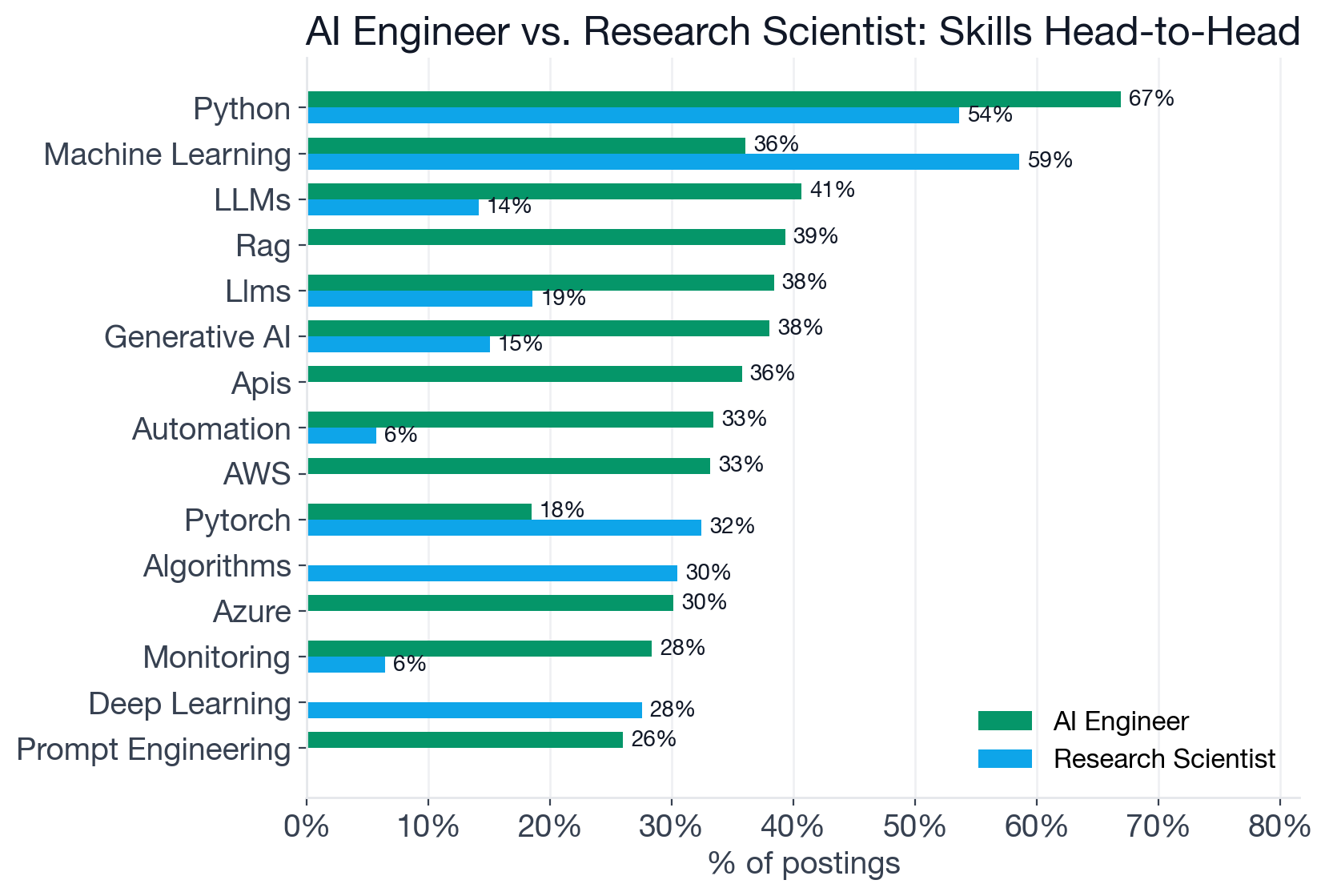 Python is the closest thing to a shared foundation; everything else that clears the "shared skill" bar still runs in one direction or the other.
| Skill | AI Engineer | Research Scientist |
|---|---|---|
| Python | 66.9% | 53.6% |
| Machine Learning | 36.0% | 58.5% |
| LLMs | 40.7% | 14.1% |
| Generative AI | 38.0% | 15.0% |
| PyTorch | 18.4% | 32.4% |
| Automation | 33.4% | 5.7% |
| Monitoring | 28.3% | 6.4% |
Machine Learning and PyTorch both nominally clear the "shared skill" threshold, but each skews hard toward Research Scientist (1.6x and 1.8x). LLMs, Generative AI, Automation, and Monitoring skew just as hard the other way, toward AI Engineer. A skill counting as "shared" doesn't mean both roles use it at the same rate; here, almost nothing does except Python.
The Skill Lists Split Along a Build vs Research Line
| Exclusive to AI Engineer | Freq. | Exclusive to Research Scientist | Freq. |
|---|---|---|---|
| RAG | 39.3% | Algorithms | 30.4% |
| APIs | 35.7% | Deep Learning | 27.5% |
| AWS | 33.1% | C++ | 18.5% |
| Azure | 30.1% | Statistics | 18.1% |
| Prompt Engineering | 26.0% | Reinforcement Learning | 17.6% |
AI Engineer's list is a product-assembly stack: retrieval (RAG), integration (APIs), and cloud deployment (AWS, Azure). Research Scientist's list reads closer to a research curriculum: Algorithms and Deep Learning are the ML-theory core, C++ signals performance-critical model code, and Reinforcement Learning signals training regimes that go well past supervised learning.
That split holds up under a build-versus-research read of the AI skills specifically. AI Engineer is the role built to construct generative-AI products: RAG, Prompt Engineering, and LangChain (a framework for chaining LLM calls together, 22.1%) don't even crack Research Scientist's top-30 skill list, meaning each sits below Research Scientist's 30th-ranked skill frequency of 5.6%, a gap of more than 3.9x for LangChain, more than 4.5x for Prompt Engineering, and more than 7x for RAG. The skills both roles' top-30 lists actually share, llm, llms, and generative ai, run a more modest 2 to 3x higher on AI Engineer. Research Scientist's explicit list, by contrast, centers on research fundamentals (Algorithms, Statistics, Reinforcement Learning) that predate the current LLM wave. Neither number captures the ambient layer underneath both roles: Stack Overflow's 2025 Developer Survey puts general AI-coding-assistant adoption (GitHub Copilot, ChatGPT, Claude Code) at 84% of developers, and AI Engineer, sitting inside that broader engineering population, likely tracks close to it. Research Scientist's relationship with the same tools is more contested: AI-assisted research still faces real scrutiny over reproducibility and trust in AI-generated findings, a different bar than production engineering has to clear. For more, see how AI is changing AI Engineer work and how AI is changing Research Scientist work.
AI Engineer vs Research Scientist: Which Role Actually Pays More?
Research Scientist does, and the premium doesn't come from either role's own headline skills. These are US-only base salaries: equity, bonus, and sign-on pay aren't disclosed in postings, so total compensation at top employers runs higher than either figure below.
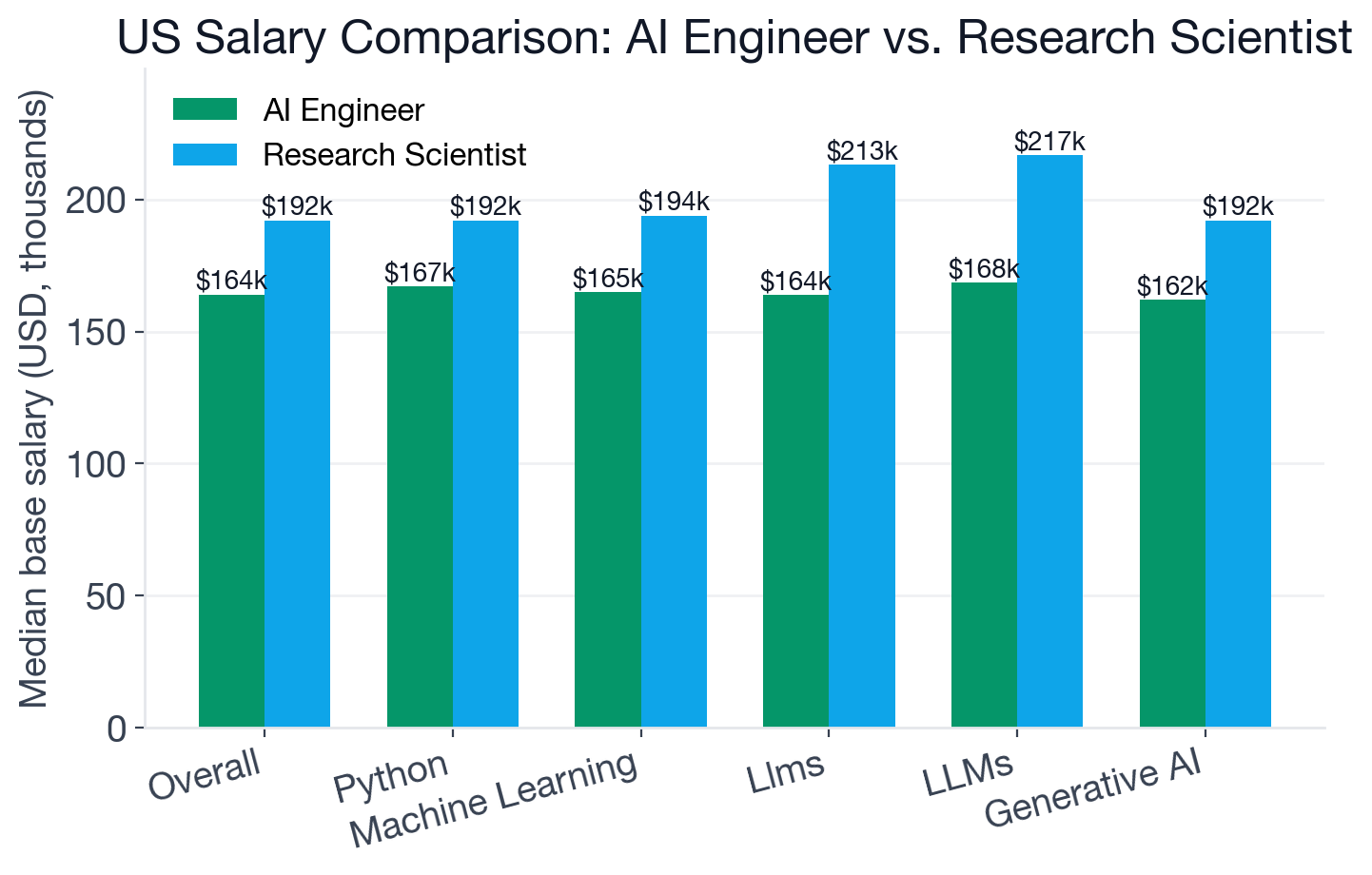 Research Scientist's median US base salary runs $28,000 above AI Engineer's, even though AI Engineer carries 4x the posting volume.
Research Scientist's median US base salary is $192,000 across 532 postings with salary disclosed, versus $164,000 for AI Engineer across 1,121 postings, a $28,000 (17.1%) gap over AI Engineer's baseline. On AI Engineer's own numbers, its top exclusive skills price close to flat: RAG and APIs each add about $6,000 over the role's $164,000 baseline, and Azure sits within $800 of it. The real premiums sit one layer down: Observability adds $16,000 (n=229) and Google Cloud adds $8,500 (n=216), both measured against AI Engineer's own baseline.
Research Scientist's own defining skills follow the same pattern. Algorithms and Deep Learning, its two most common exclusive skills, both price exactly at the role's $192,000 baseline, and Statistics prices $15,200 below it. Its real premiums also sit one layer down: on Research Scientist's own numbers, Prototyping adds $21,000 (n=86), Reinforcement Learning adds $16,400 (n=116), and Data Pipelines, a skill both roles nominally share, adds $28,500 (n=45), more than any of Research Scientist's own exclusive skills.
Why Does the Smaller Role Skew So Far Onsite?
Not because of title-level seniority. Entry-level share by keyword classification is close between the two roles (5.1% AI Engineer, 5.5% Research Scientist). But that's not the same as an equal entry bar: Research Scientist postings, especially at frontier labs, more often require a PhD or a publication record, a credential bar the title-based seniority classifier doesn't see.
The real divide is geography and employer type. AI Engineer's top employers are consulting and enterprise firms (PricewaterhouseCoopers, Booz Allen Hamilton, Accenture), spread across a global market: only 34.7% of AI Engineer postings are US-based. Research Scientist leans on a small set of frontier AI labs and quant trading desks, mostly US offices, and 62.8% of its postings are US-based. That concentration tracks with work mode: Research Scientist runs 67.2% onsite versus AI Engineer's 50.7%, and just 13.3% remote versus 21.5%. The higher-paying role is the one built around fewer, more office-bound employers.
Which Role Should You Target First?
Target AI Engineer if you:
- Want to start applying now: the role carries 4x the open postings and a broader employer base outside frontier AI labs.
- Work best close to the API layer: RAG pipelines, prompt engineering, and cloud deployment, rather than model internals.
- Need remote or hybrid flexibility: AI Engineer runs 21.5% remote and 34.2% hybrid, both comfortably ahead of Research Scientist's 13.3% remote and 24.2% hybrid.
Target Research Scientist if you:
- Already have, or are building, a deep algorithms and statistics background and want to work on model training itself, not just deployment.
- Can work onsite near a concentrated set of AI labs and quant firms, mostly in the US.
- Want the higher salary ceiling and can compete for a smaller, more selective pool of postings.
How to Use This in Your Job Search
If Research Scientist's theory bar (Algorithms, Statistics, Reinforcement Learning) is what's standing between you and the higher-paying role, InterviewStack's interactive courses cover the ML-theory and statistics foundations most postings assume. Already there? Practice with AI mock interviews built around real interview loops for both roles, and drill the Question Bank on system design, model training, and RAG-architecture questions. Then browse live AI Engineer openings or Research Scientist openings.
For a skill-by-skill breakdown of either role alone, see AI Engineer Skills Companies Want in 2026 and Research Scientist Skills in 2026. If Applied Scientist is also on your shortlist, AI Engineer vs Applied Scientist covers a closely related third path.
FAQ
Q. What is the salary difference between AI Engineer and Research Scientist in 2026?
Research Scientist postings report a median US base salary of $192,000 (n=532), a $28,000 (17.1%) premium over AI Engineer's $164,000 median (n=1,121). Equity, bonus, and sign-on pay are not disclosed in postings and are not part of these figures.
Q. Do AI Engineer and Research Scientist share the same skill set?
Only partly. The two roles have a Jaccard overlap of just 0.25 on their top-30 skills, lower than the 0.30 overlap AI Engineer shares with the closely related Applied Scientist role. Python is the strongest genuine bridge (66.9% of AI Engineer postings, 53.6% of Research Scientist postings); most other nominally shared skills split sharply toward one role.
Q. Which role asks for Machine Learning more often, AI Engineer or Research Scientist?
Research Scientist. Machine Learning appears in 58.5% of Research Scientist postings versus 36.0% of AI Engineer postings, even though AI Engineer is the role with "AI" in its title.
Q. Is it easier to get hired as an AI Engineer or a Research Scientist?
AI Engineer has far more open roles: 5,328 active postings versus 1,305 for Research Scientist, a 4.08x volume gap. Entry-level share by title keyword is close between the two (5.1% AI Engineer, 5.5% Research Scientist), though Research Scientist postings, especially at frontier labs, more often require a PhD or publication record, a credential bar the title-based classifier can't detect.
Q. Why are so many Research Scientist postings onsite?
67.2% of Research Scientist postings are onsite, versus 50.7% for AI Engineer. Research Scientist's employer roster leans heavily on frontier AI labs (Google, NVIDIA, Anthropic, OpenAI, Meta) and quantitative trading firms (Point72, Jane Street, Jump Trading), and the role is far more US-concentrated (62.8% vs 34.7% for AI Engineer).
Q. What skills are exclusive to AI Engineer postings?
RAG (39.3% of postings), APIs (35.7%), AWS (33.1%), Azure (30.1%), Prompt Engineering (26.0%), CI/CD (24.8%), Google Cloud (22.6%), LangChain (22.1%), Observability (21.3%), and OpenAI (18.9%) all clear the exclusivity threshold for AI Engineer and fall below it for Research Scientist.
Q. What skills are exclusive to Research Scientist postings?
Algorithms (30.4% of postings), Deep Learning (27.5%), C++ (18.5%), Statistics (18.1%), Reinforcement Learning (17.6%), Computer Vision (15.6%), Model Training (13.3%), TensorFlow (13.2%), Prototyping (12.1%), and JAX (11.7%) all clear the exclusivity threshold for Research Scientist and fall below it for AI Engineer.
The Premium Has Strings Attached
AI Engineer and Research Scientist sit on opposite ends of the same AI buildout: one assembles products on top of existing models, the other trains and studies the models themselves. Research Scientist pays $28,000 more at the median, but that number comes bundled with a smaller, US-concentrated, mostly-onsite pool of postings at a handful of frontier labs. AI Engineer trades that premium for 4x the openings and real remote flexibility. Neither is the "easier" AI job. They're different bets on where you want to sit in the stack, and the postings make the trade explicit once you look past the paycheck.
Topics
Ready to practice?
Put what you've learned into practice with AI mock interviews and structured preparation guides.