
Amazon Alone Explains 1 in 8 Applied Scientist Postings
Applied Scientist and Research Scientist share 71% of their top-30 skills and price within 2.5% of each other at the median, one of the tightest matches between any two titles on the InterviewStack.io job board. If the skills and the pay barely differ, what's actually splitting these two titles apart?
The employer rosters answer it, though no single company owns either title outright. Amazon alone accounts for 12.6% of Applied Scientist's distinct postings, 216 openings spread across its Music, Search, Alexa, Supply Chain, and Marketing organizations, and it doesn't appear among Research Scientist's top 15 employers at all. But Amazon isn't the only company hiring Applied Scientists: Microsoft (41 postings), Launch Potato (38), Adobe (45 combined across two listings), NVIDIA (21), and Boston Consulting Group (21) all post real Applied Scientist openings with no Amazon tie. Research Scientist's list instead runs NVIDIA, Google, Anthropic, and OpenAI alongside quant trading firms like Point72 and Jane Street. The clearest signal here is Amazon's outsized share of one title, not a clean split between two separate employer camps.
A methodology note: "scientist" job titles are noisy across the whole board, not just these two roles. Quantitative-finance researchers, life-sciences and clinical-research roles, hardware and materials scientists, and consulting "managing scientist" titles all use similar language and turn up in both roles' raw postings alongside the ML-focused majority. The skill, salary, and seniority figures throughout this piece hold up because they're computed from full posting text rather than the title alone, but if you're sizing up a specific listing, read the job description before assuming it fits the profile described here.
| Applied Scientist | Research Scientist | |
|---|---|---|
| Median US base salary | $187,300 | $192,000 |
| Active postings | 1,722 | 1,312 |
| Top skill | Machine Learning (64.9%) | Machine Learning (60.8%) |
| Onsite share | 57.3% | 61.6% |
| Entry-level share | 6.4% | 5.7% |
| Skill overlap (Jaccard) | 71% shared (pairwise) | 71% shared (pairwise) |
Key Findings
- Applied Scientist and Research Scientist share a 71% Jaccard overlap across their top-30 skills, well above what most role pairs in this series show.
- Amazon alone accounts for 12.6% of Applied Scientist's distinct postings (216 of 1,713) but doesn't appear among Research Scientist's top 15 employers.
- Research Scientist's median US base salary is $192,000 versus $187,300 for Applied Scientist, a $4,700 (2.5%) gap.
- Applied Scientist's own exclusive skills, AWS, SQL, and Linux, don't add a meaningful premium over its $187,300 baseline: AWS is +$200, SQL is +$1,500, and only Linux is meaningfully below, at -$19,300.
- Research Scientist's Prototyping and Distributed Training each add $21,000 over its $192,000 baseline; JAX adds only $3,000 despite being its signature skill.
- Applied Scientist postings skew more senior (39.3% senior or staff) than Research Scientist's (26.8%), despite Research Scientist's PhD-heavy reputation.
- Applied Scientist carries 1.31x Research Scientist's posting volume (1,722 versus 1,312).
What Applied Scientists and Research Scientists Actually Do
An Applied Scientist takes an existing research direction and gets it into a live product: tuning a ranking model for search, building recommendation logic for a media catalog, or shipping a forecasting system a supply chain team can use. The work is judged by whether it moves a production metric, not by whether it's publishable.
A Research Scientist works further upstream: designing a new training approach and running the experiments that decide whether it holds up, often on the same libraries frontier labs share. The output is more often a prototype, a benchmark, or an internal paper than a live service.
Which Skills Do Both Roles Require?
Machine Learning and Python anchor both roles by a wide margin, and that's the real overlap the 71% figure is measuring.
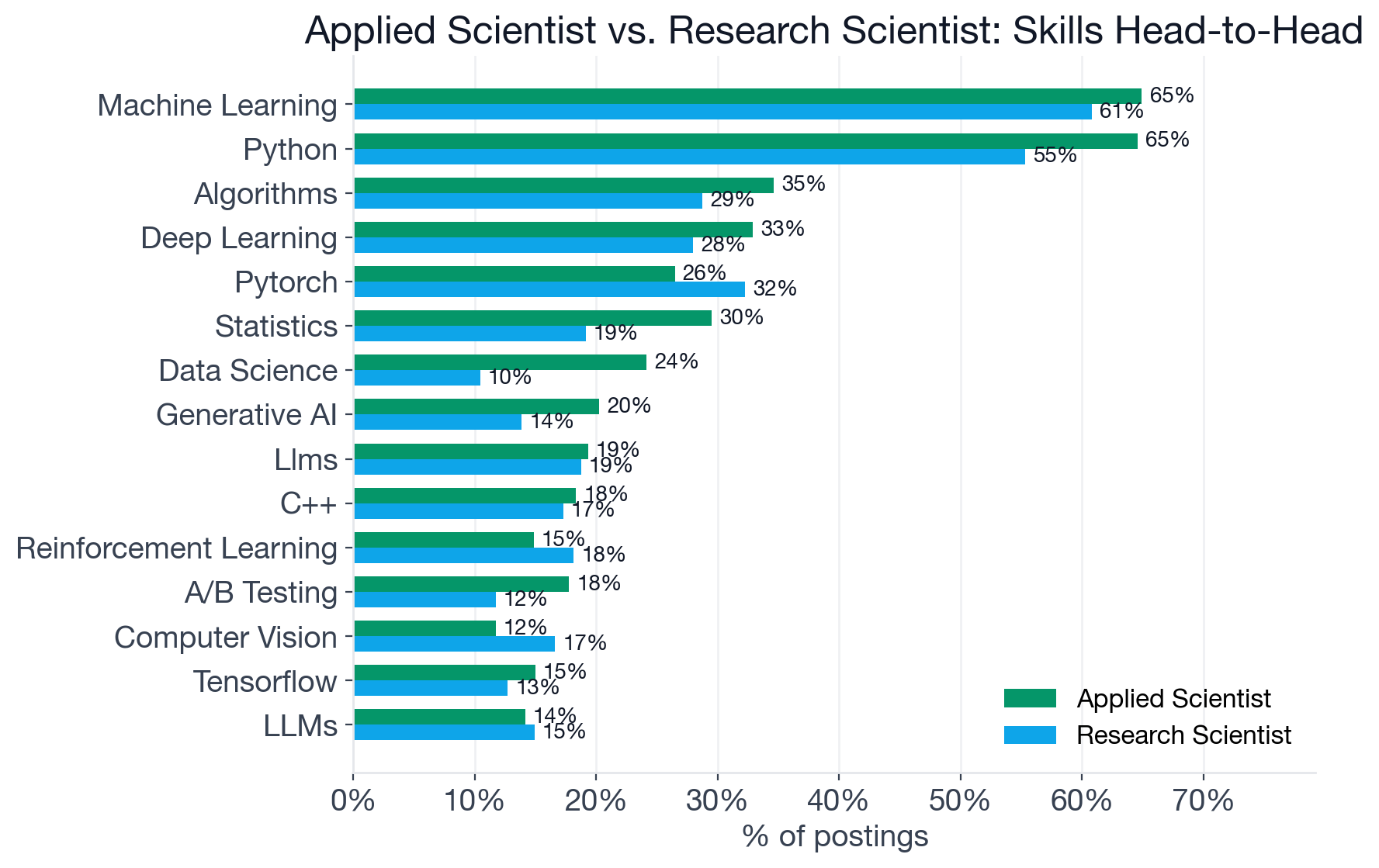 Machine Learning and Python lead for both roles; the gap narrows fast once you move past the top two skills.
| Skill | Applied Scientist | Research Scientist |
|---|---|---|
| Machine Learning | 64.9% | 60.8% |
| Python | 64.6% | 55.3% |
| Algorithms | 34.6% | 28.7% |
| Deep Learning | 32.9% | 28.0% |
| PyTorch | 26.5% | 32.2% |
| Statistics | 29.5% | 19.1% |
| LLMs | 19.3% | 18.8% |
| C++ | 18.4% | 17.3% |
Generative AI (20.3% Applied Scientist, 13.9% Research Scientist) and Large Language Models (14.1%, 10.5%) both sit well under Machine Learning itself, and that gap measures who's explicitly hired to build AI systems, not who uses AI tools to do their own work. Stack Overflow's 2025 Developer Survey puts general AI-tool adoption at 84% of developers, a reasonable floor for Applied Scientist's production-facing day-to-day. Research Scientist maps closer to a 2025 Wiley survey of 2,430 researchers, where AI adoption among scientists jumped from 57% to 84% in a single year, and AI-augmented researchers publish roughly 3x more and get cited nearly 5x more, per a 2024 arXiv study. Neither survey measures these two titles directly, but both point the same way: silence on AI in a posting reflects an assumed baseline, not absent use.
One Role's Toolkit Traces to Amazon, the Other's to a Research Lab
Applied Scientist's exclusive skills describe Amazon's own stack. Research Scientist's describe a research lab's.
| Exclusive to Applied Scientist | Freq. | Exclusive to Research Scientist | Freq. |
|---|---|---|---|
| AWS | 11.7% | Prototyping | 12.3% |
| SQL | 9.1% | JAX | 11.5% |
| Linux | 8.3% | Distributed Training | 8.2% |
| Debugging | 8.2% |
AWS, SQL, and Linux aren't a research toolkit, they're the operational layer of a company that built its own cloud and runs everything on it. Research Scientist's column points the opposite way: Prototyping and Distributed Training signal new-approach testing at scale, and JAX (a Google-built library for high-performance numerical computing, common at frontier labs) signals proximity to the exact research infrastructure Google, NVIDIA, and Anthropic run internally. The skill gap tracks the employer gap almost exactly.
Where Does the $4,700 Salary Gap Come From?
It's a narrow gap, and the answer isn't in either role's own defining skills. These are US-only base salaries; equity, bonus, and sign-on pay aren't disclosed in postings, so total compensation at top employers runs higher than either figure below.
Research Scientist's median US base salary is $192,000 across 535 postings with salary disclosed, versus $187,300 for Applied Scientist across 690 postings, a $4,700 (2.5%) edge for Research Scientist.
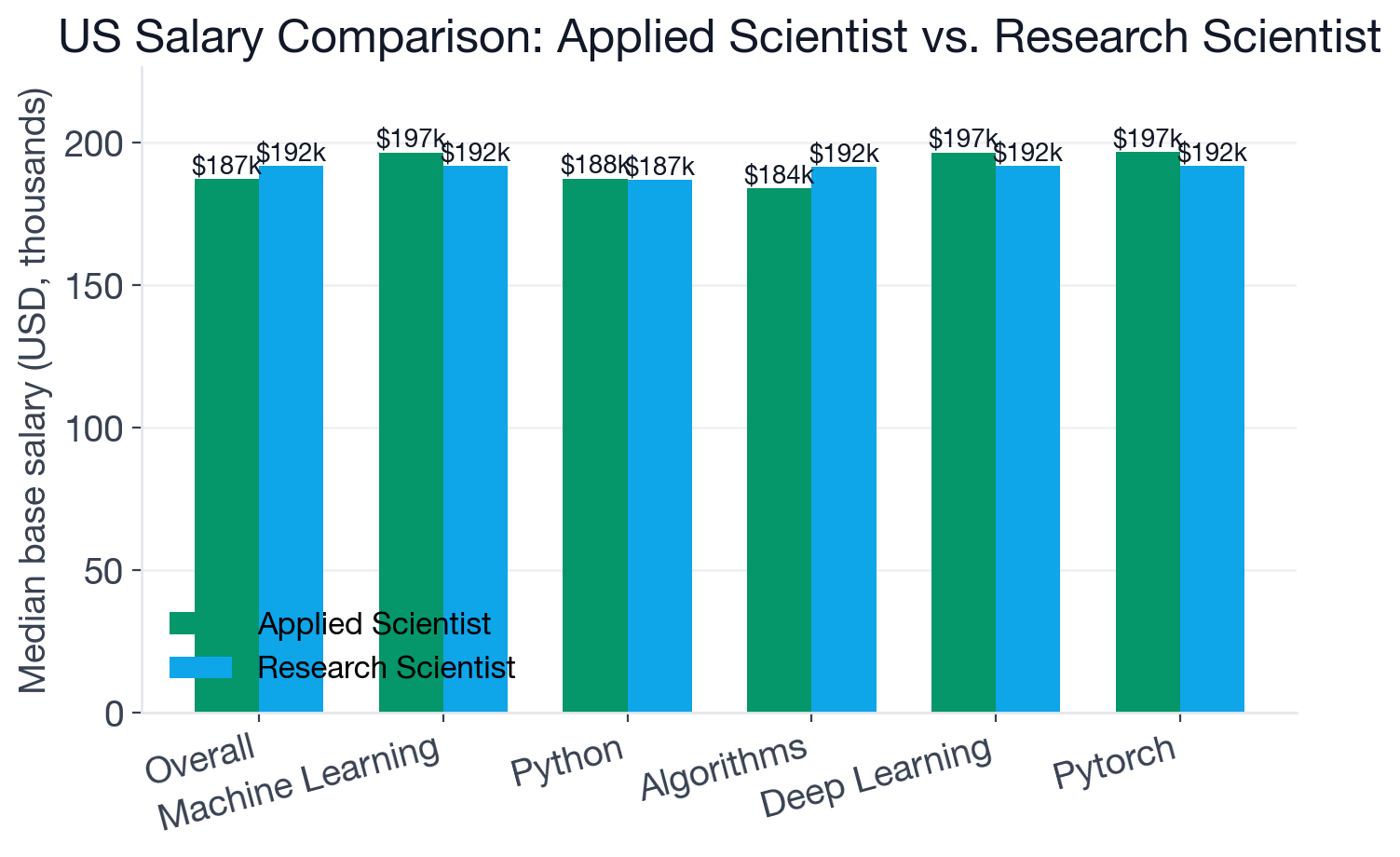 The two medians sit close enough to call a near-tie, even with a real gap in company mix behind them.
Neither role's own exclusive skills explain the gap. AWS adds just $200 and SQL $1,500 on Applied Scientist's data; Linux prices $19,300 below baseline. On Research Scientist's data, Prototyping and Distributed Training each add $21,000, Debugging sits exactly at baseline, and JAX, its most visible specialty, adds only $3,000.
| Skill (Applied Scientist's own data) | Median US salary | Premium | n |
|---|---|---|---|
| JAX | $228,800 | +$41,500 | 54 |
| Causal Inference | $210,600 | +$23,300 | 45 |
| Model Training | $206,800 | +$19,500 | 85 |
| LLM | $205,000 | +$17,700 | 109 |
| MLOps | $200,100 | +$12,800 | 35 |
One close call: User Experience also clears $210,600 (n=31), tying Causal Inference exactly. It reads as bleed-through from UX-adjacent postings rather than a genuine Applied Scientist skill, consistent with the "scientist" title-noise caveat earlier in this piece, so it's left out of the table above.
The real premiums for Applied Scientist sit in skills too rare to crack its own top 30: JAX, MLOps, and Causal Inference all clear five figures over baseline. JAX is the sharpest example, paying $41,500 over baseline on Applied Scientist's own data (n=54) but only $3,000 on Research Scientist's data (n=69), despite being Research Scientist's signature skill by frequency. Scarcity in the skill list doesn't guarantee scarcity in the pay.
Who Has the Easier Path In?
Applied Scientist has both the larger job pool and, on paper, the more senior one: 1.31x the posting volume (1,722 versus 1,312), and 39.3% senior-or-staff postings versus 26.8% for Research Scientist. That runs opposite Research Scientist's PhD-heavy reputation, though title-inferred seniority defaults to mid-level whenever a posting lacks an explicit signal, so Research Scientist's true mix is probably somewhat higher than the raw figure shows. Entry-level share is close either way (6.4% versus 5.7%); neither role is a common way to break in without prior ML experience.
Geography follows the employer split. Applied Scientist draws 8.1% of postings from India, well above Research Scientist's 2.6%, tracking Amazon's large India engineering presence, while Research Scientist is more US-concentrated (63.6% versus 56.2%) and more onsite (61.6% versus 57.3%), consistent with frontier labs clustering research talent in a handful of offices.
Applied Scientist or Research Scientist: Which Should You Choose?
Choose Applied Scientist if you:
- Want the larger job pool (1.31x the postings) inside a large, diversified tech organization rather than a research lab
- Are fine with production-adjacent skills like AWS, SQL, and Linux, even though none pays a premium on its own
- Want a path that already skews senior in the market (39.3% senior or staff)
Choose Research Scientist if you:
- Want a frontier AI lab or quant-research shop (NVIDIA, Google, Anthropic, OpenAI, Point72, Jane Street) over a diversified employer
- Have or are building experimentation depth: Prototyping and Distributed Training both price five figures above baseline
- Can accept a smaller, more onsite, more US-concentrated pool for slightly higher median pay
How to Use This in Your Job Search
If Research Scientist's experimentation-heavy toolkit (JAX, distributed training, prototyping under uncertainty) is the gap between you and that title, InterviewStack's interactive courses cover the ML systems and research-methodology foundations most postings assume. Already comfortable there? Practice with AI mock interviews built around applied and research ML loops, and drill the Question Bank on experiment design and production ML systems. When you're ready to apply, browse live Applied Scientist openings or Research Scientist openings.
For a full breakdown of either role, see Applied Scientist Skills in 2026 and Research Scientist Skills in 2026. If AI Engineer is on your shortlist too, AI Engineer vs Applied Scientist and AI Engineer vs Research Scientist cover two more angles on the same fork.
FAQ
Q. Is Applied Scientist basically the same job as Research Scientist?
The two roles share a 71% Jaccard overlap across their top-30 skills, one of the tightest overlaps we track between two distinct titles, and their median US base salaries sit within 2.5% of each other ($187,300 versus $192,000). But their employer rosters barely intersect: Amazon accounts for 12.6% of Applied Scientist postings and doesn't appear among Research Scientist's top 15 employers, where NVIDIA, Google, Anthropic, and OpenAI lead instead. It reads less like two different jobs than two different companies' names for a similar one.
Q. Which pays more, Applied Scientist or Research Scientist?
Research Scientist's median US base salary is $192,000 versus $187,300 for Applied Scientist, a $4,700 (2.5%) gap in Research Scientist's favor across a combined 1,225 US postings with salary disclosed. That's small enough to call a near-tie rather than a real premium for either title.
Q. What skills are exclusive to Applied Scientist postings?
AWS (11.7% of postings), SQL (9.1%), and Linux (8.3%) show up almost exclusively in Applied Scientist listings. None of them adds a meaningful premium over the role's own $187,300 baseline: AWS is +$200, SQL is +$1,500, and Linux is the outlier at -$19,300, so none of them functions as a pay lever.
Q. What skills are exclusive to Research Scientist postings?
Prototyping (12.3% of postings), JAX (11.5%), Distributed Training (8.2%), and Debugging (8.2%) show up almost exclusively in Research Scientist listings. On the role's own salary data, Prototyping and Distributed Training each add $21,000 over the $192,000 baseline, Debugging prices exactly at baseline, and JAX adds just $3,000 despite being the role's most visible specialty.
Q. Which role is more senior, Applied Scientist or Research Scientist?
Applied Scientist skews more senior on paper: 39.3% of its postings are senior or staff level, versus 26.8% for Research Scientist, despite Research Scientist's PhD-heavy reputation. Entry-level share is similar for both, 6.4% for Applied Scientist and 5.7% for Research Scientist.
Q. Are there more Applied Scientist or Research Scientist jobs available?
Applied Scientist carries 1.31x the posting volume of Research Scientist, 1,722 versus 1,312 active listings on the InterviewStack.io job board, a gap driven largely by Amazon's use of the title across its AI, search, and advertising organizations.
Q. Do Applied Scientist and Research Scientist jobs require AI or LLM skills?
Both already assume deep ML expertise; that's the baseline for either title. Generative AI appears in 20.3% of Applied Scientist postings and 13.9% of Research Scientist postings, and Large Language Models appear in 14.1% and 10.5% respectively. That gap measures who's explicitly hired to build AI systems, not who uses AI tools day to day. Stack Overflow's 2025 Developer Survey puts general AI-tool adoption at 84% of developers, and a 2025 Wiley survey of 2,430 researchers found adoption among scientists broadly jumped from 57% to 84% in a single year.
Read the Job Description, Not Just the Job Title
Applied Scientist and Research Scientist look, on the numbers, like two names for the same job: nearly identical skills, a pay gap small enough to be noise, similar entry difficulty. What actually separates them is who's hiring. One title is dominated by Amazon's use of it across its many businesses, even though Microsoft, Adobe, and others post it too; the other belongs mostly to frontier labs and quant shops pushing the research forward. Read the posting's employer and day-to-day description before you read the title, it will tell you more than "Applied" versus "Research" ever will.
Topics
Ready to practice?
Put what you've learned into practice with AI mock interviews and structured preparation guides.