
CASP+ Splits Down the Middle on Required vs. Preferred
Most certification mentions in job postings lean hard toward "nice to have." CompTIA Advanced Security Practitioner, CASP+, doesn't. Among the postings specific enough to say one way or the other, almost exactly half treat CASP+ as a hard requirement. That comes from 14,988 active postings across four security and infrastructure roles, Cybersecurity Engineer, Information Security Analyst, Systems Engineer, and Systems Administrator, over a 90-day window on the InterviewStack.io job board, of which 245 (1.6%) mention CASP+ at all.
That evenness isn't the only place CASP+ breaks from the pattern this kind of data usually shows. Demand for it splits along job-title lines rather than pay grade: the two roles with "security" in the title over-index on mentioning it, while the two generalist infrastructure roles don't, regardless of which of the four actually pays best. And the employer list, once you merge a couple of duplicate listings, is almost entirely defense and government-services contractors. Read together, those three findings point at the same explanation: CASP+ functions less like a market-tested skill signal and more like a credential that shows up wherever a specific kind of security-titled, often compliance-driven seat needs filling, whether or not that seat offers top-of-market pay.
Key Findings
- CASP+ appears in 1.6% of postings across four security and infrastructure roles (245 of 14,988 active postings analyzed over 90 days).
- Required and preferred language split almost evenly: of the 120 mentions specific enough to classify, 49.2% (59) call CASP+ required and 50.8% (61) call it preferred; 125 more mentions don't specify either way.
- CASP+-mentioning postings advertise a median US base salary of $144,314, 11.0% above the $130,000 median for postings in the same four roles that don't mention it, but that premium narrows from +22.0% at mid-level to +4.9% at senior.
- That premium isn't uniform by role: Information Security Analyst shows the strongest gap (+31.1%), but Cybersecurity Engineer, the single largest source of CASP+ mentions, actually runs slightly negative (-8.2%, $151,475 vs $165,000).
- Cybersecurity Engineer and Information Security Analyst, the two explicitly security-titled roles in this scope, both over-index on CASP+ mentions (1.23x and 1.22x) despite anchoring the highest and lowest ends of the pay scale ($165,000 and $101,450).
- Systems Engineer, a generalist infrastructure role, mentions CASP+ least of the four roles (0.54x the aggregate rate, less than half Cybersecurity Engineer's rate).
- After combining duplicate listings for the same employer, General Dynamics Information Technology (31 mentions) narrowly leads a list where eleven of twelve companies are defense or government-services contractors.
- CISSP appears alongside 82.4% of CASP+ mentions, by far the most common paired certification.
How Even Is CASP+'s Required-vs-Preferred Split, Really?
Job postings usually treat a certification mention as a soft signal: list it, don't gate the role on it. CASP+ comes closer to gating the role than that default suggests. Of the 245 CASP+ mentions, 120 use wording within 160 characters of the mention specific enough to classify as required or preferred; the other 125 (51.0% of all mentions) don't specify either way. Within the classified group, 59 (49.2%) state CASP+ as a required qualification and 61 (50.8%) call it preferred, a two-posting gap that's about as close to even as a real split gets.
| Count | Share | |
|---|---|---|
| Required | 59 | 49.2% of classified |
| Preferred | 61 | 50.8% of classified |
| Unspecified | 125 | 51.0% of all mentions |
That balance fits a certification that's frequently the literal gate for a specific seat rather than one bullet point among many. It also lines up with the employer list below: a credential a government contract requires someone to hold reads as "required" in the posting far more often than a certification an employer would merely like to see.
Does CASP+ Demand Track Job Titles or Pay Tiers?
Job titles, not pay. Cybersecurity Engineer and Information Security Analyst, the only two roles in this scope with "security" in the name, both mention CASP+ more often than their share of postings would predict. Cybersecurity Engineer sits at a 2.01% mention rate (over-index 1.23x) and Information Security Analyst at 1.99% (over-index 1.22x), nearly identical to each other despite anchoring opposite ends of this scope's pay range: Cybersecurity Engineer postings pay a $165,000 baseline median, the highest of the four roles, while Information Security Analyst postings pay $101,450, the lowest.
Systems Administrator sits close to parity (0.95x, a $112,000 baseline), and Systems Engineer, the other generalist infrastructure title, mentions CASP+ the least of the four (0.54x), even though its own baseline pay ($140,000) sits above Information Security Analyst's.
| Role | Postings Scanned | CASP+ Mentions | Mention Rate | Over-Index | Baseline Pay (No CASP+) |
|---|---|---|---|---|---|
| Cybersecurity Engineer | 4,225 | 85 | 2.01% | 1.23x | $165,000 |
| Information Security Analyst | 4,178 | 83 | 1.99% | 1.22x | $101,450 |
| Systems Administrator | 2,827 | 44 | 1.56% | 0.95x | $112,000 |
| Systems Engineer | 3,758 | 33 | 0.88% | 0.54x | $140,000 |
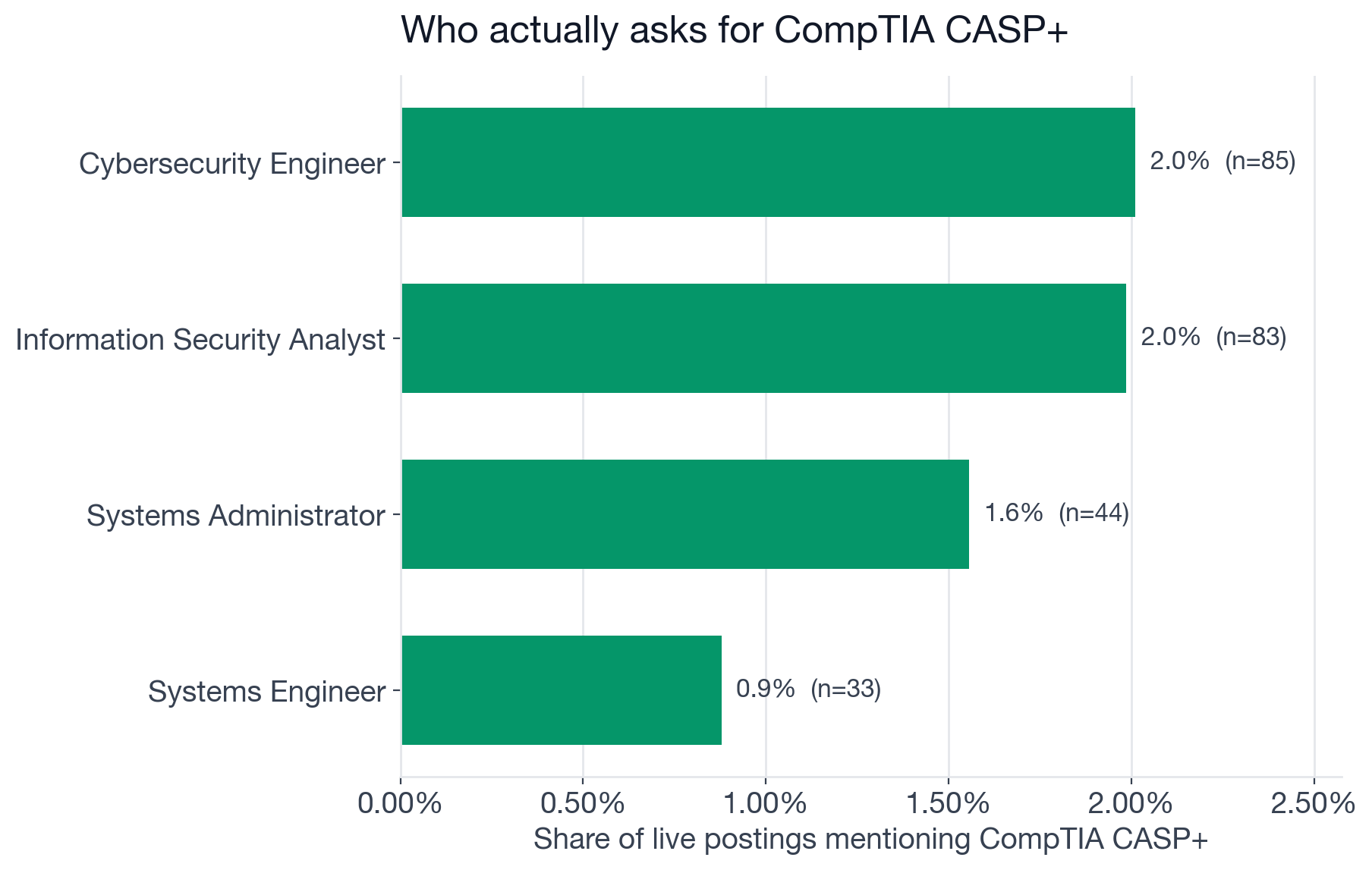
If pay tier explained the pattern, the two highest-paying roles would over-index together, or the two lowest-paying roles would. Neither happens here. Cybersecurity Engineer (the highest baseline) and Information Security Analyst (the lowest) are the over-indexers; Systems Engineer, solidly mid-tier on pay, under-indexes the most. What the two over-indexing roles actually share is the word "security" in the title, a simpler and more literal explanation than a pay-tier story: Cybersecurity Engineer and Information Security Analyst postings are, definitionally, more likely to ask for an advanced security credential than Systems Administrator or Systems Engineer postings, whatever those roles pay.
Cybersecurity Engineer names CASP+ roughly 2.3 times as often as Systems Engineer does (2.01% vs 0.88%), and Information Security Analyst names it about 2.3 times as often too (1.99% vs 0.88%), the widest spread among the four roles in scope.
CASP+'s Pay Edge Is Strongest at Mid-Level, Thinner at Senior
Real at both levels this analysis can check, but not the same size at each. CASP+-mentioning postings across these four roles advertise a median US base salary of $144,314, 11.0% above the $130,000 median for postings in the same roles that don't mention it (equity, bonus, and other compensation aren't disclosed in postings and aren't part of this comparison). That's a real premium, and unlike several other certifications, it doesn't reverse sign anywhere it can be measured. But it isn't flat, either.
| Seniority Level | Without CASP+ (Median US Base) | With CASP+ (Median US Base) | Difference |
|---|---|---|---|
| Entry | $80,500 (n=133) | Not reportable (n=5) | N/A |
| Mid-level | $116,650 (n=3,604) | $142,350 (n=126) | +22.0% |
| Senior | $152,500 (n=1,124) | $160,000 (n=29) | +4.9% |
| Staff | $174,000 (n=664) | Not reportable (n=21) | N/A |
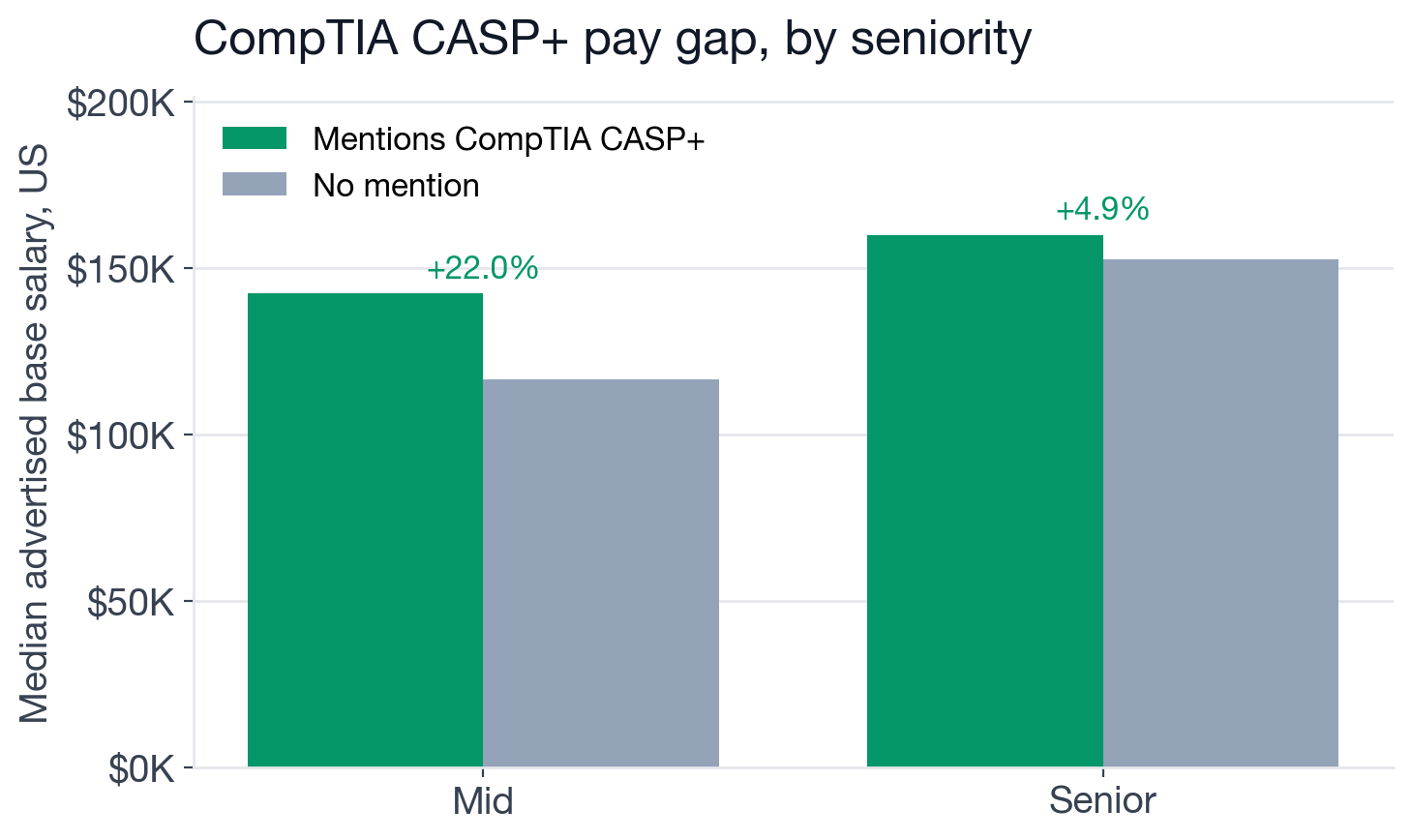
Mid-level and senior are the only two bands where the CASP+-mentioning sample clears the 25-posting reporting floor this analysis uses. At mid-level, the premium is substantial: $142,350 versus $116,650, a 22.0% gap. At senior, it's about a quarter of that in relative terms: $160,000 versus $152,500, just 4.9%. Entry (n=5) and staff (n=21) both fall short of the floor, so there's no way to confirm whether the premium holds, narrows further, or disappears at either end.
Seniority mix doesn't explain the narrowing. CASP+-mentioning postings are, if anything, slightly less senior on average than non-mentioning postings in the same scope (mean level 1.33 vs 1.37), and the two groups' level distributions are close everywhere except mid-level, where CASP+ mentions concentrate more heavily (71.8% vs 66.5%). (Seniority here is inferred from job-title keywords, and a posting with no explicit level word defaults to mid_level, which compresses the measured spread on both sides of this comparison, so read these mix figures as directional rather than exact.) If mix were driving the $144,314-vs-$130,000 aggregate, it would be pulling toward a bigger gap, not a smaller one, since CASP+ postings lean toward the level with the largest measured premium. The simpler explanation: the aggregate blends in a small entry-and-staff sample (26 postings combined) this analysis can't verify individually, and whatever those postings pay is enough to pull the blended number below the strong mid-level premium alone.
That aggregate-and-by-level story also blends four very different role-level pictures, and it's a gap the analysis's own data-quality checks don't catch, since those only test for a seniority confound, not a role confound. Broken out by role, the premium is far from uniform: Information Security Analyst shows the strongest gap ($133,000 vs $101,450, +31.1%, n=60/1,449), Systems Engineer a real but smaller one ($151,475 vs $140,000, +8.2%, n=32/1,534), and Systems Administrator essentially none ($112,250 vs $112,000, +0.2%, n=30/1,112). Cybersecurity Engineer, the single largest source of CASP+ mentions (85 of 245, more than a third of all of them), runs the other way: $151,475 with CASP+ mentioned versus $165,000 without, a real negative gap (-8.2%) on samples well above the reporting floor (n=59 and n=1,430). The aggregate and per-level premiums above are real, but the role contributing the most CASP+ mentions is also the one where they don't hold.
General Dynamics Edges Out Leidos Atop a Defense-Heavy Employer List
Two employers separate themselves from the rest of the pack. After combining postings filed under General Dynamics Information Technology's corporate name and under a separate careers-site listing for the same company, General Dynamics Information Technology leads with 31 mentions, narrowly ahead of Leidos (26). CACI International (22), Peraton (21), and Booz Allen Hamilton (18) round out the top five.
| Employer | CASP+-Mentioning Postings |
|---|---|
| General Dynamics Information Technology | 31 |
| Leidos | 26 |
| CACI International | 22 |
| Peraton | 21 |
| Booz Allen Hamilton | 18 |
| Northrop Grumman | 13 |
| KBR | 5 |
| NV5 | 5 |
| AnaVation | 4 |
| American Systems | 4 |
| Dark Wolf Solutions | 4 |
| Galapagos Federal Systems | 4 |
Eleven of these twelve companies are defense or government-services contractors, together 96.8% of the mentions across this list. NV5, an engineering and infrastructure consulting firm, is the only entry that doesn't fit.
CASP+ is one of the certifications the Department of Defense's 8570/8140 directives recognize for advanced-tier technical and cyber-defense roles, the kind of seat these contractors staff by the hundreds. That's a plausible reason the roster looks this concentrated, and it lines up with the required-vs-preferred split above: a contract that specifies a directive-approved credential for a given seat produces "required" language far more often than an employer simply expressing a preference.
Does a CASP+ Mention Usually Come With CISSP Too?
Yes, more often than not, and by a wide margin. 82.4% of CASP+-mentioning postings also mention CISSP, the highest overlap CASP+ has with any other certification in this dataset. CompTIA Security+ is a distant second at 53.5%, and CISM follows at 26.5%.
| Certification | Share of CASP+-Mentioning Postings |
|---|---|
| CISSP | 82.4% |
| CompTIA Security+ | 53.5% |
| CISM | 26.5% |
| CISA | 22.0% |
| GIAC GCIH | 21.6% |
| CompTIA CySA+ | 21.2% |
A posting naming CASP+ alongside four or five other certifications usually isn't asking a candidate to hold all of them. It reads more like a list of acceptable substitutes for the same advanced-security requirement, something like "CASP+, CISSP, or CISM accepted," than a checklist. CASP+ and CISSP in particular sit in the same competitive tier: both are advanced, experience-gated security credentials CompTIA and (ISC)² each pitch at senior practitioners, so a posting open to either is casting a wide net for the same seat rather than stacking requirements.
On the skills side, the technical asks alongside CASP+ lean toward broad security operations rather than a narrow specialty: Monitoring (50.6%), Risk Management and Linux (44.1% each), Windows (31.4%), Automation (31.0%), AWS (27.8%), Risk Assessment (25.3%), and Incident Response (24.5%), a mix that matches CASP+'s own exam scope of risk management and enterprise security operations more than it matches any single tool or platform.
Deciding What to Do With the CASP+ Numbers
If your target employers are defense or government-services contractors, the required-vs-preferred split above isn't a coin toss you can ignore. Treat "required" language in a CASP+-adjacent posting literally, since the seat is often gated by a specific compliance directive rather than a hiring manager's preference. If you're aiming at commercial employers outside that world, CASP+ is more likely to function the way CISSP and CISM do: a credential that broadens which "advanced security" postings will consider you, not a hard gate.
Either way, the skill profile above, Monitoring, Risk Management, Incident Response, and cloud platforms, is a more direct study guide than the exam objectives alone. Practice with AI mock interviews that simulate risk-assessment and incident-response scenarios rather than certification trivia. The Question Bank is a fast way to drill the specific topics that show up repeatedly in CASP+-adjacent postings, and if your fundamentals in enterprise security architecture or cloud security need work first, InterviewStack's interactive courses cover the underlying concepts these postings actually test for. When you're ready to apply, browse current openings across all four scoped roles, or filter directly to Cybersecurity Engineer postings that ask for Risk Management.
FAQ
Q. What percentage of postings ask for CompTIA CASP+?
CASP+ appears in 1.6% of postings across four roles, Cybersecurity Engineer, Information Security Analyst, Systems Engineer, and Systems Administrator (245 of 14,988 active postings analyzed over a 90-day window on the InterviewStack.io job board).
Q. Is CASP+ usually required or just preferred?
It's close to an even split, unusual for a single certification mention. Of the 245 CASP+ mentions, 120 use wording specific enough to classify: 59 (49.2%) state it as a required qualification and 61 (50.8%) call it preferred. The remaining 125 mentions don't specify either way.
Q. Who is hiring for CompTIA CASP+?
Mostly defense and government-services contractors. After combining duplicate listings for the same employer, General Dynamics Information Technology (31 mentions) narrowly leads Leidos (26), CACI International (22), Peraton (21), and Booz Allen Hamilton (18). Eleven of the twelve companies on the full list are federal contractors; the other, NV5, is an engineering and infrastructure consulting firm.
Q. Do CASP+-mentioning postings pay more than similar postings that don't mention it?
Yes, at both seniority levels with enough data to check, though the premium shrinks a lot as you move up. Overall, CASP+-mentioning postings advertise a median US base salary of $144,314, 11.0% above the $130,000 median for postings in the same four roles that don't mention it. At mid-level, the gap is $142,350 vs $116,650 (+22.0%); at senior, it narrows to $160,000 vs $152,500 (+4.9%). Entry and staff-level CASP+ samples are both too small to report individually. That premium also isn't uniform by role: Information Security Analyst shows the strongest gap (+31.1%), while Cybersecurity Engineer, the single largest source of CASP+ mentions, actually runs slightly negative (-8.2%, $151,475 vs $165,000).
Q. Which role is most likely to ask for CompTIA CASP+?
Cybersecurity Engineer and Information Security Analyst, the two roles in this scope with "security" in the title, both mention CASP+ more often than their share of postings would predict (1.23x and 1.22x over-index). Systems Administrator sits close to parity (0.95x), and Systems Engineer, a generalist infrastructure role, mentions it least (0.54x).
Q. What certification most often appears alongside CASP+?
CISSP, by a wide margin. 82.4% of postings that mention CASP+ also mention CISSP, well ahead of CompTIA Security+ (53.5%) and CISM (26.5%).
Q. Does CASP+ demand track pay level or job title?
Job title, not pay. Cybersecurity Engineer ($165,000 baseline) and Information Security Analyst ($101,450 baseline), the highest- and lowest-paying roles in this scope, both over-index on CASP+ mentions, while Systems Engineer ($140,000 baseline), a role with solidly mid-tier pay, under-indexes the most of any role in scope. A pattern driven by pay tier would put the under-indexing roles at one end of the pay scale, not in the middle of it.
CASP+ Behaves Like a Compliance Credential, Not a Resume Boost
Every thread in this data points the same direction. The required-vs-preferred split lands almost exactly even, hiring concentrates in the two roles whose titles say "security" regardless of what those roles pay, and eleven of the twelve companies naming CASP+ most often are defense or government-services contractors. None of that reads like a scarce, market-priced skill commanding a premium on its own; it reads like a credential that fills a specific, often contractually mandated seat. The salary data doesn't contradict that story: where the comparison can actually be checked, CASP+-mentioning postings do pay more, by a real amount at mid-level and a much smaller one at senior, but that premium says more about which postings ask for CASP+ than about what the certificate itself is worth. If your path runs through federal or defense-adjacent security work, CASP+ is worth taking at face value. If it doesn't, treat it as one credible option alongside CISSP and CISM rather than a must-have.
Topics
Ready to practice?
Put what you've learned into practice with AI mock interviews and structured preparation guides.