
CISA Demand Splits Cleanly Along Role Function, Not Pay Grade
CISA's own name gives away where its demand actually lives. Over the trailing 90 days, 443 of 10,027 active postings across five security roles on the InterviewStack.io job board mentioned Certified Information Systems Auditor (CISA), a 4.4% overall rate, but that rate splits unevenly by role in a way that tracks audit-and-governance function, not pay. Security Architect and Digital Forensic Examiner postings ask for CISA at rates roughly a fifth above the five-role average; Penetration Tester, the most hands-on offensive role in scope, asks for it least, about 29% below average, even though it isn't the lowest-paying role. What follows is where that demand concentrates, how often employers require it outright versus merely prefer it, who's actually hiring, and what the pay comparison looks like once seniority is controlled for.
Key Findings
- CISA appears in 4.4% of active postings across five security roles, 443 of 10,027 analyzed over 90 days.
- Security Architect (5.4% of its postings) and Digital Forensic Examiner (5.3%) ask for CISA most; Penetration Tester (3.1%) asks for it least, a gap of about 72% between the two extremes.
- Information Security Analyst carries the largest volume of any role: 46% of every CISA mention, even though its own per-posting rate sits close to the five-role average.
- Of the 230 mentions specific enough to classify, 87.8% call CISA preferred and 12.2% require it; another 213 mentions (48% of all CISA mentions) don't specify either way.
- CISA-mentioning postings pay 19.8% more than non-CISA postings at mid-level ($136,250 vs $113,700) but 12.1% less at senior ($146,863 vs $167,150), a reversal the aggregate number hides.
- CISSP appears alongside CISA in 81.9% of CISA-mentioning postings, and CISM in 54.9%, forming a governance-and-risk credential cluster.
- Federal contractors account for under a third of the top employer mentions (32.2%); the rest splits across regulated finance, gambling technology, big tech, and IT consulting.
The five roles in this scope don't ask for CISA at anywhere close to the same rate. Security Architect postings mention it in 5.4% of listings, and Digital Forensic Examiner in 5.3%, both roughly a fifth above the five-role average. Information Security Analyst sits close to average at 5.0%, and even though it's the second-largest role in scope by posting volume (4,070 of 10,027, just behind Cybersecurity Engineer's 4,132), it still carries the single largest share of CISA mentions: 46% of the 443 total. That's a plurality, not a majority, though: the other four roles combined account for 238 mentions, more than Information Security Analyst's 205 on its own. Cybersecurity Engineer, despite being the largest role in scope, mentions CISA in only 3.7% of its postings, and Penetration Tester mentions it least at 3.1%.
| Role | Postings analyzed | Mention CISA | Mention rate | Vs. five-role average |
|---|---|---|---|---|
| Security Architect | 726 | 39 | 5.4% | +22% |
| Digital Forensic Examiner | 587 | 31 | 5.3% | +20% |
| Information Security Analyst | 4,070 | 205 | 5.0% | +14% |
| Cybersecurity Engineer | 4,132 | 152 | 3.7% | -17% |
| Penetration Tester | 512 | 16 | 3.1% | -29% |
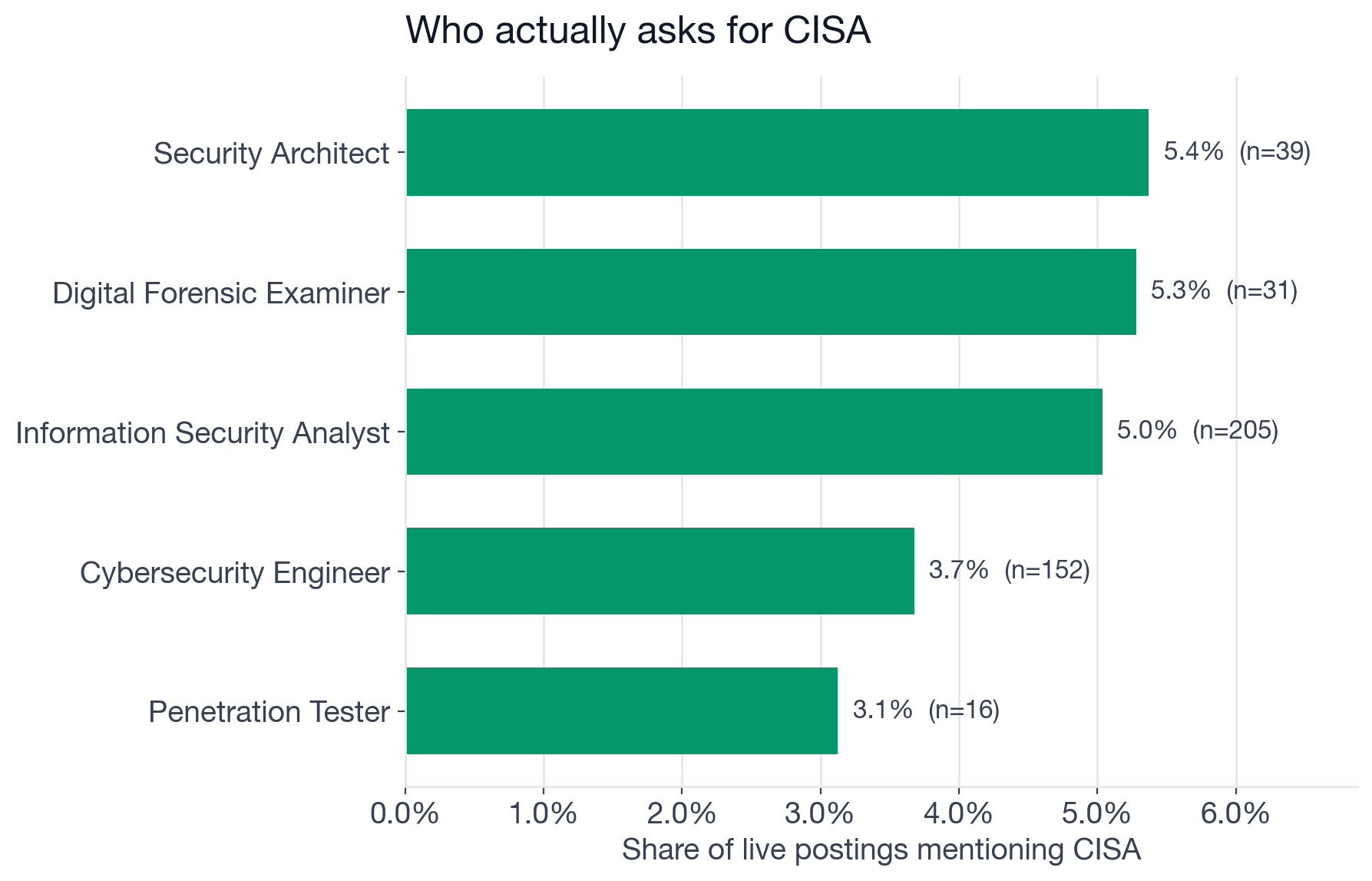 Security Architect and Digital Forensic Examiner postings mention CISA at rates roughly a fifth above the five-role average; Penetration Tester mentions it least, about 29% below average, a gap of roughly 72% between the two extremes.
That split doesn't track pay. Security Architect has both the highest mention rate and the highest baseline pay ($180,750 median for postings that don't mention CISA), which would fit a simple "expensive roles ask for more credentials" story, except Information Security Analyst breaks it: it's the lowest-paying role in scope ($89,000 baseline) yet only the third-highest mention rate, not the first. Penetration Tester, the role with the lowest mention rate, sits in the middle of the five roles by pay ($140,377), not at either extreme. What the mention rate actually tracks is closer to the exam's own scope: Security Architect, Digital Forensic Examiner, and Information Security Analyst are all roles where formal audit trails, evidentiary rigor, and governance sign-off are part of the job description; Cybersecurity Engineer and Penetration Tester are the two more purely hands-on, build-or-break roles in the set.
One measurement caveat on the two highest-scoring roles: the Security Architect and Digital Forensic Examiner labels on this board capture some senior governance and incident-response generalist titles alongside narrowly-scoped architecture or forensics postings, for example titles like "Director of Managed Security Services," "AVP, Information Security," and "Lead Incident Responder" all appear in this dataset's own title sample. That's plausibly part of why these two roles show the highest CISA rates: senior governance-adjacent and incident-response postings are more likely to reference an audit certification than hands-on architecture or forensics work specifically. Read those two rows as capturing senior security-governance functions broadly, not narrowly the job titles they're named for.
How Often Do Employers Actually Require CISA?
Not as often as the raw mention count suggests. Of the 443 postings that mention CISA, 230 (52%) use language specific enough to classify as required or preferred; the remaining 213 (48%) reference the certification inside a list of acceptable credentials without saying which way it leans.
Within that classified group, only 28 postings (12.2%, roughly 1 in 8) require CISA outright. The other 202 (87.8%, roughly 7 in 8) call it preferred. The baseline throughout this section, and the rest of the post, is other postings in the same five-role scope, not the broader job market.
The practical read: holding CISA clears the preferred bar in most postings that take a clear position, but it rarely gates a candidate out on its own. Employers appear to treat it as evidence of audit and governance competency worth having, not a hard prerequisite.
CISA Hiring Clusters Around Formal Audit Obligations
The employers asking for CISA most often aren't concentrated in one industry the way some of the security certifications in this series are. Three federal contractors, General Dynamics Information Technology, Peraton, and CACI International, account for 32.2% of the top 12 employer mentions in this data, a real presence but not a majority. The rest of the roster splits across European aerospace and defense (Thales), regulated finance and insurance (Sun Life Financial, Allianz), a regulated gambling-technology provider (Playtech), consulting and systems-integration firms that sell audit-readiness work to clients (DXC Technology, Devoteam), and large technology companies running their own internal audit and compliance functions (Amazon, Google, Mozilla Corporation).
| Employer | Postings mentioning CISA |
|---|---|
| General Dynamics Information Technology | 12 |
| Peraton | 11 |
| Amazon | 8 |
| Devoteam | 8 |
| Thales | 8 |
| Playtech | 8 |
| DXC Technology | 7 |
| 6 | |
| Sun Life Financial | 6 |
| CACI International | 6 |
| Mozilla Corporation | 5 |
| Allianz | 5 |
A handful of smaller employers round out the mention list too, including a Big Four consultancy (PricewaterhouseCoopers) and a Minnesota-based provider of services for adults with disabilities (Dungarvin). That range is itself the finding: the audit obligation CISA maps to, HIPAA, SOX, gaming licenses, federal compliance frameworks, shows up in almost any organization that has to formally answer for how it handles regulated data, not just defense contractors or banks.
The CISA Salary Gap Only Holds Up Through Mid-Level
All salary figures here are advertised US base pay only, on the subset of postings that disclose it; equity, bonus, clearance premiums, and other compensation aren't part of job-posting data. The comparison baseline is other postings in the same five-role scope that don't mention CISA, not the broader job market.
Split by seniority level, the CISA pay comparison tells two different stories. At mid-level, postings mentioning CISA advertise a median $136,250 against $113,700 for non-CISA postings in the same roles, a 19.8% edge, the larger of the two reportable gaps. At senior level, the relationship flips: postings mentioning CISA pay a median $146,863, which is 12.1% less than the $167,150 median for senior postings that don't mention it. Entry and staff samples with CISA are both too thin to report (2 and 20 postings respectively, below the 25-posting floor needed for a reliable median).
| Level | With CISA (median) | Without CISA (median) | Gap |
|---|---|---|---|
| Entry | Not reportable (n=2) | $85,280 | n/a |
| Mid-level | $136,250 | $113,700 | +19.8% |
| Senior | $146,863 | $167,150 | -12.1% |
| Staff | Not reportable (n=20) | $175,000 | n/a |
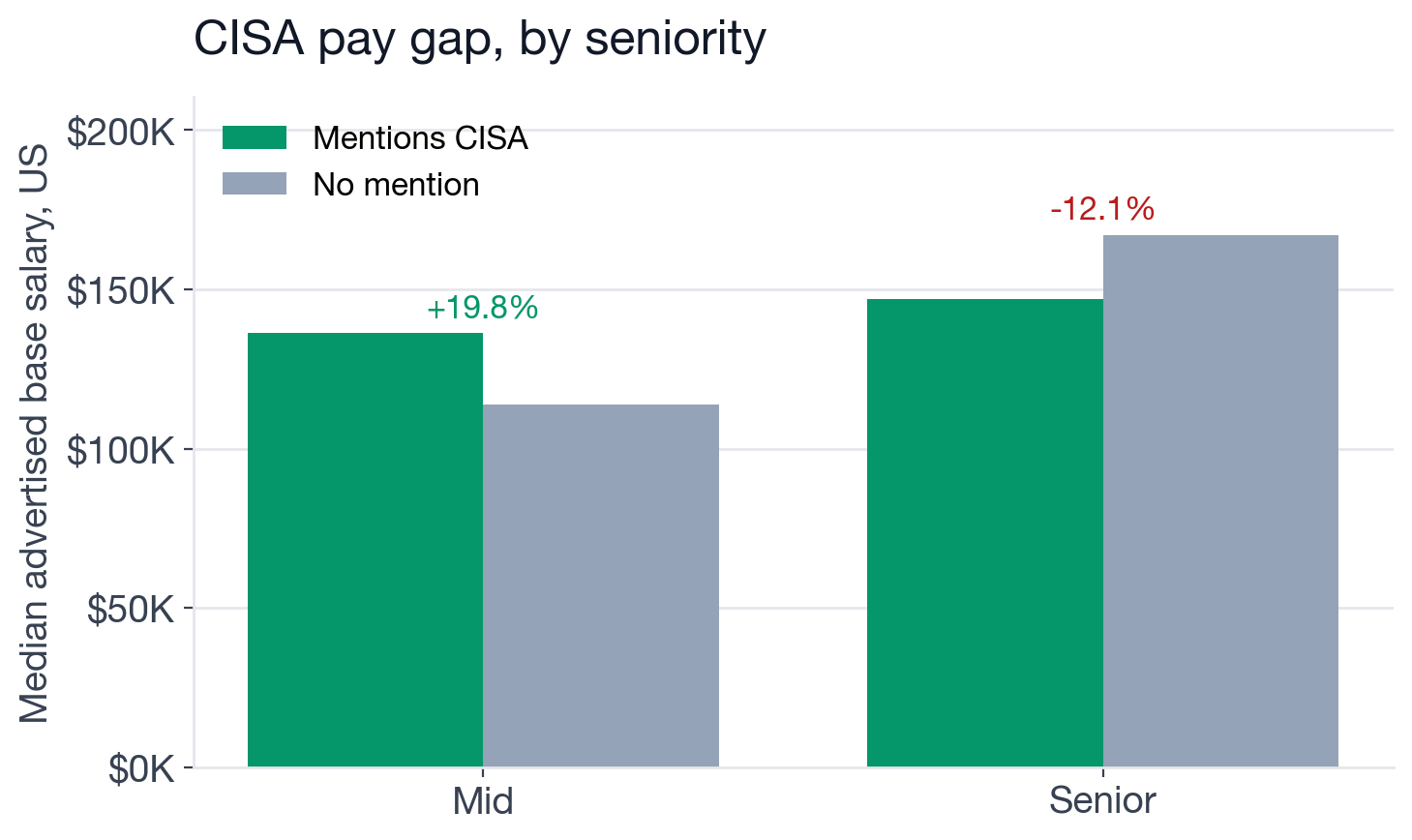 The CISA pay comparison is strongly positive at mid-level and reverses to negative at senior; entry and staff samples are too thin to report a reliable median.
Blend those two levels together and the aggregate reads $145,000 for CISA-mentioning postings versus $135,000 without it, a 7.4% edge overall. That's the number you'd see if you didn't control for seniority, and it's misleading on its own: it's carried almost entirely by the mid-level swing, while the senior segment, where a governance credential like CISA arguably matters most for a promotion case, actually runs the other direction.
The seniority mix doesn't explain the reversal away. CISA-mentioning postings skew only marginally more senior than non-CISA postings in this scope (senior plus staff combined: 33.0% versus 31.7%, mean seniority level 1.45 versus 1.41), too small a difference to account for a swing this large. It's also worth noting that seniority here is inferred from title keywords, and titles with no explicit level signal, a plausible read of leadership titles like "AVP" or "Head of" that show up in this dataset, default to mid-level, which would understate rather than overstate how senior that bucket really is. This is a correlation between postings, not proof of what the certificate itself is worth: what a posting pays is shaped by far more than one line item on a requirements list, and the honest read is that both the mid-level premium and the senior reversal are real patterns in this data, not artifacts of who happens to disclose salary.
CISA Rarely Appears Without CISSP or CISM Alongside It
CISA rarely appears alone. CISSP shows up in 81.9% of CISA-mentioning postings, and CISM in 54.9%, both far more often than any other credential in the list. CRISC (26.4%) and CCSP (17.4%) round out an ISACA-and-(ISC)²-heavy cluster of governance, risk, and cloud-security certifications; a hands-on offensive credential like CEH appears far less (14.9%).
| Certification | Co-occurs with CISA |
|---|---|
| CISSP | 81.9% |
| CISM | 54.9% |
| CRISC | 26.4% |
| CCSP | 17.4% |
| CompTIA Security+ | 15.8% |
| CEH | 14.9% |
On the skills side, risk-flavored language leads the list: Risk Management appears in 44.2% of CISA-mentioning postings and Risk Assessment in 30.9%, well ahead of hands-on technical skills like SIEM (16.7%) or Python (16.0%). GDPR shows up in 12.2% of postings, a further signal that these listings lean toward formal compliance work. That said, CISA-adjacent postings aren't pure paperwork roles: Monitoring (37.9%), Incident Response (28.7%), and Cloud Security (25.5%) all show up often too, alongside AWS (25.3%) and Azure (23.7%), so hands-on operational skill still matters, just alongside the audit and governance vocabulary.
| Skill | Appears in CISA-mentioning postings |
|---|---|
| Risk Management | 44.2% |
| Monitoring | 37.9% |
| Risk Assessment | 30.9% |
| Incident Response | 28.7% |
| Cloud Security | 25.5% |
| AWS | 25.3% |
| Azure | 23.7% |
| SIEM | 16.7% |
| Python | 16.0% |
| GDPR | 12.2% |
What This Means for Your CISA Study and Job Search Plan
If you're weighing whether to sit for CISA, the data points toward role first: it's a stronger signal for Security Architect, Digital Forensic Examiner, and Information Security Analyst postings than for Cybersecurity Engineer or Penetration Tester ones. Practice framing your audit and governance experience for an interview with InterviewStack's AI mock interviews, which adapt to the role you're targeting. Drill risk management, risk assessment, and compliance-framework questions specifically with the Question Bank, organized by topic. If governance concepts, or the cloud security and IAM skills that often sit alongside them in these postings, are still shaky, InterviewStack's interactive courses cover the underlying material before you sit the exam or the interview.
To see current openings, browse active postings across all five roles in this scope or filter down to a specific role.
FAQ
Q. How common is CISA in cybersecurity job postings in 2026?
CISA appears in 4.4% of active postings analyzed over a 90-day window, 443 of 10,027, across five security roles: Information Security Analyst, Cybersecurity Engineer, Penetration Tester, Security Architect, and Digital Forensic Examiner, on the InterviewStack.io job board.
Q. Which security roles are most likely to ask for CISA?
Security Architect (5.4% of its postings) and Digital Forensic Examiner (5.3%) mention CISA most, both roughly a fifth above the five-role average. Penetration Tester mentions it least, at 3.1%, about 29% below average. Information Security Analyst carries the largest share of total mentions (46%) simply because it's the second-largest role in scope by posting volume (4,070 postings, just behind Cybersecurity Engineer's 4,132), even though its own per-posting rate is closer to average. Note that the Security Architect and Digital Forensic Examiner categories here also pick up some senior governance and incident-response generalist titles alongside narrowly-scoped architecture or forensics roles, which likely contributes to their higher rates.
Q. Is CISA usually required or just preferred?
Mostly preferred. Of the 230 CISA mentions specific enough to classify, 87.8% call it preferred and 12.2% require it outright, roughly 1 in 8. Another 213 mentions, 48% of all CISA references, don't specify either way clearly.
Q. Do postings that mention CISA pay more than postings that don't?
It depends heavily on seniority level. Postings mentioning CISA advertise a median US base salary of $145,000 versus $135,000 for non-CISA postings in the same roles, a 7.4% edge overall. But that aggregate hides a reversal: at mid-level, CISA-mentioning postings run 19.8% higher ($136,250 vs $113,700); at senior level, they run 12.1% lower ($146,863 vs $167,150). Entry and staff samples are too thin to report reliably.
Q. What other certifications commonly show up alongside CISA?
CISSP, in 81.9% of CISA-mentioning postings, and CISM, in 54.9%. CRISC (26.4%) and CCSP (17.4%) also appear often, forming a governance-and-risk-heavy certification cluster around CISA.
Q. Who is actually hiring for CISA?
A genuinely mixed roster, not one dominated by any single industry. Federal contractors (General Dynamics Information Technology, Peraton, CACI International) account for under a third of the top employer mentions (32.2%); the rest splits across regulated finance and insurance (Sun Life Financial, Allianz), a regulated gambling-technology provider (Playtech), IT consulting firms (DXC Technology, Devoteam), and large technology companies (Amazon, Google, Mozilla Corporation) running their own internal audit functions.
CISA Is an Audit Credential, and the Market Treats It Like One
CISA behaves like what it actually is: a governance and audit certification, not a general-purpose security credential. It concentrates in the roles where formal audit trails and compliance sign-off are part of the job, Security Architect, Digital Forensic Examiner, Information Security Analyst, and it barely moves the needle in the two more hands-on technical roles in this scope. The pay comparison follows the same pattern: real at mid-level, reversed at senior, and best read as evidence of what these postings ask for, not proof of what the certificate itself pays. If your work already touches risk management, compliance, or evidentiary rigor, CISA lines up with what employers are asking for. If it doesn't, the data says look at what your target role actually requires first.
Topics
Ready to practice?
Put what you've learned into practice with AI mock interviews and structured preparation guides.