
The 0.3% Headline Hides a Security-Only Story
CSSLP shows up in 121 of the 37,446 active postings we scanned (0.3%), but that number is watered down by scope: inside the two security roles it is 107 of 4,992 postings, about 2.1%, or roughly 1 in 47. And when a posting does say whether the certification is required or preferred, 9 in 10 say preferred.
We looked at every active Cybersecurity Engineer, Security Architect, and Software Engineer posting on the InterviewStack.io job board over the last 90 days, and scanned each description for the ISC2 Certified Secure Software Lifecycle Professional credential. Software Engineer postings make up 87% of that pool, which is why the blended rate looks so small. Everything below compares postings that mention CSSLP against other postings in the same three roles, not against the whole market. This post reports what employers ask for, not what the exam is worth.
Key Findings
- 121 of 37,446 postings (0.3%) mention CSSLP; inside Cybersecurity Engineer and Security Architect postings it is 107 of 4,992 (2.1%, about 1 in 47).
- Of 50 mentions with clear wording, 45 (90%) say preferred and only 5 (10%) say required; 71 mentions say neither.
- At mid-level, US postings that mention CSSLP advertise a $169,050 median base salary versus $152,650 for those that do not (+10.7%, n=26 vs 5,678); no other level has enough CSSLP postings to compare.
- Across all levels the medians are identical at $169,050 (n=50 vs 12,440), so there is no overall pay gap to report.
- 57.0% of CSSLP postings are senior or staff level versus 45.2% of other postings, and none are entry-level (0 of 121 versus 5.1%).
- CISSP appears in 66.9% of CSSLP-mentioning postings (81 of 121); OSCP in 32.2% and CCSP in 25.6%.
- Application Security (63.6%), Automation (57.9%), CI/CD (57.0%), and SAST (55.4%) top the skills in CSSLP postings.
- Amazon has the most CSSLP-mentioning postings with 10 (8.3% of 121); Amazon, payabl., and the five employers tied at 4 postings each together account for 36 (30%), so no single company defines the demand.
Software Engineer Postings Dilute the Number, Security Postings Carry It
CSSLP is a security-role credential that Software Engineer postings almost never name. Security Architect has the highest mention rate at 2.6% (19 of 725 postings), Cybersecurity Engineer follows at 2.1% (88 of 4,267), and Software Engineer sits at 0.04% (14 of 32,454), about 1 in 2,300.
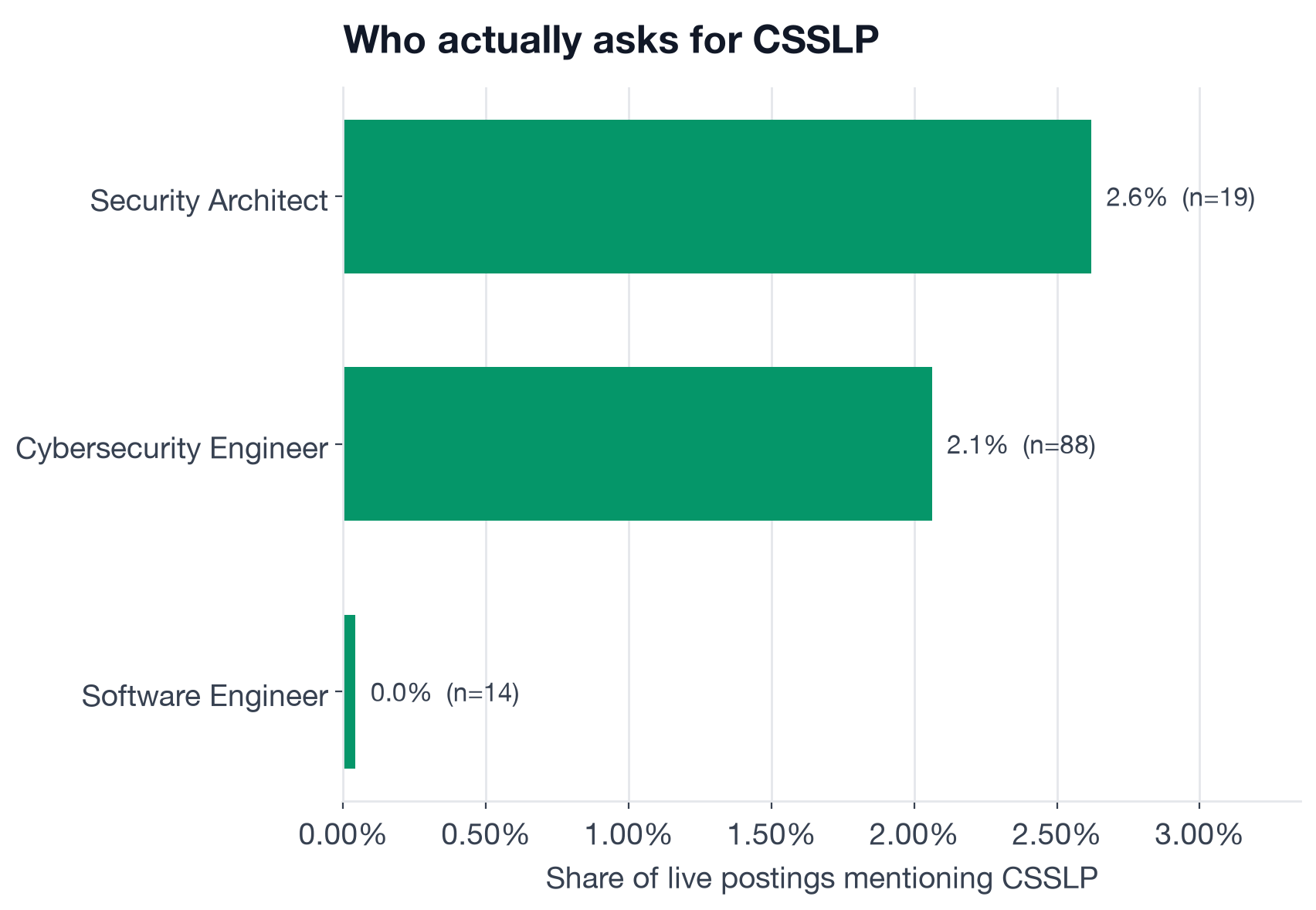
The chart shows the credential lives almost entirely in security titles even though the software-engineering pool is more than 6 times bigger than the other two roles combined.
Cybersecurity Engineer postings supply 73% of all mentions (88 of 121), so in raw volume that role is where a reader is most likely to see the certification named, while Security Architect postings name it most often relative to their size. If you are a software engineer wondering whether to add it, the honest reading is that the cert is a security-team signal, not a general engineering one. Browse current Security Architect openings or Cybersecurity Engineer openings to see the wording for yourself.
Five Requirements Among 50 Classified Mentions
CSSLP is overwhelmingly an "also nice to have" line. Of the 121 mentions, 50 had required or preferred wording within 160 characters, and among those 50, 45 (90%) were preferred and 5 (10%) were required. The other 71 mentions gave no signal either way, so we leave them out of the ratio.
Five requirements is a very small base, so treat the 10% as directional rather than exact. What it does support is a plain reading for job seekers: you are very unlikely to be screened out of a security or product-security role for lacking CSSLP, while holding it can be a tie-breaker where the wording says preferred.
What Do CSSLP Postings Advertise for Pay, Level by Level?
Among US postings that disclose pay, mid-level is the only band with enough CSSLP postings to compare, and there the gap is positive. Salary here is advertised US base only; equity, bonuses, and other compensation are not disclosed in postings, so total compensation is higher. Only a subset of postings disclose pay, and they are not a random sample.
| Level | Median base, mentions CSSLP | Median base, no mention | Gap | CSSLP n / other n |
|---|---|---|---|---|
| Entry | N/A (n=0) | $92,560 | N/A | 0 / 566 |
| Mid-level | $169,050 | $152,650 | +10.7% | 26 / 5,678 |
| Senior | N/A (n=12) | $183,500 | N/A | 12 / 3,748 |
| Staff | N/A (n=12) | $216,300 | N/A | 12 / 2,448 |
| All levels | $169,050 | $169,050 | 0.0% | 50 / 12,440 |
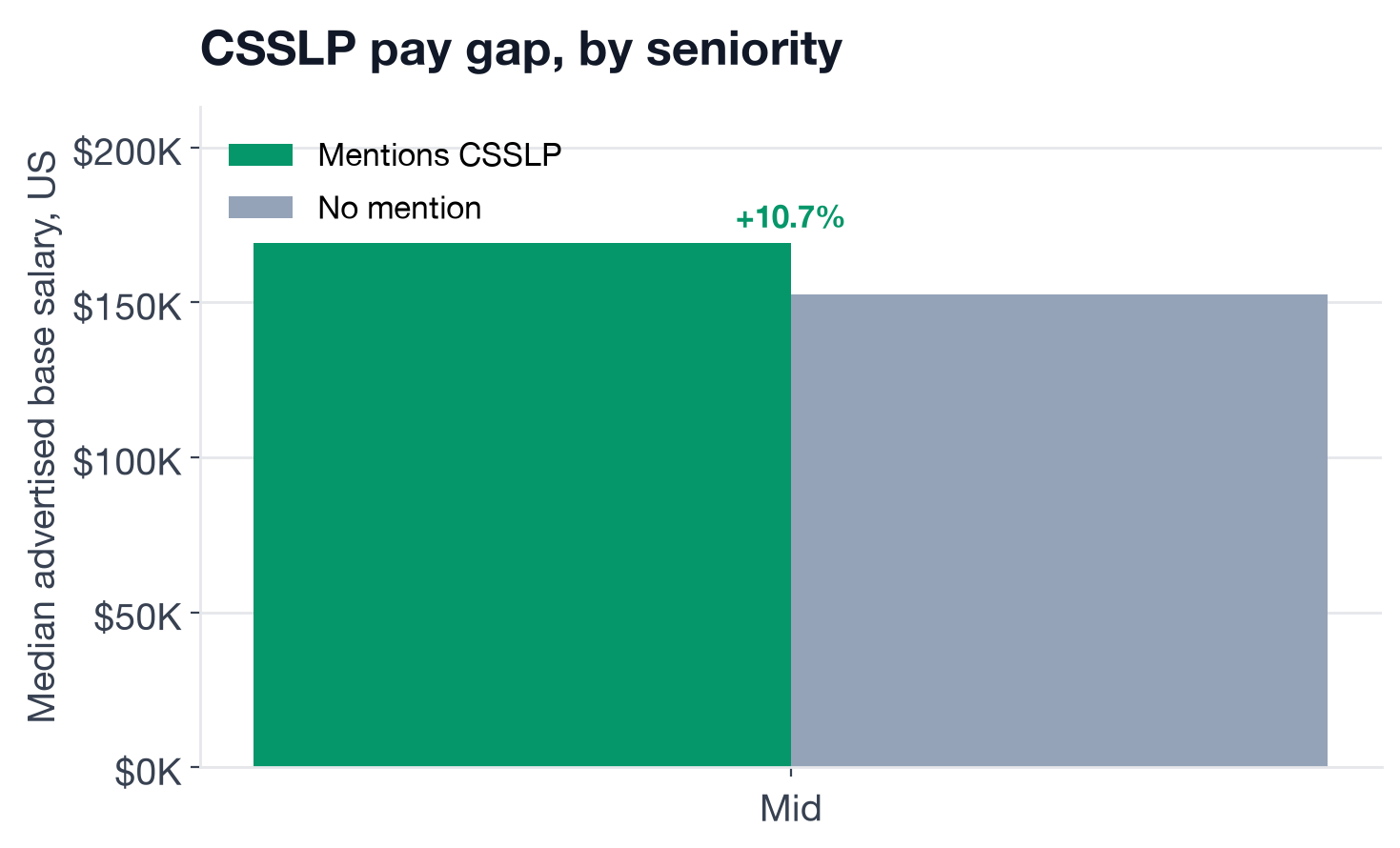
The chart has one pair of bars because mid-level is the only band where both groups clear our 25-posting floor, and even that one only just clears it at n=26.
Two cautions matter more than the +10.7%. First, the all-levels medians are identical to the dollar, which is largely a coincidence of a 50-posting median and not evidence of anything; the honest all-levels statement is "no gap." Second, CSSLP postings skew more senior (57.0% senior or staff versus 45.2%), so any blended comparison mixes seniority with the certification. That pattern (a positive gap in the one comparable band, a flat blend, and a more senior mix) could mean the senior and staff CSSLP postings are not out-earning their non-CSSLP peers, but with 12 salaried postings in each band we cannot measure it and should not read anything into it. Seniority is also inferred from titles, and untitled-level postings default to mid-level, which blurs that band. The gap mostly reflects which jobs ask for the credential, not what passing the exam is worth.
The Employers Are Mostly Product and Platform Companies, Not a Contractor Roster
The CSSLP employer list is not dominated by defense contractors. Amazon leads with 10 postings, payabl. has 6, and Danaher, Compass, AlphaSense, CACI, and Gainsight are tied at 4 each. Those seven employers together hold 36 of 121 mentions (30%), so no single company defines the demand, and the long tail is thin (no employer beyond the top 15 has more than 2).
Read the list by what these companies build: payments (payabl.), enterprise and analytics software (AlphaSense, Gainsight, SAS, Quadient), real-estate technology (Compass), industrial and medical manufacturers (Danaher, Eaton, GE HealthCare), and a large bank (Commonwealth Bank of Australia). CACI is the one recognizable federal contractor in the top 15, with 4 postings. Counts are postings, not distinct openings, and employer names are grouped approximately, so treat small differences as ties.
The job titles in the mention sample point the same way. In a 30-title sample, 9 are Product Security roles (Engineer, Architect, Manager, Specialist) and 4 are Application Security or secure-development titles, with four Amazon "Software Development Engineer" titles appearing alongside them (only one of which names security explicitly, so some of those mentions may be incidental to the job's core work). Companies that ship software and employ their own security engineers are the ones naming this credential.
What Work Do CSSLP Postings Actually Describe?
The skills tell you the job: these are secure-development pipeline roles, not compliance or audit roles. Among CSSLP-mentioning postings, Application Security appears in 63.6%, Automation in 57.9%, CI/CD in 57.0%, SAST in 55.4%, and DAST in 52.9%. Threat Modeling shows up in 47.9%, Code Review in 43.0%, and OWASP in 38.8%. These are shares of CSSLP postings, not comparisons to other postings.
Cloud and infrastructure sit right behind: AWS at 38.8%, Kubernetes at 34.7%, and Python at 36.4%. If you want to see what that looks like in live openings, filter the board to Application Security roles. The certification's own subject, building security into the software lifecycle, matches what these postings ask people to do day to day.
Which Certifications and Skills Sit Next to CSSLP?
CSSLP is rarely the only certification in the posting. CISSP appears alongside it in 66.9% of mentions (81 of 121), which means two of every three CSSLP asks also name the broader ISC2 management-track credential. OSCP is next at 32.2% (39), then CCSP at 25.6% (31), CEH at 17.4% (21), and CISM at 16.5% (20).
The pattern is a secure-development credential layered on top of broader security certifications, with a smaller offensive-security group (OSCP, CEH) alongside. It does not tell us that CSSLP holders also hold those certifications, only that postings name them together. For more on the most common companion, see our analysis of CISSP demand and pay, and for the cloud-security pairing see CCSP demand and pay.
So Should CSSLP Go on Your Study List?
The data supports a narrow answer: it is worth a look if you are aiming at product security or application security, and it is not a general resume booster. Roughly 1 in 47 security postings mention it, 9 in 10 classified mentions are preferred, and nothing here is entry-level, which fits a credential that assumes hands-on software-lifecycle experience.
Practical next steps:
- Practice the actual work. The skills above (threat modeling, SAST and DAST triage, secure code review) are what interviews probe. Practice with AI mock interviews to rehearse explaining a threat model out loud.
- Drill the topics. The Question Bank lets you focus on application security and secure design questions.
- Build the foundations. Our interactive courses cover security and software fundamentals for readers still building the base the certification assumes.
- Check the market yourself. See all current openings in scope and read how each posting words the requirement.
FAQ
Q. How many job postings ask for CSSLP?
121 of 37,446 active postings (0.3%) across Cybersecurity Engineer, Security Architect, and Software Engineer roles mention CSSLP. Inside the two security roles alone it is 107 of 4,992 postings, about 2.1%, or 1 in 47.
Q. Is CSSLP required or preferred in job postings?
Mostly preferred. Of the 50 CSSLP mentions with clear required or preferred wording nearby, 45 (90%) said preferred and 5 (10%) said required. Another 71 mentions gave no signal either way.
Q. Do postings that mention CSSLP advertise higher salaries?
Only at mid-level. Mid-level US postings that mention CSSLP advertise a median base salary of $169,050 versus $152,650 for mid-level postings in the same roles that do not (+10.7%, n=26). Across all levels the two medians are identical at $169,050, and senior and staff bands are too thin to compare.
Q. Which roles ask for CSSLP most?
Cybersecurity Engineer postings supply the most mentions (88 of 121), while Security Architect has the highest rate (2.6% of its postings). Software Engineer postings mention it in only 14 of 32,454 cases (0.04%).
Q. Which certifications do CSSLP postings ask for alongside it?
CISSP appears in 66.9% of CSSLP-mentioning postings (81 of 121), followed by OSCP at 32.2%, CCSP at 25.6%, CEH at 17.4%, and CISM at 16.5%.
Q. What skills do CSSLP postings ask for?
Application Security appears in 63.6% of CSSLP-mentioning postings, Automation in 57.9%, CI/CD in 57.0%, SAST in 55.4%, DAST in 52.9%, and Threat Modeling in 47.9%. These are secure-development pipeline roles.
What a CSSLP Mention Is Telling You
A CSSLP mention is a team saying it wants someone who can build security into software, not a hiring gate and not a proven raise. If that is the work you want, treat the certification as one supporting line next to threat modeling, pipeline security, and code-review experience that interviewers will actually test.
Topics
Ready to practice?
Put what you've learned into practice with AI mock interviews and structured preparation guides.