
CCSP's Highest Ask Rate and Its Highest Volume Point to Different Roles
Ask which security role is most likely to name the Certified Cloud Security Professional (CCSP), an ISC2 credential, and the answer is unambiguous: Security Architect postings mention it at 12.4%, a rate no other role in this scope comes close to. Ask which role actually generates the most CCSP-mentioning job postings, and the answer flips. Security Architect is a small role by headcount here, so despite its lopsided rate it supplies less than a quarter of every CCSP mention on the board. Cybersecurity Engineer, asking for CCSP at less than half Security Architect's rate, is such a larger role that it accounts for the majority of CCSP demand by volume.
We looked at active postings across the three roles ISC2 scopes CCSP toward: Cybersecurity Engineer, Security Architect, and Information Security Analyst, 8,998 postings from a 90-day window on the InterviewStack.io job board. Only 382 of those, 4.2%, named CCSP anywhere in the description, and the comparison baseline throughout this post is those three roles specifically, not the whole market.
The rate-versus-volume split lines up with pay, too. Security Architect is both the highest-paying role in this scope and the one most likely, by far, to ask for CCSP. Information Security Analyst is both the lowest-paying role and the least likely to ask for it. That is not guaranteed: several other certifications in this series concentrate in a role that has nothing to do with pay tier. Here, the cloud-architecture work CCSP actually certifies and the role that pays the most for that work are the same role.
Key Findings
- CCSP appears in 4.2% of postings across three security roles (382 of 8,998 postings analyzed).
- Security Architect postings name CCSP at 12.4%, about 6.6 times Information Security Analyst's 1.9% rate.
- Only 7.9% of classified CCSP mentions call it a required qualification; 92.1% call it preferred (214 of 382 mentions were specific enough to classify).
- Postings that mention CCSP advertise a median $151,138 US base salary, about 12% above the $135,000 median for postings in the same three roles that don't mention it.
- That premium is a mid-level story: +23.1% at mid-level, essentially flat (-1.8%) at senior.
- It also isn't uniform by role: within Cybersecurity Engineer, the role driving most CCSP volume, the reportable comparison runs negative (about 6.9% lower, $150,250 vs. $161,300).
- None of the 382 CCSP-mentioning postings in this scope are entry-level.
- 91.1% of CCSP-mentioning postings also mention CISSP, making the two nearly inseparable in this dataset.
- Cloud Security (65.7%), AWS (55.5%), and Azure (47.6%) top the skill list, consistent with CCSP's cloud-specific scope.
| Role | Postings Scanned | CCSP Mentions | Mention Rate | Share of All CCSP Mentions |
|---|---|---|---|---|
| Security Architect | 723 | 90 | 12.4% | 23.6% |
| Cybersecurity Engineer | 4,196 | 215 | 5.1% | 56.3% |
| Information Security Analyst | 4,079 | 77 | 1.9% | 20.2% |
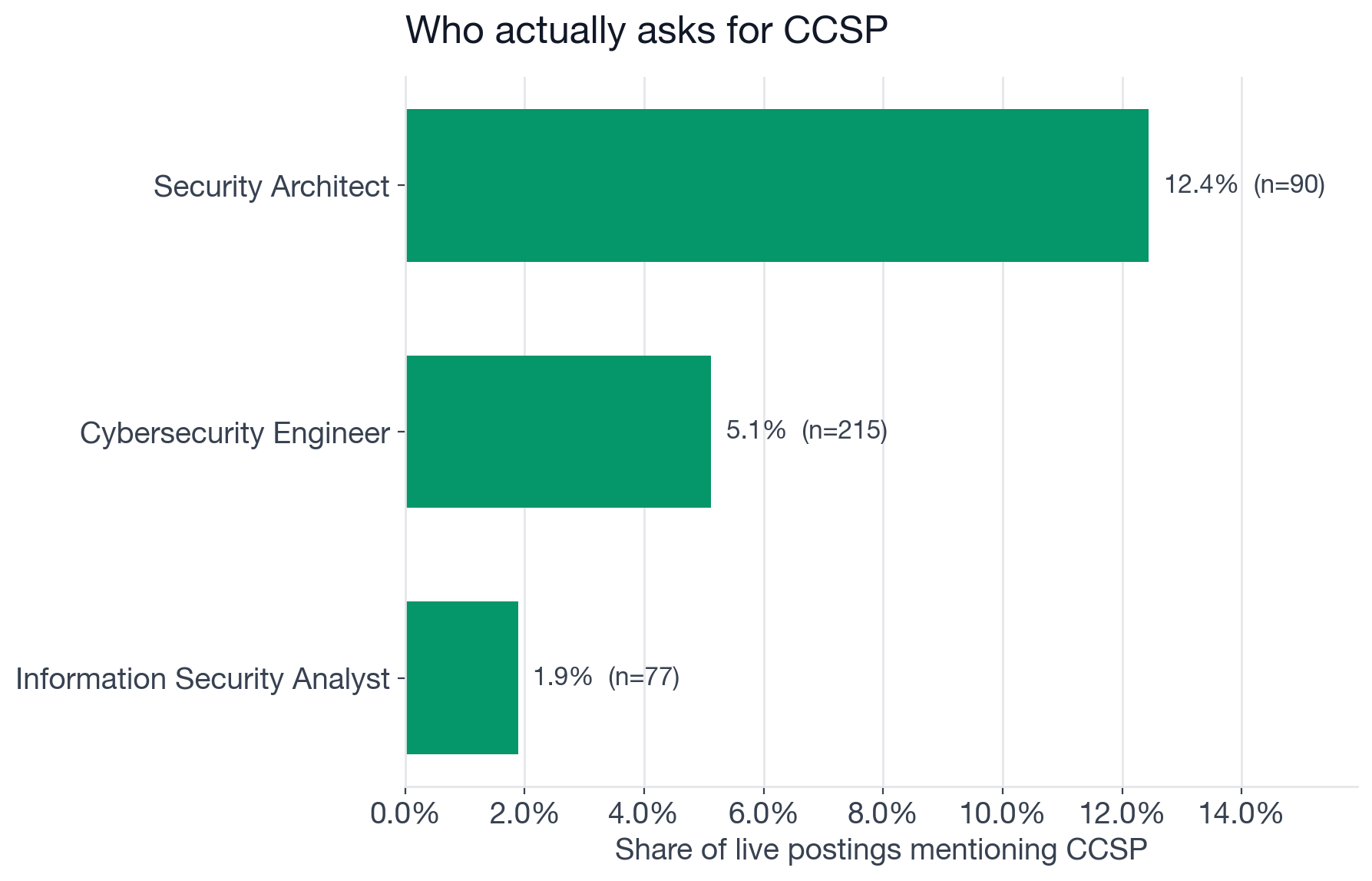
Security Architect posts CCSP at a rate no other role approaches, but it is only 8.0% of the three-role posting pool, so its outsized rate still produces a minority of total mentions. Cybersecurity Engineer, at 46.6% of the pool, supplies more than half of every CCSP mention despite a per-posting rate less than half Security Architect's. If you are counting how often a single Security Architect posting is likely to name CCSP, Security Architect wins by a wide margin. If you are counting where most of the actual CCSP-tagged openings sit, Cybersecurity Engineer is where the volume is. Information Security Analyst trails on both measures: the lowest rate (1.9%) and a smaller share of mentions (20.2%) than its size in the pool (45.3%) would predict.
One definitional note before going further: "Security Architect" here is a role-classifier bucket, not a literal job-title filter, and it has a documented tendency to also catch ISSOs, security-architecture leads, and CISO-adjacent governance titles alongside hands-on cloud architects. A few sampled titles in this scope reflect that breadth (for example, "Information Systems Security Officer" and "Head of Enterprise Security Architecture & Projects"). The 12.4% mention rate describes that broader population, not narrowly people with the exact title "Security Architect."
Does a CCSP Mention Usually Mean It's Required?
Rarely. Of the 382 postings that mention CCSP, 214 use wording specific enough to classify as required or preferred; the other 168 (44.0%) don't specify either way and are excluded from the ratio below. Within that classified group, only 17 postings (7.9%, roughly 1 in 13) state CCSP as a required qualification. The other 197 (92.1%) call it preferred, which fits a credential that most postings treat as a differentiator on top of a broader security background rather than a gate.
That low required rate is consistent with what the role comparison between Cybersecurity Engineer and Security Architect already shows: postings in this scope tend to specify a security background and let candidates fill in the specific certification portfolio. CCSP reads as evidence of cloud-security depth on top of that background, not a checkbox employers gate the interview on.
The CCSP Premium Holds at Mid-Level, Flattens at Senior
Among postings that disclose a US base salary (equity, bonus, and other compensation aren't captured in postings and aren't part of this comparison), CCSP-mentioning postings across the three-role scope advertise a median of $151,138, about 12% above the $135,000 median for postings in the same three roles that don't mention it (n=126 with CCSP, n=3,016 without). That gap is not spread evenly across seniority, and the level breakdown is the more honest number to work from.
| Seniority Level | Without CCSP (Median US Base) | With CCSP (Median US Base) | Difference |
|---|---|---|---|
| Entry | $80,450 (n=69) | Not reportable (n=0) | N/A |
| Mid-level | $113,700 (n=1,985) | $139,950 (n=77) | +23.1% |
| Senior | $165,000 (n=580) | $162,000 (n=25) | -1.8% |
| Staff | $180,000 (n=382) | Not reportable (n=24) | N/A |
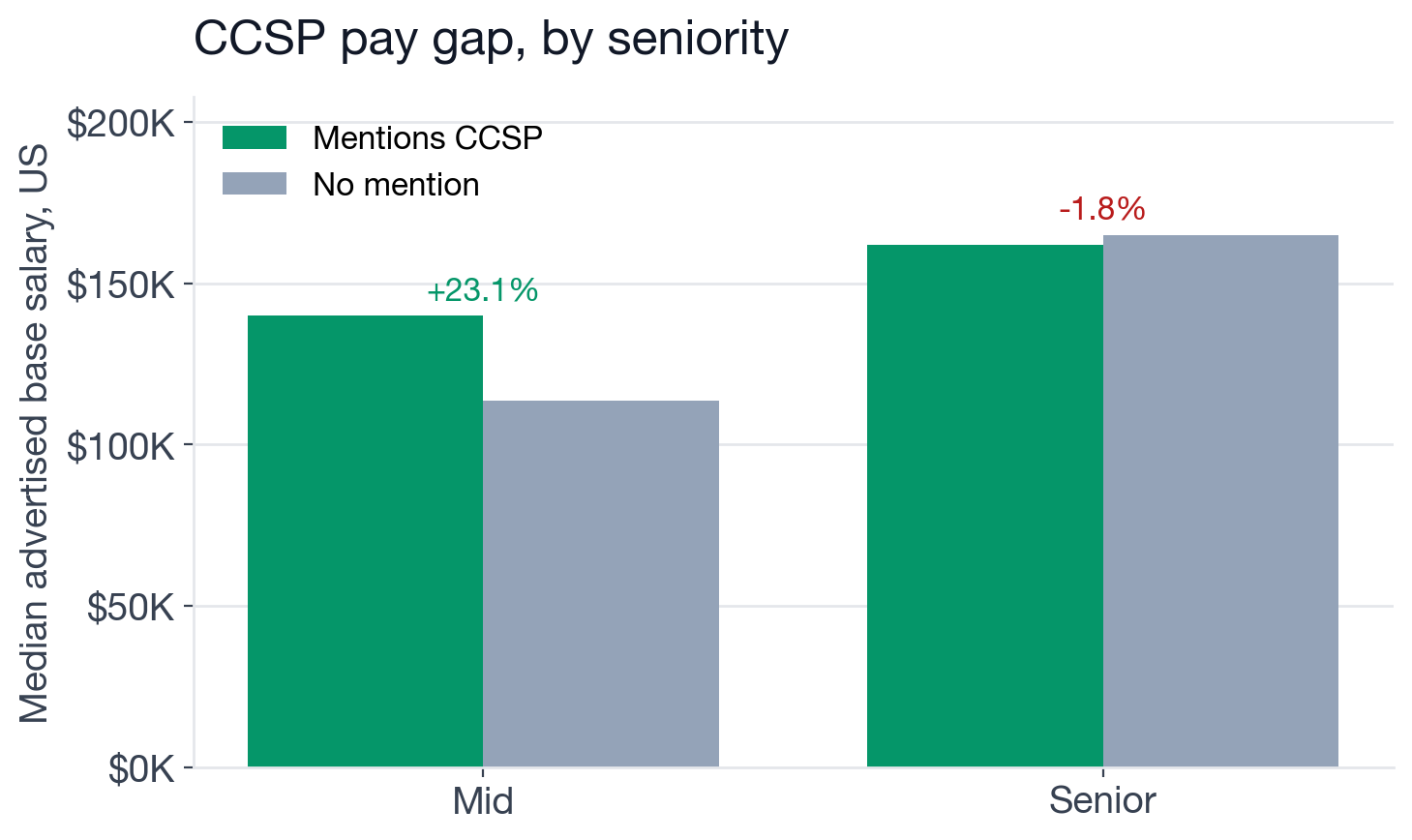
At mid-level, CCSP-mentioning postings advertise 23.1% more than mid-level postings that don't mention it. That gap essentially disappears by senior level, where the two medians sit within 1.8% of each other, functionally a wash given the sample sizes involved (senior's with-CCSP sample of 25 sits right at our reporting floor). Entry-level and staff-level comparisons aren't reportable at all: not a single CCSP-mentioning posting in this scope is entry-level, and the staff-level sample (24) falls just one short of the floor.
It would be tempting to explain the mid-level premium away as a seniority-mix artifact, but the mix here runs the opposite direction. CCSP-mentioning postings actually skew more senior overall than postings that don't mention it (a mean seniority level of 1.56 versus 1.40, with 41.1% of CCSP-mentioning postings at senior or staff level versus 31.3% of non-mentioning postings). A more senior mix should, if anything, pull the aggregate salary comparison up, not concentrate the entire visible premium at mid-level. The honest read is that the mid-level premium is real and specific to that band, not a byproduct of who applies for these roles.
One caveat on that mix argument itself: seniority in this dataset is inferred from job-title keywords, and a posting with no explicit level word (a plain "Security Architect" or "Cybersecurity Engineer" with no "Senior," "Staff," "Principal," or "Lead" qualifier) defaults to mid-level, which compresses the measured spread. Well over half of this dataset's sampled titles carry no such explicit keyword. That means the true senior/staff share on both sides of this comparison is more likely undercounted than overcounted, which, if anything, would make the CCSP-mentioning population's real seniority skew even more pronounced than the 41.1% figure above, reinforcing rather than undermining the point that the premium isn't just a mix effect.
There's one more wrinkle worth stating plainly, though: this salary story is not uniform across the three roles in scope. Cybersecurity Engineer, which supplies the majority of CCSP mentions here (56.3%), is the only role where a full with/without CCSP salary comparison clears the reporting floor on both sides (n=90 with CCSP, n=1,349 without). Within that role alone, CCSP-mentioning postings actually advertise a lower median than non-mentioning postings, $150,250 versus $161,300, about 6.9% less. Security Architect and Information Security Analyst don't have enough CCSP-mentioning salary data of their own to report a role-level comparison (n=15 and n=21, both below the 25-posting reporting floor), so the aggregate premium can't be fully decomposed by role. But the one role where the comparison is reportable, and the one that drives most of the volume, runs the opposite direction from the headline number. The aggregate premium is a property of this three-role pool, not a guarantee that holds inside every individual role.
CCSP Hiring Splits Between Federal Contractors and Everyone Else
| Employer | CCSP-Mentioning Postings |
|---|---|
| Booz Allen Hamilton | 23 |
| CACI International | 18 |
| Royal Bank of Canada | 12 |
| Cisco | 11 |
| LBG | 8 |
| Peraton | 8 |
| DXC Technology | 7 |
| Nagarro | 6 |
| SAS | 5 |
| DecisionPoint Corporation | 4 |
| AnaVation | 4 |
| PricewaterhouseCoopers | 4 |
Just over half of the mentions in this table (51.8%) come from five US federal contractors: Booz Allen Hamilton, CACI International, Peraton, DecisionPoint Corporation, and AnaVation. That is consistent with a pattern this series has seen repeatedly for security-adjacent credentials: defense and intelligence work asks for a broad certification portfolio as part of compliance and clearance requirements, not as a scarce-skill market signal.
The rest of the roster is genuinely mixed rather than a rounding error. Royal Bank of Canada and LBG, two major regulated banks, together account for 18.2% of the kept mentions, plausibly reflecting financial services' own cloud-security compliance obligations. Cisco appears as a direct technology employer at 10.0%. DXC Technology, Nagarro, and PricewaterhouseCoopers, three IT-services and consulting firms, add another 15.5%. SAS, an analytics software vendor, rounds out the table at 4.5%. CCSP hiring here is not a single-industry story the way some other certifications in this series turn out to be; it splits close to evenly between federal contracting and a real mix of finance, IT services, and technology vendors.
How Often Does CCSP Appear Without CISSP Alongside It?
Almost never. CISSP shows up in 91.1% of postings that mention CCSP, more than any other certification by a wide margin. It's worth being precise about what that number means: it describes co-occurrence within CCSP-mentioning postings specifically, not a general relationship between the two exams.
| Certification | Share of CCSP-Mentioning Postings |
|---|---|
| CISSP | 91.1% |
| CISM | 39.0% |
| CISA | 19.1% |
| CEH | 18.3% |
| CompTIA Security+ | 17.5% |
| GIAC GCIH | 12.3% |
| Azure Security Engineer Associate (AZ-500) | 11.8% |
| CRISC | 9.9% |
| CompTIA CASP+ | 9.9% |
| GIAC GSEC (a broad security-fundamentals credential) | 8.6% |
CISSP and CISM, the two most common co-occurring credentials, are both broader governance-and-management-oriented certifications rather than hands-on cloud specialties. That pattern fits CCSP's actual role in these postings: it reads as the cloud-specific add-on to a generalist security certification a candidate already needs, not a standalone qualification most postings expect on its own.
The skill list around CCSP mentions confirms the cloud focus specifically. Cloud Security tops the list at 65.7%, followed by AWS (55.5%), Azure (47.6%), and Security Architecture (45.8%).
| Skill | Share of CCSP-Mentioning Postings |
|---|---|
| Cloud Security | 65.7% |
| AWS | 55.5% |
| Azure | 47.6% |
| Security Architecture | 45.8% |
| Automation | 36.9% |
| Monitoring | 36.1% |
| Incident Response | 35.6% |
| SIEM | 33.0% |
Both major public clouds show up in roughly half of CCSP-mentioning postings, which tracks with the certification's own multi-cloud exam scope: employers asking for CCSP aren't betting on a single cloud provider.
Turning This Data Into a CCSP Study and Search Plan
If you're weighing whether to sit for CCSP, the honest starting point is your target role, not the certification itself. It shows up overwhelmingly in Security Architect postings and supplies real volume through Cybersecurity Engineer roles, but it barely registers in Information Security Analyst postings. Pair it with a plan, not a checklist: since CCSP travels with CISSP in 91% of the postings that mention it, treat the two as a package if your target roles skew senior.
To prepare for interviews where CCSP or cloud security architecture comes up, practice with AI mock interviews that simulate architecture-and-tradeoffs conversations rather than certification trivia. The Question Bank is a faster way to drill specific topics like IAM, Zero Trust, and cloud security controls that show up across CCSP-adjacent postings. If your cloud security fundamentals need work before the exam or the interview, InterviewStack's interactive courses cover the underlying cloud and security concepts these postings actually test for. When you're ready to apply, browse current openings across all three roles, or filter directly to Security Architect postings that ask for Cloud Security.
FAQ
Q. What percentage of security postings ask for CCSP?
CCSP appears in 4.2% of postings across the three roles most likely to need it: Cybersecurity Engineer, Security Architect, and Information Security Analyst (382 of 8,998 postings analyzed over a 90-day window on the InterviewStack.io job board).
Q. Which role is most likely to ask for CCSP?
Security Architect, by a wide margin. CCSP appears in 12.4% of Security Architect postings, compared with 5.1% of Cybersecurity Engineer postings and 1.9% of Information Security Analyst postings, a rate about 6.6 times Information Security Analyst's.
Q. Is CCSP usually required or just preferred?
Preferred. Of the 214 CCSP mentions specific enough to classify, only 7.9% (roughly 1 in 13) state it as a required qualification, and 92.1% call it preferred. Another 168 mentions do not specify either way.
Q. Do CCSP-mentioning postings pay more than similar postings that don't mention it?
Postings that mention CCSP advertise a median US base salary of $151,138, about 12% above the $135,000 median for postings in the same three roles that don't mention it. That gap is concentrated at mid-level (+23.1%) and essentially disappears by senior level (-1.8%), so the aggregate number overstates the case for senior candidates specifically. The picture isn't uniform by role either: within Cybersecurity Engineer, the role that drives most of the CCSP mentions in this scope, the reportable with/without comparison runs negative (about 6.9% lower, $150,250 vs $161,300), so the aggregate premium shouldn't be read as something every role experiences.
Q. Does CCSP show up in entry-level postings?
Essentially never in this dataset. None of the 382 postings that mention CCSP in this scope are entry-level, and CCSP-mentioning postings skew more senior overall than postings that don't mention it (a mean seniority level of 1.56 versus 1.40). Seniority here is inferred from title keywords and defaults to mid-level when a posting has no explicit level word, which likely undercounts the true senior/staff share on both sides.
Q. What certification most often appears alongside CCSP?
CISSP, by a wide margin. 91.1% of postings that mention CCSP also mention CISSP, making the two nearly inseparable in this dataset. CISM (39.0%) and CISA (19.1%) show up next, well behind.
The Bottom Line on CCSP's Job-Market Reach
CCSP is a niche, cloud-specific credential that concentrates hard in one role by rate (Security Architect) and a different role by volume (Cybersecurity Engineer), rarely functions as a hard requirement, and carries a real but level-specific salary signal that fades out well before the senior tier. None of that makes it a bad certification to hold. It makes it a targeted one: worth pursuing if the roles a candidate is actually targeting cluster around cloud security architecture, and worth pairing with CISSP rather than treating as a standalone credential.
Topics
Ready to practice?
Put what you've learned into practice with AI mock interviews and structured preparation guides.