
The Skill Called Data Science Belongs to Applied Scientist Postings
Search the skill list behind Data Scientist postings and one term never shows up: "Data Science." It doesn't crack the role's top 30 skills at all. Search Applied Scientist postings instead, pulled from the same InterviewStack.io job board this month, 8,091 Data Scientist listings and 1,586 Applied Scientist listings analyzed, and "Data Science" sits at 18.8%, the tenth most common skill tag in the list. The role named after the field skips citing it. The role with a different name states it outright.
That split runs deeper than vocabulary. Applied Scientist postings carry a median $187,000 US base salary against $159,100 for Data Scientist, a $27,900 gap, even though Data Scientist openings outnumber Applied Scientist ones better than five to one (8,091 vs 1,586, a 5.1x ratio).
| Data Scientist | Applied Scientist | |
|---|---|---|
| Active postings analyzed | 8,091 | 1,586 |
| Median US base salary | $159,100 | $187,000 |
| Skill overlap (Jaccard) | 0.36 (pairwise) | 0.36 (pairwise) |
| Entry-level share | 6.7% | 6.4% |
| Staff-level share | 15.4% | 17.2% |
| Remote share | 15.8% | 15.9% |
| US share of postings | 38.2% | 59.3% |
Key Findings
- Data Scientist postings outnumber Applied Scientist postings 5.1x (8,091 vs 1,586 active postings analyzed).
- Applied Scientist's median US base salary is $187,000 versus $159,100 for Data Scientist, a $27,900 (17.5%) premium.
- The two roles' top-30 skill sets overlap 36% (Jaccard 0.36); Python is the one skill at nearly identical frequency on both sides (62.5% vs 61.2%).
- SQL anchors Data Scientist at 45.8% of postings but appears in just 7.8% of Applied Scientist postings.
- "Data Science" doesn't appear in Data Scientist's own top-30 skill list, yet it's a top-10 skill (18.8%) in Applied Scientist postings.
- Deep Learning appears in 32.1% of Applied Scientist postings versus 11.9% of Data Scientist postings, and PyTorch shows a similar split (24.0% vs 13.0%).
- Entry-level access is nearly identical (6.7% Data Scientist vs 6.4% Applied Scientist); one employer, Amazon, accounts for 15.7% of the Applied Scientist postings analyzed here.
- Remote share is essentially tied (15.8% vs 15.9%), but Applied Scientist runs far more onsite overall (67.2% vs 57.3%).
Two Jobs Wearing Overlapping Vocabulary
Data Scientists mostly work embedded inside a specific business function, growth, marketing, risk, operations, answering a defined question with the data already on hand. The week is querying, building a dashboard or forecast, running an A/B test, and presenting a finding that changes a decision someone else makes. The output is usually an answer, occasionally a lightweight model, rarely a system another team has to run in production.
Applied Scientist is a research-to-production role, concentrated at a smaller set of large tech and research employers. The work starts closer to a research question, prototype a model, run it at scale, defend the approach to a research lead, then ship production-quality code (often in C++ or Java alongside Python) that a platform team keeps running. The exclusive skill clusters below make that split concrete.
Both title samples carry some noise the automated role-quality gate doesn't fully catch. A rough read of a sample of postings behind each role turns up roughly a fifth to a quarter that skew toward adjacent work rather than the role itself, a Data Migration Specialist, a Data Operations Intern, and an Azure Platform Engineer on the Data Scientist side; a Research Audiologist, a Compliance & Research Analyst, and a Research Fellow in Maritime Studies on the Applied Scientist side. That's a modest blend within a broadly correct category, not evidence the comparison is wrong, but it means the percentages below are directional rather than exact.
How Much Do the Two Skill Sets Actually Overlap?
Both roles ask for Python and Machine Learning in a majority of postings, but past that pair, "shared" stops meaning "equal."
| Shared skill | Data Scientist | Applied Scientist |
|---|---|---|
| Python | 62.5% | 61.2% |
| Machine Learning | 48.2% | 59.6% |
| Statistics | 39.2% | 24.3% |
| SQL | 45.8% | 7.8% |
| Algorithms | 20.4% | 32.8% |
| Deep Learning | 11.9% | 32.1% |
| PyTorch | 13.0% | 24.0% |
| Generative AI | 15.6% | 20.0% |
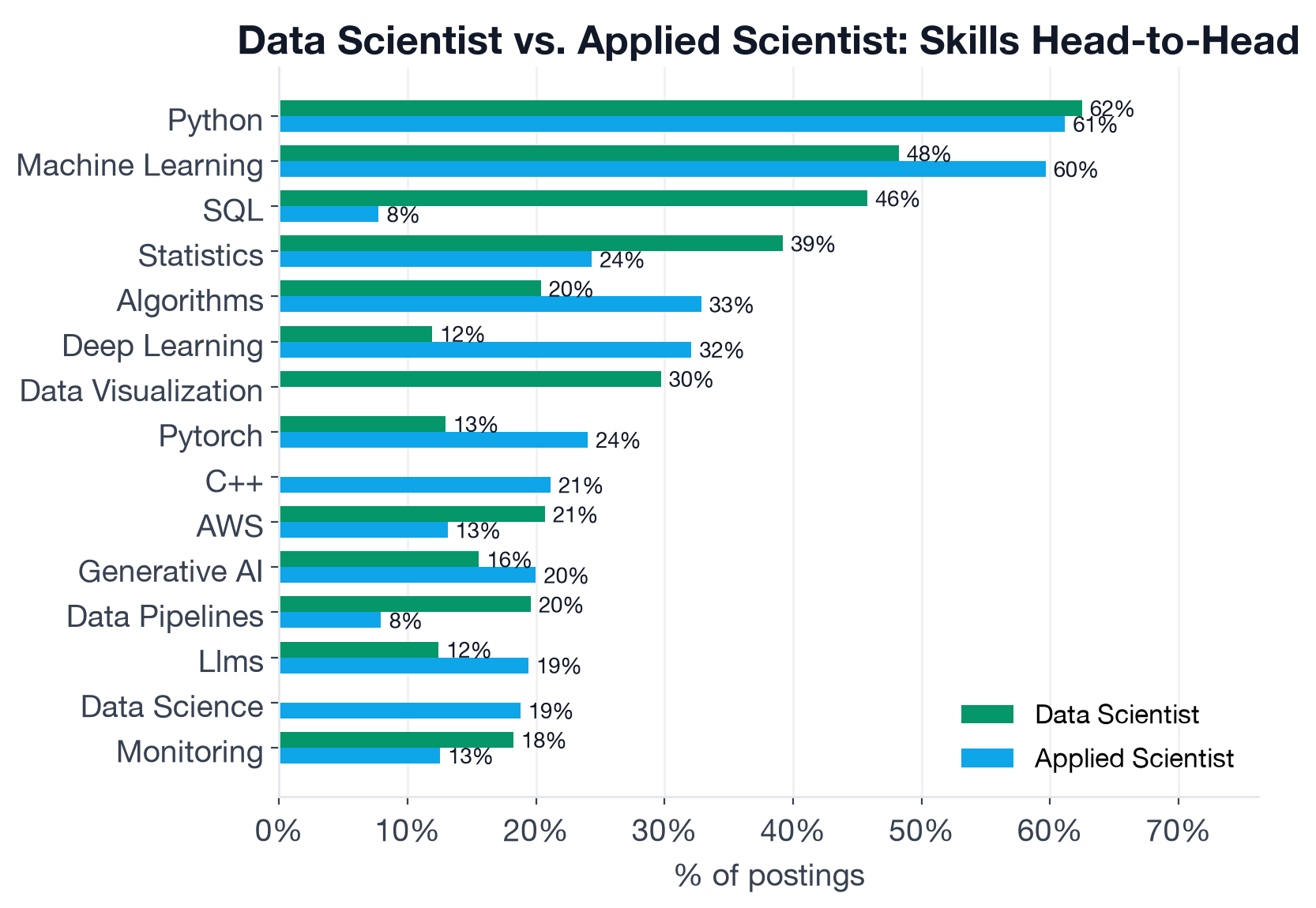 Skill frequency by role across the union of both roles' top-30 skill lists.
Python is the rare shared skill that sits at genuinely equal frequency on both sides (62.5% vs 61.2%), making it the safest single skill to have if you're not sure which of these two careers you'll end up in. Statistics runs the opposite direction from what the job titles suggest: it's a bigger presence in Data Scientist postings (39.2%) than Applied Scientist ones (24.3%), where deep learning frameworks crowd it out. SQL is the sharpest divider, foundational for Data Scientist (45.8%) and nearly absent from Applied Scientist (7.8%). Algorithms, Deep Learning, and PyTorch all tilt the other way, toward the model-building side of the work.
Where Do the Two Skill Stacks Split?
Below the shared list, the two roles run on almost entirely separate toolkits.
| Data Scientist exclusive | Freq | Applied Scientist exclusive | Freq |
|---|---|---|---|
| Data Visualization | 29.7% | C++ | 21.1% |
| Azure | 15.9% | Data Science | 18.8% |
| Data Quality | 15.7% | Java | 16.0% |
| Power BI | 14.1% | Reinforcement Learning | 14.2% |
| Tableau | 14.0% | Large Language Models | 13.5% |
| Google Cloud | 12.5% | Fine Tuning | 12.8% |
| Databricks | 11.6% | Computer Vision | 10.2% |
Data Scientist's exclusive cluster (Data Visualization, Power BI, Tableau, Data Quality, plus Azure, Google Cloud, Databricks) is the presentation-and-governance side of the job: making data trustworthy and legible for people outside the team. Applied Scientist's exclusive cluster (C++, Java, Reinforcement Learning, Fine Tuning, Computer Vision) is systems programming plus named model-building specialties. That's also where "Data Science" as a literal skill tag lives: Applied Scientist postings state it explicitly as one of several qualifying backgrounds (alongside CS, robotics, or a research domain), while Data Scientist postings, whose title already says it, don't bother.
None of this makes Data Scientist an AI-free role. Deep Learning at 32.1% for Applied Scientist versus 11.9% for Data Scientist measures who is explicitly hired to architect and train models, not who uses AI tools day to day. Stack Overflow's 2025 Developer Survey puts developer AI-tool adoption at 84% and daily use at 51%, and Anaconda's 2025 State of Data Science report found two-thirds of data scientists already use AI tools for their core analysis work. Ambient AI fluency is close to universal now regardless of title; the skill-frequency gap above is about who's asked to build the model, not who's allowed to use one.
If Databricks or Power BI shows up in a Data Scientist posting you're considering, or Computer Vision shows up on an Applied Scientist req, those postings are worth browsing directly.
Which Role Pays More, and Where Does the Premium Come From?
Every figure below is a US-only base salary median. Postings from other countries were excluded for comparability, and equity, bonus, and sign-on pay aren't disclosed in job postings, so total compensation at top employers runs higher than the numbers here.
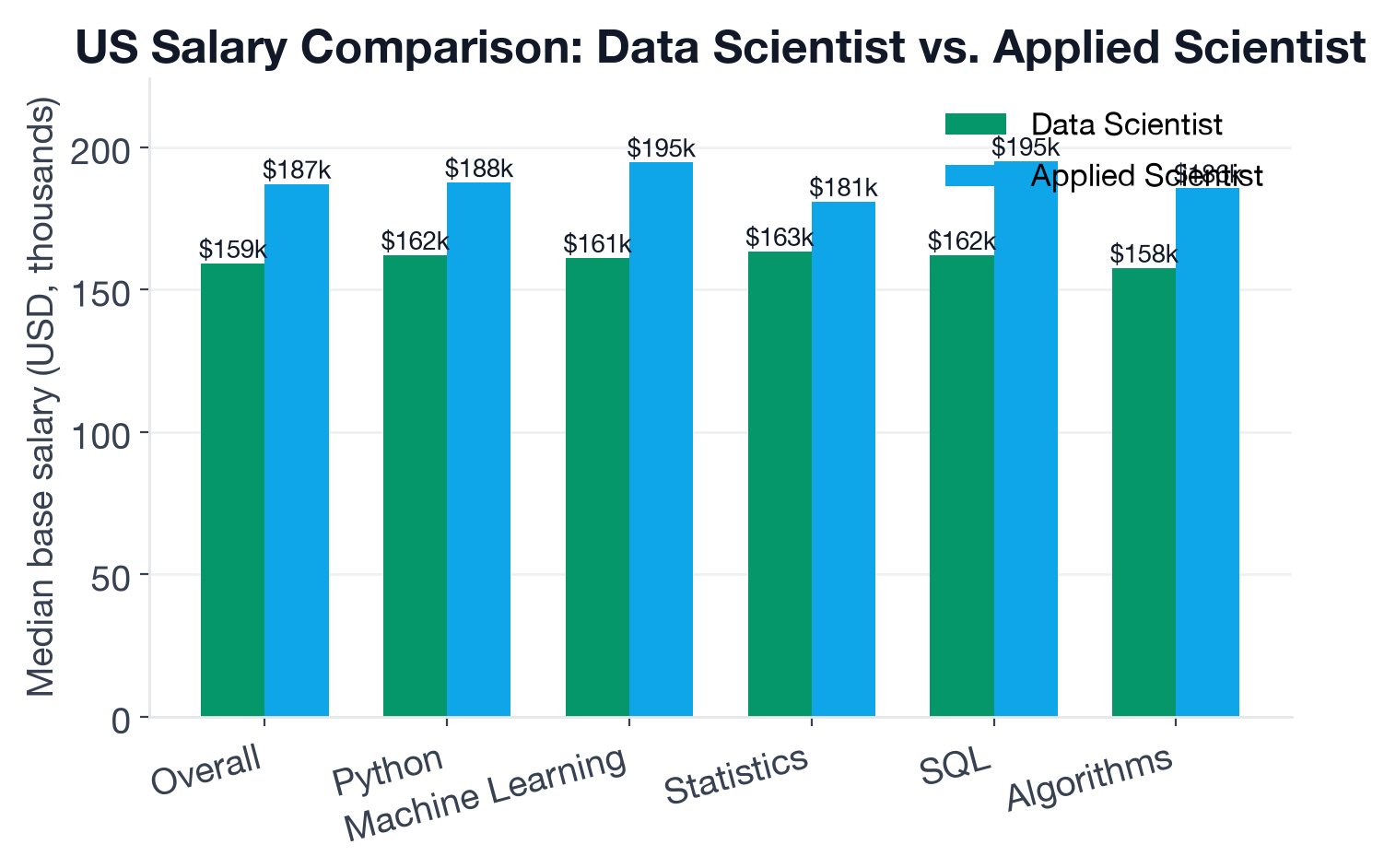 Median US base salary by role, plus shared skills with enough salary data to compare directly.
Applied Scientist's $187,000 median (n=650) sits $27,900 above Data Scientist's $159,100 (n=1,881), a 17.5% premium. The more useful finding is what actually earns that premium, and for Data Scientist it mostly isn't the role's own defining tools. Most of Data Scientist's exclusive cluster pays at or below its own baseline: Data Visualization (-$5,600, n=645), Databricks (-$4,200), Google Cloud (-$4,100), Azure (-$8,600), Tableau (-$9,300), and Power BI worst at -$17,400 (n=237). The two clearest exceptions are Forecasting, worth +$9,500 above baseline (n=221), and Data Quality, a smaller +$3,000 (n=330); Apache Spark sits close enough to baseline to round to even (+$2,900, n=277). Forecasting aside, none of Data Scientist's own labeled tools come close to the premiums below. The real premium sits one layer down, in statistical and applied-ML depth:
| Data Scientist skill | Premium over $159,100 | Sample size |
|---|---|---|
| Model Training | +$34,200 | 68 |
| Causal Inference | +$31,800 | 215 |
| A/B Testing | +$21,400 | 404 |
| Experimental Design | +$14,000 | 125 |
| LLMs | +$9,900 | 225 |
Applied Scientist shows a milder version: Data Science itself, its most literal defining skill, pays almost exactly at baseline (+$500, n=119), while C++ and Java each add roughly $9,600. The bigger premiums sit in a narrower specialization tail:
| Applied Scientist skill | Premium over $187,000 | Sample size |
|---|---|---|
| Jax (Google's high-performance array framework, used in cutting-edge ML research) | +$28,000 | 47 |
| Distributed Training | +$14,700 | 42 |
| MLOps | +$13,100 | 26 |
| Model Training | +$13,000 | 58 |
Model Training clears a real premium in both roles, +$34,200 for Data Scientist, +$13,000 for Applied Scientist, and it isn't an outlier for doing so: roughly two dozen skills in this dataset pay above their own role's baseline on both sides, including Causal Inference (+$31,800 / +$10,900), A/B Testing (+$21,400 / +$9,600), Reinforcement Learning (+$9,900 / +$9,900), and Forecasting (+$9,500 / +$7,600). Once a skill signals real statistical or applied-ML depth, it tends to pay a premium regardless of which of these two postings it shows up in; the exception, not the rule, is a skill that pays well on one side and nothing on the other. One employer, Amazon, accounts for 15.7% of the Applied Scientist postings analyzed here, so a chunk of Applied Scientist's salary and skill data reflects one large hirer's pay bands rather than an even cross-section of the specialty.
Which Role Is Easier to Break Into?
Data Scientist has 5.1x more active postings, but that's a volume advantage, not a friendlier funnel. Entry-level share is nearly identical, 6.7% of Data Scientist postings versus 6.4% of Applied Scientist postings, so a given posting isn't meaningfully easier to break into by title alone. The gap that does exist sits higher up the ladder: staff-level titles are a larger share of Applied Scientist postings (17.2% vs 15.4%), a modestly steeper senior tier on the smaller, higher-paid side.
Geography follows the same concentration pattern flagged above. Applied Scientist postings are far more US-based (59.3% vs 38.2% for Data Scientist, which draws a more global mix including 11.2% India and 4.7% UK), and Amazon's 15.7% share of the Applied Scientist postings in this dataset pulls a good part of that US concentration along with it. Work mode tells a similar story: remote share is essentially tied (15.8% Data Scientist vs 15.9% Applied Scientist), but Applied Scientist runs noticeably more onsite (67.2% vs 57.3%), again plausibly shaped by the return-to-office norms at its largest employer rather than the specialty as a whole.
Making the Call: Data Scientist or Applied Scientist
Choose Data Scientist if you:
- Want to work close to a business team, turning data into a decision through dashboards, forecasts, and experiments rather than shipping model code
- Already have SQL and stakeholder-facing analysis as strengths and would rather deepen causal inference and experimental design than pivot into deep learning frameworks
- Want the larger, more globally distributed pool of openings, 5.1x more postings, spread across a wider set of countries and employers
Choose Applied Scientist if you:
- Want to build and ship the model itself, not just interpret what it outputs, and you're comfortable pairing Python with C++ or Java
- Are drawn to a named research specialty, reinforcement learning, fine-tuning, computer vision, rather than general-purpose analytics
- Value the higher ceiling ($27,900 premium and a fatter staff-level tier) more than opening-pool size, and don't mind that a large share of this market concentrates at a handful of big employers and skews onsite
How to Use This in Your Job Search
If SQL, dashboards, and A/B testing are solid but deep learning frameworks are thin on your resume, that gap is what separates the two exclusive skill clusters above; a PyTorch or reinforcement-learning foundation is a more direct path toward Applied Scientist than adding another BI tool. InterviewStack's interactive courses cover the statistics, experimental design, and machine learning foundations both roles draw on, and the question bank lets you drill topics, causal inference, model training, fine-tuning, that this data shows carry real salary weight.
Before an interview for either role, AI mock interviews let you rehearse the technical and behavioral questions each posting type tends to ask, tuned to the role you're targeting. To see what's open right now rather than a snapshot from this analysis, browse current Data Scientist openings or current Applied Scientist openings. For a deeper look at either role's own skill demand, see our breakdowns of Data Scientist skills and Applied Scientist skills, or our comparison of Data Scientist vs Machine Learning Engineer if you're weighing a different AI-adjacent pivot.
FAQ
Q. What is the salary difference between Data Scientist and Applied Scientist in 2026?
The median US base salary for Applied Scientist postings is $187,000 (n=650), compared with $159,100 for Data Scientist postings (n=1,881), a $27,900 gap, 17.5% above the Data Scientist median.
Q. Do Data Scientist and Applied Scientist postings share the same skills?
About a third of the two roles' combined top-30 skill sets overlap (Jaccard 0.36). Python is the strongest bridge, appearing in 62.5% of Data Scientist postings and 61.2% of Applied Scientist postings. Machine Learning, Statistics, Algorithms, and Deep Learning also show up on both sides, usually at very different rates.
Q. Why does 'Data Science' show up as a skill in Applied Scientist postings but not Data Scientist postings?
'Data Science' doesn't crack Data Scientist's own top-30 skill list at all, yet it's the tenth most common skill tag in Applied Scientist postings (18.8%). The likely explanation: a posting titled Data Scientist doesn't need to restate its own field, while Applied Scientist postings, which draw candidates from adjacent fields like robotics, computational biology, and general ML research, more often spell out 'data science' as one of several qualifying backgrounds.
Q. Is SQL important for Applied Scientist roles?
Not especially. SQL appears in just 7.8% of Applied Scientist postings versus 45.8% of Data Scientist postings, making it one of the sharpest single-skill dividers between the two roles. Applied Scientist postings lean instead on Algorithms, Deep Learning, and frameworks like PyTorch.
Q. Which role has more job openings, Data Scientist or Applied Scientist?
Data Scientist, by a wide margin. This analysis found 8,091 active Data Scientist postings versus 1,586 Applied Scientist postings, a 5.1x volume ratio.
Q. Is it harder to get an entry-level Applied Scientist job than an entry-level Data Scientist job?
Not based on posting share: entry-level roles make up 6.4% of Applied Scientist postings versus 6.7% of Data Scientist postings, essentially tied. The real difference shows up at the top of the ladder, where staff-level titles are a larger share of Applied Scientist postings (17.2% vs 15.4%).
Q. Do Data Scientists need deep learning skills in 2026?
Only a minority of postings ask for it explicitly: Deep Learning appears in 11.9% of Data Scientist postings versus 32.1% of Applied Scientist postings. That gap measures who is explicitly hired to build neural network models, not who uses AI tools day to day; industry survey data shows a large majority of data scientists already use AI tools for their core analysis work regardless of what a posting states.
The Label Isn't the Job
Data Scientist doesn't list "data science" as a skill; Applied Scientist does. Take that as a small, literal reminder that a job title is a label, not a spec sheet. The two roles named after the same field split on almost everything that matters, what you build, what you're paid, who's hiring, once you look past the words on the posting. Read the skill list, not the title, before you decide which one you're actually applying for.
Topics
Ready to practice?
Put what you've learned into practice with AI mock interviews and structured preparation guides.