
Seniority Runs Backward
Research Scientist is supposed to be the credentialed track: PhD, publications, deep math, the kind of technical bar that should read as senior by default. If that credential gap showed up in the hiring data, Research Scientist postings should skew senior. They don't. 40.4% of Data Scientist postings carry a senior or staff seniority signal in the title; only 28.5% of Research Scientist postings do, even though Research Scientist is the smaller, higher-paying, more credential-gated role.
We looked at every active Data Scientist and Research Scientist posting on the InterviewStack.io job board as of July 2026: 8,192 and 1,402 listings respectively, with skills, salary, and seniority signals extracted directly from each posting. Data Scientist outnumbers Research Scientist 5.84 to 1, which makes the seniority gap more striking, not less: the role with far more competition for each opening is also the one where "senior" and "staff" show up more often in the title.
Role classification on a dataset this size isn't perfect. A manual read of a title sample from both sides found a minority of postings sitting adjacent to, rather than squarely inside, each role: data-governance and product-adjacent titles (Data Steward, Data Modeller) on the Data Scientist side, and life-sciences, hardware, and social-science research titles (bioinformatics, power electronics, demography) on the Research Scientist side. The top skills for both roles still match what a practitioner would expect with no red flags, so we treat the direction of the findings, especially the seniority inversion and the salary gap, as reliable even with that noise.
| Data Scientist | Research Scientist | |
|---|---|---|
| Median US base salary | $159,100 | $192,000 |
| Active postings | 8,192 | 1,402 |
| Top skill | Python (61.9%) | Machine Learning (59.1%) |
| Senior + staff share | 40.4% | 28.5% |
| Entry-level share | 6.9% | 6.5% |
| Skill overlap (Jaccard) | 0.30 (pairwise) | 0.30 (pairwise) |
Key Findings
- Data Scientist postings outnumber Research Scientist by 5.84x: 8,192 vs. 1,402 active listings.
- 40.4% of Data Scientist postings show a senior or staff signal, vs. 28.5% of Research Scientist postings, the opposite of what the credential gap would predict.
- Entry-level share is nearly identical: 6.9% for Data Scientist, 6.5% for Research Scientist.
- Research Scientist pays a $32,900 (17.1%) higher US median base salary: $192,000 vs. $159,100.
- The two roles share only a 0.30 Jaccard overlap; Python and Machine Learning are the sole skills both use at scale.
- Research Scientist postings concentrate 62.9% in the US, vs. 38.3% for Data Scientist, which is far more globally distributed.
What These Two Jobs Actually Do
Data Scientists spend most of their week in exploratory analysis: querying, visualizing, and building model prototypes to answer a specific business question, then handing a finding or a lightweight model to stakeholders or engineering. The work is SQL-heavy, dashboard-heavy, and judged on whether the business decision it informed was right.
Research Scientists build the models other teams later apply. The employer roster behind this dataset (Google, NVIDIA, Meta, Anthropic, OpenAI, alongside quant trading firms like Jane Street, Point72, and Jump Trading) signals two distinct populations: frontier AI/ML research and quantitative research, not general scientific R&D. Their output is a new model, a paper, or a training technique, not a stakeholder deck.
Which Skills Do Both Roles Actually Share?
Both roles lean on Python and Machine Learning, and not much else at scale. Python appears in 61.9% of Data Scientist postings and 55.8% of Research Scientist postings; Machine Learning runs the other direction, 47.8% for Data Scientist and 59.1% for Research Scientist. Statistics is nominally shared too, but it skews toward Data Scientist (39.3% vs. 18.8%), the opposite of what the "scientist" title implies: the role without "research" in the name cites the statistics skill more than twice as often.
Generative AI sits in a similar range for both (15.7% Data Scientist, 13.6% Research Scientist), while LLMs skews toward Research Scientist (18.5% vs. 12.5%), consistent with more of those postings sitting inside AI/ML research labs building directly on large language models. These numbers measure explicit build-or-architect requirements in the posting text, not overall AI usage. Separately, developer and researcher surveys put AI-tool adoption at 84 to 85% for both populations as of 2025 (Stack Overflow 2025 Developer Survey, JetBrains State of Developer Ecosystem 2025, Wiley researcher-adoption survey), so a posting that never says "AI" is not evidence the job is AI-free. It usually means AI tooling is assumed baseline rather than a named differentiator.
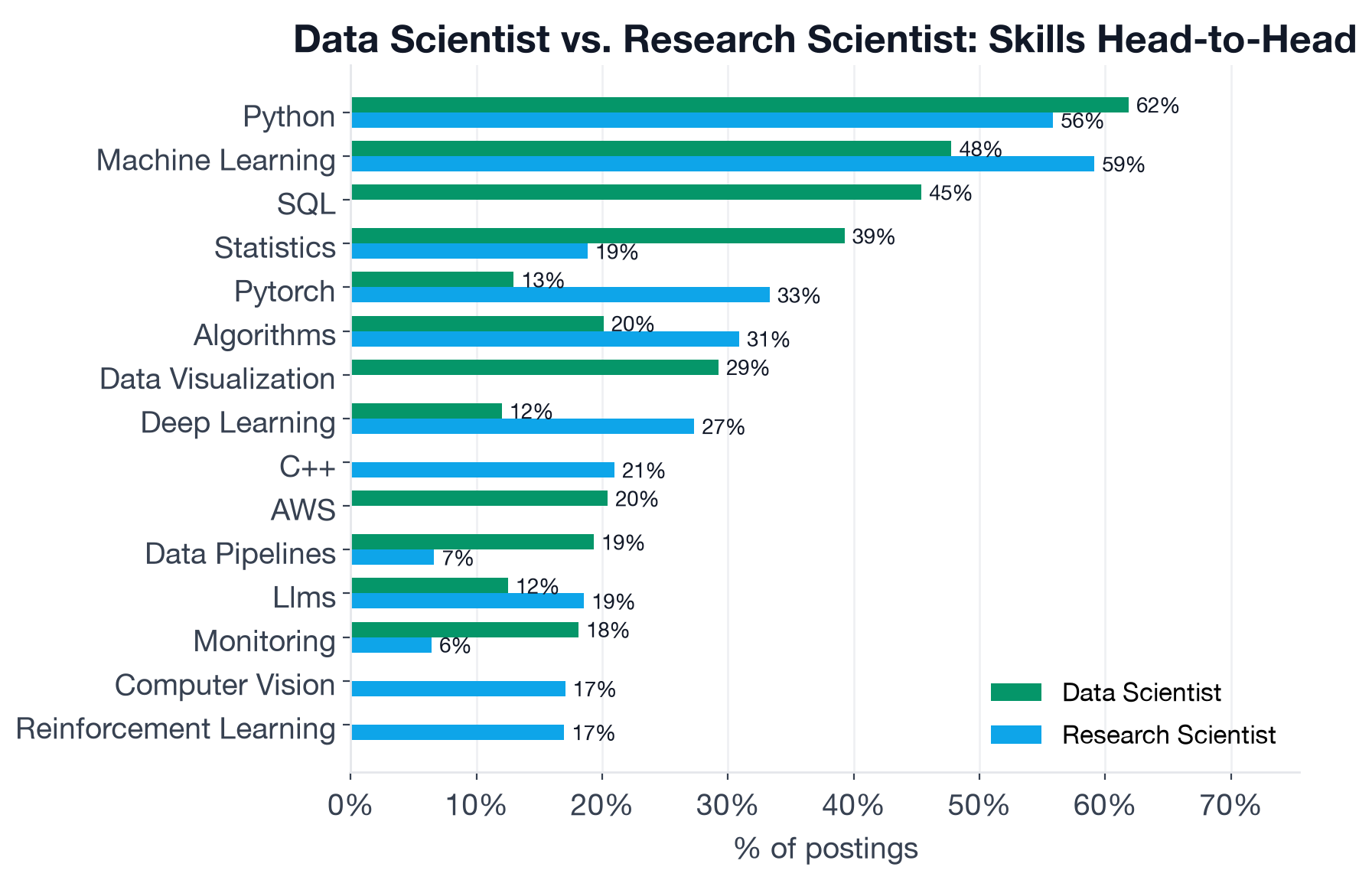 Python and Machine Learning are the only skills that clear meaningful frequency on both sides; everything else in the chart belongs mostly to one role.
Where Do the Roles Diverge?
Data Scientist's exclusive cluster is a presentation-and-warehouse layer: SQL (45.4%), Data Visualization (29.2%), AWS (20.4%), Data Quality (16.2%), Azure (15.5%), Tableau (13.9%), Power BI (13.6%), Google Cloud (12.3%), Apache Spark (11.3%), and Databricks (11.2%). These are the tools that turn analysis into something a stakeholder can act on.
Research Scientist's exclusive cluster is a model-building layer: C++ (21.0%), Computer Vision (17.0%), Reinforcement Learning (17.0%), LLM as a standalone skill tag (13.8%), Model Training (12.7%), Fine Tuning (11.8%), Prototyping (11.4%), and JAX (10.7%), a NumPy-like framework built for large-scale model training that frontier labs favor over more production-oriented PyTorch or TensorFlow. C++ in particular signals performance-critical research code, not the SQL-and-dashboards workflow on the other side. A handful of Research Scientist postings (10.0%) even cite "Data Science" itself as a skill tag, the kind of adjacent-field labeling you see when a posting is trying to signal breadth to candidates arriving from outside a pure ML research background.
Which Pays More?
Research Scientist. The median US base salary is $192,000 (n=569) versus $159,100 for Data Scientist (n=1,910), a $32,900 gap (17.1%). Both figures reflect base salary only; equity, bonus, and sign-on are not disclosed in posting salary fields, so total compensation at top employers on either side runs higher than what's reported here.
The pattern that shows up in almost every role-comparison in this dataset holds again: each role's own headline, title-defining skills sit at or below that role's baseline, and the real premium sits one layer deeper.
| Data Scientist skill | Premium over $159,100 baseline | Sample |
|---|---|---|
| Model Training | +$35,800 | n=70 |
| Causal Inference | +$32,800 | n=222 |
| A/B Testing | +$20,900 | n=412 |
| BigQuery / dbt / Airflow (cluster) | +$15,900 to $16,900 | n=55-83 |
| SQL, Tableau, Power BI (the role's own defining tools) | -$17,400 to +$2,900 | n=222-978 |
| Research Scientist skill | Premium over $192,000 baseline | Sample |
|---|---|---|
| Data Pipelines | +$46,000 | n=47 |
| Kubernetes | +$33,700 | n=33 |
| Distributed Systems | +$33,000 | n=35 |
| Fine Tuning | +$21,000 | n=62 |
| LLMs | +$18,000 | n=119 |
| C++, Computer Vision, Reinforcement Learning (the role's own defining tools) | -$8,000 to $0 | n=114-152 |
One skill, Model Training, clears a real premium in both roles independently ($194,900 for Data Scientist, $197,300 for Research Scientist), which is as close as this dataset gets to a cross-role validation signal. We excluded "Compensation and Benefits" ($249,000, n=55) from the Research Scientist table and several product-management-adjacent skills (People Management, Product Roadmap, Product Strategy) from the Data Scientist list; both look like HR- or hybrid-title contamination rather than genuine technical pay drivers a practitioner in either role would recognize.
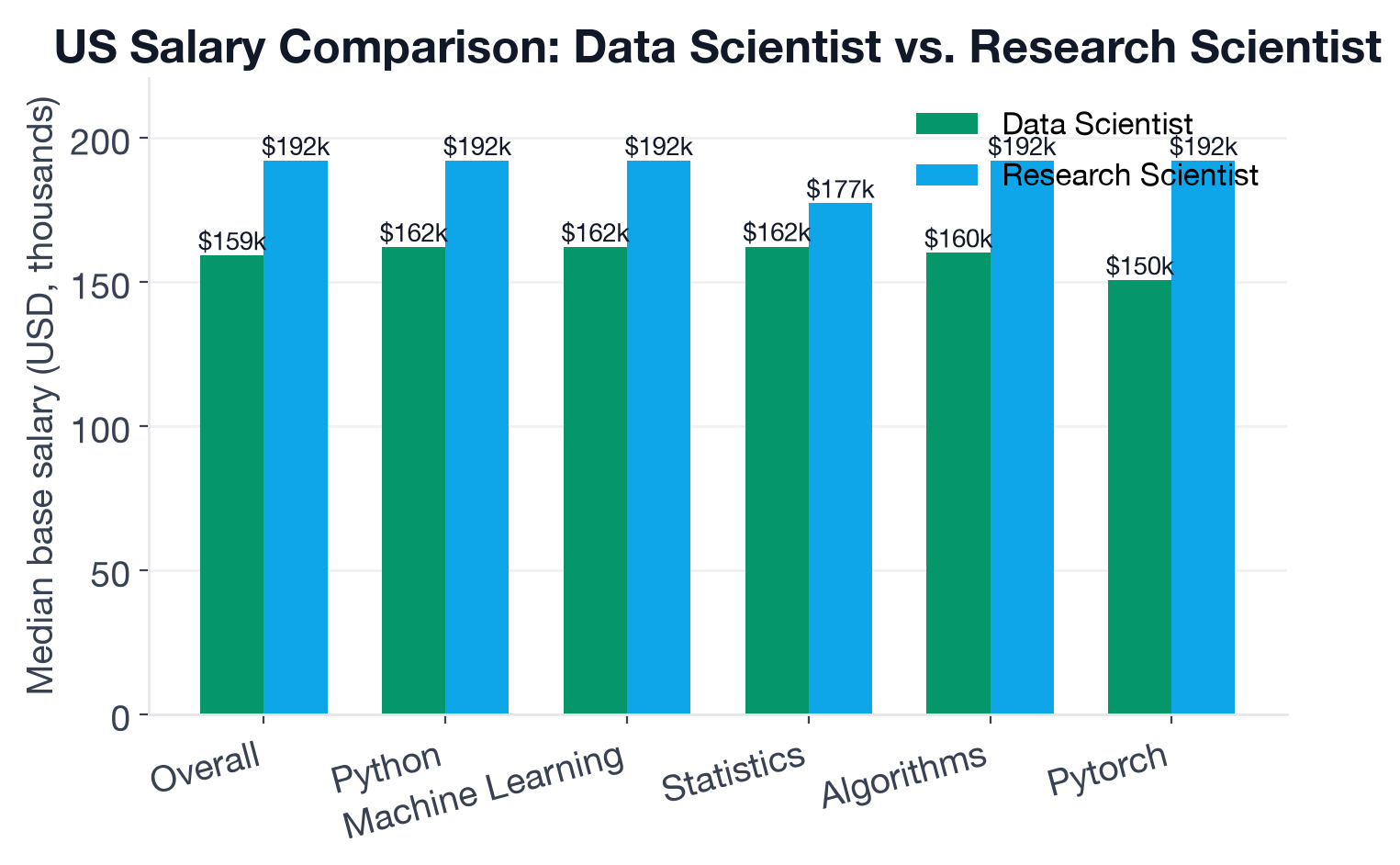 The $32,900 gap sits on top of a shared pattern: a role's own signature skills rarely carry its biggest pay premium.
Why the "Senior" Label Skips Research Scientist
The seniority split from the top of this post is worth unpacking, because it runs against intuition. Mid-level titles absorb 65.0% of Research Scientist postings, compared to 52.7% for Data Scientist; senior and staff together account for 40.4% of Data Scientist postings but just 28.5% of Research Scientist ones. Entry-level share is nearly identical (6.9% vs. 6.5%), so it isn't that Research Scientist is simply more open at the bottom either.
The likely explanation is a mismatch between what seniority language captures and what the job actually requires. This dataset infers seniority from job-title keywords like "senior," "staff," and "principal"; postings without one of those markers default to mid-level. A Research Scientist posting can require a PhD and years of specialized training without ever using a seniority modifier in the title, because "Research Scientist" already implies an advanced degree as a baseline. The practical lesson: don't use title-language seniority as a proxy for how hard a role is to break into. For Research Scientist, the real gate is the credential, not the word "senior."
Geography reinforces the story. Research Scientist concentrates 62.9% in the US, driven by the frontier-lab and quant-desk employers in this dataset, versus 38.3% for Data Scientist, which spreads more evenly across Data Scientist roles worldwide including India (11.2%) and the UK (4.5%). Research Scientist is also more onsite (67.5% vs. 57.5%) and less remote (12.6% vs. 15.8%), consistent with work that clusters around a small number of physical research hubs rather than distributed data teams.
Which Should You Choose?
Choose Data Scientist if you:
- Want the larger, more accessible market: 5.84x more active postings and a role that's hired globally, not just in a handful of US hub cities.
- Prefer stakeholder-facing work: SQL, dashboards, and A/B testing that translate directly into business decisions.
- Want a career ladder where "senior" and "staff" show up reliably in the job title as you advance.
Choose Research Scientist if you:
- Want to build and train models rather than mainly apply them, with Reinforcement Learning and JAX as signature tools rather than SQL and Tableau.
- Have or are pursuing the credential bar (a PhD is common at the frontier labs and quant desks that dominate this role's employer list).
- Want the $32,900 salary premium and can work with a market that's more concentrated onsite in the US.
How to Use This in Your Job Search
If you're weighing a move into either role, start by testing where your current skills actually land. Practice with AI mock interviews built around Data Scientist or Research Scientist scenarios to see how your SQL, statistics, or model-building answers hold up under real interview conditions. If a gap shows up in a specific area, like causal inference for Data Scientist roles or fine-tuning and distributed training for Research Scientist roles, drill it directly in the question bank rather than studying broadly. For foundational gaps, our interactive courses cover the statistics, ML, and applied-research concepts that show up across both role families. When you're ready to apply, browse live Data Scientist openings or Research Scientist openings directly.
FAQ
Q. Which pays more, Data Scientist or Research Scientist?
Research Scientist. The median US base salary for Research Scientist postings is $192,000 (n=569), compared to $159,100 for Data Scientist (n=1,910), a $32,900 (17.1%) gap. Both figures are base salary only; equity and bonus are not disclosed in job postings.
Q. Is Research Scientist actually a more senior role than Data Scientist?
Not by the job-title data. 40.4% of Data Scientist postings carry a senior or staff seniority signal, compared to 28.5% of Research Scientist postings, and entry-level share is nearly identical (6.9% vs 6.5%). Research Scientist's technical bar, often a PhD, does not reliably show up as a senior or staff keyword in the title.
Q. How much skill overlap is there between Data Scientist and Research Scientist?
The two roles share a Jaccard overlap of 0.30 on their top-30 skill sets. Python and Machine Learning are the only two skills both roles require at meaningful scale; the rest of each role's toolkit diverges sharply.
Q. Which role has more job openings?
Data Scientist, by a wide margin. There are 8,192 active Data Scientist postings on the InterviewStack.io job board versus 1,402 for Research Scientist, a 5.84x difference.
Q. Do Research Scientist jobs require a PhD?
Many do, especially at the frontier AI labs and quantitative trading firms that dominate this role's employer roster, including Google, Meta, NVIDIA, Anthropic, OpenAI, Jane Street, and Point72. The posting data does not tag 'PhD' as a skill, but the skill mix (Reinforcement Learning, JAX, Fine Tuning, Distributed Training) signals research-lab-level depth rather than applied business analytics.
Q. Does Research Scientist always mean AI/ML research?
In this dataset, mostly yes, with a quantitative-finance subset. The top employers are AI/ML research labs (Google, NVIDIA, Meta, Anthropic, OpenAI) alongside quant trading firms (Point72, Jane Street, Jump Trading), so treat this comparison as AI/ML- and quant-research-specific rather than life-sciences or physical-sciences research.
Q. What's the biggest skill gap between the two roles?
SQL. It appears in 45.4% of Data Scientist postings and does not register at meaningful frequency for Research Scientist. Research Scientist's biggest exclusive skill is C++ at 21.0%, reflecting its focus on building and training models rather than querying and visualizing data.
The Bar Is Invisible in the Title
Research Scientist carries the harder credential bar and the bigger paycheck, but the job-title data doesn't show it as the more senior role, because the PhD requirement operates as an invisible filter that title keywords like "senior" and "staff" don't capture. If you're scanning listings for how far along your career needs to be before you qualify, read the skill list and the degree requirement in the description, not the seniority word in the title. For more on how these two roles compare to their nearest neighbors, see how Data Analyst stacks up against Research Scientist or dig into the full Data Scientist and Research Scientist skill breakdowns.
Topics
Ready to practice?
Put what you've learned into practice with AI mock interviews and structured preparation guides.