
GCIA Postings Skew Senior, and That Inflates the Headline Pay Gap
Postings that mention GCIA advertise a median US base salary of $151,475, comfortably above the $137,500 median for postings in the same role scope that don't, a gap of $13,975. That is the number most people will see first, and it is not the number that survives scrutiny. Isolate the only seniority band with enough GCIA-mentioning postings to compare directly, mid-level, and the real gap drops to $5,625, less than half the headline figure.
GCIA, the GIAC Certified Intrusion Analyst credential from GIAC and SANS, covers network traffic analysis and intrusion detection. Looking at every active Information Security Analyst, Cybersecurity Engineer, and Digital Forensic Examiner posting on the InterviewStack.io job board over a 90-day window turns up 192 mentions of GCIA out of 8,923 postings scanned, 2.2% of the scope. The rest of this post breaks down where that 2.2% concentrates, why the aggregate salary number overstates the real gap, and who is actually hiring for it.
Key Findings
- GCIA appears in 192 of 8,923 active postings across three security roles over a 90-day window, 2.2% of the scope.
- Postings that mention GCIA advertise a median US base salary of $151,475 versus $137,500 for postings that don't, a $13,975 (10.2%) gap.
- The only seniority band with enough GCIA-mentioning postings to compare directly, mid-level, shows a smaller gap: $122,275 versus $116,650, a $5,625 (4.8%) difference.
- GCIA-mentioning postings are 61% more likely to be senior-level than non-mentioning postings (32.3% versus 20.0%), which inflates the aggregate gap since senior postings pay more regardless of certification.
- Splitting the same postings by role instead of seniority complicates the number further: Information Security Analyst's own with/without gap (20.5%, n=36) runs well above the mid-level figure, while Cybersecurity Engineer's (8.3%, n=40) sits closer to the aggregate.
- Digital Forensic Examiner postings mention GCIA at 6.0%, about 3 times Information Security Analyst's 2.0% and about 3.4 times Cybersecurity Engineer's 1.7%.
- Of the 109 classified mentions, 22.9% call GCIA required and 77.1% call it preferred; 83 of all 192 mentions (43.2%) don't specify either way.
- GCIA co-occurs with its GIAC sibling GCIH in 80.2% of mentions and with CISSP in 63.0%.
The $13,975 aggregate gap and the $5,625 mid-level gap are both real numbers computed from the same dataset; they disagree because the population asking for GCIA does not look like the population that isn't. Entry-level postings are a smaller share of GCIA mentions (2.1% versus 3.1%), mid-level postings are a smaller share too (55.7% versus 65.9%), and senior-level postings are a much larger share: 32.3% of GCIA mentions are senior-level, versus 20.0% of non-mentioning postings, 61% more representation. Staff-level share is close to flat (9.9% versus 10.9%). Put together, the average seniority level across GCIA-mentioning postings runs about 8% higher than for postings that don't mention it. Seniority itself is inferred from title keywords, and titles with no explicit level word default to mid-level, compressing the measured spread in both populations; the true gap in seniority mix between GCIA-mentioning and non-mentioning postings could differ somewhat from what's reported here, though the direction isn't something this dataset can pin down.
That matters because seniority is a stronger predictor of pay in this scope than any single certification. Non-GCIA senior postings already advertise a median $165,000, 41% above non-GCIA mid-level postings' $116,650, before GCIA enters the picture at all. A pool of postings that skews toward the senior band will look like it pays more in aggregate even if the certification itself carries no premium whatsoever at that level, purely because it is carrying more of the expensive band.
Whether GCIA carries a real premium at senior level specifically is not something this dataset can confirm. Only 24 GCIA-mentioning senior postings disclose US salary, one short of the 25-posting floor this analysis requires to report a median; entry (2) and staff (10) fall further short. Mid-level is the only band with enough sample on both sides, 48 GCIA-mentioning postings against 2,013 that don't, and there the certification does show a real, if modest, edge: $122,275 versus $116,650.
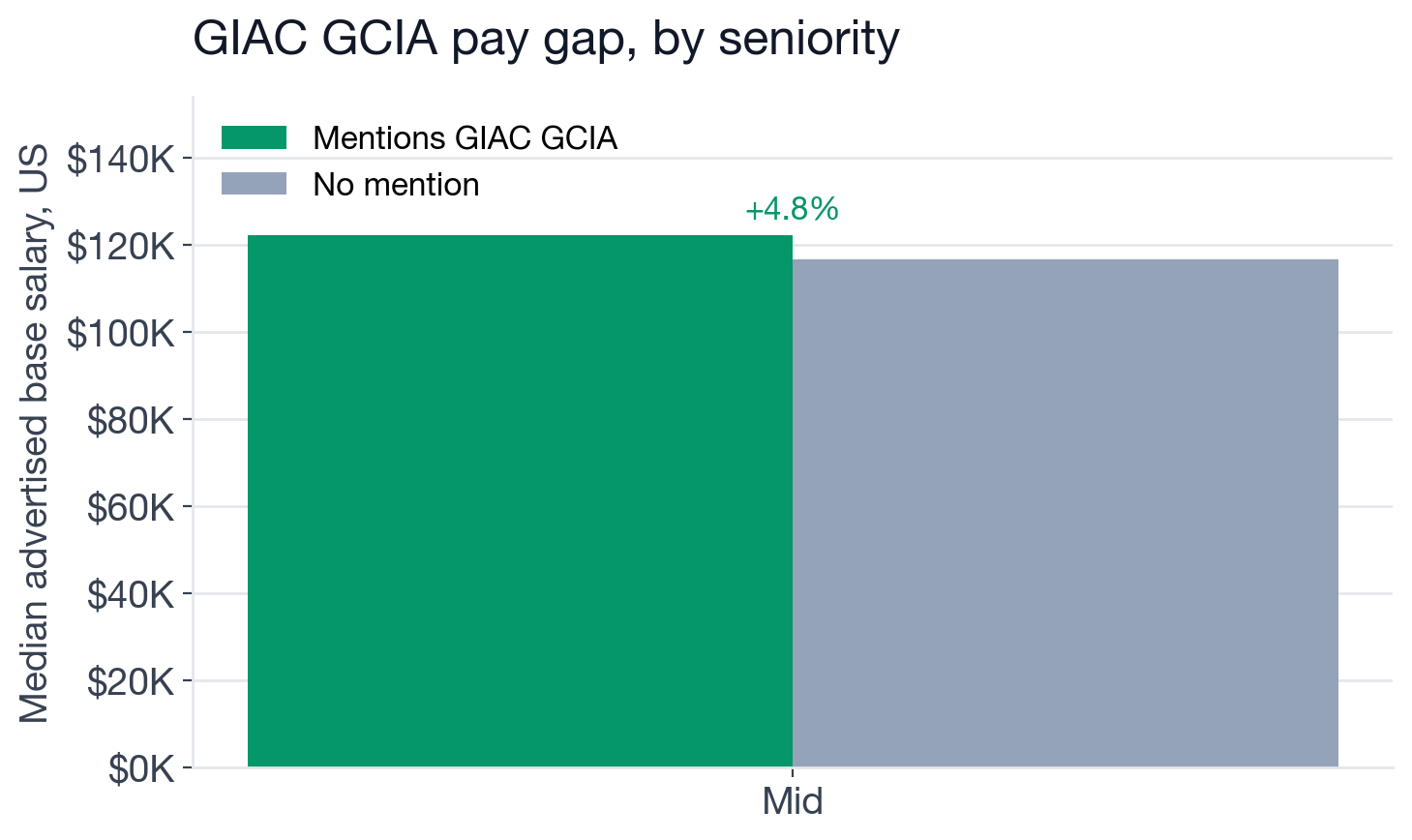 Mid-level is the only band with enough GCIA-mentioning postings to compare directly; the aggregate gap is wider than the mid-level gap because GCIA-mentioning postings skew senior.
| Seniority Level | Median US Base, With GCIA | Median US Base, Without GCIA | Gap | Sample (With / Without) |
|---|---|---|---|---|
| Entry | Not reportable (n=2) | $80,450 | N/A | 2 / 78 |
| Mid-level | $122,275 | $116,650 | +4.8% | 48 / 2,013 |
| Senior | Not reportable (n=24) | $165,000 | N/A | 24 / 600 |
| Staff | Not reportable (n=10) | $175,500 | N/A | 10 / 411 |
| All levels (aggregate) | $151,475 | $137,500 | +10.2% | 84 / 3,102 |
The honest number for a candidate deciding what GCIA is worth checking is the mid-level one, +4.8%, not the aggregate +10.2%. Both are real gaps in the data; only one of them isolates what the certification itself is associated with rather than who happens to be applying with it. This is base salary only, on the subset of postings that disclose it; equity, bonus, and other compensation aren't captured, and the comparison is against other postings in this same three-role scope, not the broader job market.
The mid-level figure isn't the full story either, once the same postings are split by role instead of by seniority. Two of the three roles clear the sample floor for their own with-cert salary comparison: Information Security Analyst shows $122,275 versus $101,450 (n=36 with cert, n=1,438 without), a 20.5% gap, and Cybersecurity Engineer shows $175,500 versus $162,000 (n=40, n=1,481), an 8.3% gap. Digital Forensic Examiner's with-cert sample (n=8) is too small to report. Neither role-level gap matches the mid-level-only +4.8% figure above: Information Security Analyst's own gap runs roughly four times larger, and Cybersecurity Engineer's sits closer to the aggregate +10.2% than to the mid-level number. Role composition, not just seniority, is doing real work in the aggregate gap, and this dataset can't fully separate the two effects at the sample sizes available.
How Much More Often Does Digital Forensic Examiner Ask for GCIA?
Digital Forensic Examiner is the smallest of the three roles in this scope by posting volume, 564 of the 8,923 postings scanned, 6.3% of the pool. It is also, by a wide margin, the role most likely to ask for GCIA. 6.0% of Digital Forensic Examiner postings mention the certification, compared with 2.0% for Information Security Analyst (about 3 times the rate) and 1.7% for Cybersecurity Engineer (about 3.4 times the rate). Put differently, Digital Forensic Examiner supplies 17.7% of every GCIA mention off just 6.3% of the postings scanned, a 2.8x over-index.
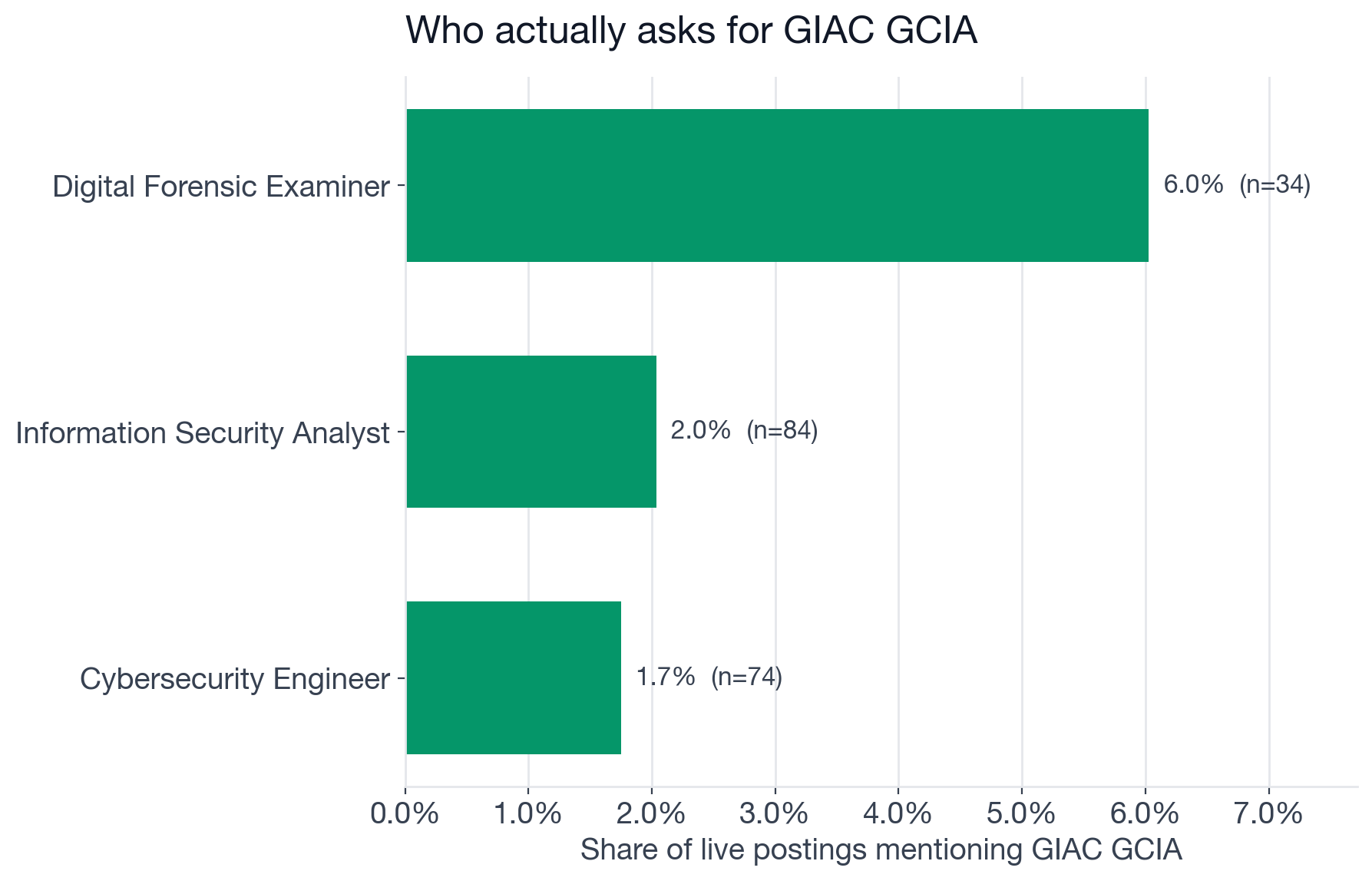 Digital Forensic Examiner's 6.0% mention rate runs about 3 to 3.4 times higher than Information Security Analyst's and Cybersecurity Engineer's.
| Role | Postings Scanned | GCIA Mentions | Mention Rate | Share of All GCIA Mentions |
|---|---|---|---|---|
| Digital Forensic Examiner | 564 | 34 | 6.0% | 17.7% |
| Information Security Analyst | 4,130 | 84 | 2.0% | 43.8% |
| Cybersecurity Engineer | 4,229 | 74 | 1.7% | 38.5% |
That concentration doesn't track pay tier. Digital Forensic Examiner's own baseline pay ($145,500 without the certification) sits between Information Security Analyst's ($101,450) and Cybersecurity Engineer's ($162,000), not at either extreme, yet Cybersecurity Engineer, the highest-paying of the three, under-indexes on GCIA mentions (0.81x) while Digital Forensic Examiner over-indexes hardest. The more plausible explanation is functional, not financial: GCIA's exam leans on packet-level traffic analysis and network-based intrusion detection, skills that overlap directly with reconstructing how an intrusion happened, which is close to Digital Forensic Examiner's actual job. Information Security Analyst and Cybersecurity Engineer postings run closer to parity with their own share of the overall pool (0.95x and 0.81x).
One caveat on the Digital Forensic Examiner figures specifically: role classification for this label has been observed elsewhere to sweep in a broader population than literal courtroom-facing forensic examiners, including incident-response and SOC-generalist titles that share keywords with the role. The 6.0% mention rate above is best read as characterizing that broader digital-forensics-and-incident-response-adjacent population rather than a narrow specialist pool.
Under One in Four GCIA Mentions Are an Actual Requirement
Of the 192 total GCIA mentions in this dataset, 109 (56.8%) use wording specific enough to classify as required or preferred; the other 83 (43.2%) don't specify either way and are excluded from the ratio below. Among the 109 classified mentions, 25 (22.9%, just under 1 in 4) treat GCIA as required, and 84 (77.1%) list it as preferred.
| Classification | Count | Share of Classified Mentions | Share of All Mentions |
|---|---|---|---|
| Required | 25 | 22.9% | 13.0% |
| Preferred | 84 | 77.1% | 43.8% |
| Unspecified | 83 | N/A | 43.2% |
A clear majority of the mentions read as preferred rather than required: employers name GCIA as a differentiator on a resume more often than they gate an application on it. For a candidate, that means a missing GCIA line is unlikely to be an automatic disqualifier for most of these postings, but a present one is a real, if modest, signal that gets read by whoever screens the application.
Does GCIA Hiring Stay Inside the Government-Contractor World?
Peraton (20 mentions) and Leidos (15) are the two busiest employers in this dataset, together accounting for 18.2% of all 192 GCIA mentions. Add Booz Allen Hamilton, KBR, and CACI International, and defense and government contractors make up 58.9% of the mentions among the top 12 employers kept in the table below.
| Employer | GCIA Mentions |
|---|---|
| Peraton | 20 |
| Leidos | 15 |
| 7 | |
| BNY | 6 |
| Mitsubishi UFJ Financial Group | 4 |
| Thales | 4 |
| Altruist | 3 |
| Booz Allen Hamilton | 3 |
| PricewaterhouseCoopers | 3 |
| Millennium | 3 |
| KBR Inc. | 3 |
| CACI International Inc | 2 |
But the rest of the list breaks from a pure government-contracting story. Google appears at 7 mentions, and two banks, BNY and Mitsubishi UFJ Financial Group, plus the hedge fund Millennium, add another 13 mentions, together with Google 27.4% of the kept-12 total. Financial institutions and the companies that protect high-value digital infrastructure are the kind of organization GCIA's network-intrusion focus is built for, security operations centers that run their own detection work rather than outsourcing it, which is a plausible fit for why they show up here rather than something this dataset can prove directly.
The remaining three companies in the table, Thales (4), PricewaterhouseCoopers (3), and Altruist (3), don't fit neatly into either bucket: Thales is a French defense-and-security conglomerate with its own detection needs, closer in kind to the contractors above; PricewaterhouseCoopers' presence more likely reflects cybersecurity consulting engagements for clients than protecting its own infrastructure; and Altruist is a fintech platform, closer to the banks-and-hedge-fund group. Together they account for the remaining 13.7% of the kept-12 total.
GCIA Rarely Shows Up Without GCIH or CISSP
GCIA doesn't tend to appear alone. 80.2% of postings that mention it also ask for GCIH (GIAC Certified Incident Handler), its closest GIAC sibling; GCIH's own demand and pay pattern is covered in a separate post. CISSP follows at 63.0%, and GCFA (GIAC Certified Forensic Analyst) at 38.5%. CISSP's full breakdown lives in its own post too.
| Certification | Co-occurs With GCIA (% of Mentions) |
|---|---|
| GCIH (GIAC Certified Incident Handler) | 80.2% |
| CISSP | 63.0% |
| GCFA (GIAC Certified Forensic Analyst) | 38.5% |
| CompTIA Security+ | 29.2% |
| CEH (Certified Ethical Hacker) | 29.2% |
| CompTIA CySA+ | 22.4% |
On skills, Incident Response is close to universal in GCIA-mentioning postings (80.7%), followed by SIEM (64.6%, the platforms that centralize and correlate security log data), Monitoring (57.3%), and Security Operations (52.6%). Threat Intelligence (45.8%) and Threat Hunting (39.1%) round out the core cluster, and Digital Forensics itself appears in 18.8% of GCIA-mentioning postings, consistent with the Digital Forensic Examiner concentration covered above.
| Skill | Share of GCIA-Mentioning Postings |
|---|---|
| Incident Response | 80.7% |
| SIEM | 64.6% |
| Monitoring | 57.3% |
| Security Operations | 52.6% |
| Threat Intelligence | 45.8% |
| Automation | 44.3% |
| EDR (Endpoint Detection and Response) | 41.1% |
| Threat Hunting | 39.1% |
| Digital Forensics | 18.8% |
Where GCIA Fits Into an Actual Job Search
If GCIA is already on your resume or you're deciding whether to add it, the three-role scope behind this analysis is browsable directly, and filtering by role shows where it actually registers: Digital Forensic Examiner openings are where the mention rate is highest, while Information Security Analyst and Cybersecurity Engineer postings mention it at roughly a third that rate or less. Digital Forensic Examiner's broader skills picture beyond this one certification is covered in its own post.
GCIA's exam leans on packet-level traffic analysis: reading raw captures, spotting anomalous patterns, and reconstructing what an intrusion actually did on the wire. That is also the kind of scenario a security-operations or forensics interview tends to probe directly, not just ask about in the abstract. Practicing that kind of walkthrough with AI mock interviews is a reasonable way to rehearse explaining a traffic-analysis finding out loud before it happens in front of an interviewer.
Incident response and SIEM correlation, the two skills that show up most often alongside GCIA in this dataset, are also common standalone interview topics on their own. The question bank covers both individually, useful if the goal is drilling a specific weak spot rather than re-studying the whole exam blueprint. For readers building the underlying network-analysis foundation before committing exam-fee money, interactive courses covering networking, security fundamentals, and incident response are a lower-stakes starting point.
FAQ
Q. What is GCIA, and how common is it in security job postings?
GCIA (GIAC Certified Intrusion Analyst) is a GIAC and SANS credential focused on network traffic analysis and intrusion detection. It appears in about 2.2% of postings (192 of 8,923) across three roles, Information Security Analyst, Cybersecurity Engineer, and Digital Forensic Examiner, analyzed over a 90-day window on the InterviewStack.io job board.
Q. Which role asks for GCIA the most?
Digital Forensic Examiner, by a wide margin. It mentions GCIA in 6.0% of its own postings, about 3 times Information Security Analyst's 2.0% and about 3.4 times Cybersecurity Engineer's 1.7%, and supplies 17.7% of every GCIA mention off just 6.3% of the postings scanned, a 2.8x over-index. The concentration doesn't track pay tier: Digital Forensic Examiner's baseline pay sits between the other two roles, not at either extreme. Digital Forensic Examiner role labeling in this dataset likely spans a broader incident-response-adjacent population rather than narrowly courtroom-facing forensic examiners, so this figure is best read at that broader level.
Q. Is GCIA usually required or just preferred?
Preferred, in most of the mentions specific enough to classify. Of the 109 mentions with clear required-or-preferred wording, 77.1% (84) call GCIA preferred and 22.9% (25), just under 1 in 4, call it required. Another 83 mentions (43.2% of all 192) don't specify either way.
Q. Do GCIA-mentioning postings pay more?
The aggregate number says yes by a wide margin, but that number overstates the real gap. GCIA-mentioning postings advertise a median US base salary of $151,475 versus $137,500 for postings in the same three-role scope that don't, a 10.2% gap. The only seniority band with enough GCIA-mentioning postings to compare directly is mid-level, where the gap is smaller, 4.8% ($122,275 vs $116,650, n=48). Entry, senior, and staff levels don't have enough disclosed-salary GCIA postings to report reliably, and GCIA-mentioning postings skew notably more senior than postings that don't, which inflates the aggregate gap since senior postings pay more regardless of certification. Splitting by role complicates this further: Information Security Analyst's own gap runs larger on its own (20.5%, n=36) than the mid-level figure suggests, while Cybersecurity Engineer's role-level gap (8.3%, n=40) sits closer to the aggregate than to the mid-level number.
Q. What other certifications and skills usually appear alongside GCIA?
GCIH (GIAC Certified Incident Handler) appears in 80.2% of GCIA mentions, CISSP in 63.0%, and GCFA (GIAC Certified Forensic Analyst) in 38.5%. On skills, Incident Response appears in 80.7% of GCIA-mentioning postings, alongside SIEM (64.6%), Monitoring (57.3%), and Security Operations (52.6%).
Q. Which companies most often ask for GCIA?
Peraton (20 mentions) and Leidos (15) are the most frequently cited employers, and government and defense contractors make up 58.9% of the top-12 employer mentions. But the roster also includes Google, two banks (BNY and Mitsubishi UFJ Financial Group), and the hedge fund Millennium, employers with their own security operations that a network-intrusion-focused credential like GCIA fits naturally. The remaining three, Thales, PricewaterhouseCoopers, and Altruist, round out the table at 13.7% and don't fit neatly into either bucket (a defense conglomerate, a consulting firm, and a fintech platform, respectively).
Q. Is GCIA worth pursuing for a security career?
That depends on the role. GCIA's demand is modest and concentrated (2.2% of postings overall, but 6.0% of Digital Forensic Examiner postings specifically), it's rarely a hard requirement, and its measured salary edge is real but small once seniority is accounted for (4.8% at mid-level). It functions best as a specific, function-matched credential alongside GCIH and CISSP rather than a standalone requirement most employers gate hiring on.
What the GCIA Numbers Actually Support
GCIA's demand pattern in this dataset resolves cleanly on three points: it is a niche credential relative to the three-role scope (2.2% of postings), it concentrates hardest in Digital Forensic Examiner postings without tracking pay tier, and its salary story is a genuine but modest mid-level edge, not the larger aggregate number that composition alone can produce. None of that makes GCIA a guaranteed line toward a raise. It makes it a specific, function-matched credential that shows up alongside GCIH and CISSP more often than it shows up on its own, which is a fair description of what a narrow, technical certification is supposed to do in a hiring process it doesn't dominate.
Topics
Ready to practice?
Put what you've learned into practice with AI mock interviews and structured preparation guides.