
GICSP Shows Up as a Layer on Top of a Base Security Certification
The Global Industrial Cyber Security Professional (GICSP) certification, issued by GIAC/SANS, rarely shows up as a posting's only certification ask. Looking at active Information Security Analyst, Cybersecurity Engineer, Network Engineer, and Systems Administrator postings on the InterviewStack.io job board over the last 90 days, 13,737 postings scanned, 161 mentioning GICSP, 66.5% of the postings that name GICSP also name CompTIA Security+, and 58.4% also name GIAC GSEC. GICSP reads less like a certification employers ask for on its own and more like a specialization layered on top of a base security credential someone is already expected to hold.
That fits what GICSP actually tests: securing industrial control systems, SCADA (supervisory control and data acquisition systems), and other operational-technology (OT) environments used in manufacturing, energy, and critical infrastructure, a narrower, more specialized slice of security work than a general IT-security exam covers. It shows up in only 1.17% of the postings scanned across the four scoped roles, one of the thinner demand rates in this series, but the postings that do ask for it are unusually specific about what else they expect a candidate to already hold.
Key Findings
- GICSP appears in 1.17% of postings across four scoped roles (161 of 13,737 analyzed over the last 90 days).
- 66.5% of GICSP-mentioning postings also ask for CompTIA Security+, and 58.4% also ask for GIAC GSEC.
- Required-vs-preferred wording is close to a coin flip on classified mentions: 49.3% required, 50.7% preferred.
- The aggregate salary gap is -10.0% ($116,650 vs $129,575), but narrows to just -0.8% at mid-level, the only band with enough data to compare.
- Checked by role instead of by level, the pattern reverses: the two roles with enough GICSP-mentioning salary data to compare individually, Information Security Analyst and Cybersecurity Engineer, both run positive (+16.1% and +8.1%), not negative.
- GICSP-mentioning postings are staff-level only 5.0% of the time, versus 9.1% for postings that don't mention it, roughly half the representation in the highest-paying tier ($172,500 baseline).
- Information Security Analyst and Cybersecurity Engineer together carry 66.5% of all GICSP mentions, though they're only 60.3% of the four-role posting pool.
- 10 of GICSP's top 11 employers by mention count are defense or government-IT-services contractors, covering 61.5% of all mentions.
What Does a GICSP Requirement Usually Come Bundled With?
GICSP's co-occurring-certification list is the most telling number in this dataset. Two out of every three postings that ask for GICSP also ask for CompTIA Security+, and well over half also ask for GIAC GSEC, both broad, foundational security certifications rather than anything OT-specific.
| Certification | Co-occurs With GICSP (% of Mentions) |
|---|---|
| CompTIA Security+ | 66.5% |
| GIAC GSEC | 58.4% |
| SSCP | 49.7% |
| CompTIA CySA+ | 44.1% |
| CCNA | 42.9% |
| CISSP | 41.6% |
| GIAC GCIH | 29.2% |
Read down that table and a pattern holds at every row: every certification GICSP pairs with most often is a general-security or general-networking credential, not another OT or ICS-specific one. That is consistent with GICSP functioning as an add-on specialization rather than a standalone qualification: employers appear to expect a general security foundation already in place before asking for the OT-specific layer on top of it.
The skills profile lines up with that read. Monitoring appears in 57.1% of GICSP-mentioning postings, followed by Risk Management (33.5%), Incident Response (30.4%), Automation (23.6%), and Windows (21.1%), a general security-operations skill set, not a list of ICS-specific tools. (One skill in the raw extraction, a language-detection match on "TypeScript" at 46.6%, is almost certainly a false positive from "TS/SCI," the Top Secret/Sensitive Compartmented Information clearance phrase that appears repeatedly in this dataset's postings, and is excluded from the list above.)
How Does GICSP Demand Split Across the Four Scoped Roles?
Information Security Analyst and Cybersecurity Engineer postings carry the great majority of GICSP demand. Together they account for 66.5% of every GICSP mention, while making up only 60.3% of the four-role posting pool, a modest but real over-index. Network Engineer and Systems Administrator postings, by contrast, mention GICSP less often than their share of the market would predict.
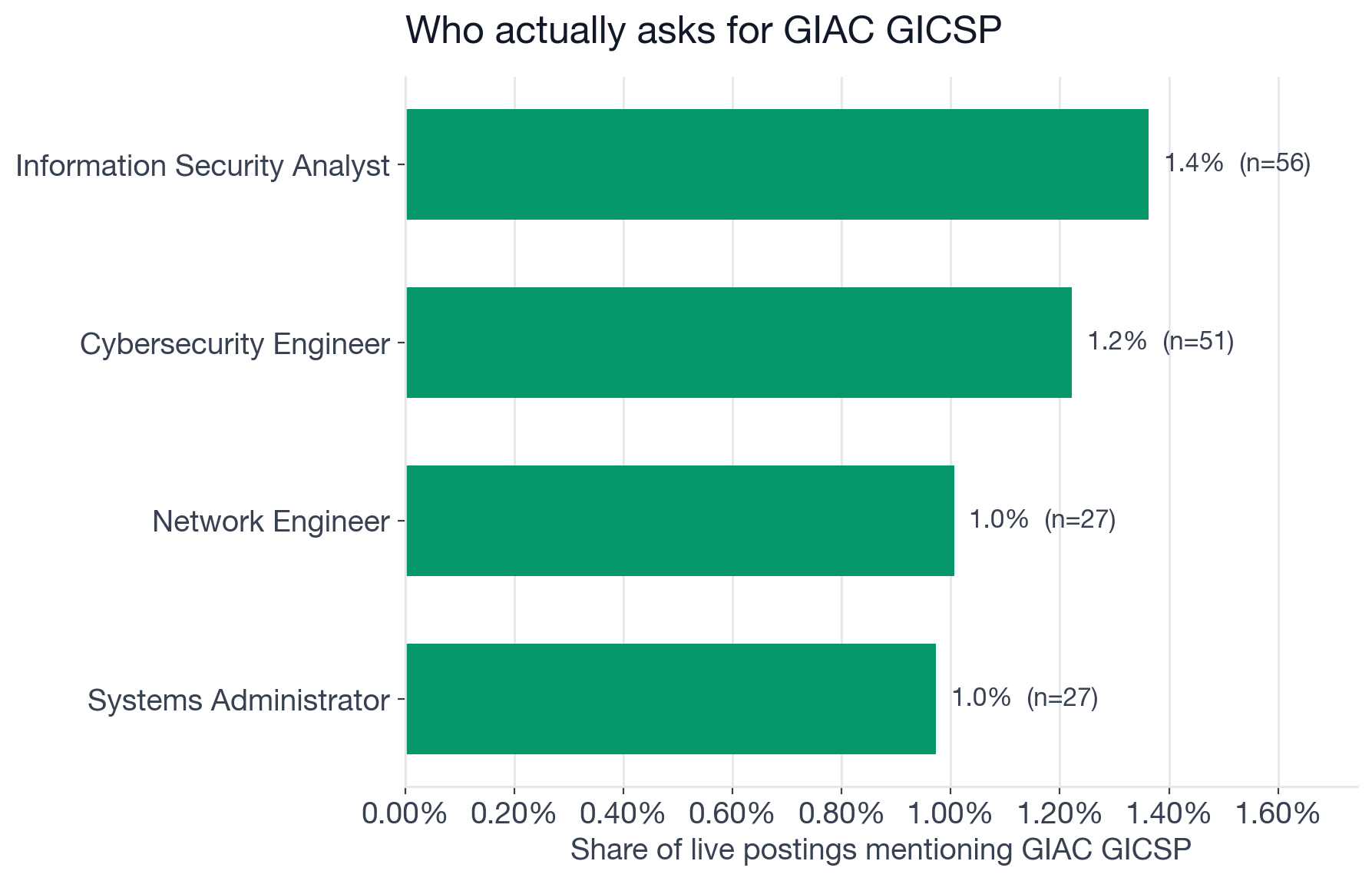 Information Security Analyst and Cybersecurity Engineer combine for two-thirds of all GICSP mentions; Network Engineer and Systems Administrator are tied at 27 mentions each.
| Role | Postings Scanned | GICSP Mentions | Mention Rate | Share of All GICSP Mentions |
|---|---|---|---|---|
| Information Security Analyst | 4,108 | 56 | 1.36% | 34.8% |
| Cybersecurity Engineer | 4,172 | 51 | 1.22% | 31.7% |
| Network Engineer | 2,682 | 27 | 1.01% | 16.8% |
| Systems Administrator | 2,775 | 27 | 0.97% | 16.8% |
It's worth checking whether this tracks pay tier before accepting a simpler explanation, and it doesn't cleanly. Information Security Analyst is also the lowest-paying of the four roles in this scope ($100,475 median base without the certification) and over-indexes the most (1.16x its posting share), which could support a "cheap role over-mentions" story on its own. But Cybersecurity Engineer, the highest-paying role in scope ($162,325), also over-indexes, just less dramatically (1.04x), while Network Engineer and Systems Administrator, the two roles priced in between, both under-index (0.86x and 0.83x). The split tracks each role's exposure to threat-facing security work more plausibly than it tracks the paycheck: Information Security Analyst and Cybersecurity Engineer's day-to-day centers on identifying and responding to security issues, the same territory GICSP's industrial-control-systems focus extends into, while Network Engineer and Systems Administrator's day-to-day centers more on keeping infrastructure running. That's a plausible fit, not something this dataset can prove directly.
Information Security Analyst openings and Cybersecurity Engineer openings are both browsable directly if GICSP is already on your resume and you're checking where it actually registers.
How Close Is GICSP's Required-vs-Preferred Split to a Coin Flip?
Slightly more than half of GICSP mentions in this dataset don't specify required or preferred wording at all, so any required-versus-preferred read here is a floor, not the full picture: 86 of 161 mentions (53.4%) carry no classifiable wording nearby. Among the 75 mentions that are classifiable, the split is about as close to even as it gets: 37 call GICSP required (49.3%) and 38 call it preferred (50.7%), a gap of just 1.3 percentage points on a base small enough that a handful of postings either way could shift it.
| Classification | Count | Share of Classified Mentions | Share of All Mentions |
|---|---|---|---|
| Required | 37 | 49.3% | 23.0% |
| Preferred | 38 | 50.7% | 23.6% |
| Unspecified | 86 | N/A | 53.4% |
For a candidate deciding whether to sit the exam, that near-even split means GICSP doesn't function as a gate the way some baseline certifications do. It's about as likely to be the deciding factor on an application as it is to be a nice-to-have line that doesn't move the outcome either way.
The GICSP Pay Gap Nearly Vanishes at the One Level We Can Actually Measure
Postings that mention GICSP advertise a median US base salary of $116,650, compared with $129,575 for postings in the same four-role scope that don't mention it, a 10.0% gap. This is base salary only, on the subset of postings that disclose it; equity, bonus, and other compensation aren't captured, and the comparison is against other postings in this same role scope, not the broader job market.
That aggregate gap looks meaningful until it's checked level by level. Entry, senior, and staff levels don't have enough GICSP-mentioning postings with disclosed salary to report reliably (2, 23, and 6, respectively, all below the 25-posting floor this analysis requires; senior comes within two postings of clearing it). Mid-level is the only band with enough data on both sides, 75 GICSP-mentioning postings against 3,405 that don't, and there the gap all but disappears: -0.8% ($113,610 vs $114,534).
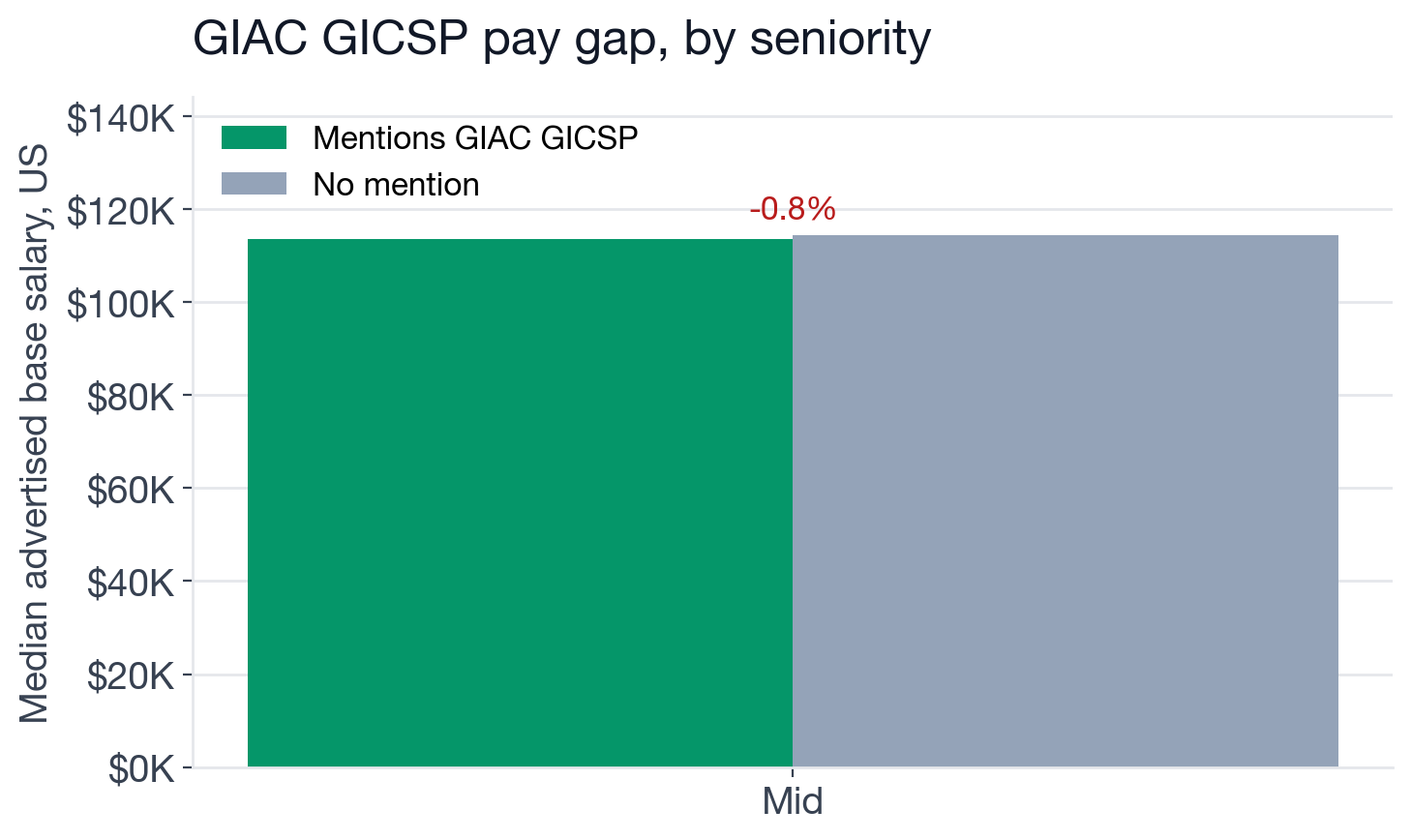 Mid-level is the only band with enough GICSP-mentioning postings to compare directly; the gap there is close to flat even though the aggregate gap looks much larger.
| Seniority Level | Median US Base, With GICSP | Median US Base, Without GICSP | Gap | Sample (With / Without) |
|---|---|---|---|---|
| Entry | Not reportable (n=2) | $80,450 | N/A | 2 / 108 |
| Mid-level | $113,610 | $114,534 | -0.8% | 75 / 3,405 |
| Senior | Not reportable (n=23) | $152,000 | N/A | 23 / 1,002 |
| Staff | Not reportable (n=6) | $172,500 | N/A | 6 / 547 |
| All levels (aggregate) | $116,650 | $129,575 | -10.0% | 106 / 5,062 |
The gap between -0.8% and -10.0% traces to composition, not a bigger real difference at any level. GICSP-mentioning postings are staff-level only 5.0% of the time, versus 9.1% for postings that don't mention it, roughly half the representation in the highest-paying tier ($172,500 baseline, more than any other level). GICSP-mentioning postings actually skew slightly more senior in one respect, 23.6% are senior-level versus 20.2% for the baseline, but that gain is outweighed by the steeper staff shortfall, so the average GICSP-mentioning posting ends up marginally less senior overall (mean level 1.32 vs 1.35). A pool that's missing representation in the single most expensive band will look worse in aggregate than a level-matched comparison shows, simply because it's short on the band that would have pulled the median up. The honest number is the mid-level one, essentially flat, not the aggregate 10.0%. One methodology note on that composition read: seniority here is inferred from title keywords, and a posting with no explicit level word defaults to mid-level, which can understate the true entry and senior/staff share on both sides of the comparison. Roughly half of this dataset's sampled GICSP-mentioning titles carry no explicit level marker, so the staff-shortfall explanation above is directionally useful, not exact.
That composition read is about seniority. Checking the same with/without comparison broken out by role instead tells a more complicated story. Of the four roles in scope, only Information Security Analyst (38 GICSP-mentioning postings with disclosed salary, versus 1,448 that don't mention it) and Cybersecurity Engineer (29 versus 1,453) clear this analysis's 25-posting reporting floor; Network Engineer (23) and Systems Administrator (16) both fall just short. Both of the reportable roles run positive, not negative: Information Security Analyst shows GICSP-mentioning postings at $116,650 versus $100,475 without, a +16.1% gap, and Cybersecurity Engineer shows $175,500 versus $162,325, a +8.1% gap, the opposite direction from both the pooled aggregate (-10.0%) and the mid-level comparison (-0.8%) above. (Information Security Analyst's own with-cert median, $116,650, is identical to the pooled aggregate with-cert median, which makes sense given it supplies 38 of the 106 total US salary observations behind that pooled figure, the single largest contributor.) The pooled and mid-level numbers remain the more defensible read of the overall picture, since medians don't average linearly across groups and Network Engineer's and Systems Administrator's unreported with-cert salaries could plausibly be pulling the blended figure down. But anyone reading this specifically for Information Security Analyst or Cybersecurity Engineer should know the role-level picture, where it's measurable at all, points the other way.
GICSP's Top 11 Employers Include Just One Non-Defense Name
Peraton (22 mentions) is the single most frequently cited employer in this dataset, followed by General Dynamics Information Technology (19, combining a raw ATS-token listing with its named entry), CACI International (15), and Leidos (14). Of the 11 employers kept in the table below, 10 are defense or government-IT-services contractors, together accounting for 61.5% of every GICSP mention in this dataset.
| Employer | GICSP Mentions |
|---|---|
| Peraton | 22 |
| General Dynamics Information Technology | 19 |
| CACI International | 15 |
| Leidos | 14 |
| Booz Allen Hamilton | 9 |
| SOSi | 6 |
| Northrop Grumman Corporation | 4 |
| Avalore, LLC | 4 |
| AtkinsRéalis | 3 |
| AnaVation | 3 |
| Dark Wolf Solutions | 3 |
AtkinsRéalis, a global engineering and infrastructure firm, is the one name on this list that isn't a defense-services contractor in the strict sense, though it does substantial critical-infrastructure and government work of its own. That roster shape lines up with what GICSP actually certifies: protecting industrial control systems and OT environments is disproportionately work done inside government, defense, and large-scale critical-infrastructure contracts, not the general commercial IT market most other certifications in this series draw from. The postings themselves back this up: titles in this dataset lean heavily on "Information Systems Security Officer (ISSO)," "Information Systems Security Engineer (ISSE)," and clearance language like "TS/SCI," all markers of cleared, contract-driven government security work.
Using This Data in Your GICSP Study and Search Plan
If GICSP is already on your resume, the fastest way to see where it actually registers is filtering by role: Information Security Analyst openings and Cybersecurity Engineer openings both show where the demand concentrates, while the full four-role scope is browsable from the link in the first section above.
Given how often GICSP pairs with CompTIA Security+ and GIAC GSEC in this dataset, sequencing matters more than which credential to chase first: CompTIA Security+'s own demand and pay pattern, GIAC GSEC's, and SSCP's are each covered in their own posts in this series and are worth reading before deciding where GICSP fits in a study plan.
GICSP interviews tend to lean on scenario questions about OT and ICS environments specifically: how you'd segment a SCADA network from the corporate IT network, or respond to an incident on equipment that can't simply be patched or rebooted on a normal IT schedule. Practicing with AI mock interviews is a reasonable way to rehearse walking through that kind of scenario out loud before a real interview, and the question bank covers incident response and risk management topics individually if the goal is drilling a specific weak spot.
If the underlying security foundation still needs work before GICSP makes sense as a next step, interactive courses covering networking, security fundamentals, and systems administration are a lower-stakes way to close gaps before committing exam-fee money to a specialization.
FAQ
Q. What percentage of postings ask for the GICSP certification?
GICSP appears in about 1.17% of active postings (161 of 13,737) across four roles, Information Security Analyst, Cybersecurity Engineer, Network Engineer, and Systems Administrator, analyzed over a 90-day window on the InterviewStack.io job board. That is a thin demand rate, consistent with GICSP's role as a specialist industrial-control-systems credential rather than a general security requirement.
Q. Is GICSP usually required, or just preferred?
Among the mentions with clear wording (75 of 161, since 53.4% don't specify either way), it is close to a coin flip: 49.3% required versus 50.7% preferred. A GICSP line in a posting is about as likely to be a hard requirement as a nice-to-have.
Q. Does GICSP correlate with higher pay?
Not in a way that holds up once seniority is controlled for. The aggregate comparison shows postings mentioning GICSP at a median $116,650 versus $129,575 for postings in the same roles that don't, a 10.0% gap. But the only seniority band with enough data to compare, mid-level, where 69.6% of GICSP mentions sit, shows almost no gap at all: $113,610 versus $114,534, just 0.8% apart. Most of the aggregate gap traces to composition, not a real premium loss. Checked by role instead of by level, the picture is more mixed: the two roles with enough data to compare individually, Information Security Analyst and Cybersecurity Engineer, both show GICSP-mentioning postings paying more, not less (+16.1% and +8.1% respectively), the opposite direction from the pooled and mid-level numbers above.
Q. What other certifications typically appear alongside GICSP?
GICSP mentions are rarely standalone. 66.5% of postings that ask for GICSP also ask for CompTIA Security+, 58.4% also ask for GIAC GSEC, and roughly half also ask for SSCP (49.7%) or CompTIA CySA+ (44.1%). It reads as a specialization layered on top of a foundational security credential, not a first certification.
Q. Which roles ask for GICSP most often?
Information Security Analyst and Cybersecurity Engineer together account for 66.5% of every GICSP mention, despite being only 60.3% of the four-role posting pool. Network Engineer and Systems Administrator postings mention it noticeably less often relative to their size.
Q. Who is hiring for GICSP?
Demand concentrates hard among defense and government-IT-services contractors. Peraton (22 mentions), General Dynamics Information Technology (19, combining a raw ATS-token listing with its named entry), CACI International (15), and Leidos (14) lead the roster, and 10 of the top 11 employers by mention count are contractors of this type, together covering 61.5% of all GICSP mentions.
Q. Should GICSP be someone's first security certification?
The data says no. It shows up almost exclusively alongside a base credential like Security+ or GSEC, concentrates in two of the four scoped roles, and its salary signal disappears once seniority is controlled for. It reads as a specialization for people who already hold a general security certification and want to move into industrial or critical-infrastructure security work, not an entry point.
GICSP Works Best as a Second Certification, Not a First
Every angle in this dataset points the same direction: GICSP is a specialization, not a foundation. It rarely appears without CompTIA Security+ or GIAC GSEC already in the same posting, it concentrates in the two roles most focused on identifying and responding to security issues, and whatever salary difference shows up in aggregate mostly evaporates once seniority is held constant. For someone who already holds a general security certification and wants to move toward industrial or critical-infrastructure work, that's a reasonable next credential to study for. For someone still building a first certification, the data says start elsewhere.
Topics
Ready to practice?
Put what you've learned into practice with AI mock interviews and structured preparation guides.