
SSCP Hiring Runs Almost Entirely Through Defense Contractors
Eleven of the twelve companies that most often name SSCP in active job postings are defense or government-services contractors, not general commercial employers. That comes from 17,466 active postings across five infrastructure and security roles over a 90-day window on the InterviewStack.io job board, of which 205 (1.2%) mention SSCP (Systems Security Certified Practitioner, an ISC2 credential) at all.
The concentration explains most of what follows in this data. SSCP sits on the Department of Defense's 8570/8140 directives as one of several baseline certifications accepted for certain IT and cybersecurity contractor roles, alongside CompTIA Security+ and CCNA-Security. Contractors staffing those seats mostly don't ask for SSCP because it signals a scarce skill the broader market is bidding for. They ask for it because the contract requires someone in that seat to hold a directive-approved credential, and SSCP is one of the cheaper, faster ones to earn. That single fact explains why the certificate is a hard requirement almost as often as it's a soft preference, why it barely reaches senior-level postings, and why the raw salary comparison for SSCP-mentioning postings looks worse than it actually is.
Key Findings
- SSCP appears in 1.2% of postings across five security and infrastructure roles (205 of 17,466 active postings analyzed over 90 days).
- Eleven of the twelve employers most often naming SSCP are defense or government-services contractors; only one is a commercial software vendor.
- Among the 116 SSCP mentions specific enough to classify, 46.6% (54) state it as a required qualification and 53.4% (62) call it preferred; a further 89 mentions don't specify either way.
- The pooled salary comparison looks negative overall (-6.5%, $122,275 vs $130,770), but reverses to +2.1% at mid-level ($120,000 vs $117,500), the only seniority band with enough SSCP data to report.
- The by-role picture is more mixed than the mid-level premium suggests: Information Security Analyst postings mentioning SSCP show a 22.3% pay premium and Systems Administrator a 4.9% premium, while Network Engineer postings show a 23.0% pay cut, each at sample sizes too small individually to explain why.
- SSCP-mentioning postings almost never reach staff level: 2.9%, versus 9.7% for postings in the same roles that don't mention it.
- Systems Administrator postings mention SSCP at 1.9%, roughly 3.6 times Systems Engineer's 0.5% rate, the widest spread among the five scoped roles.
- 86.8% of SSCP-mentioning postings also mention CompTIA Security+, the highest single co-occurring-certification rate in this dataset.
| Employer | SSCP-Mentioning Postings |
|---|---|
| Leidos | 30 |
| General Dynamics Information Technology | 23 |
| CACI International | 15 |
| Peraton | 9 |
| Booz Allen Hamilton | 8 |
| Northrop Grumman | 7 |
| SOSi | 6 |
| AnaVation | 4 |
| Avalore | 3 |
| Virtuozzo | 3 |
| Steampunk | 3 |
| KBR | 3 |
Leidos alone accounts for twice as many mentions as CACI International, the third-ranked employer on this list (30 vs. 15). General Dynamics Information Technology (combining postings filed under its corporate name and under its careers-site listing) and CACI International round out a top three that, together with Peraton, Booz Allen Hamilton, and Northrop Grumman, are all large federal systems integrators. SOSi, a defense and intelligence contractor, AnaVation and Avalore, both smaller firms built around cleared IT and cybersecurity staffing for the intelligence community, Steampunk, a federal digital-transformation contractor, and KBR add five more government-services names to the list. Virtuozzo, a commercial virtualization-software vendor, is the only entry that doesn't fit the pattern.
That's about as concentrated as an employer roster gets in this dataset: 97.4% of the mentions across these twelve companies come from defense or government-services contractors. It's worth reading every section below with that in mind. The demand SSCP shows up in is largely compliance demand, staffing a specific certified seat on a specific contract, not open-market demand for a scarce skill.
Is an SSCP Mention Usually a Real Requirement?
Close to a coin flip, which is unusual for a single certification mention. Of the 205 SSCP mentions, 116 use wording specific enough within 160 characters of the mention to classify as required or preferred; the other 89 don't specify either way. Within that classified group, 54 (46.6%) state SSCP as a required qualification, and 62 (53.4%) call it preferred.
That's a far more even split than a nice-to-have skill mention usually produces, and it fits the compliance read from the section above. When a posting exists to staff a specific contract seat that a directive requires be filled by someone holding an approved baseline certification, SSCP often isn't one line in a long wish list. It's the actual gate for that seat, which is a plausible reason it shows up as "required" so much more often here than the softer language most certifications in this dataset get.
The SSCP Salary Comparison Flips Once You Isolate Mid-Level
Read as a single number, SSCP looks like a small pay cut. SSCP-mentioning postings in these five roles advertise a median US base salary of $122,275, about 6.5% below the $130,770 median for postings in the same roles that don't mention it (equity, bonus, and other compensation aren't disclosed in postings and aren't part of this comparison). That comparison doesn't hold up once you split by seniority level, and treating it as the finding would be misleading.
| Seniority Level | Without SSCP (Median US Base) | With SSCP (Median US Base) | Difference |
|---|---|---|---|
| Entry | $80,475 (n=148) | Not reportable (n=2) | N/A |
| Mid-level | $117,500 (n=4,276) | $120,000 (n=101) | +2.1% |
| Senior | $151,475 (n=1,368) | Not reportable (n=16) | N/A |
| Staff | $171,000 (n=777) | Not reportable (n=5) | N/A |
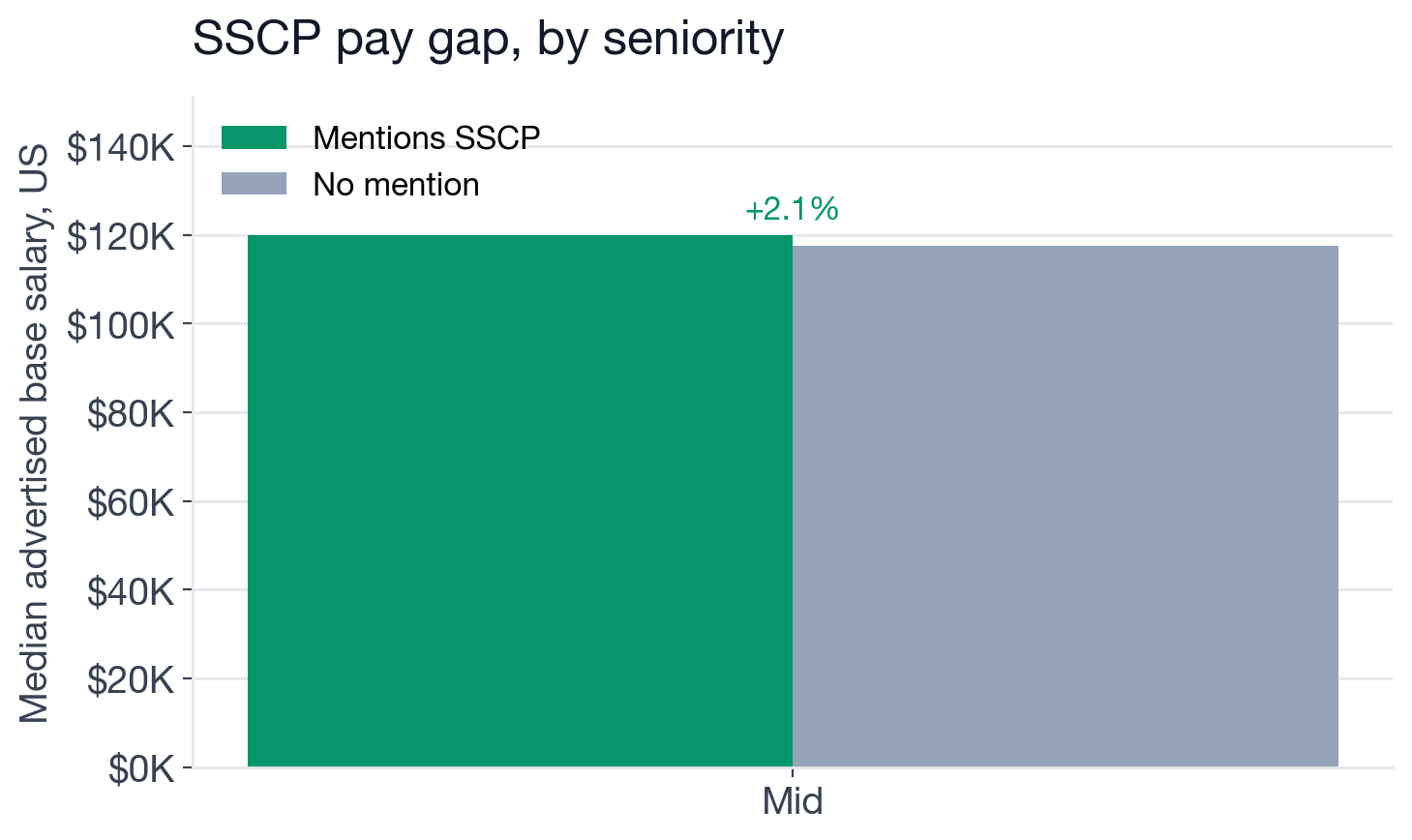
Mid-level is the only band where the SSCP-mentioning sample clears the 25-posting reporting floor (n=101). Entry (n=2), senior (n=16), and staff (n=5) are all too thin to report a median. At the one level we can actually check, the comparison reverses: SSCP-mentioning postings pay 2.1% more, not less.
So why does the pooled number go negative if the only band we can measure is positive? Composition. SSCP mentions concentrate hard at mid-level, 78.5% of them, against 66.0% for non-mentioning postings in the same scope, and thin out fast above it: only 2.9% of SSCP mentions are staff-level, compared with 9.7% of non-mentioning postings, where the non-cert median reaches $171,000. Pool a group that's almost entirely mid-level with a comparison group that includes a real staff-level tail, and the pooled median for the SSCP group gets dragged toward the mid-level number even though mid-level itself pays more with the certificate than without. The honest read: SSCP correlates with a modest premium where it actually shows up, and it essentially doesn't show up at the senior levels where the biggest paychecks are. (Seniority here is inferred from title keywords, and a posting with no explicit level word defaults to mid-level; roughly half the titles in this dataset's SSCP-mentioning sample carry no such word, so the true mid-level concentration could differ somewhat from the measured 78.5%, though it's not clear in which direction.)
Splitting by role instead of by level complicates the story further, in a way the numbers above don't capture. Three of the five scoped roles have enough of their own SSCP-mentioning salary data to compare against the 25-posting reporting floor: Systems Administrator ($117,500 vs. $112,000 without SSCP, n=37, a 4.9% premium), Information Security Analyst ($122,275 vs. $100,000, n=31, a 22.3% premium), and Network Engineer ($102,420 vs. $132,998, n=25, a 23.0% pay cut). Cybersecurity Engineer and Systems Engineer don't clear that floor for their own SSCP-mentioning sample (n=18 and n=13) and aren't comparable. So the picture beneath the mid-level premium is genuinely mixed, not uniform: a large premium in Information Security Analyst postings, a smaller one in Systems Administrator postings, and a sizable pay cut in Network Engineer postings, each on a sample too thin on its own to fully explain why. Read the mid-level premium above as an average of a more complicated underlying pattern, not as something that holds evenly across every role SSCP touches.
Why Does SSCP Demand Concentrate in Systems Administrator Postings?
Systems Administrator postings mention SSCP more than any other scoped role, and by a wide margin over the least likely one. The rate is 1.9% (52 of 2,795 postings), compared with 1.3% for Information Security Analyst, 1.2% for Network Engineer, 1.1% for Cybersecurity Engineer, and just 0.5% for Systems Engineer (19 of 3,672), a gap of roughly 3.6 times between the highest and lowest role.
| Role | Postings Scanned | SSCP Mentions | Mention Rate | Share of All SSCP Mentions |
|---|---|---|---|---|
| Systems Administrator | 2,795 | 52 | 1.9% | 25.4% |
| Information Security Analyst | 4,158 | 55 | 1.3% | 26.8% |
| Network Engineer | 2,672 | 33 | 1.2% | 16.1% |
| Cybersecurity Engineer | 4,169 | 46 | 1.1% | 22.4% |
| Systems Engineer | 3,672 | 19 | 0.5% | 9.3% |
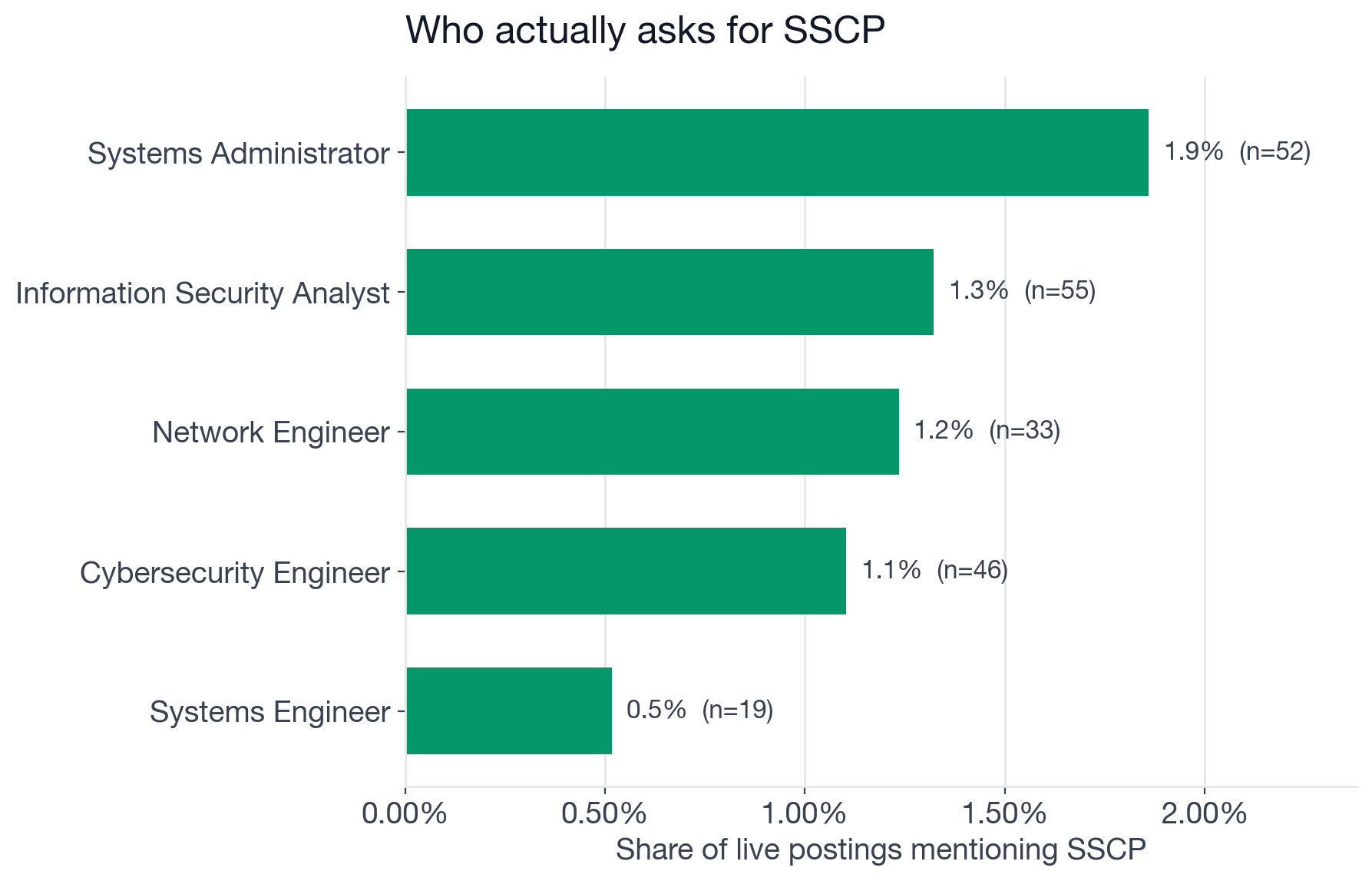
That ordering tracks what SSCP actually certifies: hands-on operational security work, hardening systems, managing access, and monitoring for incidents, rather than architecture, engineering design, or offensive security. It maps closest to day-to-day Systems Administrator work and least closely to Systems Engineer work, where responsibilities skew toward broader infrastructure design. Information Security Analyst supplies the largest raw share of mentions (26.8%) simply because it's a large role in this scope, but its own mention rate (1.3%) sits below Systems Administrator's.
Which Certifications Travel With an SSCP Mention?
CompTIA Security+, overwhelmingly. 86.8% of SSCP-mentioning postings also name Security+ (178 of 205), by far the largest pairing in this dataset. GIAC GSEC (60.5%), CompTIA CySA+ (47.8%), CCNA (46.3%), and GIAC GICSP (45.4%) round out the top five, with CISSP further back at 35.6%.
| Certification | Share of SSCP-Mentioning Postings |
|---|---|
| CompTIA Security+ | 86.8% |
| GIAC GSEC | 60.5% |
| CompTIA CySA+ | 47.8% |
| CCNA | 46.3% |
| GIAC GICSP | 45.4% |
| CISSP | 35.6% |
A single posting naming five different certifications isn't asking a candidate to hold all of them. It's more likely a posting listing several DoD-approved baseline certifications as interchangeable options for the same seat, something like "SSCP, Security+, or CCNA-Security accepted." That's a plausible read consistent with the employer pattern and the required-rate finding above, not something the co-occurrence data can confirm directly on its own.
On the skills side, the most common technical asks alongside SSCP are operational and hands-on: Monitoring (47.8%), Linux (32.7%), Incident Response (29.3%), Windows (26.3%), and Risk Management and Automation (25.9% each), a mix that matches infrastructure-security operations rather than a specialist offensive or architecture track.
Putting the SSCP Numbers to Work in Your Search
If you're weighing SSCP against your target role, the data points toward context over hype. It's a real, common credential in Systems Administrator and Information Security Analyst postings, but its demand concentrates in defense and government-services contracting rather than the broader commercial market, and it's asked for as a hard requirement almost exactly as often as it's asked for as a nice-to-have. If your target employers are federal contractors, treat "required" language literally. If they're commercial employers outside that world, SSCP is more likely to read as one acceptable option among several.
To prepare for interviews at the kind of operational security and systems-administration roles SSCP maps to, practice with AI mock interviews that simulate incident-response and access-management scenarios rather than certification trivia. The Question Bank is a faster way to drill topics like monitoring, incident response, and risk management that show up repeatedly in SSCP-adjacent postings. If your fundamentals in Linux administration or network security need work before the interview, InterviewStack's interactive courses cover the underlying concepts these postings actually test for. When you're ready to apply, browse current openings across all five scoped roles, or filter directly to Systems Administrator postings that ask for Monitoring.
FAQ
Q. What percentage of postings ask for SSCP?
SSCP appears in 1.2% of postings across five roles, Information Security Analyst, Cybersecurity Engineer, Systems Administrator, Network Engineer, and Systems Engineer (205 of 17,466 active postings analyzed over a 90-day window on the InterviewStack.io job board).
Q. Is SSCP usually required or just preferred?
Close to a coin flip. Of the 205 SSCP mentions, 116 use wording specific enough to classify: 54 (46.6%) state it as a required qualification and 62 (53.4%) call it preferred. The remaining 89 mentions don't specify either way.
Q. Who is hiring for SSCP?
Almost entirely defense and government-services contractors. Eleven of the top twelve employers naming SSCP, led by Leidos (30 mentions), General Dynamics Information Technology (23), and CACI International (15), are federal contractors; only one, a commercial virtualization vendor, is not.
Q. Do SSCP-mentioning postings pay more than similar postings that don't mention it?
It depends entirely on which seniority level, and which role, you look at. Overall, SSCP-mentioning postings advertise a median US base salary of $122,275, about 6.5% below the $130,770 median for postings in the same five roles that don't mention it. But at mid-level, the only band with enough SSCP-mentioning salary data to report, the comparison reverses to a 2.1% premium ($120,000 vs $117,500). SSCP mentions concentrate heavily at mid-level (78.5% of them) and almost never reach staff level (2.9%, versus 9.7% for non-mentioning postings), which pulls the pooled median down even though the certification correlates with higher pay at the level where it actually shows up. It's also uneven by role: Information Security Analyst postings mentioning SSCP show a 22.3% premium and Systems Administrator a 4.9% premium, while Network Engineer postings show a 23.0% pay cut, at sample sizes too small individually to explain why.
Q. Which role is most likely to ask for SSCP?
Systems Administrator, by a wide margin. SSCP appears in 1.9% of Systems Administrator postings, compared with 0.5% of Systems Engineer postings, roughly 3.6 times higher. Information Security Analyst (1.3%), Network Engineer (1.2%), and Cybersecurity Engineer (1.1%) fall in between.
Q. What certification most often appears alongside SSCP?
CompTIA Security+, overwhelmingly. 86.8% of postings that mention SSCP also mention Security+, most likely because both satisfy the same category of baseline security-certification requirement rather than because employers expect candidates to hold both.
Q. Does SSCP show up at senior levels?
Rarely. Only 15.1% of SSCP-mentioning postings are senior-level and 2.9% are staff-level, compared with 21.1% and 9.7% for postings in the same roles that don't mention it. SSCP-mentioning postings skew heavily toward mid-level (78.5% of them).
An SSCP Ask Usually Means a Government Contract
SSCP's employer roster, its near-even required-versus-preferred split, and its near-total absence above mid-level all point at the same explanation: it's a compliance credential, one of several the Department of Defense accepts to fill a specific staffing requirement, not a scarce open-market skill commanding a premium on its own. The salary data backs that up rather than complicating it. Where SSCP-mentioning postings can actually be compared apples to apples, at mid-level, they pay slightly more, not less; the pooled number only looks negative because SSCP essentially doesn't reach the senior and staff roles where pay is highest. That premium isn't even across roles, though: it runs much larger in Information Security Analyst postings and reverses into a pay cut in Network Engineer postings, on samples too thin individually to say why. Worth holding if government IT or defense contracting is the actual target; read the "required" label literally when it shows up, because for this certificate, it usually means exactly that.
Topics
Ready to practice?
Put what you've learned into practice with AI mock interviews and structured preparation guides.