
When Employers Name GSEC, They're More Likely to Mean It
Most security certifications that turn up in job postings follow a predictable pattern: mentioned often, required rarely. GIAC GSEC (Security Essentials) runs the second half of that pattern backward. It rarely shows up at all, in just 1.9% of active postings across five security roles, but when a posting does name it, 29.2% of the time that mention is a hard requirement rather than a nice-to-have. That is a notably higher required rate than the vague, wish-list language most security certifications get, and it changes what a single GSEC mention in a listing is worth paying attention to.
We looked at 9,877 active postings across Information Security Analyst, Cybersecurity Engineer, Penetration Tester, Security Architect, and Digital Forensic Examiner roles on the InterviewStack.io job board over a 90-day window, screening each description for a GSEC mention and for the language immediately around it. GSEC turned up in 184 of those postings, about 1 in every 54 listings in scope.
The rest of this breakdown covers where those 184 mentions concentrate by role, what they do to pay once seniority is accounted for, and who is actually hiring for the credential.
Key Findings
- GSEC appears in just 1.9% of active postings across five security roles (184 of 9,877 analyzed), about 1 in every 54 listings.
- Among mentions specific enough to classify, 29.2% call GSEC a required qualification, notably higher than the "usually just preferred" pattern most security certifications show.
- Digital Forensic Examiner postings mention GSEC at 3.09%, more than 5 times Penetration Tester's 0.58%, the widest gap among the five roles (this dataset's DFE bucket can include broader incident-response-adjacent titles, not just narrow forensic-examiner roles).
- The only reliably comparable salary band (mid-level, n=68) shows GSEC-mentioning postings at a median $120,000, about 2.9% above the $116,650 non-GSEC median.
- The overall aggregate salary comparison, $129,500 versus $138,450, understates the real picture: GSEC-mentioning postings are 8.7 percentage points less likely to be senior or staff level.
- Defense and intelligence contractors, Booz Allen Hamilton, CACI International, Leidos, Peraton, Northrop Grumman, and General Dynamics IT, account for about 69% of the mentions in this table.
- CompTIA Security+ (72.8%) and CISSP (50%) are the two certifications most likely to appear alongside a GSEC mention.
How Often Does a GSEC Mention Actually Mean "Required"?
Not every mention of a certification tells you the same thing. Some postings say a credential is mandatory, some say it is a plus, and plenty just list it without saying which. Of the 184 GSEC mentions in this scope, 106 were specific enough to classify one way or the other:
| Framing | Mentions | Share of classified |
|---|---|---|
| Required | 31 | 29.2% |
| Preferred | 75 | 70.8% |
| Unspecified | 78 | not classified (42.4% of all 184 mentions) |
Nearly 3 in 10 classified mentions treat GSEC as a genuine requirement, not a bonus line. That share is worth taking at face value only as a floor: the 78 unspecified mentions, 42.4% of every GSEC mention in this dataset, could tilt either direction, and the required/preferred split is inferred from nearby wording rather than a structured field. Still, a required rate this high for a certification that shows up this rarely is a signal that the postings naming GSEC tend to mean it literally, not decoratively.
The comparison baseline throughout this post is other postings within the same five-role scope that do not mention GSEC, not the broader job market. That distinction matters most in the sections on pay and seniority below.
Forensic Examiner Postings Lean on GSEC Far More Than Pentesting Ones
GSEC's 184 mentions are not spread evenly across the five roles in scope:
| Role | Postings | GSEC mentions | Mention rate |
|---|---|---|---|
| Digital Forensic Examiner | 583 | 18 | 3.09% |
| Information Security Analyst | 3,950 | 82 | 2.08% |
| Security Architect | 730 | 14 | 1.92% |
| Cybersecurity Engineer | 4,097 | 67 | 1.64% |
| Penetration Tester | 517 | 3 | 0.58% |
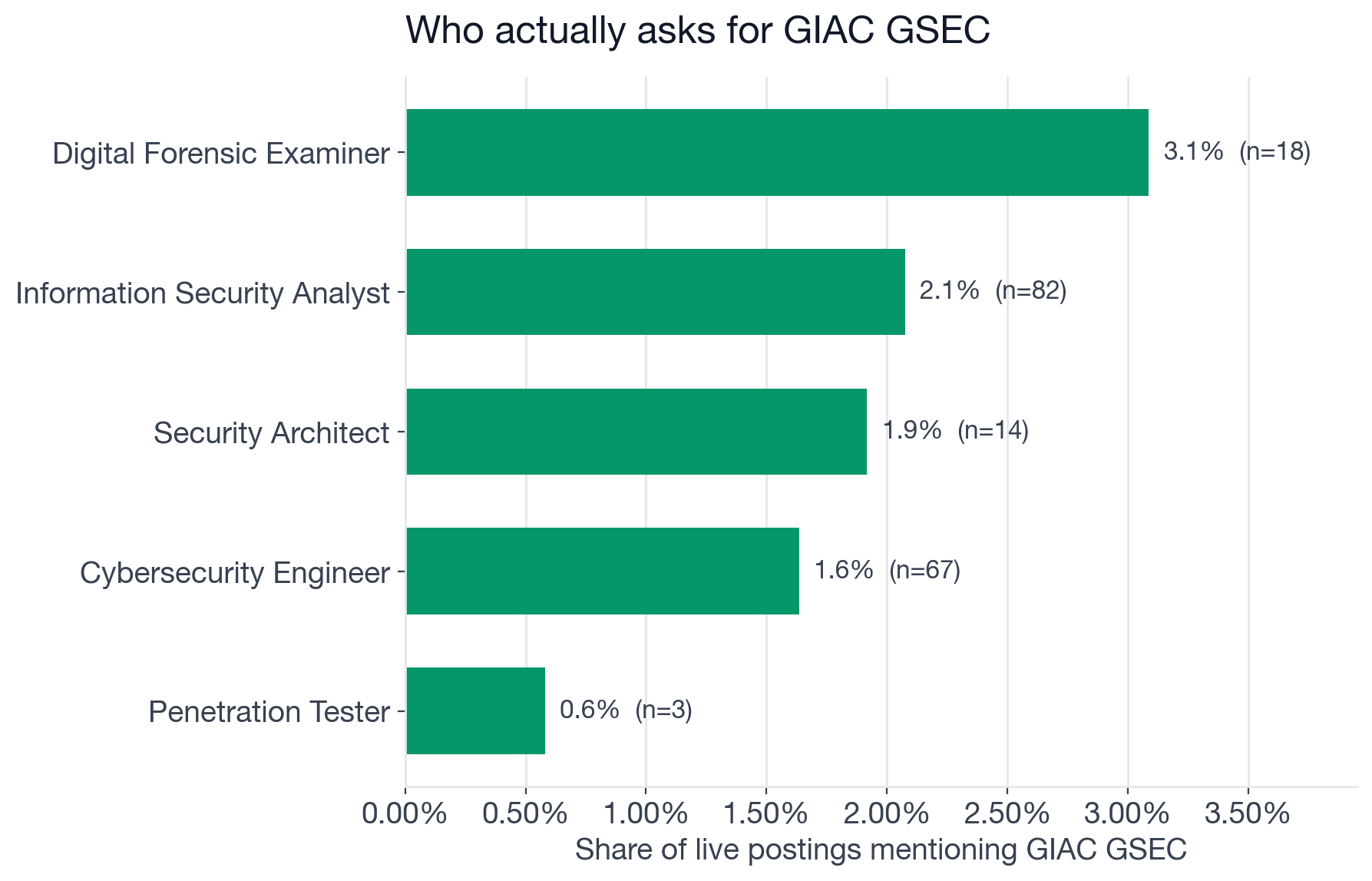 Digital Forensic Examiner postings mention GSEC more than 5 times as often as Penetration Tester postings, the widest gap of the five roles.
Digital Forensic Examiner leads at 3.09%, over-indexing at 1.66 times its share of postings in scope. Penetration Tester sits at the opposite end, 0.58%, under-indexing to just 0.31 times its expected share. Information Security Analyst supplies the largest raw count of mentions (82 of 184, 44.6% of every GSEC mention), but mostly because it is the largest role in the pool (40% of all postings scanned), not because it over-indexes sharply on its own.
One caveat on the Digital Forensic Examiner figure specifically: role classification on this board is title-based, and the Digital Forensic Examiner category can sweep in broader incident-response and DFIR-adjacent titles alongside narrowly defined forensic-examiner roles. That doesn't erase the pattern, monitoring and incident-response skills dominate the GSEC profile either way, but it means the 3.09% figure is better read as a DFIR-and-forensics-adjacent signal than a narrow claim about examiner-only roles.
The split does not track pay tier the way some certification concentration patterns do. GSEC is GIAC's broad "security essentials" exam, covering network fundamentals, defense-in-depth, cryptography basics, and incident-handling fundamentals rather than a specialized offensive or engineering skill set. That breadth reads as a plausible fit for forensic and analyst work, where a broad security foundation is table stakes before specializing, and a weaker fit for penetration testing, where the skills that actually define the role sit closer to offensive tooling and exploit development. This is a descriptive pattern in the data, not a mechanism the dataset can prove directly. Readers comparing the two roles side by side can see the fuller Digital Forensic Examiner vs. Penetration Tester breakdown, and the role-level view in Digital Forensic Examiner skills companies want.
GSEC's Overall Pay Gap Is Really a Seniority-Mix Story
All salary figures here are advertised US base pay only, drawn from postings that disclose a number; equity, bonus, and total compensation are not captured. The comparison group is other postings within the same five-role scope that do not mention GSEC, not the wider job market.
| Level | GSEC-mentioning median | Other postings median | Difference | Sample (with / without) |
|---|---|---|---|---|
| Entry | Not reportable (n=2) | $85,390 | n/a | 2 / 76 |
| Mid-level | $120,000 | $116,650 | +2.9% | 68 / 2,111 |
| Senior | Not reportable (n=14) | $165,700 | n/a | 14 / 638 |
| Staff | Not reportable (n=11) | $176,891 | n/a | 11 / 452 |
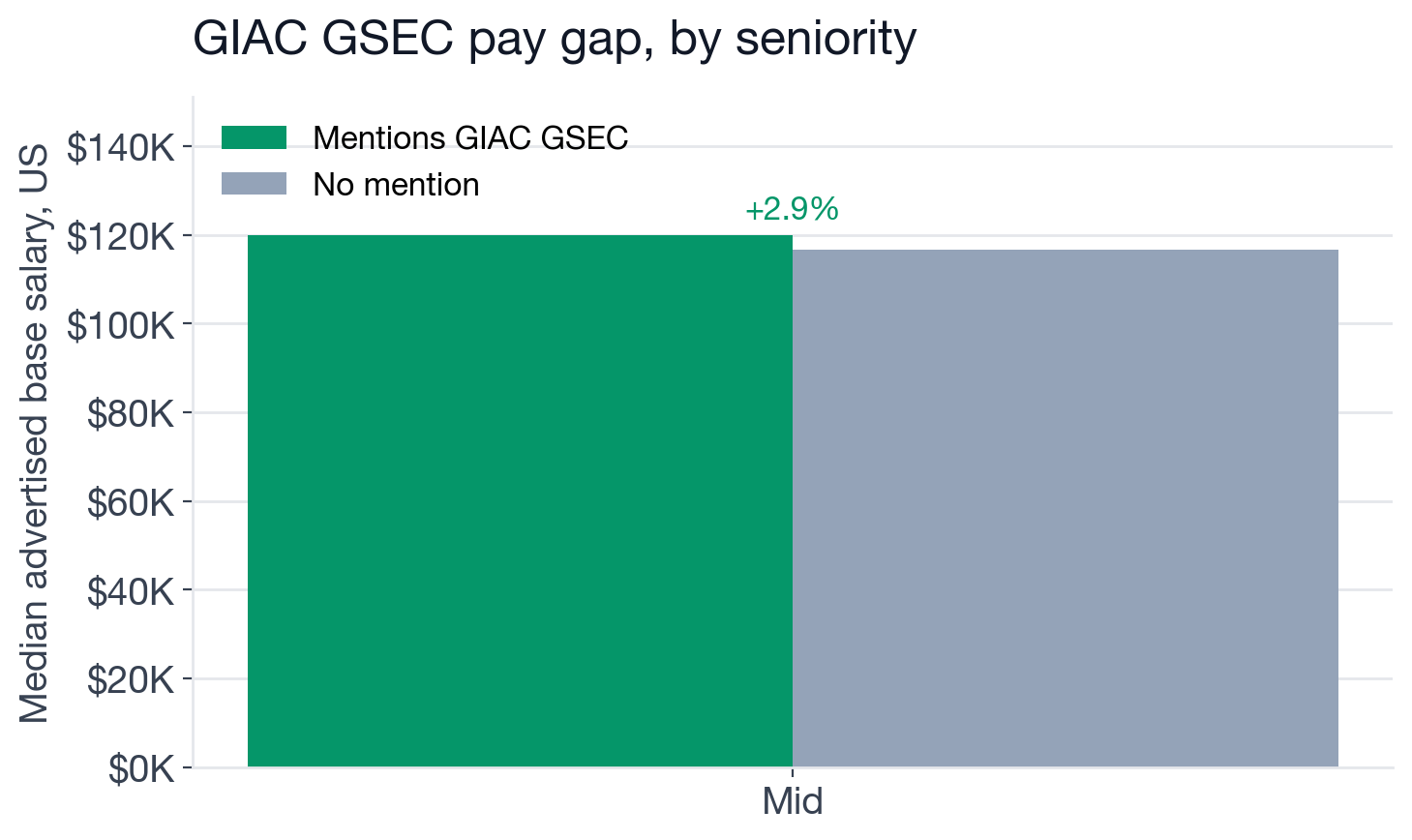 Mid-level is the only band with enough GSEC-tagged postings (n=68) to compare directly, and it is the one level where GSEC-mentioning postings out-earn the rest.
The aggregate comparison across all levels, $129,500 for GSEC-mentioning postings versus $138,450 for the rest, about 6.5% lower, is the number you would get if you did not control for seniority, and it is misleading on its own. Two things are happening underneath it. First, entry, senior, and staff levels all have too few GSEC-tagged postings (2, 14, and 11 respectively) to support a direct comparison, so the aggregate leans heavily on the one band that is measurable. Second, GSEC-mentioning postings in this scope skew away from the highest-paying levels: senior and staff together make up 23.4% of GSEC-mentioning postings versus 32.1% of postings that do not mention it, a gap of 8.7 percentage points. Since senior and staff pay well above mid-level, that mix shift alone pulls the aggregate down, independent of anything the certification itself is doing. The one level that is actually measurable, mid, shows GSEC-mentioning postings paying slightly more, not less.
One more limitation on that mid-level comparison: seniority in this dataset is inferred from title keywords, and postings without an explicit level signal default to mid-level, which compresses the measured spread at that band for both groups equally. The relative direction, GSEC-mentioning postings slightly ahead, still holds, but treat the size of that gap as directional rather than a precise dollar figure.
GSEC Hiring Still Runs Mostly Through Defense and Intelligence Contractors
| Company | GSEC-mentioning postings |
|---|---|
| Booz Allen Hamilton | 16 |
| CACI International | 12 |
| Leidos | 8 |
| Peraton | 7 |
| Northrop Grumman Corporation | 5 |
| Amazon | 5 |
| Dungarvin | 5 |
| Mitsubishi UFJ Financial Group | 4 |
| General Dynamics Information Technology | 4 |
| Ntt Limited | 3 |
| SOSi | 3 |
| Avalore, LLC | 3 |
Six of these twelve, Booz Allen Hamilton, CACI International, Leidos, Peraton, Northrop Grumman, and General Dynamics IT, are large, well-established federal contractors, and together they account for about 69% of the mentions in this table. That concentration lines up with GSEC's real-world status: it is one of the certifications the Department of Defense accepts as a baseline credential for certain cybersecurity job categories under its 8570/8140 workforce framework, the kind of compliance requirement that tends to get stated as mandatory rather than aspirational, consistent with the unusually high required rate covered above.
The rest of the roster is a reminder that the credential is not exclusively a government-contractor signal. Amazon and Mitsubishi UFJ Financial Group both appear, and Dungarvin, a Minnesota-based provider of home and community-based care services, is a genuinely unexpected entry: a reminder that any organization handling sensitive personal data, not just defense and intelligence contractors, can end up needing a security analyst with a broad, general-purpose credential like GSEC.
What Other Certifications and Skills Travel With a GSEC Requirement?
| Certification | Co-occurs with GSEC | Share of GSEC mentions |
|---|---|---|
| CompTIA Security+ | 134 | 72.8% |
| CISSP | 92 | 50.0% |
| CompTIA CySA+ | 64 | 34.8% |
| SSCP | 63 | 34.2% |
| CEH | 58 | 31.5% |
| GIAC GCIH | 47 | 25.5% |
CompTIA Security+ is the closest thing to a default pairing, showing up in nearly 3 out of every 4 GSEC mentions, which fits GSEC's role as another broad, foundational security credential rather than a specialist one. CISSP appears in half of GSEC mentions, typically the more senior, generalist counterpart. CompTIA CySA+ and SSCP each appear in roughly a third of mentions, and CEH, a broad ethical-hacking credential rather than a harder offensive-security exam, outranks every GIAC sibling cert on this list. That last point echoes the earlier role finding: postings that stack GSEC with an offense-adjacent credential reach for the generalist CEH, not a specialized penetration-testing exam, which lines up with Penetration Tester's low GSEC mention rate.
The skill profile behind these postings points the same direction, toward detection and response work rather than building or hardening infrastructure:
| Skill | Share of GSEC-mentioning postings |
|---|---|
| Monitoring | 48.9% |
| Incident Response | 46.7% |
| SIEM (security information and event management) | 37.5% |
| Risk Management | 29.3% |
| Cloud Security | 27.7% |
| Vulnerability Management | 27.2% |
| Network Security | 22.3% |
| Threat Intelligence | 16.8% |
Monitoring and Incident Response lead by a wide margin, both ahead of any single named cloud platform or tool. That fits a SOC-and-analyst orientation more than a hands-on engineering one, reinforcing why Information Security Analyst and Digital Forensic Examiner postings ask for GSEC more often than Cybersecurity Engineer or Penetration Tester ones do.
How to Use This in Your Job Search
If a posting names GSEC and calls it required, treat it as a real filter, not boilerplate; this dataset shows required language is used more deliberately here than it is for most security certifications. Before an interview at a defense contractor or a similarly compliance-driven employer, practice with AI mock interviews built around the incident-response and monitoring scenarios that dominate GSEC-adjacent postings. To shore up the specific technical areas GSEC covers, network fundamentals, defense-in-depth, cryptography basics, and incident handling, the question bank has focused drilling by topic, and the interactive courses catalog covers security fundamentals for readers building that foundation from scratch. From there, browse current Digital Forensic Examiner openings or the full five-role search to see where GSEC actually appears today.
FAQ
Q. How many active postings mention GSEC?
Across the five security roles tracked (Information Security Analyst, Cybersecurity Engineer, Penetration Tester, Security Architect, and Digital Forensic Examiner), GSEC appears in 184 of 9,877 active postings, about 1.9%, or roughly 1 in every 54 listings.
Q. Is GSEC usually required or just preferred?
Among the 106 mentions specific enough to classify, 29.2% state GSEC as required and 70.8% list it as preferred. Another 78 mentions, 42.4% of all 184, do not specify either way.
Q. Which security role is most likely to ask for GSEC?
Digital Forensic Examiner postings mention GSEC at 3.09%, the highest rate of the five roles and more than 5 times Penetration Tester's rate of 0.58%, the lowest. Information Security Analyst supplies the largest raw volume of mentions, 82 of 184, mostly because it is the largest role in the scope. Note that this dataset's Digital Forensic Examiner role bucket, like most title-based role classifications, can sweep in broader incident-response and DFIR-adjacent titles alongside narrowly defined forensic-examiner roles, so read the DFE figure as a DFIR-and-forensics-adjacent signal rather than a claim about examiner-only postings specifically.
Q. Do postings that mention GSEC pay more?
It depends entirely on seniority level. The only band with enough GSEC-tagged postings to compare reliably, mid-level (n=68), shows a median of $120,000 against $116,650 for mid-level postings that do not mention it, about 2.9% higher. The overall aggregate figure ($129,500 versus $138,450, about 6.5% lower) is misleading on its own: too few GSEC postings exist at senior and staff level to compare directly, and GSEC-mentioning postings in this scope skew toward mid-level roles rather than the higher-paying senior and staff bands.
Q. Who is actually hiring for GSEC?
Defense and intelligence contractors dominate the roster. Booz Allen Hamilton, CACI International, Leidos, Peraton, Northrop Grumman, and General Dynamics Information Technology together account for about 69% of the mentions in this table, consistent with GSEC's status as a Department of Defense-recognized baseline certification for certain cybersecurity roles.
Q. What other certifications commonly appear alongside GSEC?
CompTIA Security+ is by far the most common pairing, appearing alongside GSEC in 72.8% of mentions, followed by CISSP (50%), CompTIA CySA+ (34.8%), SSCP (34.2%), and CEH (31.5%).
Q. Does GSEC help if the goal is a Penetration Tester role?
The data does not support that path specifically. Penetration Tester postings mention GSEC in just 0.58% of listings, the lowest of the five roles tracked, and the certifications that pair most often with a GSEC mention (Security+, CISSP, CySA+, SSCP) are broad, defensive-leaning credentials rather than offensive-security ones. Postings aimed at penetration testing specifically point toward hands-on offensive-security certifications instead.
What to Make of GSEC Before You Study for It
GSEC is a low-visibility, high-conviction credential. It shows up in a small slice of postings, but the postings that do name it are more likely than most security certifications to mean it as a genuine requirement, not a wish-list line. The demand that exists concentrates in forensic and analyst work rather than penetration testing or engineering, the pay edge only holds up cleanly at mid-level, and the hiring is still anchored in defense and intelligence contractors working under DoD baseline requirements. For someone targeting Digital Forensic Examiner or Information Security Analyst roles, particularly at a government-adjacent employer, that combination is worth the study time. For someone set on penetration testing, this specific credential is not where the postings data points.
Topics
Ready to practice?
Put what you've learned into practice with AI mock interviews and structured preparation guides.