
Penetration Testing Is Quietly Growing an AI Wing
Penetration Tester's fourth most common skill isn't a security tool. It's RLHF (reinforcement learning from human feedback, the technique used to fine-tune AI models on human ratings), showing up in 18.3% of postings alongside titles like "AI Safety Expert - Red Team" and "Senior AI Red Team Engineer." We pulled every active posting for both roles from the InterviewStack.io job board as of September 2026: 797 for Digital Forensic Examiner and 704 for Penetration Tester. Only one of the two shows any sign of this shift; Digital Forensic Examiner's skill list has no AI-specific tag at all.
That doesn't make Penetration Tester an AI job overnight. One employer, Mercor, a marketplace that mostly staffs AI-training and AI red-teaming contract work, accounts for 21.5% of this role's distinct postings, the largest single-employer concentration here. A meaningful share of that 18.3% figure likely traces to one company's hiring push, not a broad industry pivot. Still, it's the clearest early signal in either role's data that AI is starting to create new job categories, not just new skills inside old ones.
| Digital Forensic Examiner | Penetration Tester | |
|---|---|---|
| Median US base salary | $136,100 | $142,300 |
| Active postings | 797 | 704 |
| Top skill | Incident Response (93.2%) | Penetration Testing (54.3%) |
| Remote share | 16.3% | 17.8% |
| Entry-level share | 3.4% | 4.3% |
| Skill overlap (Jaccard) | 36% shared (pairwise) | 36% shared (pairwise) |
Key Findings
- RLHF appears in 18.3% of Penetration Tester postings (129 of 704), its fourth most common skill.
- One employer, Mercor, accounts for 21.5% of Penetration Tester's distinct postings, the largest single-employer share in this comparison.
- Digital Forensic Examiner posts slightly more often: 797 active postings versus 704 for Penetration Tester, a 1.13x ratio.
- Penetration Tester pays a bit more at the median: $142,300 US base salary versus $136,100 for Digital Forensic Examiner, a $6,200 (4.4%) gap.
- The two roles share 36% skill overlap (Jaccard) on their top 30 skills.
- Automation is Penetration Tester's single highest-paying skill (+$32,700) and Digital Forensic Examiner's second-highest (+$20,400), just behind EDR, endpoint detection and response (+$21,900).
- Neither role is entry-friendly: 3.4% of Digital Forensic Examiner postings and 4.3% of Penetration Tester postings are entry-level.
- "Digital forensics" itself appears in just 14.8% of Digital Forensic Examiner postings, far behind Incident Response's 93.2%.
One Role Investigates the Breach; the Other Tries to Cause One
Digital Forensic Examiner is mostly an incident-response job wearing a forensics title, and the underlying postings run broader than that framing suggests. Incident Response shows up in 93.2% of postings, the highest single-skill concentration in either role's data, while the skill literally named "Digital Forensics" ranks 19th, at 14.8%; no classic forensic-tooling skill (chain of custody, forensic imaging, evidence-processing suites) cracks the top 20 at all. As InterviewStack's deep dive on the role found, most of what the market calls Digital Forensic Examiner is DFIR work: triage a breach, preserve the evidence trail, use EDR and SIEM (security information and event management) tooling to reconstruct how an attacker got in, then write up root cause. But a random sample of postings in this dataset skews wider still: alongside genuine IR titles sit generic "Director of Information Security," GRC/compliance ("ISSM," "SAP Security, GRC & Compliance"), and even a "Travel Security Manager" posting that has nothing to do with forensics or breach response. Treat this role's numbers as describing the broad IT-security/IR territory the job board classifies under "Digital Forensic Examiner," not a narrow courtroom-evidence, chain-of-custody specialty.
Penetration Tester is the offense side: scope an engagement, exploit web and network weaknesses, then translate what broke into business risk for a client. A growing slice of these postings, covered next, aren't classic infrastructure pentesting at all.
The Skills Both Roles Lean On, Just Not Equally
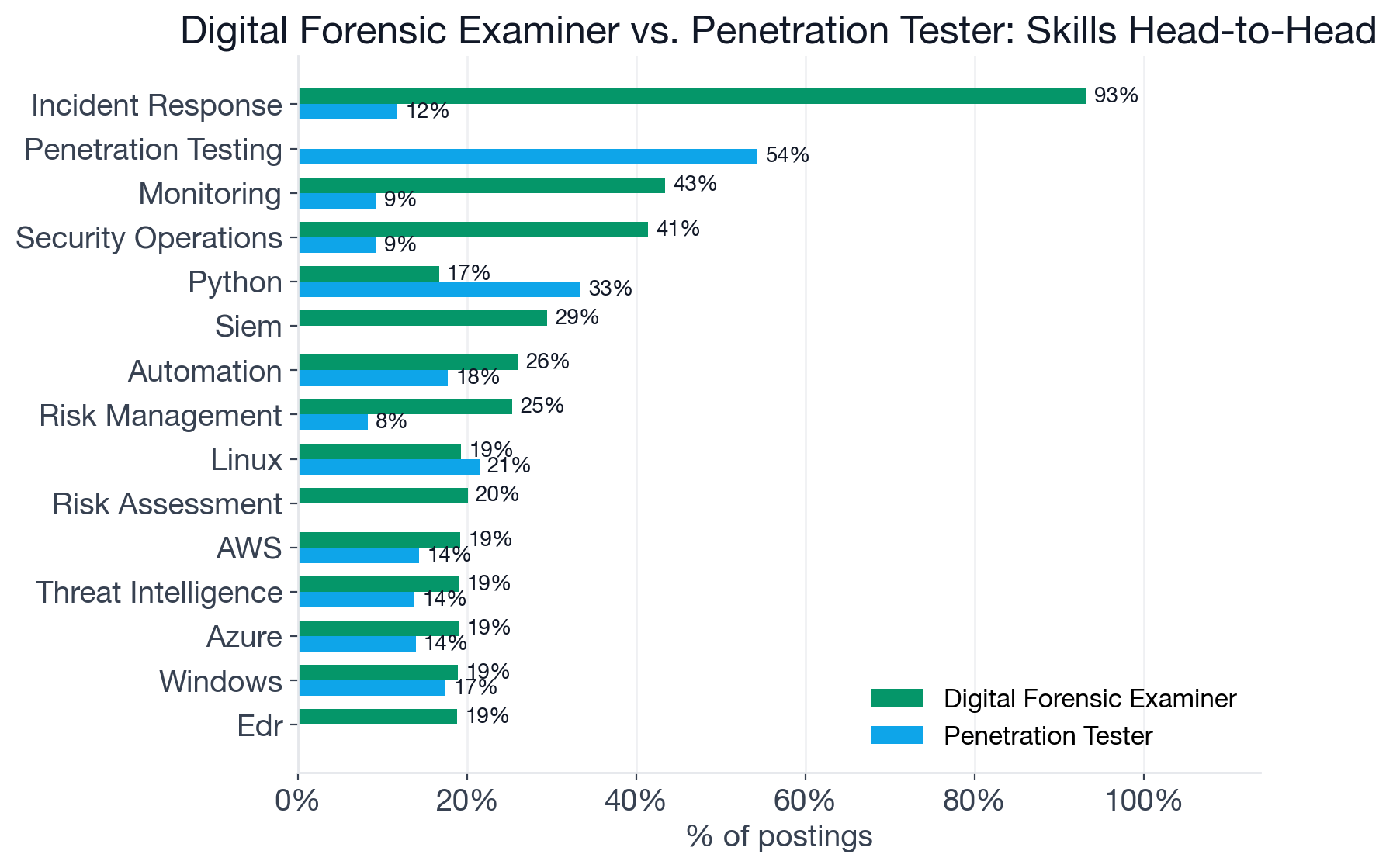 Incident Response dominates Digital Forensic Examiner's side; Penetration Testing tops Penetration Tester's, where RLHF ranks fourth on its own list, a skill that doesn't appear anywhere in Digital Forensic Examiner's data.
Both roles lean on the same infrastructure fundamentals, just at different intensities. Vulnerability Management is the most evenly shared skill in the dataset: 15.9% of Digital Forensic Examiner postings and 15.3% of Penetration Tester postings ask for it, within a percentage point of each other. Cloud platforms tell a less uniform story: Digital Forensic Examiner leans harder on AWS and Azure, close to 1 in 5 postings (19.2% and 19.1%), while Penetration Tester sits nearer 1 in 7 for the same two skills (14.3% and 13.9%); Google Cloud is the smallest of the three on both sides, at 13.0% and 9.8% respectively.
| Shared Skill | Digital Forensic Examiner | Penetration Tester |
|---|---|---|
| Incident Response | 93.2% | 11.8% |
| Automation | 26.0% | 17.8% |
| Python | 16.7% | 33.4% |
| Vulnerability Management | 15.9% | 15.3% |
| Threat Intelligence | 19.1% | 13.8% |
Python breaks the pattern: it matters more to testers (33.4%) than examiners (16.7%), reflecting how much offensive work depends on custom exploit and automation scripting. Two shared skills also carry outsized pay premiums on both sides independently: Automation adds $20,400 to Digital Forensic Examiner's baseline and $32,700 to Penetration Tester's, and Threat Intelligence adds $18,900 and $25,200. Whichever role you land in, those two are worth learning regardless of title.
Only One Skill Stack Is Growing an AI Wing
Digital Forensic Examiner's exclusive skills, the ones its postings ask for that Penetration Tester's mostly don't, are entirely blue-team tooling and investigative process: SIEM (29.5%), Risk Assessment (20.1%), EDR (18.8%), Incident Management (15.4%), Threat Hunting (14.9%), Digital Forensics (14.8%), Root Cause Analysis (11.9%), Splunk (11.7%), Malware Analysis (11.4%), and Firewalls (9.8%). It's a coherent, if unglamorous, picture: the examiner's identity runs through SOC platforms, not courtroom forensics.
Penetration Tester's exclusive list splits into two stories. Penetration Testing itself leads at 54.3%, still the plurality core of the role, but RLHF sits second at 18.3%, right behind Penetration Testing itself and ahead of OWASP (14.2%) and Application Security (12.1%). The title sample backs it up: entries like "AI Safety Expert - Red Team" and "Senior AI Red Team Engineer" make up roughly a third of what we pulled. As noted above, treat this as concentrated in one employer's hiring rather than a market-wide pivot.
That doesn't mean forensic examiners are sitting out AI, only that the job posting hasn't caught up. Practitioner surveys tell a sharper story: AI use inside forensic investigations jumped from 20% to 68% of practitioners in about two years, per Magnet Forensics' 2026 State of Enterprise DFIR Report, driven by triage and report-drafting tools rather than a new job title. Penetration testers report similarly high ambient adoption, 82% per Bugcrowd's 2026 hacker survey, but there it's compounding on top of a specialty already visible in job postings. Pentesting is growing a hireable AI specialty; forensics is absorbing AI as an invisible productivity layer, held back by policy and evidentiary standards, not appetite. For more, see our deep dives on how AI is changing Digital Forensic Examiner and how AI is changing Penetration Tester.
Which Skills Pay More at Digital Forensic Examiner and Penetration Tester Jobs?
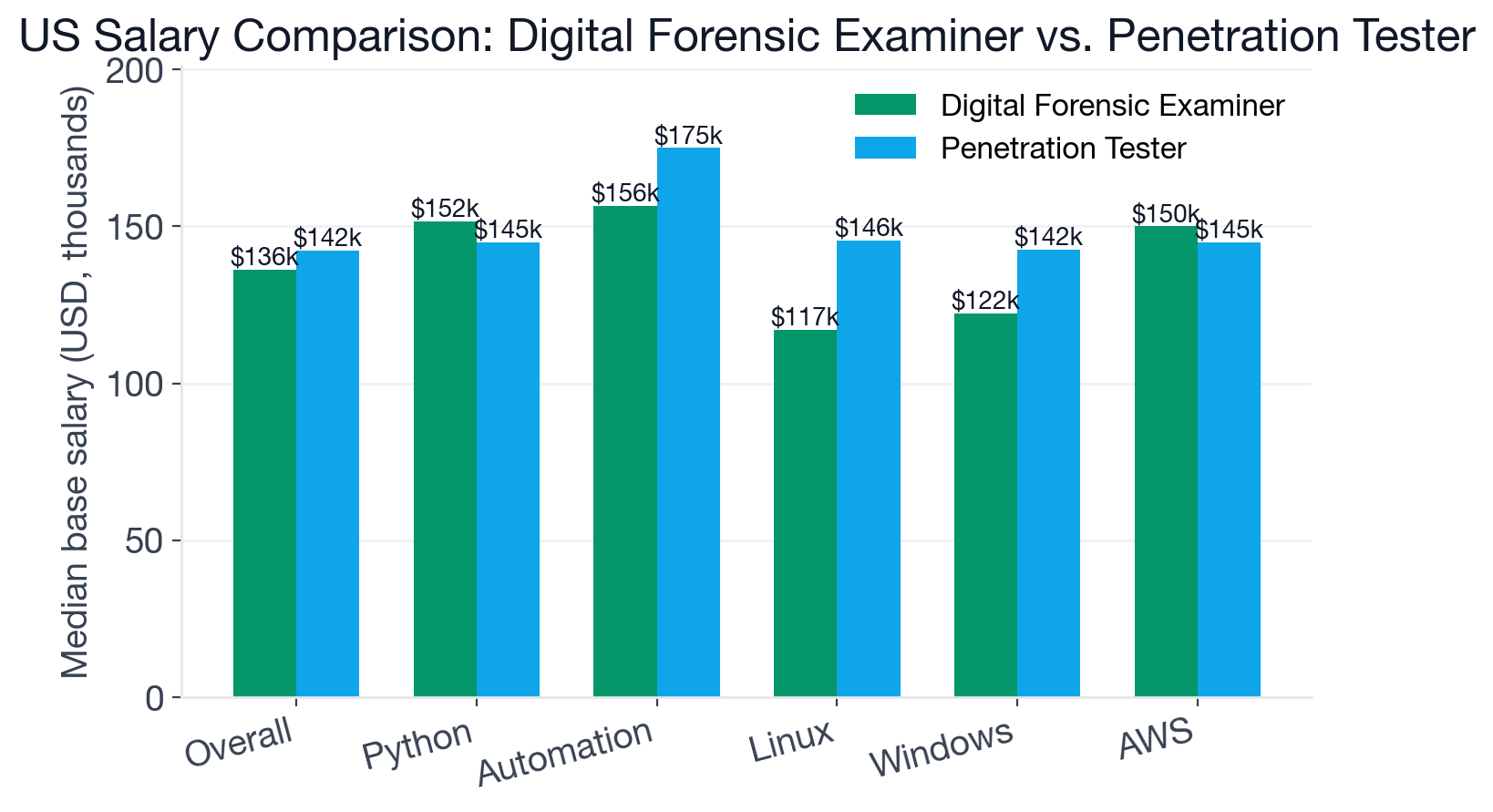 Automation pays the most for Penetration Tester; Linux and Windows pay far more there than at Digital Forensic Examiner, where both sit below the role's own baseline.
These are US-only base salary figures; equity, bonus, and sign-on aren't disclosed in job postings, so total comp at top employers runs higher than the numbers below. Digital Forensic Examiner's median US base salary is $136,100 across 232 postings with disclosed pay; Penetration Tester's is $142,300 across 175.
In both jobs, the skill named in the job title pays below that role's own median. Digital Forensics comes in at $135,000 (n=35), $1,100 under the Digital Forensic Examiner baseline. Penetration Testing comes in at $137,000 (n=93), $5,300 under the Penetration Tester baseline. The real premiums sit in adjacent, more general skills. On Digital Forensic Examiner's own numbers, EDR adds $21,900 (n=25), the largest premium in Digital Forensic Examiner's data and just ahead of Automation's $20,400; SIEM adds $15,400 (n=59), behind both. On Penetration Tester's own numbers, C++ adds $29,000 (n=28) and TypeScript adds $12,100 (n=58): general-purpose engineering languages, not security tools, price better than the role's namesake skill.
Pay, Openings, and the Entry Bar: How Do They Compare?
Penetration Tester's $6,200 (4.4%) gap is closer to noise than a real premium, given its smaller sample (n=175 vs. n=232). Digital Forensic Examiner also posts slightly more often, 797 versus 704, a 1.13x ratio: not wide enough to call either role the safer bet by volume.
Neither is easy to break into cold. Entry-level postings sit at 3.4% for Digital Forensic Examiner and 4.3% for Penetration Tester, and both concentrate at mid-level (62.0% and 68.9%). Digital Forensic Examiner carries more staff-level postings (14.3% vs. 8.1%), a slightly higher ceiling in title terms. On location, both roles are mostly onsite and mostly international: only 47.2% of Digital Forensic Examiner postings and 40.1% of Penetration Tester postings are US-based. Remote share is similar for both (16.3% and 17.8%), but Digital Forensic Examiner offers meaningfully more hybrid flexibility (27.0% vs. 16.6%), while Penetration Tester leans onsite (62.1% vs. 50.3%).
Should You Investigate Breaches or Cause Them?
Choose Digital Forensic Examiner if you:
- Want to work the aftermath of a breach: reconstructing what happened, preserving the evidence trail, and reporting root cause with SIEM and EDR tooling.
- Come from a SOC or incident-response background; the role's own identity skills map directly onto that experience.
- Want more schedule flexibility: postings here run hybrid about 60% more often than onsite-heavy Penetration Tester postings (27.0% vs. 16.6%).
Choose Penetration Tester if you:
- Want to work offense: scoping engagements, exploiting vulnerabilities, and reporting risk before an attacker finds it first.
- Have a general-purpose coding background (C++, TypeScript, scripting); those skills price better here than security tools alone.
- Are curious about the emerging AI red-teaming niche inside the role. Drill exploit-chaining and reporting scenarios in our question bank before you specialize.
How to Use This in Your Job Search
If Penetration Tester's AI red-teaming corner is what draws you in, InterviewStack's interactive courses cover the offensive-security and applied-ML foundations that those postings assume. Building toward Digital Forensic Examiner instead? The same courses cover the SIEM, EDR, and incident-response fundamentals that dominate that role's postings. Either way, drill the specifics in our Question Bank and pressure-test your answers with AI mock interviews built around DFIR triage and exploit-chaining scenarios.
For a full skills breakdown of either role, see Digital Forensic Examiner Skills in 2026 and Penetration Tester Skills in 2026. When you're ready to apply, browse live Digital Forensic Examiner postings or Penetration Tester postings on InterviewStack.io.
FAQ
Q. Does Digital Forensic Examiner or Penetration Tester pay more in 2026?
Penetration Tester pays slightly more. The median US base salary is $142,300 across 175 postings with disclosed salary, versus $136,100 for Digital Forensic Examiner across 232 postings, a $6,200 (4.4%) gap. Both figures are base salary only; equity, bonus, and sign-on are not disclosed in job postings.
Q. How much skill overlap is there between Digital Forensic Examiner and Penetration Tester?
The two roles share 36% Jaccard overlap on their top 30 skill lists, a moderate fork. Vulnerability Management is the most evenly shared skill (15.9% Digital Forensic Examiner vs. 15.3% Penetration Tester), while Incident Response is nearly universal for examiners (93.2%) but rare for testers (11.8%).
Q. Is Penetration Tester becoming an AI job?
Partly, and mostly in one corner of the market. RLHF is Penetration Tester's fourth most common skill, appearing in 18.3% of postings, alongside titles like "AI Safety Expert - Red Team" in the sample. But a single employer, Mercor, accounts for 21.5% of the role's distinct postings, so a meaningful share of that AI signal likely reflects one company's hiring rather than an industry-wide shift. Digital Forensic Examiner shows no comparable AI-specific skill or title cluster.
Q. Which role has more job openings, Digital Forensic Examiner or Penetration Tester?
Digital Forensic Examiner is slightly larger: 797 active postings versus 704 for Penetration Tester, a ratio of about 1.13 to 1. Neither is a high-volume market compared to broader security titles.
Q. Is it easy to break into either role as an entry-level candidate?
No. Entry-level postings are rare for both: 3.4% for Digital Forensic Examiner and 4.3% for Penetration Tester. Both roles concentrate at mid-level (62.0% and 68.9% respectively), so most postings expect some prior security experience already.
Q. What skills pay the biggest premium for each role?
On Digital Forensic Examiner's own baseline ($136,100), EDR adds $21,900 and Automation adds $20,400. On Penetration Tester's own baseline ($142,300), Automation adds $32,700 and C++ adds $29,000. Notably, the named skill in each job title, Digital Forensics and Penetration Testing, each pays below its own role's baseline.
Q. Are Digital Forensic Examiner and Penetration Tester remote-friendly roles?
Rarely. About 16.3% of Digital Forensic Examiner postings and 17.8% of Penetration Tester postings are remote. Digital Forensic Examiner offers more hybrid flexibility (27.0% vs. 16.6%), while Penetration Tester leans onsite (62.1% vs. 50.3%).
The Real Fork Is Inside One Job Title, Not Between Two
Compare these two roles on paper and you'll find a similar entry bar, similar pay, and 36% skill overlap. The more interesting fork isn't between them. It's inside Penetration Tester, where a small but real AI red-teaming specialty is branching off classic exploit work, concentrated for now in one employer's hiring. Digital Forensic Examiner shows no equivalent split yet. Either way, the fundamentals matter more than the title: build incident-response and exploit-development skills first, and let the AI specialty, if you want it, come later.
Topics
Ready to practice?
Put what you've learned into practice with AI mock interviews and structured preparation guides.