
Four Times the Postings, Statistically the Same Paycheck
Machine Learning Engineer carries 4.43 times more active postings than Research Scientist, 5,692 versus 1,284 on the InterviewStack.io job board, yet the median US base salary gap between them is just $2,000: $190,000 for Machine Learning Engineer versus $192,000 for Research Scientist. If job scarcity commanded a real wage premium, a role with less than a quarter of the openings should pay noticeably more than that.
The two roles share a moderate 46% skill overlap (Jaccard similarity across their top-30 skills), anchored by Machine Learning and Python, but the skills that make each role distinct tell a much sharper story than the near-tied salary headline. Browse live Machine Learning Engineer postings or Research Scientist postings to see the pattern for yourself.
| Machine Learning Engineer | Research Scientist | |
|---|---|---|
| Median US base salary | $190,000 | $192,000 |
| Active postings | 5,692 | 1,284 |
| Top skill | Machine Learning (68.0%) | Machine Learning (58.5%) |
| Onsite share | 58.9% | 67.0% |
| Entry-level share | 4.5% | 5.5% |
| Skill overlap (Jaccard) | 46% shared (pairwise) | 46% shared (pairwise) |
Key Findings
- Machine Learning Engineer carries 4.43x the posting volume of Research Scientist (5,692 versus 1,284 active listings), yet the median US base salary gap is just $2,000 (about 1%): $190,000 versus $192,000.
- The two roles share a 46% Jaccard overlap across their top-30 skill sets, anchored by Machine Learning (68.0% MLE / 58.5% RS) and Python (61.1% / 53.7%).
- Every one of Machine Learning Engineer's ten exclusive skills, AWS, MLOps, Azure, CI/CD, Google Cloud, Kubernetes, Docker, SQL, RAG, and APIs, prices at or below its own $190,000 baseline.
- Research Scientist's exclusive skills price unevenly: Distributed Training adds $26,500 and Prototyping adds $21,000 over its own $192,000 baseline, but C++ prices $3,500 below it.
- JAX pays a $23,000 premium on Machine Learning Engineer's own data (n=129) but only $1,100 on Research Scientist's own data (n=66), despite being a Research Scientist specialty by frequency.
- Research Scientist postings skew less senior than Machine Learning Engineer's on paper: just 29.0% are senior or staff level, versus 39.7% for Machine Learning Engineer, though title-inferred seniority defaults unqualified postings to mid-level, so this likely undercounts Research Scientist's true seniority (see below).
- Research Scientist is far more onsite (67.0%) and US-concentrated (63.0%) than Machine Learning Engineer (58.9% onsite, 45.3% US).
A Day in Each Role Looks Nothing Alike
A Machine Learning Engineer spends most of the week making models survive contact with production traffic: packaging a trained model behind an API, wiring it into a CI/CD pipeline, monitoring it once live, and scaling the infrastructure on AWS, Azure, or Google Cloud. The exclusive skill list, AWS, MLOps, CI/CD, Kubernetes, reads like a deployment checklist.
A Research Scientist works further upstream: designing a new approach, running the experiments that decide whether it's worth pursuing, and often writing performance-critical code in C++ to make those experiments run at scale. Reinforcement Learning, JAX (a numerical-computing library for large-scale ML research), and Distributed Training round out a toolkit closer to a research lab's than a production team's. The output is usually a paper, a benchmark result, or a working prototype handed off to engineering to productionize, not a live service.
Which Skills Do Both Roles Actually Share?
Machine Learning and Python anchor both roles, and that's the clearest true overlap in the data.
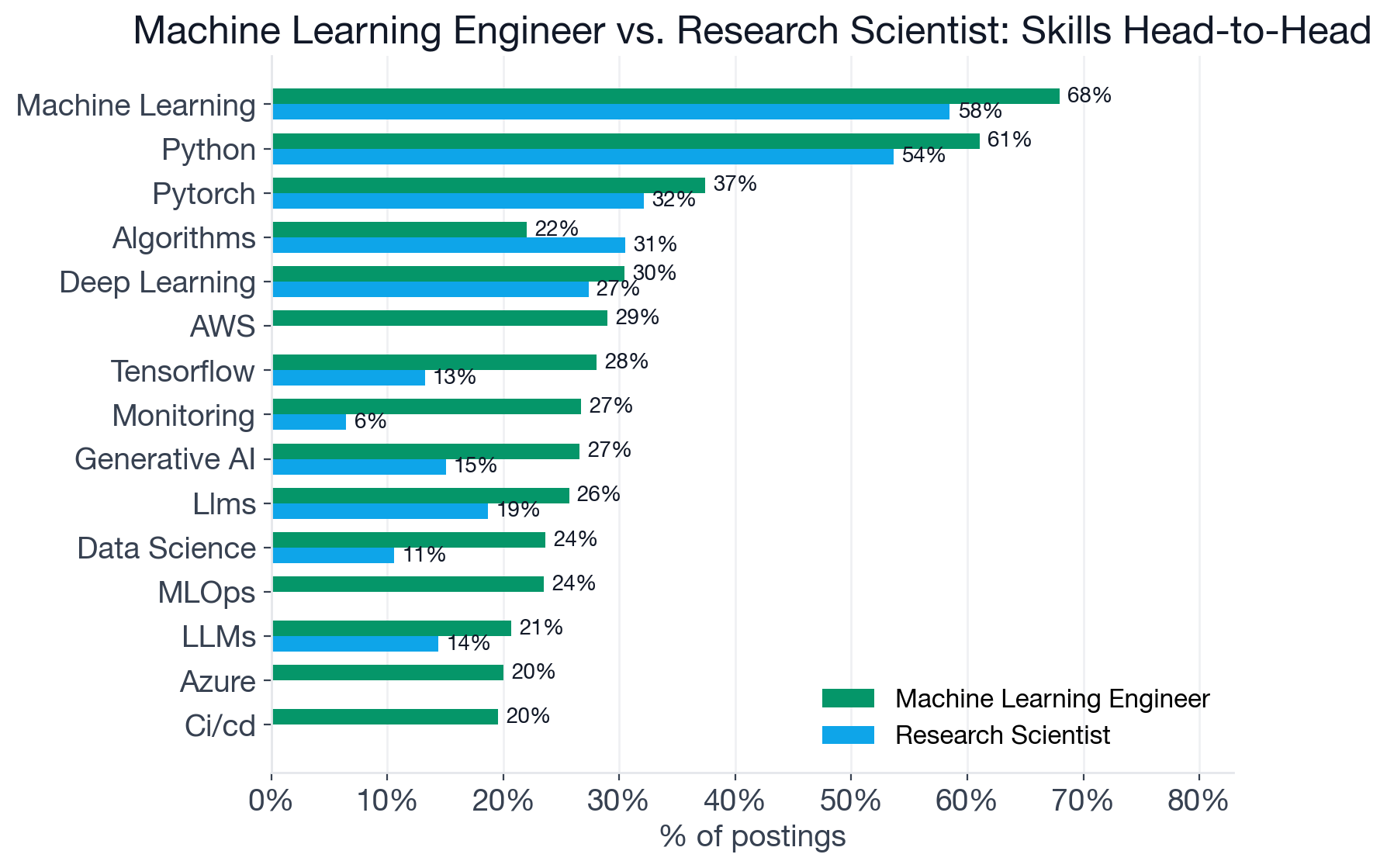 Machine Learning and Python sit well above everything else for both roles; past that, the shared skills start tilting toward one side or the other.
| Skill | Machine Learning Engineer | Research Scientist |
|---|---|---|
| Machine Learning | 68.0% | 58.5% |
| Python | 61.1% | 53.7% |
| PyTorch | 37.4% | 32.1% |
| Deep Learning | 30.4% | 27.3% |
| Algorithms | 22.0% | 30.5% |
| Statistics | 13.2% | 18.5% |
| Generative AI | 26.6% | 15.0% |
Machine Learning and Python are the genuine bridge; anyone fluent in both wouldn't need to relearn either one moving between roles. Algorithms and Statistics tilt the other way, more common for Research Scientist (30.5% and 18.5%) than Machine Learning Engineer (22.0% and 13.2%), a reminder that a 46% Jaccard overlap still counts a skill as "shared" even when the two roles lean on it at very different rates.
Generative AI and LLM-tagged skills sit well below Machine Learning itself for both roles (26.6% and 25.7% for Machine Learning Engineer, 15.0% and 18.7% for Research Scientist). That gap measures who's explicitly hired to build AI systems, not who uses AI day to day. Stack Overflow's 2025 Developer Survey puts general AI-tool adoption at 84% of developers, so most Machine Learning Engineers are almost certainly using Copilot-style tools daily regardless of posting language. Research Scientists look more bifurcated: a 2026 Anthropic survey of 1,260 quantitative social scientists, a proxy population likely undercounting actual industry Research Scientists' tool access and adoption, found 81% had tried an AI chatbot for writing code or editing prose, but only 20% had adopted autonomous coding agents, a trust gap rather than an adoption gap, since an agent silently altering an experiment's code threatens the reproducibility research depends on.
Where Do the Exclusive Skills Split?
Machine Learning Engineer's exclusive skills describe how you keep a model running. Research Scientist's describe how you invent one.
| Exclusive to Machine Learning Engineer | Freq. | Exclusive to Research Scientist | Freq. |
|---|---|---|---|
| AWS | 29.0% | C++ | 18.6% |
| MLOps | 23.5% | Reinforcement Learning | 17.6% |
| Azure | 20.0% | Prototyping | 11.8% |
| CI/CD | 19.6% | JAX | 11.5% |
| Google Cloud | 17.4% | Distributed Training | 8.4% |
The Machine Learning Engineer column, AWS, MLOps, CI/CD, Google Cloud, reads as a production-infrastructure checklist: package it, deploy it, scale it, keep it alive. The Research Scientist column runs the opposite direction: C++ signals performance-critical experiment code, Reinforcement Learning and Prototyping signal new-approach testing, and JAX and Distributed Training signal large-scale numerical experiments rather than an always-on service.
Does the Smaller Role Actually Pay More?
Barely, and the headline number undersells how differently that near-tie gets built. These are US-only base salaries: equity, bonus, and sign-on pay aren't disclosed in postings, so total compensation at top employers runs higher than either figure below.
Research Scientist's median US base salary is $192,000 across 527 postings with salary disclosed, versus $190,000 for Machine Learning Engineer across 1,523 postings, a $2,000 (about 1%) gap in Research Scientist's favor, despite Machine Learning Engineer posting 4.43x more openings.
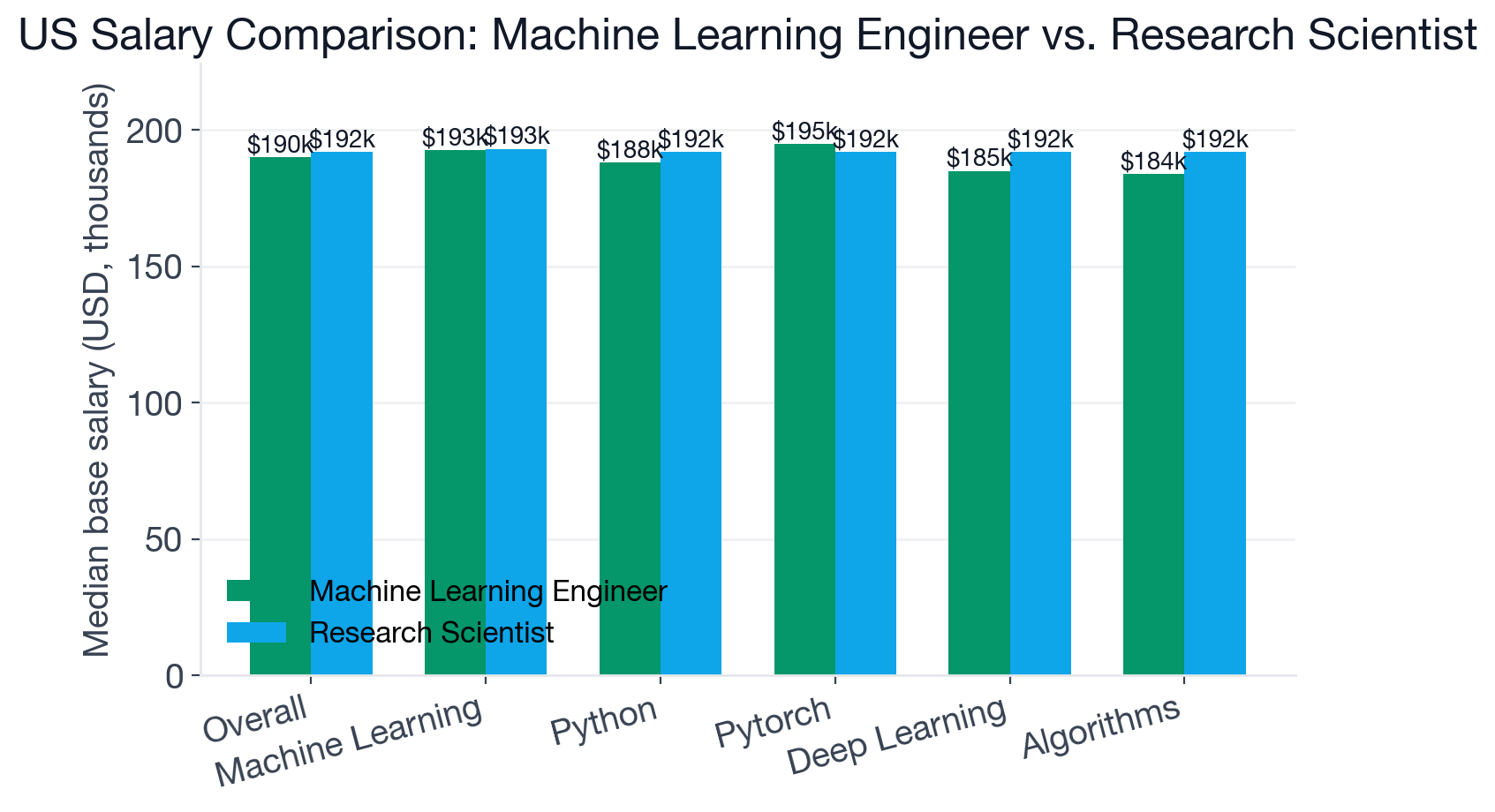 The two roles' median US base salaries sit close enough to call a statistical tie, even though one role has a fraction of the other's job pool.
Each role's differentiator skills price in opposite directions. On Machine Learning Engineer's own salary data, every one of its ten exclusive skills prices at or below the role's $190,000 baseline: AWS (-$10,000), MLOps (-$5,000), Azure (-$14,500), CI/CD (-$5,200), Google Cloud (-$3,700), Kubernetes (flat), Docker (-$15,000), SQL (-$11,300), RAG (-$2,500), and APIs (-$6,600). None of the skills that define the job title buy a raise.
On Research Scientist's own data, the pattern is mixed but mostly positive: Distributed Training adds $26,500, Prototyping adds $21,000, and Reinforcement Learning adds $12,400 over the role's $192,000 baseline; only C++ prices below it, by $3,500.
The clearest asymmetry sits in a skill neither role claims exclusively. JAX pays $23,000 over baseline on Machine Learning Engineer's own data (n=129) but just $1,100 on Research Scientist's own data (n=66), despite being nominally a Research Scientist specialty (11.5% of postings, too low to crack Machine Learning Engineer's top 30). Scarcity in a posting's skill list doesn't guarantee scarcity in its pay.
Which Role Is Easier to Break Into?
Neither role is especially entry-friendly, but Research Scientist's 5.5% entry-level share edges out Machine Learning Engineer's 4.5%, and it carries a lower combined senior-plus-staff share (29.0% versus 39.7%), the opposite of what the role's PhD-heavy reputation suggests. Part of the explanation shows up in the title samples themselves: postings like "PhD Research Scientist Intern" and "Research Scientist, Generalist Embodied Agent Research, PhD New College Grad 2026" treat a fresh PhD as the specialization credential itself, collapsing the usual junior-to-senior climb that engineering titles require.
That gap is probably wider on paper than in reality, though. Seniority in this data is inferred from title keywords, and any posting without an explicit level signal defaults to mid-level. The Research Scientist title sample is full of plain, unqualified titles ("Research Scientist," "Senior Researcher" aside) attached to what are typically experienced PhD hires who simply don't carry a "Senior" prefix the way engineering titles do. So treat the 29.0% senior-plus-staff figure as a floor, not a precise read on how senior the role actually skews.
Geography and work mode diverge too. Research Scientist is far more US-concentrated (63.0% versus 45.3% for Machine Learning Engineer, which draws 16.3% of postings from India) and more onsite (67.0% versus 58.9%), with about two-thirds the remote share (13.5% versus 20.4%). The employer mix explains why: Research Scientist's top listed employers include frontier AI labs like Google, NVIDIA, and Anthropic, which concentrate research talent in a handful of physical offices, while Machine Learning Engineer's list leans toward large, globally distributed organizations (Accenture alone accounts for 6.99% of its postings).
Machine Learning Engineer or Research Scientist: Which Fits You?
Choose Machine Learning Engineer if you:
- Want the larger, more open job market (4.43x the postings) and more flexibility to work remote (20.4% versus 13.5%) or outside the US
- Are drawn to the production side of ML: deploying, monitoring, and scaling models rather than designing them from first principles
- Can accept that your core toolset (AWS, MLOps, CI/CD, Kubernetes) is table stakes rather than a pay lever; your ceiling comes from layering scarcer specialties like JAX or distributed training on top
Choose Research Scientist if you:
- Have, or are building toward, a PhD-level research background and want that credential to substitute for years of industry seniority
- Want your specialization to price in directly: Reinforcement Learning, Prototyping, and Distributed Training each add five figures over the role's baseline
- Are comfortable with a smaller, more onsite, more US-concentrated job pool in exchange for research-facing work at essentially the same median pay
How to Use This in Your Job Search
If Research Scientist's research bar, Reinforcement Learning, JAX, distributed systems, stands between you and that role, InterviewStack's interactive courses cover the ML theory and systems foundations most postings assume. Already comfortable there? Practice with AI mock interviews built around real ML system-design and research-methodology loops, and drill the Question Bank on MLOps pipelines, reinforcement learning, and experiment design. When you're ready to apply, browse live Machine Learning Engineer openings or Research Scientist openings.
For a full breakdown of either role on its own, see Machine Learning Engineer Skills in 2026 and Research Scientist Skills in 2026. If Applied Scientist or AI Engineer are also on your shortlist, Machine Learning Engineer vs Applied Scientist and AI Engineer vs Research Scientist cover two more angles on the same fork.
FAQ
Q. Does Machine Learning Engineer or Research Scientist pay more in 2026?
Research Scientist has a slightly higher median US base salary, $192,000 versus $190,000 for Machine Learning Engineer, a $2,000 (about 1%) gap. Machine Learning Engineer posts 4.43x more active jobs, so the far smaller, more specialized role does not command the large premium that scarcity would typically predict.
Q. How much skill overlap is there between Machine Learning Engineer and Research Scientist?
The two roles share a 46% Jaccard overlap across their top-30 skill sets. Machine Learning (68.0% of Machine Learning Engineer postings, 58.5% of Research Scientist postings) and Python (61.1% versus 53.7%) anchor both, but roughly half of each role's skill profile does not transfer.
Q. What skills are exclusive to Machine Learning Engineer postings?
AWS (29.0% of postings), MLOps (23.5%), Azure (20.0%), CI/CD (19.6%), and Google Cloud (17.4%) show up almost exclusively in Machine Learning Engineer listings, reflecting the role's focus on deploying and operating models in production.
Q. What skills are exclusive to Research Scientist postings?
C++ (18.6% of postings), Reinforcement Learning (17.6%), Prototyping (11.8%), JAX (11.5%), and Distributed Training (8.4%) show up almost exclusively in Research Scientist listings, signaling algorithmic and experimental depth over deployment infrastructure.
Q. Do the differentiator skills for either role actually pay more?
Not for Machine Learning Engineer. All ten of its exclusive skills, including AWS, MLOps, Azure, and CI/CD, price at or below its own $190,000 baseline. Research Scientist's exclusive skills are mixed but mostly positive: Distributed Training adds $26,500 and Prototyping adds $21,000 over its $192,000 baseline, while C++ prices $3,500 below it.
Q. Which role is easier to break into?
Neither is especially entry-friendly, but Research Scientist edges ahead: 5.5% of its postings are entry-level versus 4.5% for Machine Learning Engineer. Its combined senior-plus-staff share is lower too (29.0% versus 39.7%), despite the role's PhD-heavy reputation, though that gap is likely overstated: seniority here is inferred from title keywords and defaults to mid-level when a posting has no explicit signal, and many Research Scientist postings are plain, unqualified titles for what are typically experienced PhD hires.
Q. Do both roles require generative AI or LLM skills?
Both assume deep ML expertise already; that is the job. Generative AI appears in 26.6% of Machine Learning Engineer postings and 15.0% of Research Scientist postings. But job-posting language only captures explicit build requirements, not day-to-day AI-assisted tool use, which Stack Overflow's 2025 Developer Survey puts at 84% of developers overall.
The Premium That Never Showed Up
Research Scientist has a quarter of Machine Learning Engineer's job pool, a more research-heavy skill set, and a reputation built on PhDs, yet it clears Machine Learning Engineer's median by only $2,000. The premium that scarcity should buy mostly doesn't show up at the role level; it shows up skill by skill, in Distributed Training, Prototyping, and Reinforcement Learning specifically, not in the job title. Pick the role by the day-to-day work and the job pool you actually want, and treat the near-identical headline salary as confirmation that neither path shortchanges you for choosing it.
Topics
Ready to practice?
Put what you've learned into practice with AI mock interviews and structured preparation guides.