
PCNSE Is a Network Engineer's Credential More Than a Security Engineer's
Network Engineer postings mention the Palo Alto PCNSE (Palo Alto Networks Certified Network Security Engineer) 2.5% of the time, about three times the 0.8% rate in Cybersecurity Engineer postings. Across the three roles that could plausibly ask for it, 116 of 7,740 postings mention it: 1.5%, or roughly 1 in 67. We scanned every active Network Engineer, Cybersecurity Engineer and Security Architect posting on the InterviewStack.io job board from the last 90 days, and every comparison below is against other postings in those same three roles, not against the whole market.
That split is the surprise. A firewall certification from a security vendor turns out to be asked for far more by the people who run the network than by the people who carry the security title. Network Engineer postings make up 35.3% of the postings we scanned but 59.5% of the PCNSE mentions. Cybersecurity Engineer postings are 55.5% of the scan and only 31.0% of the mentions. Security Architect sits near parity: 9.2% of postings, 9.5% of mentions.
Key Findings
- 116 of 7,740 Network Engineer, Cybersecurity Engineer and Security Architect postings mention PCNSE: 1.5%, about 1 in 67.
- Network Engineer postings mention it 2.5% of the time (69 of 2,732), versus 1.6% for Security Architect and 0.8% for Cybersecurity Engineer.
- Of the 81 mentions where the wording is clear, 77 (95.1%) are preferred and only 4 (4.9%) are required; 35 more do not say either way.
- US postings mentioning PCNSE advertise a median base of $141,900 (n=37) versus $150,600 for other postings in the same roles (n=2,783), a gap that tracks role mix, not the exam.
- CCNP appears in 76.7% of PCNSE-mentioning postings (89 of 116); CCIE in 38.8% and CISSP in 37.1%.
- Firewalls appear in 70.7% of PCNSE-mentioning postings, BGP in 47.4% and Python in 39.7%.
- No employer accounts for more than 6 of the 116 mentions (5.2%); the 15 most frequent employers together cover 31.9%.
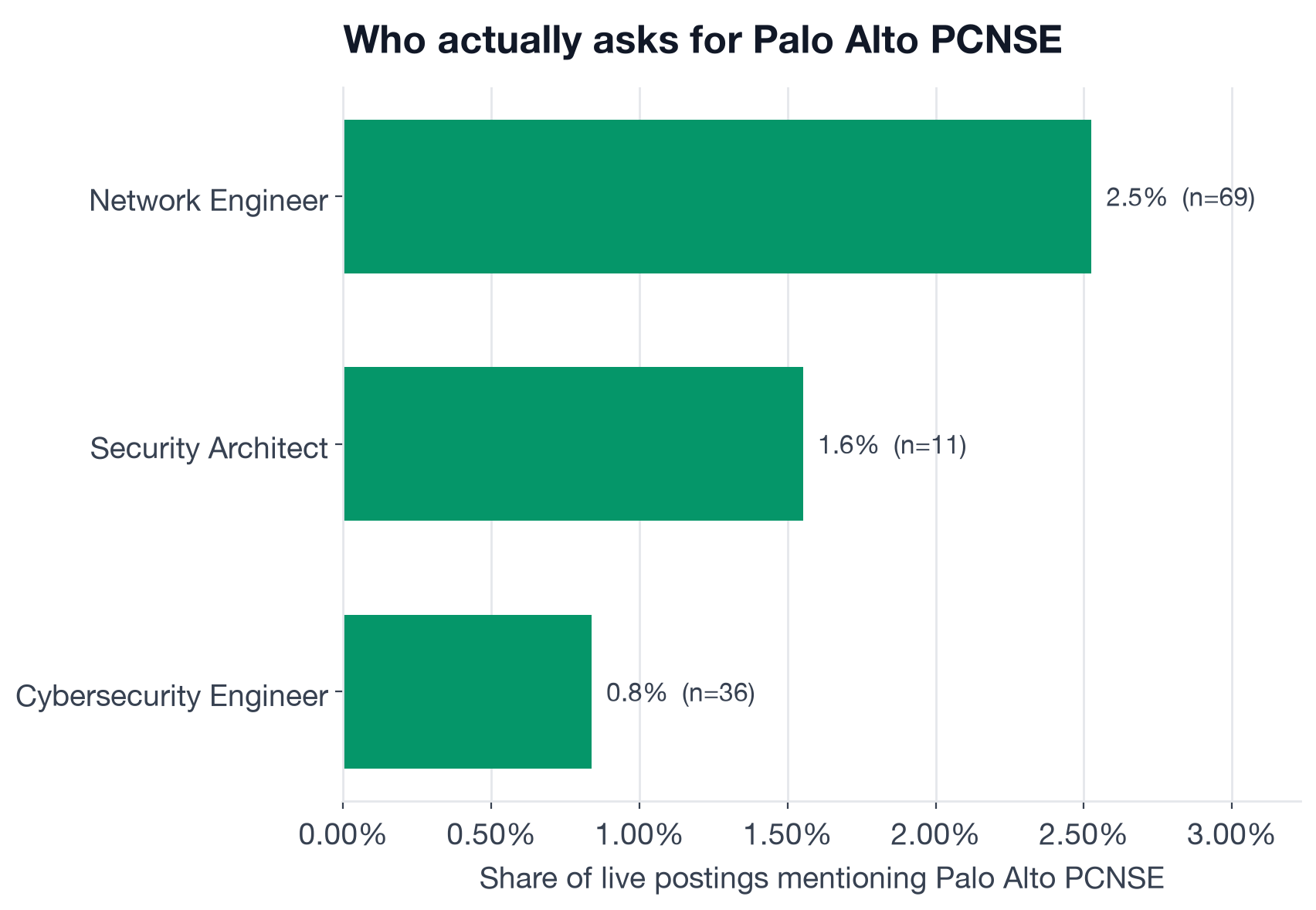
The chart makes the ordering plain: PCNSE demand follows the network-operations end of the security spectrum, not the security-engineering end.
We do not have a dataset-backed reason for why Cybersecurity Engineer postings trail Security Architect ones. What the data does show is that Network Engineer postings, where firewalls and routing are the daily work, mention it most. Cybersecurity Engineer is also the broadest of the three role labels, so its low rate may partly reflect a mix of security jobs that never touch a Palo Alto estate. That is the frame for the rest of this post: PCNSE is a small, specialist signal that appears where firewalls are the job.
Nineteen Out of Twenty Classified PCNSE Mentions Are Preferred, Not Required
The required-versus-preferred split is where the "do I need it?" question gets answered. We read the wording within a short window of each mention. For 81 of the 116 mentions the intent is clear: 77 say preferred or a plus, and just 4 say required. That is 95.1% preferred and 4.9% required. The other 35 mentions are listed without either signal (for example, in a plain list of certifications), so we leave them out of the ratio instead of guessing.
For a reader deciding whether to sit the exam, the message is direct. The overwhelming majority of employers who name PCNSE treat it as a tiebreaker. A missing PCNSE will rarely disqualify you at the resume stage; a working knowledge of the firewall platform it certifies is what the job description is actually built around.
Two caveats matter here. Required-versus-preferred is inferred from wording, and where a mention could be read either way we count it as preferred, so the required share is if anything a slight underestimate. And 116 mentions is a small base: this is a narrow certification, and a dozen postings would move the percentages by several points.
Do PCNSE Postings Advertise Higher Pay?
In aggregate, no, and the reason is who is asking. A note on scope first: these are US postings only, base salary only, on the subset of postings that disclose pay. Equity and bonus are not in the data, so total compensation at larger employers runs higher than any number here. Postings that disclose salary are also not a random sample of all postings.
| US advertised base salary | Median | Postings with salary |
|---|---|---|
| Postings mentioning PCNSE | $141,900 | 37 |
| Other postings in the same three roles | $150,600 | 2,783 |
Postings that ask for PCNSE advertise a median about $8,700 (5.8%) below the rest of the pool. That is not a statement about what the exam pays. It is a statement about which jobs mention it, and the mix explains most of the picture:
- Role mix. 30 of the 37 salary-disclosed PCNSE postings are Network Engineer roles (81.1%). In the comparison pool, Network Engineer is 39.3% of the salary-disclosed postings (1,093 of 2,783). Without a PCNSE mention, Network Engineer postings advertise a median of $131,150, against $162,000 for Cybersecurity Engineer and $175,500 for Security Architect. A pool weighted toward the cheapest of the three roles will look cheaper before any certification enters the picture.
- Seniority mix. PCNSE-mentioning postings skew lower on the ladder: 67.2% are mid-level (versus 57.6%), and only 5.2% are staff-level (versus 12.8%). On a scale where mid-level is 1 and senior is 2, the average is 1.38 for PCNSE postings and 1.50 for the rest. Seniority here is inferred from title keywords and defaults to mid-level when no signal exists, which compresses the true spread.
We cannot run the honest test, a within-level comparison, because no seniority band reaches our reporting floor of 25 salary-disclosed PCNSE postings.
| Level | PCNSE median | PCNSE n | Other-postings median | Other n |
|---|---|---|---|---|
| Entry | Not reportable | 0 | $85,305 | 69 |
| Mid-level | Not reportable | 24 | $137,050 | 1,542 |
| Senior | Not reportable | 9 | $165,000 | 757 |
| Staff | Not reportable | 4 | $184,325 | 415 |
Mid-level misses the floor by a single posting. The right takeaway is not a dollar figure. It is that the data cannot show a PCNSE pay premium or penalty inside any level, and the aggregate should not be read as either.
One more caution on the role view. Inside Network Engineer postings, those mentioning PCNSE advertise $136,750 (n=30) against $131,150 without it. That is a small sample with no seniority breakdown behind it, so we treat it as a reason not to conclude PCNSE lowers pay, rather than as evidence that it raises it.
CCNP Shows Up in Three of Four PCNSE Postings, and That Pairing Is the Profile
PCNSE is rarely asked for alone. CCNP appears in 89 of the 116 PCNSE-mentioning postings (76.7%), which makes the typical target a network engineer who can run Cisco routing and switching and also operate Palo Alto firewalls. Higher-tier and adjacent certifications follow:
| Also mentioned in the same posting | Postings | Share of PCNSE postings |
|---|---|---|
| CCNP | 89 | 76.7% |
| CCIE | 45 | 38.8% |
| CISSP | 43 | 37.1% |
| CCNA | 26 | 22.4% |
| CompTIA Security+ | 22 | 19.0% |
| CISM | 13 | 11.2% |
Read the table as two audiences. Roughly 3 in 4 postings pair PCNSE with a Cisco networking track (the CCNP demand data covers that side). Just over a third pair it with CISSP, the broad security-management credential, which points at the security-architecture end of the same roster.
The skills in these postings fill in the rest of the profile. Network Security (72.4%) and Firewalls (70.7%) lead, as expected. Routing then shows up strongly: BGP in 47.4% and OSPF in 42.2%. Cloud and automation follow: AWS in 50.0%, Azure in 42.2%, Automation in 53.4%, Python in 39.7%, Ansible in 27.6% and Terraform in 24.1%. Zero Trust appears in 37.1%. The picture is a network engineer who has been pulled toward security and cloud, and who is expected to script the firewall estate rather than click through it. If you want to see that work first-hand, browse Network Engineer postings that mention firewalls.
No Employer Tops 6 Mentions, and the Names Read Like Integrators
Employers asking for PCNSE do not cluster the way they do for many other security certifications. The busiest, NorthBay Solutions, has 6 of the 116 mentions (5.2%), followed by NTT at 4 and Doha International Company at 3. A dozen more employers have 2 each, and together the 15 most frequent account for 37 mentions, or 31.9%. Counts are by posting, not distinct opening, and company names are merged by a presentation key, so treat them as approximate.
What stands out is the type of company. Several leading names are IT integrators, resellers and consultancies (NorthBay Solutions, NTT, GuidePoint Security, Myriad360), and the job titles in the sample agree: pre-sales security architect, security consultant, consulting engineer, solution architect. That fits how vendor certifications tend to work in the channel: partner organizations that implement a vendor's products for customers usually need certified engineers on staff. It is general industry context rather than something this dataset proves. Defense and government contractors are a minority here, with only Booz Allen Hamilton, Peraton and (in part) Thales Group appearing, at 2 mentions each, and end-user names such as Google and Roche also show up at 2 each.
For a candidate, the takeaway is that the employers naming PCNSE include consultancies and integrators that live on their vendor credentials. Those may be the places where it counts for more, though this dataset does not break required versus preferred down by employer type, and most mentions across the whole pool are marked preferred.
If You're Weighing the PCNSE Exam
Start from the job, not the badge. If you are a network engineer moving toward security, search current Network Engineer openings and read how firewall work is described; the skills that show up beside PCNSE (routing, VPN, automation, cloud) are the ones interviewers will probe. If your title is Cybersecurity Engineer, remember that only 0.8% of those postings mention it, so it is a niche add-on unless your target employers run Palo Alto estates. Security Architect postings sit in between.
The interview is where the certification's content actually gets tested. Practice with AI mock interviews to rehearse walking through a firewall policy change, a VPN troubleshooting case or a routing failover on the spot. Use the Question Bank to drill network security and routing topics, and the interactive courses to build the networking and cloud foundations that these postings assume. For a broader view of where these roles are hiring, the full three-role job board is one click away.
FAQ
Q. How many job postings ask for the Palo Alto PCNSE certification?
116 of 7,740 active Network Engineer, Cybersecurity Engineer and Security Architect postings on the InterviewStack.io job board over the last 90 days mention PCNSE, or 1.5% (about 1 in 67).
Q. Is PCNSE required or preferred in job postings?
Overwhelmingly preferred. Among the 81 mentions where the wording makes the intent clear, 77 (95.1%) treat PCNSE as preferred and 4 (4.9%) treat it as required. Another 35 mentions do not say either way.
Q. Which roles ask for PCNSE most often?
Network Engineer postings, at 2.5% (69 of 2,732), versus 1.6% for Security Architect (11 of 709) and 0.8% for Cybersecurity Engineer (36 of 4,299). Network Engineer postings account for 59.5% of all PCNSE mentions.
Q. Do postings that mention PCNSE advertise higher salaries?
Not in aggregate. Among US postings with salary disclosed, those mentioning PCNSE advertise a median base of $141,900 (n=37) versus $150,600 (n=2,783) for other postings in the same three roles. The gap mostly reflects which roles ask for it: 30 of the 37 salary-disclosed PCNSE postings are Network Engineer roles, and it says nothing about what the exam pays.
Q. What certifications do PCNSE postings ask for alongside it?
CCNP is by far the most common companion, appearing in 76.7% of PCNSE-mentioning postings (89 of 116), followed by CCIE (38.8%), CISSP (37.1%) and CCNA (22.4%).
Q. Who is hiring for PCNSE?
No employer dominates. The busiest, NorthBay Solutions, accounts for 6 of the 116 mentions (5.2%), and the 15 most frequent employers together account for 37 (31.9%). The list includes many IT integrators and consultancies rather than a defense-contractor cluster.
Treat PCNSE as a Tiebreaker, Not a Ticket
A PCNSE mention tells you the employer runs Palo Alto firewalls and would like someone who can operate them, and 19 times in 20 it stops short of requiring the exam. The firewall, routing and automation skills around the mention carry more weight than the badge, and the pairing with CCNP tells you which kind of engineer they are trying to hire.
Topics
Ready to practice?
Put what you've learned into practice with AI mock interviews and structured preparation guides.