
A Near-Identical Skill Stack Still Splits $60,000 at the Median
Product Designer and UI Designer share a 71% Jaccard overlap on their top skills: Figma, Design Systems, and Prototyping anchor both. And yet the median US base salary gap between them is $60,000, 55.8% higher for Product Designer. A near-identical skill stack doesn't buy a near-identical paycheck.
We looked at every active Product Designer and UI Designer posting on the InterviewStack.io job board as of August 2026, with skills, seniority, geography, and salary extracted from each. Both role classifiers pull in some adjacent titles: brand, graphic, and industrial designers bleed into the Product Designer sample, and retail visual-merchandising or generic "Creative Designer" postings bleed into UI Designer, so read both as broad title families rather than a perfectly pure cohort. The skill and salary patterns below are driven by the clean majority in each. The gap isn't about tools. It's about what each title is accountable for.
| Product Designer | UI Designer | |
|---|---|---|
| Median US base salary | $167,500 | $107,500 |
| Active postings | 3,635 | 957 |
| Top skill | Product Design (45.4%) | Figma (56.2%) |
| Remote share | 29.6% | 28.3% |
| Entry-level share | 4.5% | 8.2% |
Key Findings
- Skill overlap between the two roles is 71% (Jaccard similarity on each role's top 30 skills), high enough that the two titles share most of their core toolkit.
- The median US base salary gap is $60,000: $167,500 for Product Designer (n=931) versus $107,500 for UI Designer (n=141), a 55.8% difference.
- Product Designer postings (3,635 active) outnumber UI Designer postings (957) by 3.8x.
- UI Designer is the easier entry point: 8.2% of its postings are entry-level versus 4.5% for Product Designer.
- Product Designer has the higher ceiling: 19.3% of its postings are staff-level versus just 5.0% for UI Designer.
- "Product Design," the literal namesake skill, appears in 45.4% of Product Designer postings but only 9.9% of UI Designer postings.
- Figma, UI Designer's single most common skill (56.2% of postings), prices exactly at UI Designer's own baseline: $107,500, no premium.
- UI Designer's US salary sample (n=141) is roughly six times smaller than Product Designer's (n=931); treat its median as directional.
Two Jobs Wearing the Same Toolkit
A Product Designer typically owns a problem end to end: scoping what's worth building with a PM, running research, prototyping multiple directions, and staying involved through launch and iteration. Their exclusive skills (Product Strategy, Product Management, Automation) point at business ownership, not just visual craft.
A UI Designer's day centers on the screen in front of them: turning an approved direction into pixel-accurate, systematized components and keeping a design system consistent as the product grows. Branding and Web Design, the two skills unique to UI Designer postings, point at a role judged on visual execution and consistency, not what to build in the first place.
What Carries Over Between the Two Titles?
Both roles lean on Figma, Design Systems, and Prototyping more than any other skills, with Visual Design and User Experience close behind. Anyone who already has these five skills won't need to relearn much moving between titles.
| Skill | Product Designer | UI Designer |
|---|---|---|
| Figma | 45.0% | 56.2% |
| Design Systems | 44.5% | 36.6% |
| Prototyping | 34.8% | 22.0% |
| Visual Design | 22.3% | 28.5% |
| User Experience | 26.2% | 23.5% |
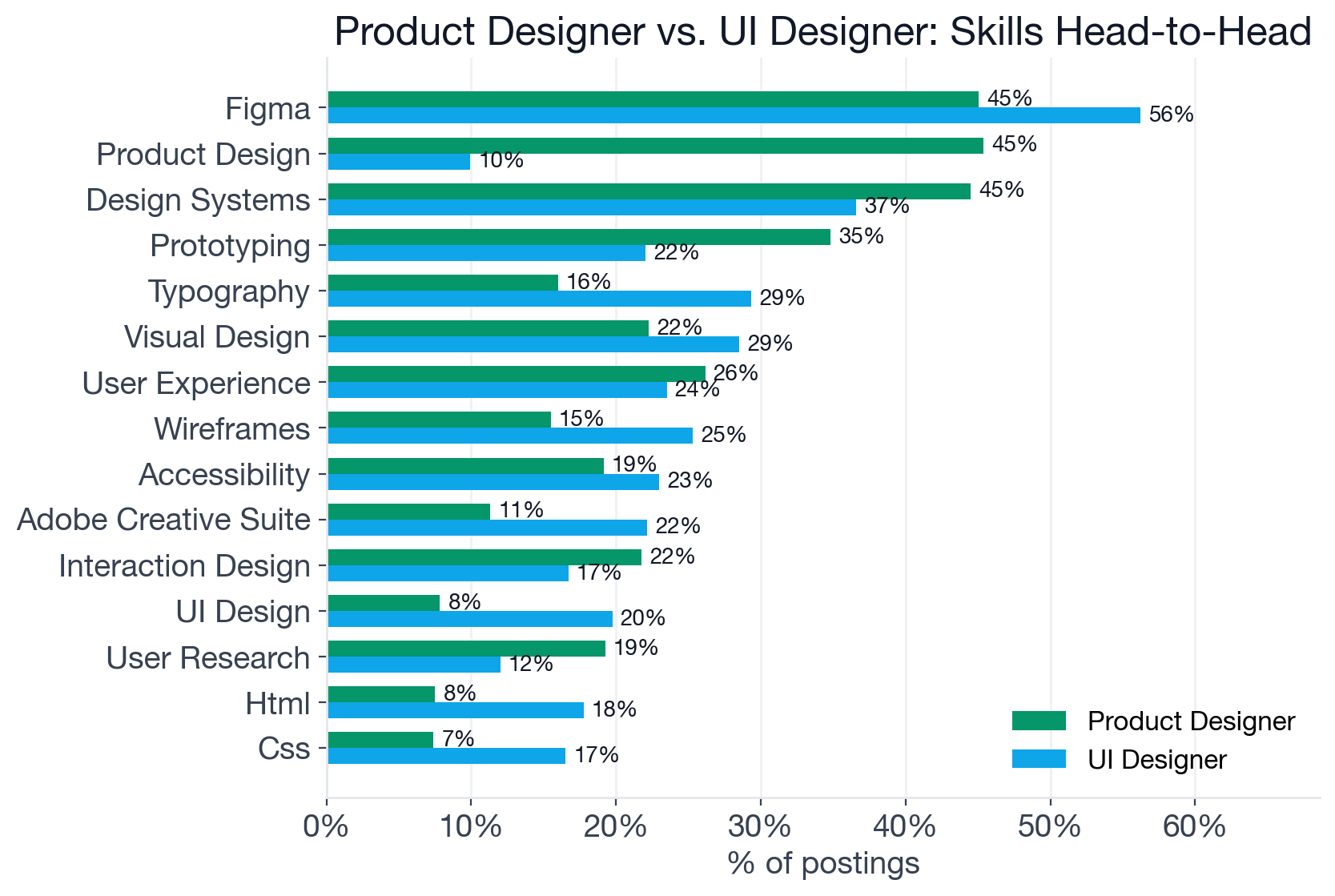 Figma, Design Systems, and Prototyping anchor both roles; the gap opens once you get to strategy and business-facing skills.
The one shared skill that isn't actually shared evenly is the role's own namesake. "Product Design" appears in 45.4% of Product Designer postings but only 9.9% of UI Designer postings, a 4.6x gap. That's the clearest signal these are adjacent jobs, not identical ones: the craft skills transfer, the ownership doesn't.
The Skills That Divide Strategy From Execution
Product Strategy (10.0% of Product Designer postings), Automation (9.1%), and Product Management (8.1%) are Product Designer's clearest differentiators: none of them crack UI Designer's top-30 skill list at all, whose 30th-ranked skill sits at 6.4% of postings. These are business-facing skills: they describe someone deciding what to build, not just how it looks.
UI Designer's differentiators run the other direction. Branding (11.8%) and Web Design (9.8%) are its clearest signals, and neither cracks Product Designer's top-30 skill list, whose 30th-ranked skill sits at 6.1% of postings. Both are visual-execution disciplines, brand consistency and layout, not strategic ownership.
Neither role's top skills list includes an explicit AI or ML skill; the closest either gets is buried in Product Designer's salary-linked data, where Generative AI (n=60) and LLMs (n=35) both price above its baseline. UI Designer has no equivalent entries at this sample size. That doesn't mean UI Designers aren't using AI: separate 2026 design-industry surveys (Figma's State of the Designer, the AI in Design Report 2026) find generative-AI adoption among designers at 72%, with weekly use as high as 91%, up sharply from 54% a year earlier. Job postings staying quiet on AI reflects assumed craft, the same way "knows Figma" stopped needing to be spelled out. What differs is the use case: Product Designer postings that do name AI skew toward evaluating strategic options; UI Designer's AI use, per industry write-ups, leans toward accelerating visual production.
Who Actually Earns the $60,000?
Product Designer's median US base salary is $167,500 (n=931 with US salary disclosed) versus UI Designer's $107,500 (n=141), a $60,000 (55.8%) gap. Equity, bonus, and sign-on aren't disclosed in postings and aren't in this dataset, so total comp at senior levels runs higher on both sides than these figures show. UI Designer's sample is about six times smaller than Product Designer's, so treat its median as directional rather than precise.
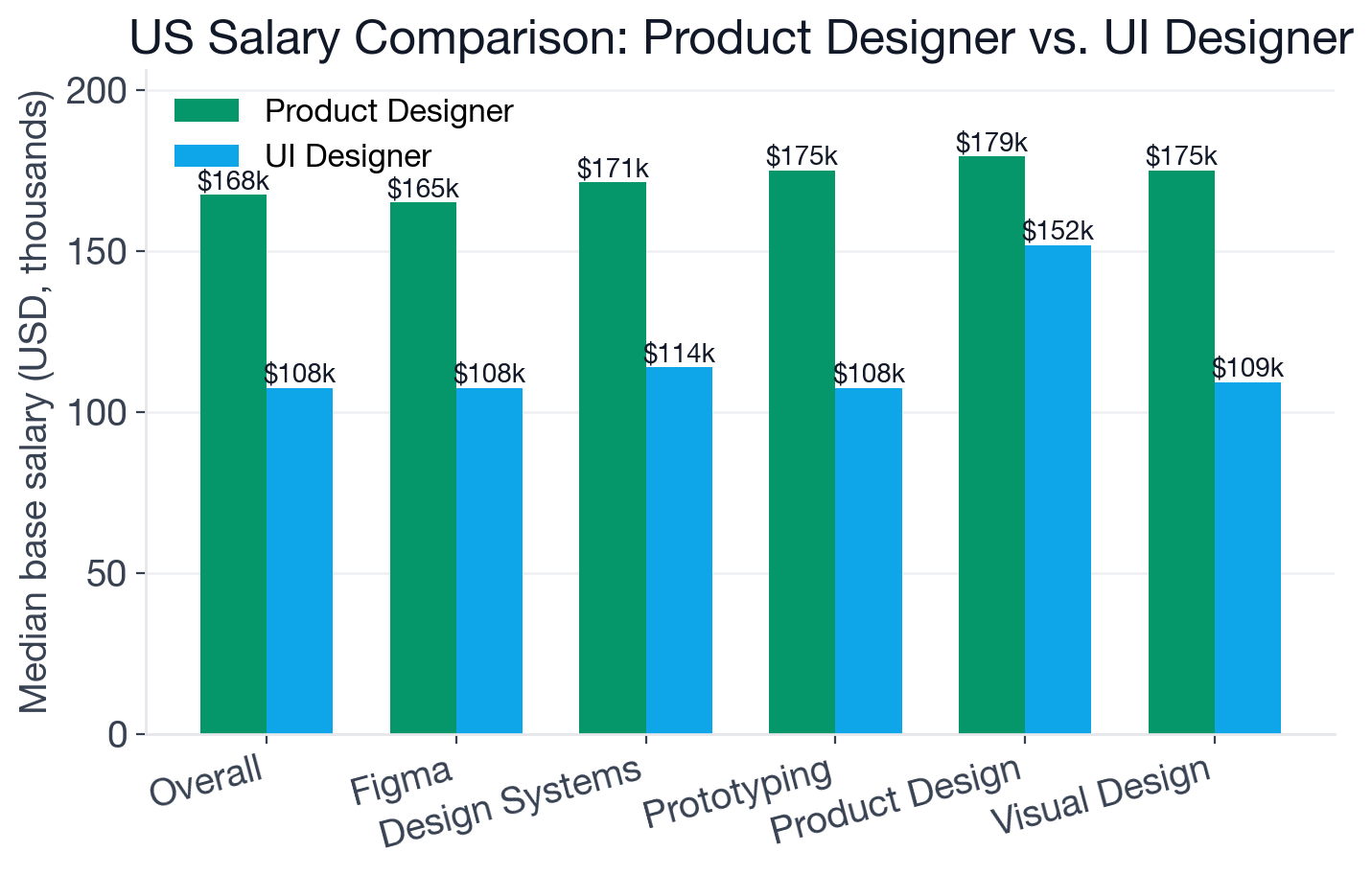 Product Designer's median outpaces UI Designer's by $60,000; the skills that clear each role's own baseline tell a strategy-versus-execution story.
On Product Designer's own data, Design Strategy carries the single largest premium (+$42,500, n=89), and two of its three exclusive skills price above baseline too: Product Strategy adds $16,300 (n=152) and Product Management adds $9,000 (n=119). Automation, the third, is roughly flat (-$1,800, n=87). Postings that ask for Branding, UI Designer's top differentiator, actually pay $61,900 below Product Designer's baseline (n=28) on the rare occasions they show up in Product Designer postings at all, reinforcing that Branding reads as production work wherever it appears.
UI Designer's own numbers hold a genuine surprise. Product Design, present in only 9.9% of its postings, is the highest-paid skill in its entire salary table at $151,800 (n=34), a $44,300 premium over UI Designer's own baseline. Figma, by contrast, the single most common skill for either role (56.2% of UI Designer postings), prices at exactly UI Designer's baseline ($107,500, n=67): no premium at all. It's the entry ticket, not the differentiator.
The Easier Door Leads to a Lower Ceiling
Product Designer postings outnumber UI Designer postings 3.8x (3,635 versus 957), more surface area on the Product Designer side. But volume isn't accessibility. UI Designer postings are 8.2% entry-level versus Product Designer's 4.5%, nearly double, making UI Designer the easier way in. Once inside, the paths split: UI Designer's staff-level share is just 5.0% versus Product Designer's 19.3%, roughly a 4x gap, and mid-level roles absorb two-thirds of UI Designer postings (66.5%) versus under half of Product Designer's (47.3%). UI Designer reads as a role people move through, not one they stay senior in.
Geography reinforces the split: 45.0% of Product Designer postings are US-based versus 27.7% for UI Designer, whose next-largest markets (Germany, India, Canada) each sit under 6%. Work mode is close between the two (roughly 29% remote and 20-24% hybrid for each), so remote flexibility isn't what separates them; geography and the seniority ceiling are.
Which Should You Choose?
Choose Product Designer if you:
- Want to own a problem from research through launch, not just execute an already-approved direction
- Are comfortable partnering directly with PMs and engineers on what to build, not only how it looks
- Want the higher pay ceiling and can compete where staff-level openings (19.3%) outnumber entry-level ones (4.5%) by roughly 4 to 1
Choose UI Designer if you:
- Want to specialize in visual craft, typography, systems, brand consistency, rather than business strategy
- Are earlier in your career and want the more accessible entry point (8.2% of postings versus 4.5%)
- Are comfortable with a lower pay ceiling and a shorter progression than Product Designer offers
How to Use This in Your Job Search
If your current title is UI Designer and your day-to-day already touches product strategy, research synthesis, or roadmap decisions, that's the strongest case for testing the Product Designer market: the two roles already overlap 71% on skills, so the gap to close is scope, not tools. Browse current UI Designer openings or Product Designer openings, and check Product Designer roles that specifically ask for Product Strategy to gauge the bar.
Before an interview loop, practice with AI mock interviews built around your target role, and use the question bank to drill portfolio-review and strategy-framing questions, since that's where these two loops diverge hardest. For a full breakdown of each role, see our deep dives on Product Designer skills and UI Designer skills; if UX Designer is also on your shortlist, see how it stacks up against Product Designer too.
FAQ
Q. What's the salary difference between a Product Designer and a UI Designer?
Product Designer postings show a median US base salary of $167,500 (n=931) versus $107,500 for UI Designer (n=141), a $60,000 (55.8%) gap. Equity, bonus, and sign-on are not included in this data, and UI Designer's much smaller sample size means its figure carries more uncertainty than Product Designer's.
Q. Do Product Designer and UI Designer share the same skills?
Mostly, yes. The two roles share a 71% skill overlap (Jaccard similarity on each role's top 30 skills), a high overlap for two distinct design titles. Figma, Design Systems, and Prototyping rank among the top skills for both.
Q. Is UI Designer a good entry-level role compared to Product Designer?
Yes, more so. UI Designer postings are 8.2% entry-level versus Product Designer's 4.5%, nearly double. But UI Designer's staff-level share is only 5.0% versus Product Designer's 19.3%, so it's an easier door in and a noticeably lower ceiling.
Q. What skills are exclusive to Product Designer but not UI Designer?
Product Strategy (10.0% of Product Designer postings), Automation (9.1%), and Product Management (8.1%) appear often enough in Product Designer postings to count as real differentiators, and none of them crack UI Designer's top-30 skill list, whose 30th-ranked skill sits at 6.4% of postings.
Q. What skills are exclusive to UI Designer but not Product Designer?
Branding (11.8% of UI Designer postings) and Web Design (9.8%) are UI Designer's clearest differentiators, and neither cracks Product Designer's top-30 skill list, whose 30th-ranked skill sits at 6.1% of postings.
Q. Does knowing Figma guarantee a Product Designer level salary?
No. Figma is the single most common skill for UI Designer, appearing in 56.2% of its postings, but it prices at exactly UI Designer's own baseline ($107,500, n=67), no premium at all. It's the entry ticket for the role, not a differentiator.
Q. Do Product Designer and UI Designer postings ask for AI skills?
Explicit AI or ML mentions are rare for both roles, below the roughly 6% threshold that would place them in either role's top-30 skill list. Product Designer postings that do name Generative AI (n=60) or LLMs (n=35) pay above that role's own baseline; UI Designer shows no equivalent entries at this sample size. Separate 2026 design-industry surveys (Figma's State of the Designer, the AI in Design Report 2026) find generative-AI adoption among designers at 72%, with weekly use reported as high as 91%, so the near-silence in job postings reflects assumed craft, not absent usage.
The Fastest Raise Might Be a New Title
Product Designer and UI Designer share a 71% skill overlap, yet the $60,000 gap isn't explained by a different toolkit: it's explained by scope, strategy ownership versus visual execution, and by a ceiling that Product Designer simply has more room under. For a UI Designer already doing strategy-adjacent work without the title to match, that's a real opening. Browse live Product Designer or UI Designer postings on InterviewStack.io to see where you fit today.
Topics
Ready to practice?
Put what you've learned into practice with AI mock interviews and structured preparation guides.