
Each Role's Signature Skill Is Invisible to the Other
Security Architect and Penetration Tester get lumped together as "cybersecurity jobs" more often than the data supports. More than a third of the combined skill vocabulary overlaps (a 0.36 Jaccard overlap on the top-30 skill lists from each), but the skill that defines each role never shows up on the other's list at all: Security Architecture appears in 65.1% of Security Architect postings and doesn't crack Penetration Tester's top 30, and Penetration Testing appears in 54.4% of Penetration Tester postings and doesn't crack Security Architect's. We pulled every active posting for both roles from the InterviewStack.io job board as of September 2026, 1,106 for Security Architect and 711 for Penetration Tester, skills extracted from descriptions with synonyms merged.
That split lines up with a real pay gap. Security Architect's median US base salary is $184,000, a $41,600 (29.2%) premium over Penetration Tester's $142,400. Equity, bonus, and sign-on aren't disclosed in posting data and aren't in these figures, so total compensation runs higher on both sides. The premium doesn't track who touches more tools; it tracks who owns the design.
| Security Architect | Penetration Tester | |
|---|---|---|
| Median US base salary | $184,000 | $142,400 |
| Active postings | 1,106 | 711 |
| Top skill | Security Architecture (65.1%) | Penetration Testing (54.4%) |
| Onsite share | 43.6% | 62.6% |
| Staff-level share | 14.7% | 8.2% |
| Skill overlap (Jaccard) | 36% shared (pairwise) | 36% shared (pairwise) |
Key Findings
- Security Architect pays a $41,600 (29.2%) higher US median base salary than Penetration Tester: $184,000 vs $142,400.
- The two roles' top-30 skill lists overlap 36% (Jaccard), yet each role's own headline skill, Security Architecture (65.1%) and Penetration Testing (54.4%), never cracks the other's top 30.
- Security Architect postings skew toward staff-level seniority almost twice as often as Penetration Tester: 14.7% vs 8.2% (seniority defaults to mid-level when a title has no explicit modifier, so a bare "Security Architect" title likely undercounts true seniority here).
- Penetration Tester postings run far more onsite than Security Architect (62.6% vs 43.6%), and hybrid arrangements are more than 2x rarer for testers (16.7% vs 36.3%).
- Security Architect carries 1.56x the posting volume of Penetration Tester: 1,106 vs 711 active postings.
- Regulatory Compliance is Security Architect's top salary premium at +$30,100 (n=25); Automation adds the same +$30,100 for Penetration Tester (n=40).
- RLHF appears in 18.85% of Penetration Tester postings, but one staffing firm, Mercor, accounts for 22% of the role's distinct openings, and RLHF-tagged postings median just $43,700, far below the $142,400 baseline.
- Only 2.1% of Security Architect postings are explicitly entry-level, versus 4.2% for Penetration Tester; both remain hard roles to break into cold.
One Role Designs the Defense, the Other Tests It
A Security Architect's week runs on paper before it runs on a keyboard: threat models, Zero Trust rollouts, IAM policy, sign-off on whether a new cloud service clears the org's risk bar. The output is a design decision other teams have to live with. A Penetration Tester's week is spent trying to break that design, scoping an engagement, exploiting a target, writing up exactly how an attacker would get in. The output is a finding someone else has to fix.
That split shows up cleanly in each role's exclusive skills. Security Architect's list, Zero Trust, IAM, Risk Assessment, SIEM, Encryption, Firewalls, DevSecOps, is a governance vocabulary. Penetration Tester's list, Linux, Windows, PowerShell, Bash, Java, Active Directory, is an execution vocabulary: the tooling you need to actually operate inside someone else's environment.
What Actually Carries Over Between the Two Roles?
Both roles demand cloud security, risk management, monitoring, and incident response in a meaningful share of postings, but not at the same rate: Cloud Security spans 40.4% of Security Architect postings versus just 11.5% of Penetration Tester's, the widest split of the 15 shared skills. Vulnerability Management is the closest thing to common ground, 16.8% vs 14.9%, with Automation nearly as even (20.4% vs 18.0%).
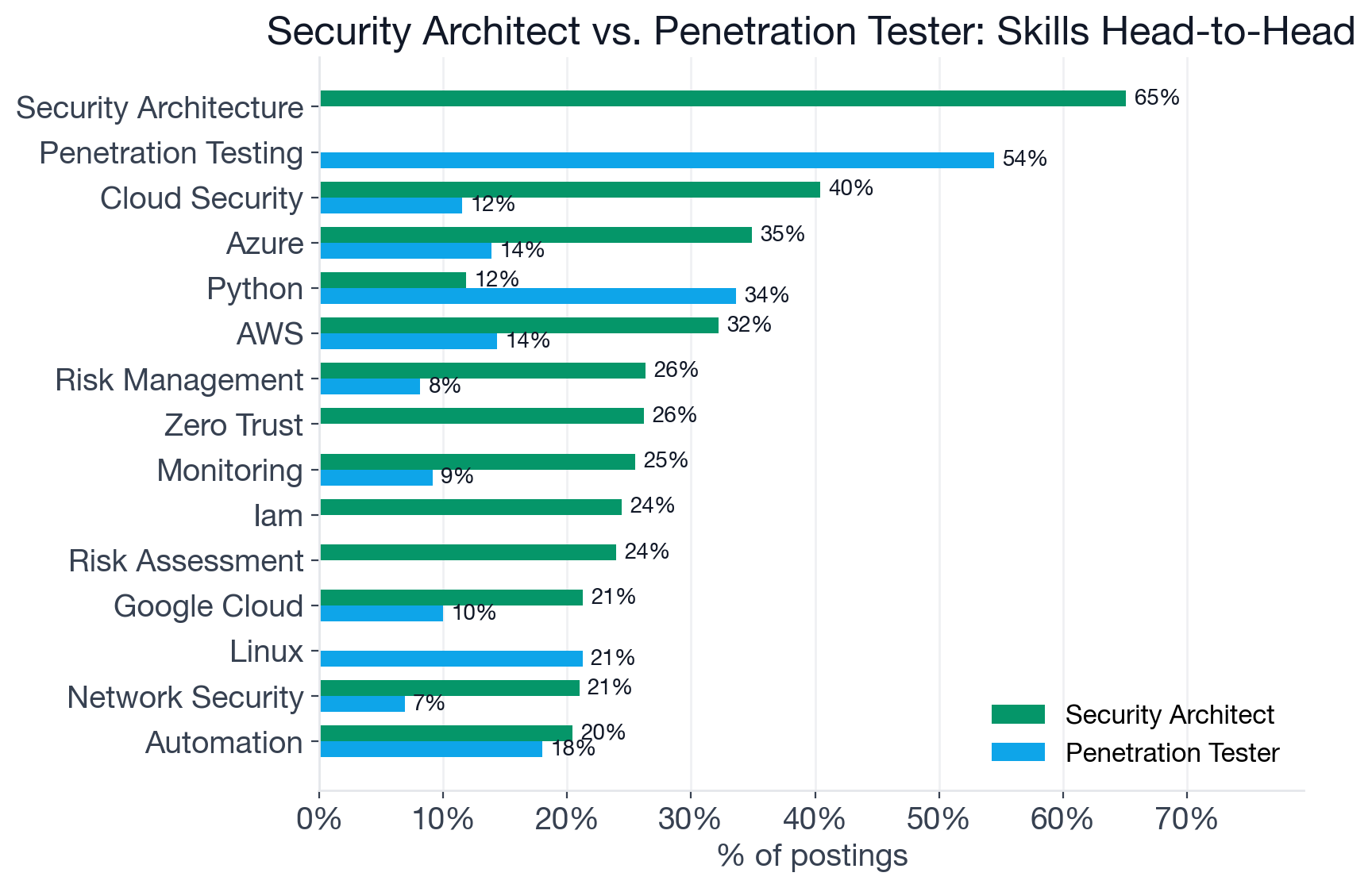 Cloud platforms and risk-adjacent skills carry over into both roles; the identity skills at the top of each list, Security Architecture and Penetration Testing, don't appear on the other's chart at all.
| Shared skill | Security Architect | Penetration Tester |
|---|---|---|
| Cloud Security | 40.4% | 11.5% |
| Azure | 34.9% | 13.9% |
| AWS | 32.2% | 14.3% |
| Automation | 20.4% | 18.0% |
| Vulnerability Management | 16.8% | 14.9% |
| Risk Management | 26.3% | 8.2% |
| Incident Response | 20.2% | 12.0% |
For someone with a cloud-security or risk-management background, this is the part of either job you won't have to relearn. Python is the most dramatic shared skill that flips direction: 33.6% of Penetration Tester postings ask for it against just 11.8% of Security Architect postings, a reminder that Security Architect leans policy even where scripting shows up. OWASP flips the same way on a narrower gap (13.5% Penetration Tester vs 8.8% Security Architect).
Where Do Security Architect and Penetration Tester Diverge?
Security Architect's exclusive cluster (skills clearing 8% here and under 5% on the other side) is Zero Trust (26.2%), IAM (24.4%), Risk Assessment (24.0%), SIEM (19.1%), Encryption (17.2%), Identity and Access Management (15.3%), Firewalls (14.5%), and DevSecOps (13.9%), all about deciding and enforcing policy, not exploiting a gap in it.
Penetration Tester's exclusive cluster starts as expected, Linux (21.2%), Windows (17.6%), PowerShell (11.4%), hands-on offensive tooling. But RLHF (reinforcement learning from human feedback, the technique used to fine-tune AI models on human ratings) ranks third at 18.85%, ahead of Windows. That signal is real but narrow: one staffing firm, Mercor, accounts for 22% of Penetration Tester's distinct postings, the largest single-employer concentration in either role's data, with title samples including "AI Safety Expert - Red Team." RLHF-tagged postings median just $43,700, nearly $98,700 below the role's $142,400 baseline, consistent with contract AI red-teaming gig work rather than the infrastructure and application pentesting most of this role's postings describe. Treat it as a distinct sub-market inside the label, not evidence that core pentesting pay has shifted toward AI.
The RLHF/AI-red-team cluster isn't the only adjacent-role bleed under the Penetration Tester label. A manual read of the role's sampled titles also turns up vulnerability-management leads, remediation analysts, and embedded-security vulnerability analysts, defensive and GRC-flavored roles, not offensive testing, sitting alongside genuine "Penetration Tester" and "Red Team Operator" titles. That likely nudges shared-skill frequencies like Vulnerability Management and Threat Intelligence upward versus what a purely offensive-testing sample would show, and it's also the more plausible source of skills like TypeScript in the exclusive-skill list than actual pentest tooling. None of it changes the direction of this comparison (Penetration Testing itself is still the label's dominant skill at 54.4%), but treat Penetration Tester's own skill percentages as directionally right rather than exact.
The ambient picture looks different from either job-posting signal. A SANS Institute 2026 AI survey of security practitioners found AI use in cybersecurity work jumped from 50% to 78% year over year, well beyond what posting language captures. For Security Architect, AI shows up less as a tool you run and more as a governance surface, AI risk inside a threat model, Zero Trust for AI workloads, evaluating whether an AI security product does what it claims. Neither role's posting-level silence on AI (outside the RLHF cluster) means practitioners aren't using it; it means the postings haven't caught up.
Which Role Pays More?
Security Architect, by $41,600 at the median US base salary, $184,000 versus $142,400 for Penetration Tester, a 29.2% premium. These figures cover base pay only from postings with US salary disclosed (Security Architect n=239, Penetration Tester n=176); equity, bonus, and sign-on aren't in job-posting data, so total compensation at top employers runs higher for both roles.
On Security Architect's own numbers, the standout premium is Regulatory Compliance at $214,100 (+$30,100, n=25), a compliance skill rather than a technical one, fitting a role built around governance. Security Operations (+$8,800, n=39) and Incident Response (+$6,000, n=66) also clear baseline; DevSecOps, despite being an exclusive skill, actually prices $21,500 below Security Architect's own median (n=33).
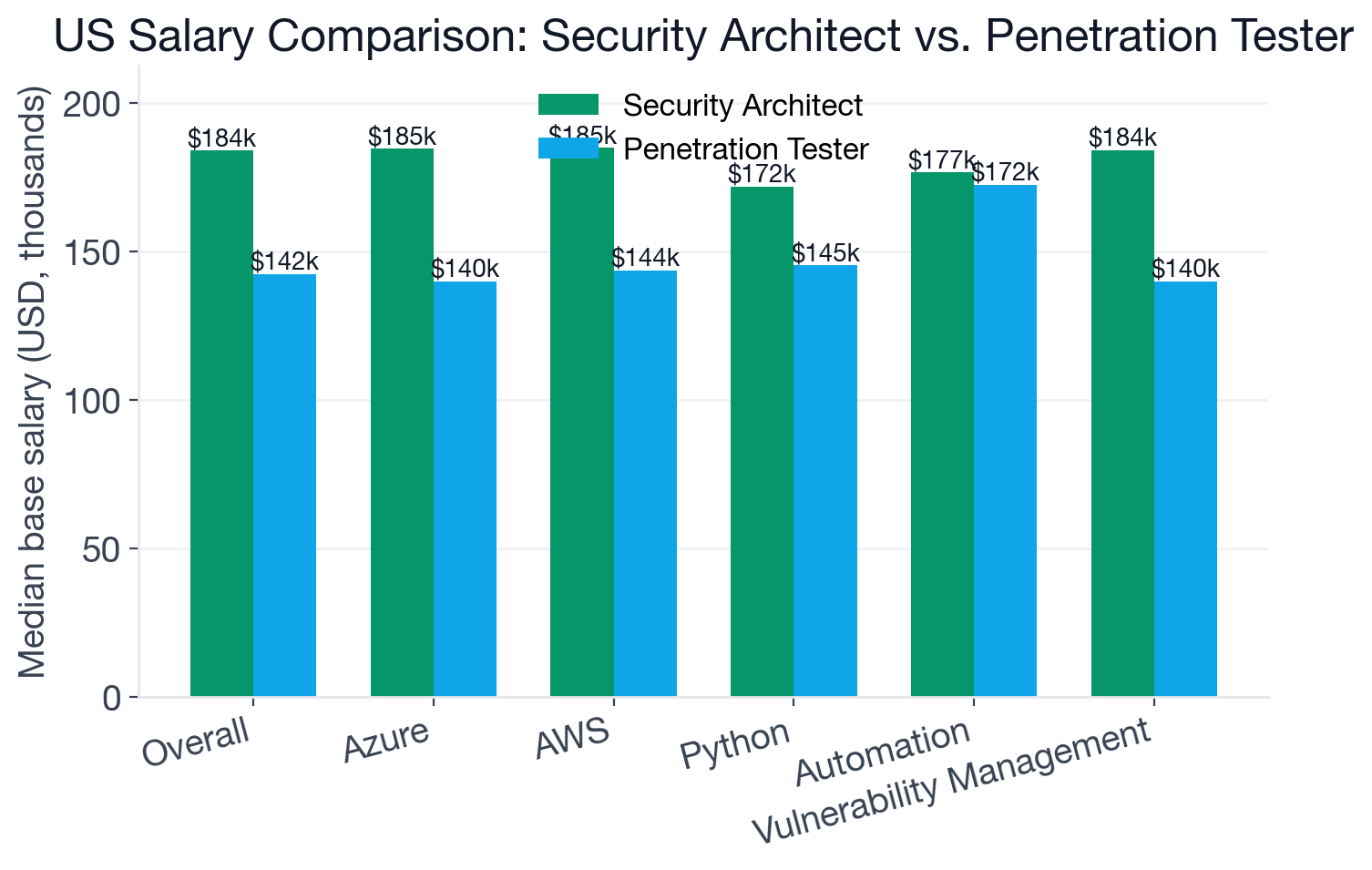 Security Architect's US base salary baseline sits $41,600 above Penetration Tester's; on Penetration Tester's own data, even its best-paid skills top out closer to the Security Architect floor than above it.
On Penetration Tester's own numbers, Automation (+$30,100, n=40) and C++ (+$28,900, n=28) carry the largest premiums, with Threat Intelligence close behind (+$25,100, n=25). Penetration Testing itself, the role's core identity skill, prices $6,400 below its own baseline (n=94): the skill that defines you on paper isn't always the one that pays.
Which Role Is Easier to Break Into?
Neither role is a natural first job, but they fail entry-level candidates differently. Only 2.1% of Security Architect postings are explicitly entry-level, with 62.8% at mid-level, meaning most hiring assumes security experience elsewhere. Penetration Tester has double the entry share (4.2%), still low in absolute terms, but its ceiling is lower too: Security Architect's staff-level share (14.7%) is nearly double Penetration Tester's (8.2%), part of what the salary premium reflects. One methodology note worth flagging: seniority here is inferred from title keywords, and a posting titled simply "Security Architect" with no seniority modifier defaults to mid-level. A large share of the Security Architect title sample is exactly that, a bare title with no "Senior," "Staff," or "Principal" attached, so the true staff/senior share for Security Architect is likely somewhat higher than the 62.8% mid-level figure implies.
Work mode splits sharply too. Security Architect runs 43.6% onsite, 36.3% hybrid, 14.8% remote. Penetration Tester runs 62.6% onsite and just 16.7% hybrid, with remote share (17.2%) slightly ahead of Security Architect's. In practice, Penetration Tester work tends to be fully onsite or fully remote, with far less hybrid middle ground. Both roles concentrate in the US (33.5% Security Architect, 39.9% Penetration Tester); Security Architect's next market is India (14.0%), Penetration Tester's is the UK (8.4%).
Design the Defense, or Go Break It
Choose Security Architect if you:
- Want to design and own security decisions, not probe someone else's.
- Already have hands-on cloud, risk, or IAM experience: Cloud Security, Azure, and AWS carry over cleanly.
- Want a hybrid-friendly schedule and a realistic staff-level ceiling; entry is hard either way, so this pays off once you're not starting from zero.
Choose Penetration Tester if you:
- Want hands-on offensive work: scoping, exploiting, and reporting.
- Want to build general-purpose technical depth (Linux, Windows, scripting) over a security-specific credential stack.
- Can work with a more binary onsite-or-remote arrangement and want a slightly more accessible, if still competitive, entry point.
How to Use This in Your Job Search
If you're weighing these two paths, practice with AI mock interviews against the cluster each role actually tests for: threat modeling and IAM scenarios for Security Architect, exploit-chain and reporting scenarios for Penetration Tester. The question bank is a faster way to drill Zero Trust, risk assessment, or OWASP-style questions once you know which stack you're targeting, and our interactive courses cover the security and cloud fundamentals both roles assume you already have. For a deeper look at either role on its own, see our breakdowns of Security Architect skills and Penetration Tester skills. Once you've picked a lane, browse live Security Architect postings or Penetration Tester postings to see what's open now.
FAQ
Q. Which pays more, Security Architect or Penetration Tester?
Security Architect, by $41,600 at the median US base salary in 2026 ($184,000 vs $142,400 for Penetration Tester), a 29.2% premium. These are base-salary figures only; equity, bonus, and sign-on are not disclosed in job postings, so total compensation at senior levels runs higher for both roles.
Q. Do Security Architect and Penetration Tester share the same skill set?
Partially. About 36% of their combined top-30 skill vocabulary overlaps, including cloud platforms, risk management, incident response, and monitoring. But each role's own identity skill is essentially absent from the other's list: Security Architecture appears in 65.1% of Security Architect postings and doesn't crack Penetration Tester's top 30, and Penetration Testing appears in 54.4% of Penetration Tester postings and doesn't crack Security Architect's top 30.
Q. Is RLHF a real Penetration Tester skill in 2026?
It's real but concentrated. RLHF (reinforcement learning from human feedback) shows up in 18.85% of Penetration Tester postings, but one staffing firm, Mercor, accounts for 22% of the role's distinct openings, and RLHF-tagged postings carry a median salary of just $43,700, well below the role's $142,400 baseline. That points to a separate AI red-teaming gig-labor segment, not a shift in core penetration-testing pay or demand.
Q. Which role is easier to break into?
Neither is genuinely entry-friendly, but Penetration Tester has roughly double the entry-level share: 4.2% of postings versus 2.1% for Security Architect. Security Architect instead skews toward staff-level seniority (14.7% of postings, versus 8.2% for Penetration Tester), reflecting its position as a role you typically grow into rather than start in. Note that seniority is inferred from title keywords and defaults to mid-level when a posting has no explicit modifier, so a bare "Security Architect" title likely undercounts true seniority; the staff-level gap is probably a floor, not a ceiling.
Q. Which role has more open positions?
Security Architect, with 1,106 active postings analyzed versus 711 for Penetration Tester, a 1.56x volume advantage.
Q. Is Penetration Tester a remote-friendly role?
Not especially, and less so than Security Architect. Penetration Tester postings are 62.6% onsite versus 43.6% for Security Architect, and hybrid arrangements are far less common (16.7% vs 36.3%). Remote share is close between the two roles (17.2% Penetration Tester, 14.8% Security Architect), meaning Penetration Tester work tends to be either fully onsite or fully remote, with less middle ground.
Q. Should I target Security Architect or Penetration Tester?
Target Security Architect if you want to design and govern security controls, prefer a hybrid-friendly schedule, and are aiming for a staff-level ceiling. Target Penetration Tester if you want hands-on offensive work, can work with a more binary onsite-or-remote arrangement, and want to enter with a slightly lower experience bar.
The Job Title Tells You More Than the Skill List Does
Cloud platforms, risk management, and monitoring show up on both sides of this comparison, which is why the two roles get confused for near-substitutes. But the skills that actually define each job, and the $41,600 gap between them, don't come from the shared middle of the list. They come from the two skills that never appear on both: the one that means you designed the control, and the one that means you broke it.
Topics
Ready to practice?
Put what you've learned into practice with AI mock interviews and structured preparation guides.