
One Role Gets Paid for Its Own Skills. The Other Doesn't.
Line up each role's own defining skills against its own median pay and a clean split appears. Every one of Site Reliability Engineer's (SRE) core exclusive skills, Terraform, Observability, Infrastructure as Code, sits at or above SRE's own baseline. Eight of Systems Administrator's ten defining exclusive skills, Windows, Active Directory, Windows Server, sit at or below its own baseline. Same idea, get paid for what the job actually asks of you, opposite outcome depending on which title is on the posting.
We pulled every active Systems Administrator and SRE posting that passes the same quality filter used on the InterviewStack.io job board: 4,273 for Systems Administrator, 3,510 for SRE, as of July 2026. SRE runs a $35,100 higher median US base salary, but the more useful number is where that gap actually lives.
Both counts carry some noise from adjacent job families the title-matching picks up: Systems Administrator's is a mix of generic "IT Specialist" postings and a handful of apprenticeship/technician-level titles, while SRE's is a share of industrial and hardware "Reliability Engineer" titles (automotive, aerospace, electrical, manufacturing) that share the job-title vocabulary but aren't software SRE roles at all. The skill and salary figures below hold up regardless: SRE's top skills stay cloud/software-native top to bottom, but the true count of software SRE postings is likely somewhat smaller than the 3,510 headline number.
| Systems Administrator | Site Reliability Engineer (SRE) | |
|---|---|---|
| Median US base salary | $115,000 | $150,100 |
| Active postings | 4,273 | 3,510 |
| Top skill | Monitoring (38.6%) | Monitoring (55.6%) |
| Hybrid + remote share | 36.1% | 50.1% |
| Entry-level share | 2.8% | 1.8% |
| Skill overlap (Jaccard) | 22% | 22% |
Key Findings
- SRE's median US base salary is $150,100 versus $115,000 for Systems Administrator, a $35,100 premium (about 31% above the Systems Administrator baseline).
- Eight of Systems Administrator's ten defining exclusive skills (Windows, Active Directory, Windows Server, and others) sit at or below its own $115,000 baseline; the two exceptions, System Administration itself (+$1,700) and TypeScript (+$12,100), are essentially flat or likely a cross-role artifact rather than a genuine premium.
- Every one of SRE's ten defining exclusive skills sits at or above its own $150,100 baseline; Terraform and Infrastructure as Code each add $24,400.
- The two roles share only a 22% Jaccard overlap across their top 30 skills.
- Systems Administrator carries 1.22x the posting volume (4,273 vs. 3,510) but skews mid-level (76.3%); SRE skews senior or staff (48.3% combined).
- Half (50.1%) of SRE postings offer remote or hybrid work versus 36.1% for Systems Administrator.
- Azure is nominally a shared skill but pays $3,100 below Systems Administrator's baseline and $7,000 above SRE's, the same tool moving in opposite directions.
- Entry-level postings are thin for both roles: 2.8% for Systems Administrator, 1.8% for SRE.
What Does Each Job Actually Involve?
A Systems Administrator keeps an organization's own IT estate alive: patching Windows and Linux servers, managing Active Directory and user identity, keeping VMware hosts and DNS/DHCP running, and fielding the ticket when a VPN or file share goes down. The work is internal-facing, largely reactive, and still anchored in on-prem or lightly virtualized infrastructure at many employers.
A Site Reliability Engineer keeps someone else's product alive in production: writing Terraform to provision infrastructure, instrumenting services with observability tooling, carrying the on-call pager, and running the postmortem after an incident. The work is external-facing, proactive by design, and shipped through code and CI/CD rather than a console click.
Which Skills Do Systems Administrator and SRE Both Require?
Monitoring is each role's single most-cited skill, but at very different intensities: 38.6% of Systems Administrator postings versus 55.6% of SRE postings. Automation follows the same shape (30.0% vs. 55.4%). Linux is the one skill that's genuinely balanced, 34.9% vs. 34.5%, a gap of four-tenths of a point, smaller than any other shared skill. Past those three, the list tilts hard toward SRE: Python (15.5% vs. 49.1%), AWS (16.6% vs. 39.8%), and Kubernetes, which technically clears the shared-skill threshold in both roles but still shows up 5.7 times more often in SRE postings (7.0% vs. 39.9%).
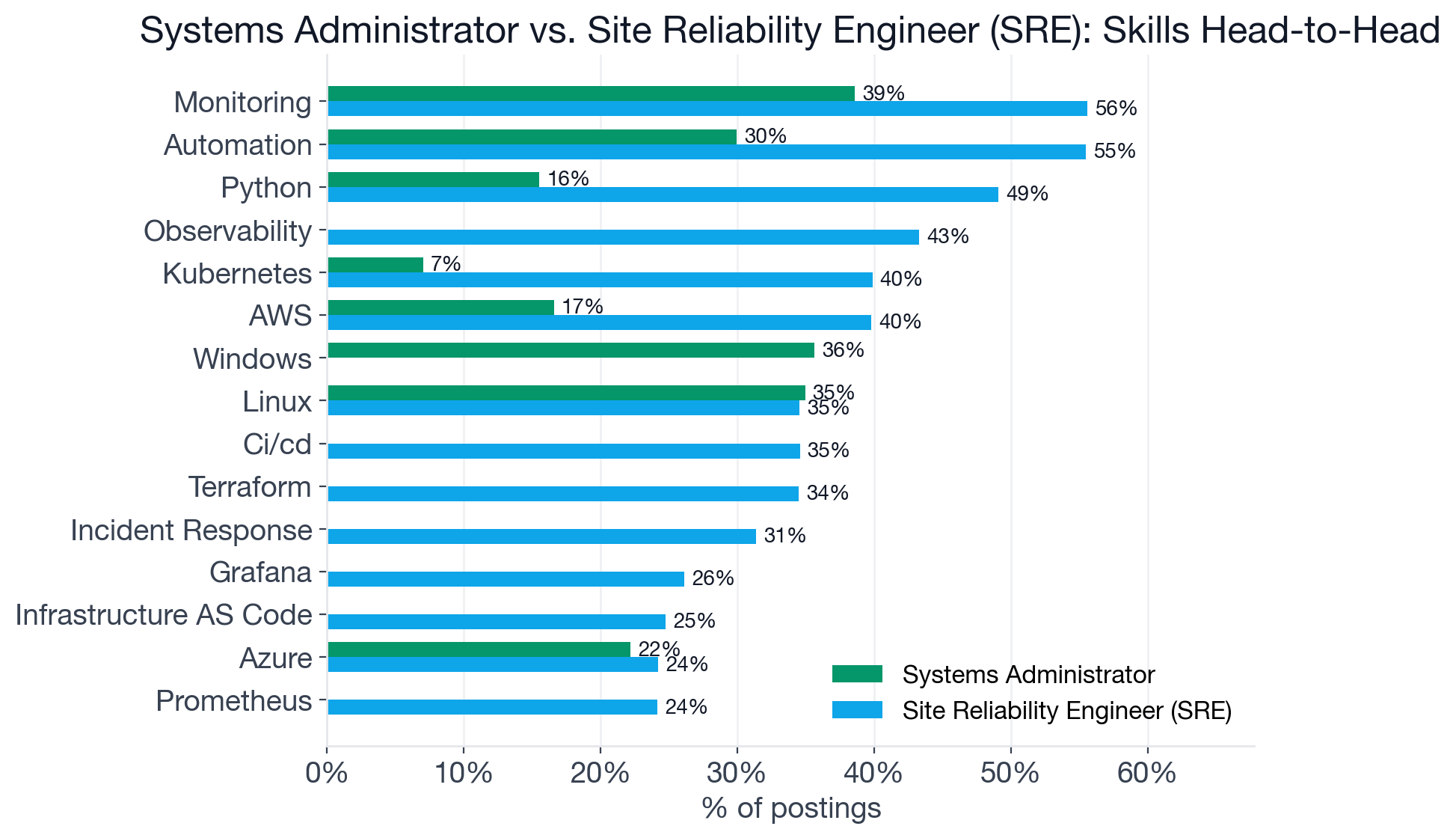 Monitoring and Linux are the closest thing to a level playing field here; everything else in the shared set skews toward SRE, several skills by 3x or more.
Where the Skill Sets Actually Split
Systems Administrator's exclusive cluster, Windows (35.6%), Active Directory (23.8%), VMware (23.6%), Windows Server (17.0%), DNS (17.0%), Technical Support (16.5%), describes identity and endpoint infrastructure: keeping a fleet of company-owned machines, directory services, and virtual hosts running for internal users.
SRE's exclusive cluster, Observability (43.3%), CI/CD (34.6%), Terraform (34.5%), Incident Response (31.3%), Grafana (26.1%), Prometheus (24.1%), describes a live production system: watching it, shipping changes to it safely, and getting paged when it breaks. These aren't two versions of the same job; they're two different things being kept alive, an internal IT estate versus an external-facing product.
Neither role's top-30 skill list names an explicit AI or ML skill (SRE's closest hits, Machine Learning and LLMs, sit at just 3 to 5% of US postings in the salary data, not the top 30). That's a posting-language silence, not a real-world one. Systems Administrators are earlier and more skeptical: only 45% say they currently know how to use AI tools, though most expect it to absorb specific tasks soon, 80% expect automated log analysis, 67% vulnerability prioritization, within about a year (Action1 2025 Sysadmin Survey). SREs are further along, mostly through tooling rather than a chat window: AI-using accounts on observability platforms see roughly 2x the alert-correlation rate and 27% less noise than non-AI accounts (InfoWorld: How AI Impacts Site Reliability Engineering), though toil reduction is uneven, about half of SREs report a real drop, the rest see no change (LogicMonitor: The SRE Report 2026). Both roles still trail developers' broader curve: 84 to 85% now use AI coding tools regularly (Stack Overflow, JetBrains, 2025), a bar SRE's code-heavy day is closer to than a sysadmin's ticket-and-console-driven one.
Systems Administrator vs. SRE: Which Pays More, and Why?
SRE, and not narrowly. Among US postings, base salary only (equity, bonus, and sign-on aren't disclosed in job postings), the median is $150,100 for SRE versus $115,000 for Systems Administrator, a $35,100 gap, about 31% above the Systems Administrator baseline.
Most of Systems Administrator's own defining skills don't clear a premium over its own baseline: Windows pays $110,000 (-$5,000, n=562), Active Directory $108,000 (-$7,000, n=349), Windows Server $105,000 (-$10,000, n=222), Technical Support $104,000 (-$11,000, n=232). Two exceptions sit above baseline: the literal label, System Administration, barely moves the needle ($116,700, +$1,700, n=304), and TypeScript pays $127,100 (+$12,100, n=384). TypeScript showing up among Systems Administrator's exclusive skills at all looks like a cross-role tooling artifact rather than a genuine core sysadmin requirement. The real lift comes from skills that actually belong to the other role: AWS (+$14,500, n=279), Ansible (+$13,300, n=196), Kubernetes (+$13,300, n=91), and a Terraform/Infrastructure-as-Code/CI-CD cluster that all land at $126,800 (+$11,800, n=51 to n=72).
SRE runs the opposite way. Its own defining skills mostly do clear a premium: Terraform and Infrastructure as Code each add $24,400 (n=251 and n=184), Observability adds $17,700 (n=366), Google Cloud adds $14,700 (n=154), Incident Response adds $9,900 (n=289), CI/CD and Grafana each add $4,900 (n=279 and n=157). Only Prometheus (+$1,600, n=144) and Root Cause Analysis (+$900, n=241) sit close to flat, and neither goes negative. For SRE, the job's own vocabulary is largely what the premium is paying for.
Azure makes the point in miniature. It's nominally a shared skill (22.2% of Systems Administrator postings, 24.2% of SRE postings), but it pays $3,100 below Systems Administrator's baseline ($111,900, n=256) and $7,000 above SRE's ($157,100, n=185). Same tool, opposite direction, depending on which role is asking for it.
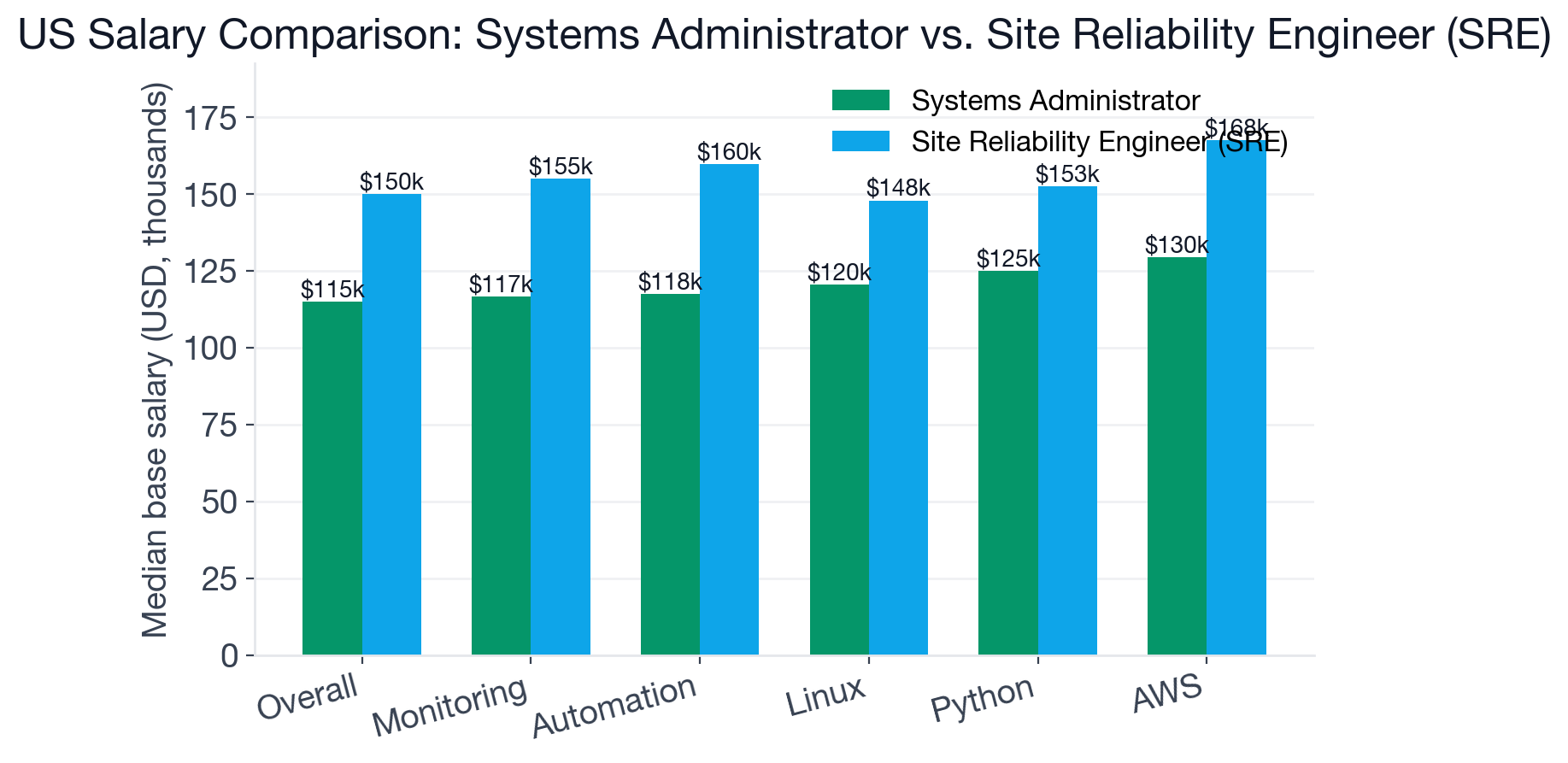 SRE's own defining skills sit at or above its baseline almost across the board; Systems Administrator's sit at or below, with the real premium one layer out in cloud and automation tooling.
How Accessible Is Each Role, and Where Are the Jobs?
Systems Administrator carries the larger pool, 4,273 active postings versus 3,510 for SRE, a 1.22x edge, and a mid-level-dominated mix: 76.3% of postings sit at mid-level, with senior and staff together at just 20.8%. SRE inverts that: only 49.8% mid-level, with senior (34.8%) and staff (13.5%) together accounting for 48.3%, nearly half the market. That seniority skew explains a real share of the pay gap: SRE isn't only a different job, it's a job posted disproportionately for people who already did the entry-level version of infrastructure work somewhere else. Entry-level share is thin either way, 2.8% for Systems Administrator, 1.8% for SRE, so neither is a soft landing for a total beginner.
Flexibility follows the seniority split. Half (50.1%) of SRE postings offer remote or hybrid work (19.1% remote, 31.0% hybrid) versus 36.1% for Systems Administrator (8.9% remote, 27.2% hybrid), which is 65.4% onsite. Geography diverges more mildly: Systems Administrator skews slightly more toward the US and Germany (51.2% US, 9.9% Germany), while SRE spreads further into India (11.6% vs. 4.7% for Systems Administrator).
Which Path Fits You?
Choose Systems Administrator if you:
- Already know Windows Server, Active Directory, and VMware, and would rather deepen that stack than start over in a cloud-native one.
- Want the larger current pool of open roles (4,273 vs. 3,510) and can accept that most of it (65.4%) is still onsite.
- Want a clear, addable pay lever without changing titles: AWS (+$14,500) and Ansible (+$13,300) are among the clearest, most job-relevant premiums to add inside the role today, part of the same cloud and automation cluster driving most of Systems Administrator's pay upside.
Choose Site Reliability Engineer if you:
- Want Terraform, observability, and incident response to be the core job, not a bonus skill layered on top of a different one.
- Value flexibility and a higher ceiling: 50.1% of postings are remote or hybrid, and the median pay sits $35,100 above Systems Administrator's.
- Are ready to compete at a more senior bar: 48.3% of SRE postings sit at senior or staff, more than double Systems Administrator's 20.8%.
Both roles have a narrow entry door, under 3% of postings, so expect some hands-on infrastructure experience either way. For how SRE compares to a more design-oriented neighbor, see Systems Engineer vs Site Reliability Engineer; for the full skill picture on either role, see Systems Administrator Skills Companies Want in 2026 and Site Reliability Engineer Skills in 2026.
If you're weighing the move, practicing incident-response and infrastructure-automation questions in an AI mock interview surfaces gaps in Terraform or observability fluency faster than reading docs, and the question bank has role-specific drills for both tracks.
FAQ
Q. What is the salary difference between Systems Administrator and Site Reliability Engineer (SRE)?
Site Reliability Engineer carries a median US base salary of $150,100 versus $115,000 for Systems Administrator, a $35,100 (about 31%) premium over the Systems Administrator baseline. These are base-salary figures from 902 and 1,242 US-salary-disclosing postings; equity, bonus, and sign-on aren't disclosed in job postings.
Q. How much skill overlap is there between Systems Administrator and SRE?
The two roles share a 22% Jaccard overlap across their top 30 skills. Monitoring, Automation, and Linux are the only skills that show up at meaningful frequency in both, and even those split unevenly: Automation appears in 55.4% of SRE postings versus 30.0% of Systems Administrator postings. Linux is the one genuinely balanced skill, 34.9% versus 34.5%.
Q. Do Systems Administrator's own core skills, like Windows and Active Directory, pay a salary premium?
Mostly not. Eight of Systems Administrator's ten defining exclusive skills sit at or below its own $115,000 baseline: Windows pays $110,000, Active Directory $108,000, Windows Server $105,000, Technical Support $104,000. Two exceptions sit above baseline: System Administration itself is essentially flat ($116,700, +$1,700), and TypeScript pays $127,100 (+$12,100), which looks like a cross-role tooling artifact rather than a genuine core sysadmin skill. The real premium comes from cloud and automation skills that are actually more central to SRE work: AWS (+$14,500), Ansible (+$13,300), and a Terraform/Infrastructure-as-Code/CI-CD cluster (+$11,800).
Q. Do SRE's own core skills pay a premium?
All of them do. Terraform and Infrastructure as Code each add $24,400 over SRE's $150,100 baseline, Observability adds $17,700, Incident Response adds $9,900, and Google Cloud adds $14,700. Unlike Systems Administrator, SRE's own defining vocabulary is largely what the premium is paying for, not an outside layer added on top of it.
Q. Which role is more accessible for someone starting out?
Neither is an easy first job. Entry-level postings make up 2.8% of Systems Administrator listings and 1.8% of SRE listings. Systems Administrator does carry more total volume (4,273 active postings versus 3,510) and a heavily mid-level-weighted mix (76.3%), while SRE skews senior and staff (48.3% combined), so the more common entry path runs through Systems Administrator or an adjacent role first.
Q. Which role offers more remote or hybrid work?
SRE does. 50.1% of SRE postings offer remote or hybrid work (19.1% remote, 31.0% hybrid) versus 36.1% for Systems Administrator (8.9% remote, 27.2% hybrid), which is 65.4% onsite.
Where the Paycheck Actually Comes From
Two roles that both watch systems for a living split hard on where the money attaches. Systems Administrator's own core skills, Windows, Active Directory, Windows Server, sit at or below its own baseline; the premium lives one layer out, in the cloud and automation tooling SRE treats as native. SRE's core skills mostly clear a premium on their own. If you're deciding between the two, that split is a more durable signal than the title: which skill set do you want to be the reason you get paid more, not the skill set you add on top of it afterward. Browse current Systems Administrator openings or Site Reliability Engineer openings on the InterviewStack.io job board to see where you'd land.
Topics
Ready to practice?
Put what you've learned into practice with AI mock interviews and structured preparation guides.