
Selenium Pays $16,100 Less Here and $25,000 More There
Selenium shows up in roughly a quarter of postings for both Test Automation Engineer (TAE) and Software Development Engineer in Test (SDET), the same tool, nearly the same frequency. But postings that mention it pay $16,100 below the Test Automation Engineer baseline and $25,000 above the SDET baseline. We looked at 2,270 active Test Automation Engineer postings and 1,044 active SDET postings on the InterviewStack.io job board as of August 2026, and Selenium isn't the only skill that flips sign depending on which title sits above it.
The two roles overlap heavily on paper: 76% Jaccard similarity (the share of each role's top-30 skill list the other role's list also contains). What that overlap hides is which specific skills carry a premium under each title.
| Test Automation Engineer | SDET | |
|---|---|---|
| Median US base salary | $120,100 | $130,000 |
| Active postings | 2,270 | 1,044 |
| Top skill | Automation (93.9%) | Automation (88.2%) |
| Remote share | 11.4% | 14.9% |
| Entry-level share | 1.9% | 2.6% |
| Skill overlap (Jaccard) | 76% shared | 76% shared |
A note on "Automation" as a skill: both title samples include a meaningful share of industrial, manufacturing, and controls-engineering postings (robotics automation, electrical/instrumentation automation, warehouse automation) that share the "Automation Engineer" title pattern but aren't software test automation roles. That inflates the top-line Automation percentage shown above; treat it as an upper bound. The more specific skills below (CI/CD, Python, Selenium, Playwright) are the cleaner signal of what these jobs actually require.
Key Findings
- Test Automation Engineer and SDET postings share 76% of their top-30 skills by Jaccard similarity, a high degree of overlap for two roles with distinct titles and hiring markets.
- SDET pays a median $130,000 US base salary (n=191) vs. $120,100 for Test Automation Engineer (n=405): a $9,900 (7.6%) gap.
- Test Automation Engineer has 2.17x the active postings (2,270 vs. 1,044), the larger and more accessible of the two roles.
- Selenium, Java, SQL, Automated Testing, and Root Cause Analysis all price below the Test Automation Engineer baseline but above the SDET baseline on the same postings, opposite economics for the same skills.
- SDET postings skew more senior: 37.3% are senior or staff level vs. 30.4% for Test Automation Engineer, and staff-level share alone is nearly double (13.6% vs. 7.6%).
- Entry-level hiring is rare for both roles: 1.9% of Test Automation Engineer postings and 2.6% of SDET postings.
- Docker, GitHub Actions, Linux, and Scalability are exclusive to SDET postings; Cucumber, C#, GitLab, and Project Management are exclusive to Test Automation Engineer postings.
- Neither role's top-30 skill list mentions AI tools explicitly, even though industry surveys report 72% of QA professionals already use AI to generate or optimize tests.
How Do These Two Jobs Actually Differ Day to Day?
Test Automation Engineer, in practice, is the QA-side automation job: writing and maintaining test scripts against an application someone else built, wiring them into a CI pipeline someone else owns. Cucumber (9.6%, a behavior-driven-development framework for writing test scenarios in plain English) and C# (9.7%) point to enterprise QA teams in .NET shops; Project Management (10.4%) and GitLab (9.2%) put the role close to release coordination, not infrastructure ownership.
SDET is the software-engineering version of the same idea: building and owning the test framework and the platform it runs on, not just the scripts inside it. Docker (14.9%), GitHub Actions (12.9%), Linux (10.7%), and Scalability (10.3%), all exclusive to SDET, describe someone who containerizes test environments and treats test infrastructure the way a backend engineer treats a production service. Full breakdowns: Test Automation Engineer skills and SDET skills.
What Skills Are Non-Negotiable for Both Roles?
Both roles demand automation, CI/CD, and Python in the majority of postings, the baseline that transfers completely if you're weighing one title against the other. Automation is close to universal on both sides (93.9% Test Automation Engineer, 88.2% SDET), and CI/CD (35.2%/38.8%), Test Automation itself (34.4%/36.6%), Python (30.0%/37.1%), and Agile (26.2%/29.1%) round out the top shared tier. Selenium (24.8%/22.4%) and Java (19.7%/22.7%) clear the shared-skill threshold too, at close to matched frequency, worth remembering since the salary section below shows frequency and pay pulling in opposite directions for those two.
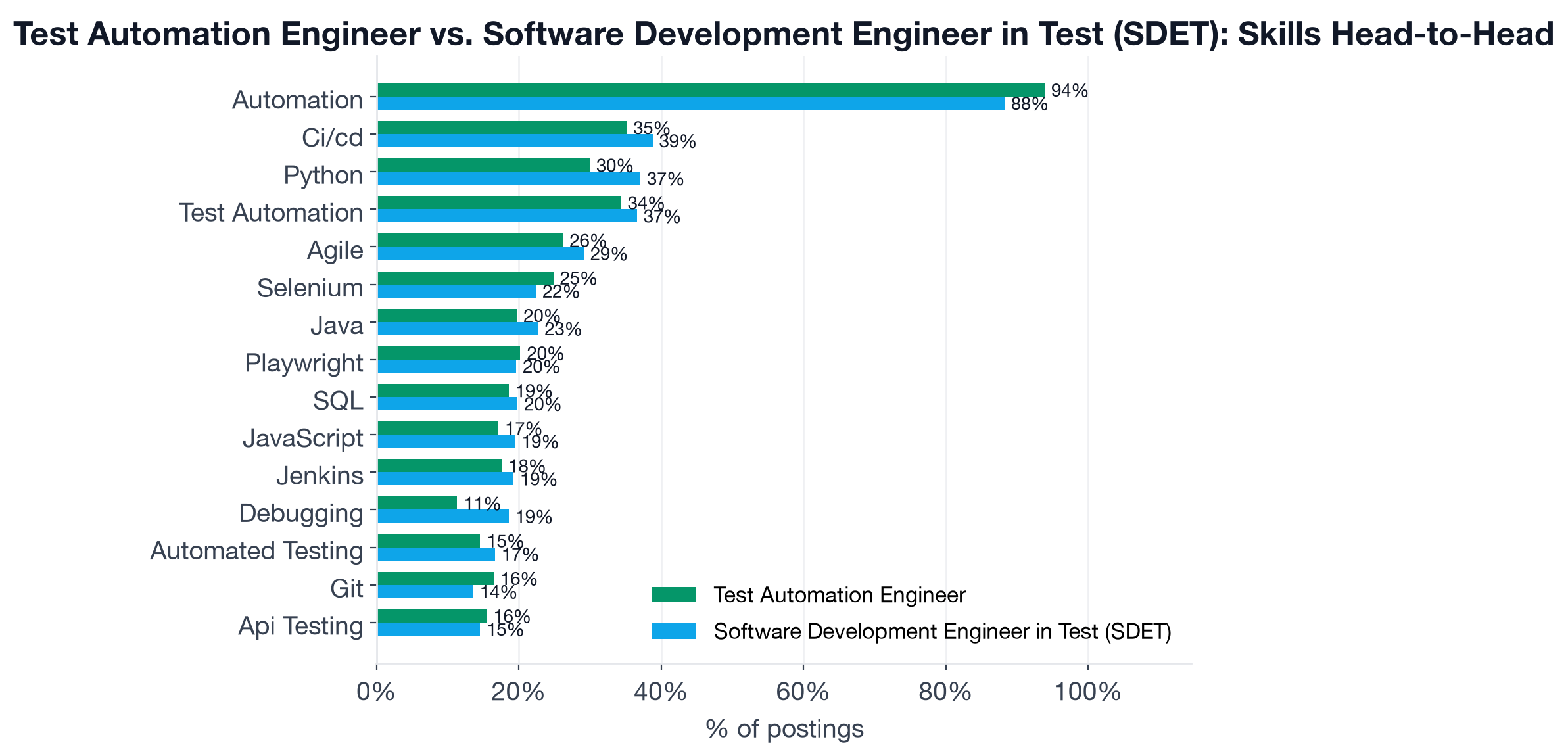 Automation, CI/CD, and Python anchor both roles at similar frequency; the real divide opens up in the exclusive skills, not the shared ones.
With that foundation in place, switching between these two titles is mostly a resume-framing exercise, not a skills gap.
The Skill Split Signals Two Different Engineering Cultures
Where the roles pull apart tells a cleaner story than where they overlap. Test Automation Engineer's exclusive skills, Project Management (10.4%), C# (9.7%), Cucumber (9.6%), and GitLab (9.2%), cluster around process and coordination. SDET's exclusive skills, Docker (14.9%), GitHub Actions (12.9%), Linux (10.7%), and Scalability (10.3%), cluster around infrastructure ownership: containerized environments, CI pipelines you build rather than plug into, systems-level performance concerns.
Neither exclusive list names a testing framework. The differentiator isn't which tool you script with, it's whether the job stops at the test script or extends to the platform underneath it.
Which Role Pays More, and Why Doesn't the Overlap Show It?
SDET pays more: a median $130,000 US base salary (n=191 postings with disclosed compensation) vs. $120,100 for Test Automation Engineer (n=405), a $9,900 (7.6%) premium. Both figures are base salary only, from US postings, where wage-transparency laws produce the most consistent disclosure; equity, bonus, and sign-on are not captured.
A 76% skill overlap makes that gap look like it shouldn't exist, until you check how the same shared skills price on each side. Several of the most common shared skills, ones neither role treats as a rare differentiator, price below the Test Automation Engineer baseline while pricing above the SDET baseline on the same postings:
| Skill | TAE premium (vs. $120,100) | SDET premium (vs. $130,000) |
|---|---|---|
| Automated Testing | -$1,400 (n=57) | +$38,200 (n=34) |
| Selenium | -$16,100 (n=53) | +$25,000 (n=40) |
| Java | -$16,100 (n=43) | +$10,000 (n=38) |
| SQL | -$14,100 (n=67) | +$8,000 (n=26) |
| Root Cause Analysis | -$9,700 (n=74) | +$8,000 (n=32) |
On the Test Automation Engineer side, these are common-enough skills, Selenium alone sits in a quarter of postings, that having them doesn't distinguish a candidate. On the SDET side, the same skills show up in postings that also demand infrastructure ownership, so the premium likely reflects the rest of the job, not the skill itself. What DOES pay a premium on both sides regardless of title, CI/CD (+$14,100 TAE / +$25,000 SDET), Jenkins (+$22,300 / +$25,000), Test Automation itself (+$16,400 / +$25,000), Python (+$19,900 / +$10,000), is the build-and-pipeline cluster, not the test-writing cluster.
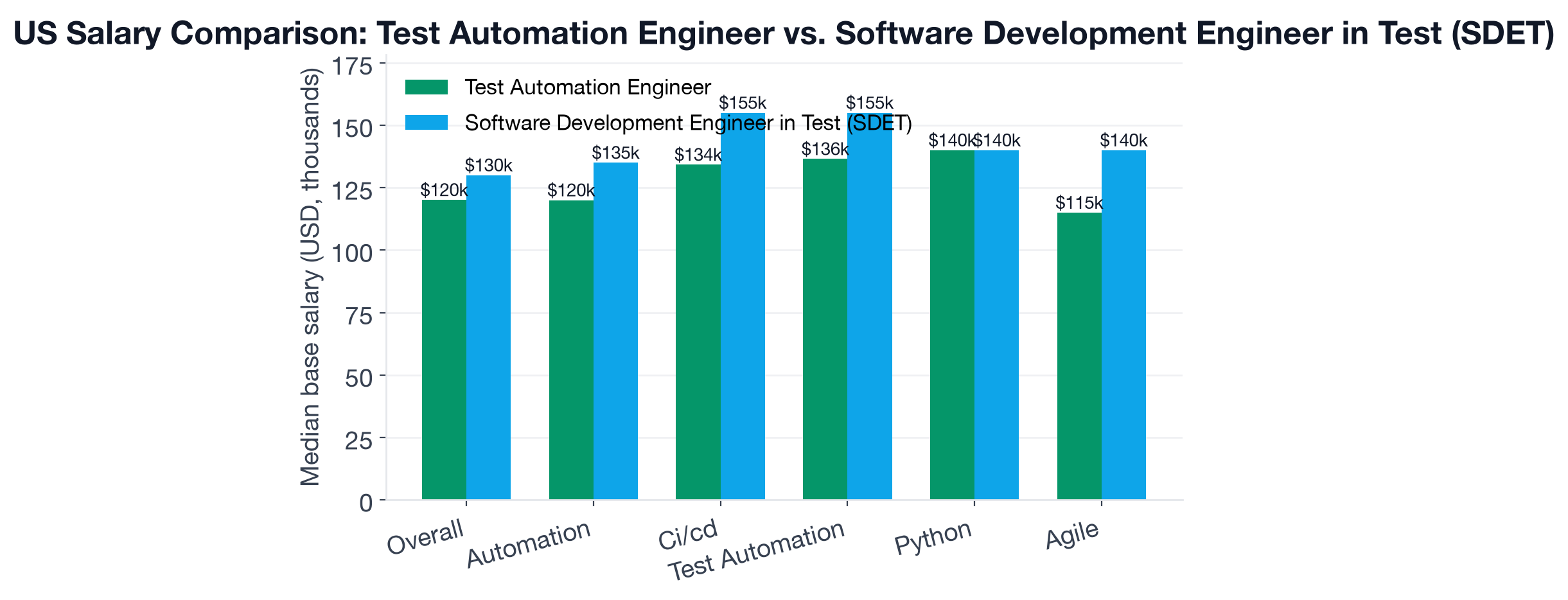 SDET's overall baseline sits $9,900 above Test Automation Engineer's, but several shared skills price in opposite directions once each is measured against its own role's baseline.
Who Has More Openings, and Is It Easier to Break In?
Test Automation Engineer is the larger, easier-to-find role: 2,270 active postings vs. 1,044 for SDET, a 2.17x ratio. If maximizing live openings matters more than the title, Test Automation Engineer is the wider net.
Neither role is a common entry point. Just 1.9% of Test Automation Engineer postings and 2.6% of SDET postings are explicitly entry-level; both are overwhelmingly mid-level (67.7% TAE, 60.2% SDET) or higher. They diverge at the top: SDET's senior-plus-staff share is 37.3% (23.7% senior, 13.6% staff) vs. Test Automation Engineer's 30.4% (22.8% senior, 7.6% staff), staff share alone nearly double. That tracks with SDET's more engineering-heavy skill profile: less an entry-level fork of the same job, more a track that concentrates experienced hires.
Geography and flexibility look similar at a glance: both cluster in the US (about 35% of postings each) with India second (14.6% TAE, 20.4% SDET). SDET runs slightly more remote-friendly (14.9% remote, 20.5% hybrid) than Test Automation Engineer (11.4%/19.4%), though both stay majority onsite.
AI Fluency Is Already the Floor for Both Roles
Neither role's top-30 skill list names an AI tool, ChatGPT, Copilot, or otherwise. Job postings only state a skill when it's an explicit requirement, and employers haven't started writing "AI-assisted testing" into these listings yet. That silence isn't evidence the work doesn't involve AI: industry surveys report 72% of QA professionals already use AI to generate or optimize test scripts (Quash, 2026), and separately that 71% of organizations have adopted AI-powered testing tools in some form (Perforce, 2026); more broadly, 84-85% of developers use AI coding tools regularly (Stack Overflow and JetBrains, 2025).
Given SDET's engineering-heavy profile, its practitioners likely track closer to the general-developer adoption numbers, while Test Automation Engineer's QA-process-oriented profile sits closer to the testing-specific figures. Industry commentary already frames SDET as the role expected to own AI-assisted test authoring, with the differentiating human skill shifting toward reviewing AI-generated tests and telling a real defect from a flaky one. More on this: how AI is changing Test Automation Engineer work and how AI is changing SDET work.
Which Should You Choose?
Choose Test Automation Engineer if you:
- Want the wider pool of openings (2,270 vs. 1,044) and a lower bar to get noticed.
- Come from a QA or manual-testing background; Cucumber, C#, and project-management experience carry real weight here.
- Are comfortable working mostly onsite (59.8% of postings) in exchange for a lower barrier to entry.
Choose SDET if you:
- Want the higher median pay ($130,000 vs. $120,100) and don't mind a smaller, more competitive pool.
- Come from a software-engineering background; Docker, GitHub Actions, Linux, and infrastructure ownership define the job more than scripting does.
- Want a track with a higher senior/staff ceiling: 37.3% senior-plus-staff vs. 30.4% for Test Automation Engineer.
QA Engineer also on your shortlist? See QA Engineer vs Test Automation Engineer and QA Engineer vs SDET.
How to Use This in Your Job Search
Whichever title you're targeting, close the gap between what you can talk about and what these postings actually screen for. Practice explaining your test-framework decisions out loud with AI mock interviews, which simulate the back-and-forth a TAE or SDET screen actually runs. If Selenium, Playwright, or CI/CD internals are shakier than they should be, drill them in the question bank rather than relearning them mid-interview. Making the jump from scripting tests to owning test infrastructure? Our interactive courses cover the CI/CD and systems fundamentals SDET postings assume you already have. Then browse live openings: Test Automation Engineer postings or SDET postings.
FAQ
Q. Is a Test Automation Engineer the same job as an SDET?
They're closely related but not identical. Their top-30 skill sets overlap by 76% (Jaccard similarity), a high degree of shared vocabulary for two distinctly titled roles. SDET postings lean toward software-engineering skills like Docker, GitHub Actions, and Linux; Test Automation Engineer postings lean toward QA-process skills like Cucumber, C#, and project management.
Q. Does an SDET make more money than a Test Automation Engineer?
Yes. The median US base salary for SDET postings is $130,000 (n=191) vs. $120,100 for Test Automation Engineer postings (n=405), a $9,900 (7.6%) gap. Both figures are base salary only; equity and bonus are not captured in job postings.
Q. Which role has more job openings, Test Automation Engineer or SDET?
Test Automation Engineer, by a wide margin: 2,270 active postings vs. 1,044 for SDET, a 2.17x ratio.
Q. Do I need a software engineering background to become an SDET?
Not strictly, but SDET postings lean more heavily on engineering-heavy skills, Docker (14.9% of postings), GitHub Actions (12.9%), Linux (10.7%), and Scalability (10.3%), that don't clear the differentiator threshold for Test Automation Engineer. SDET postings also skew more senior overall: 37.3% are senior or staff level vs. 30.4% for Test Automation Engineer.
Q. Is Selenium still worth learning for test automation roles in 2026?
It depends on which title you're targeting. Selenium appears in roughly a quarter of postings for both roles (24.8% Test Automation Engineer, 22.4% SDET), but it prices in opposite directions: postings that mention it pay $16,100 below the Test Automation Engineer baseline and $25,000 above the SDET baseline. Frequency alone doesn't tell you what a skill is worth.
Q. Do these roles require AI skills in 2026?
Not explicitly. Neither role's top-30 skill list mentions AI, ChatGPT, or Copilot by name in job postings. But industry surveys report 72% of QA professionals already use AI to generate or optimize test scripts, and separately that 71% of organizations have adopted AI-powered testing tools in some form; more broadly, 84-85% of developers use AI tools regularly. AI fluency is an unstated baseline for both roles, not a specialty employers list separately.
Q. Is entry-level hiring common for Test Automation Engineer or SDET?
Rarely, for either title. Entry-level postings make up just 1.9% of Test Automation Engineer listings and 2.6% of SDET listings; both roles are overwhelmingly filled at the mid-level (60-68%) and above.
The 24% That Matters More Than the 76%
The headline number is real: these two roles share three-quarters of their skill stack, and if you already have the automation-and-CI/CD foundation, you're not starting over by switching titles. But the 24% that doesn't overlap, Cucumber and project management on one side, Docker and GitHub Actions on the other, is what an interviewer is actually screening for, and it's what explains the $9,900 gap raw skill overlap can't. Match your prep to the 24%, not the 76%.
Topics
Ready to practice?
Put what you've learned into practice with AI mock interviews and structured preparation guides.