
VMware VCP Demand Sits Almost Entirely Inside Two Traditional Infrastructure Roles
VMware Certified Professional (VCP), VMware's hands-on credential for virtualization and private-cloud infrastructure, shows up almost exclusively in one kind of job: running physical infrastructure, not shipping software through a pipeline. Across Systems Engineer, Systems Administrator, Cloud Engineer, and DevOps Engineer postings on the InterviewStack.io job board, 14,216 active postings analyzed over a trailing 90-day window, VCP appears in just 105 of them, 0.74%. Three in four of those mentions come from two roles, Systems Engineer and Systems Administrator, while DevOps Engineer, the single largest role pool in this scope, barely mentions it at all.
That split matters more than the raw rarity does. VMware's certification line certifies skills for operating an existing VMware estate: vSphere and vCenter administration, storage and network virtualization, disaster recovery planning. DevOps Engineer postings, by contrast, skew toward CI/CD pipelines and cloud-native automation, work that increasingly runs on public cloud rather than a company-owned VMware cluster. The pay data below tracks that same divide: postings that mention VCP advertise less, not more, than other postings in this same four-role scope, a pattern that traces back to who is actually hiring for it, not to what the certification itself is worth.
Key Findings
- VMware VCP appears in just 0.74% of postings across Systems Engineer, Systems Administrator, Cloud Engineer, and DevOps Engineer roles (105 of 14,216 analyzed over a 90-day window).
- Systems Engineer and Systems Administrator combine for 75% of every VCP mention (79 of 105), while DevOps Engineer, the largest role pool in this scope at 5,161 postings, contributes just 9 mentions, a 0.17% mention rate.
- Systems Engineer postings name VCP about 7 times as often as DevOps Engineer postings (1.22% vs. 0.17%).
- Among the 58 mentions specific enough to classify, 82.8% read as preferred and only 17.2% read as required; a further 47 mentions (44.8% of all 105) don't specify either way.
- Postings that mention VCP advertise a median US base salary of $122,275, 11.5% below the $138,100 median for other postings in the same four-role scope.
- At mid-level, the only seniority band with enough VCP-mentioning postings to compare directly, the gap holds at 12.2% ($112,000 vs. $127,500).
- Federal and defense IT contractors, Leidos, CACI International, Peraton, and General Dynamics Information Technology among them, account for roughly 28% of all VCP mentions.
- CompTIA Security+ is VCP's most common co-occurring certification, appearing in 37.1% of VCP-mentioning postings.
How Skewed Is VMware VCP Demand Across These Four Roles?
VCP demand doesn't track posting volume across the four roles in scope.
| Role | Active postings | Mention VCP | Share |
|---|---|---|---|
| Systems Engineer | 3,760 | 46 | 1.22% |
| Systems Administrator | 2,765 | 33 | 1.19% |
| Cloud Engineer | 2,530 | 17 | 0.67% |
| DevOps Engineer | 5,161 | 9 | 0.17% |
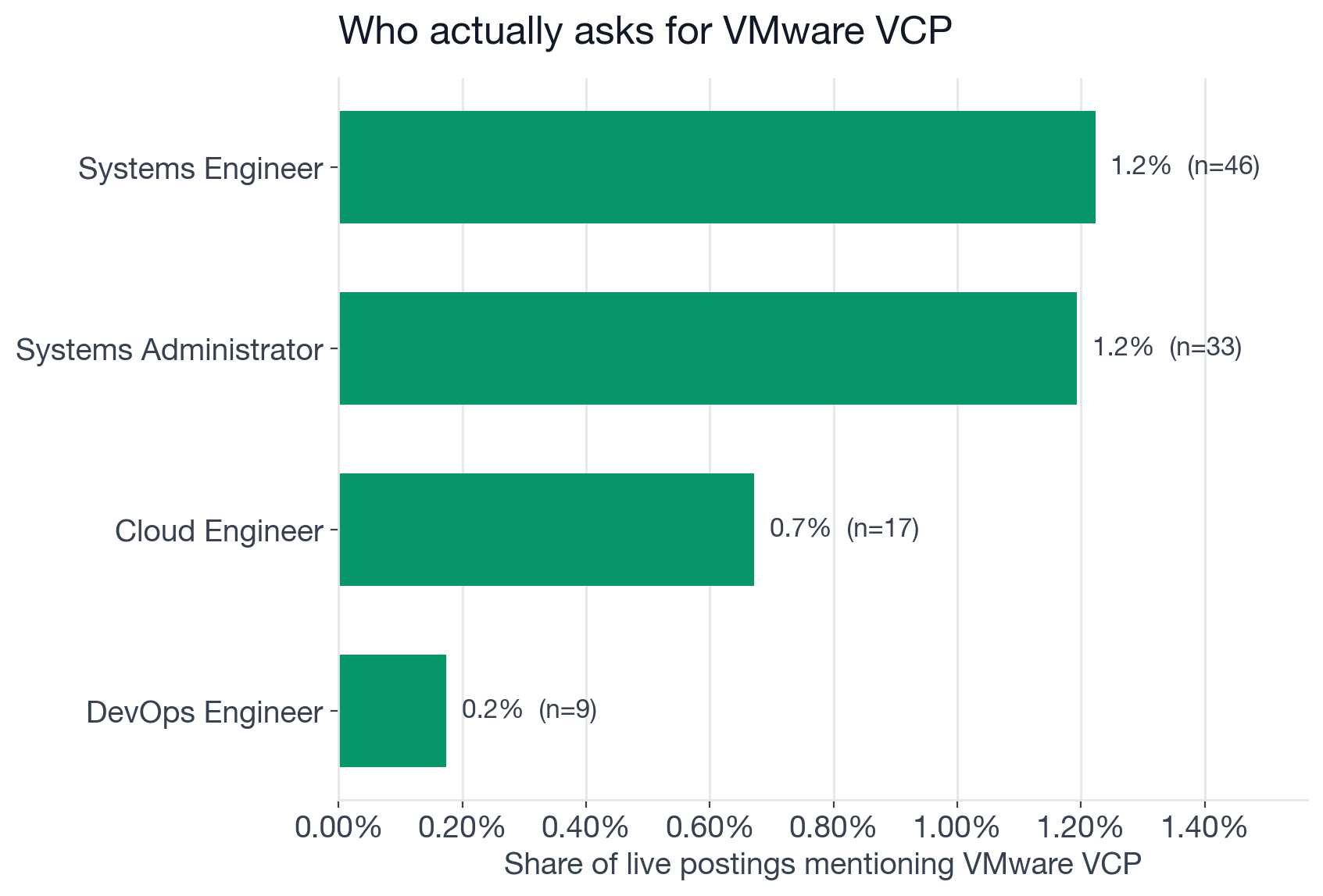 Systems Engineer and Systems Administrator postings name VCP at close to seven times DevOps Engineer's rate, even though DevOps Engineer supplies more postings than any other role in this scope.
DevOps Engineer supplies more active postings than any other role here, 5,161, 36.3% of the total, yet contributes only 9 of the 105 VCP mentions, 8.6%; its own mention rate, 0.17%, is less than a quarter of the 0.74% average across all four roles. Systems Engineer and Systems Administrator, a combined 45.9% of postings, supply 75.2% of mentions between them: Systems Engineer names VCP about 7 times as often as DevOps Engineer does (1.22% vs. 0.17%), and Systems Administrator does too, at roughly 6.8 times (1.19% vs. 0.17%). Cloud Engineer sits close to the overall average (0.67% against a 0.74% baseline), a mild under-mention rather than a story of its own.
The pattern reads as operational, not accidental. VCP certifies the work of running an existing VMware estate, provisioning virtual machines, managing vCenter, configuring storage and network virtualization, planning disaster recovery, and that work still concentrates in Systems Engineer and Systems Administrator titles even as infrastructure elsewhere in this same role scope moves toward public cloud and pipeline automation.
Preferred Beats Required by Nearly Five to One for VCP Mentions
Of the 105 total VCP mentions, 58 (55.2%) use language specific enough to classify as required or preferred; the remaining 47 (44.8%) sit inside certification lists or general "nice to have" phrasing that doesn't resolve either way. Within that classified set, VCP reads overwhelmingly as a plus, not a gate: 48 mentions (82.8%) call it preferred, and only 10 (17.2%) call it required outright.
Zoomed out to every mention in the dataset, not just the classified ones, VCP disqualifies a candidate outright in only about 9.5% of postings that name it at all (10 of 105), a little under 1 in 10. For nearly everyone else, holding VCP reads as a credential an employer is glad to see, not a line item a candidate has to clear before applying.
VMware VCP Postings Pay Less, Not More, in This Role Scope
The comparison below covers only postings that disclose a US base salary, and it compares VCP-mentioning postings against other postings in this same four-role scope, not the broader job market. Equity, bonus, and other compensation aren't disclosed in job postings and aren't part of this comparison.
Postings that mention VCP advertise a median US base salary of $122,275 across 43 postings with US salary disclosed, 11.5% below the $138,100 median for the 4,470 other postings in the same role scope that disclose a US salary. That gap doesn't reverse or shrink to nothing once you control for seniority, unlike some certifications in this series. At mid-level, the only band with enough VCP-mentioning postings to compare directly (33 with the cert, 2,717 without), the gap holds at 12.2%: $112,000 versus $127,500. Entry, senior, and staff levels don't have enough VCP-mentioning postings with disclosed salary to report a median (0, 5, and 5 respectively, all below the 25-posting floor this analysis requires), but the one band that does clear the floor tells the same story as the aggregate, not a different one.
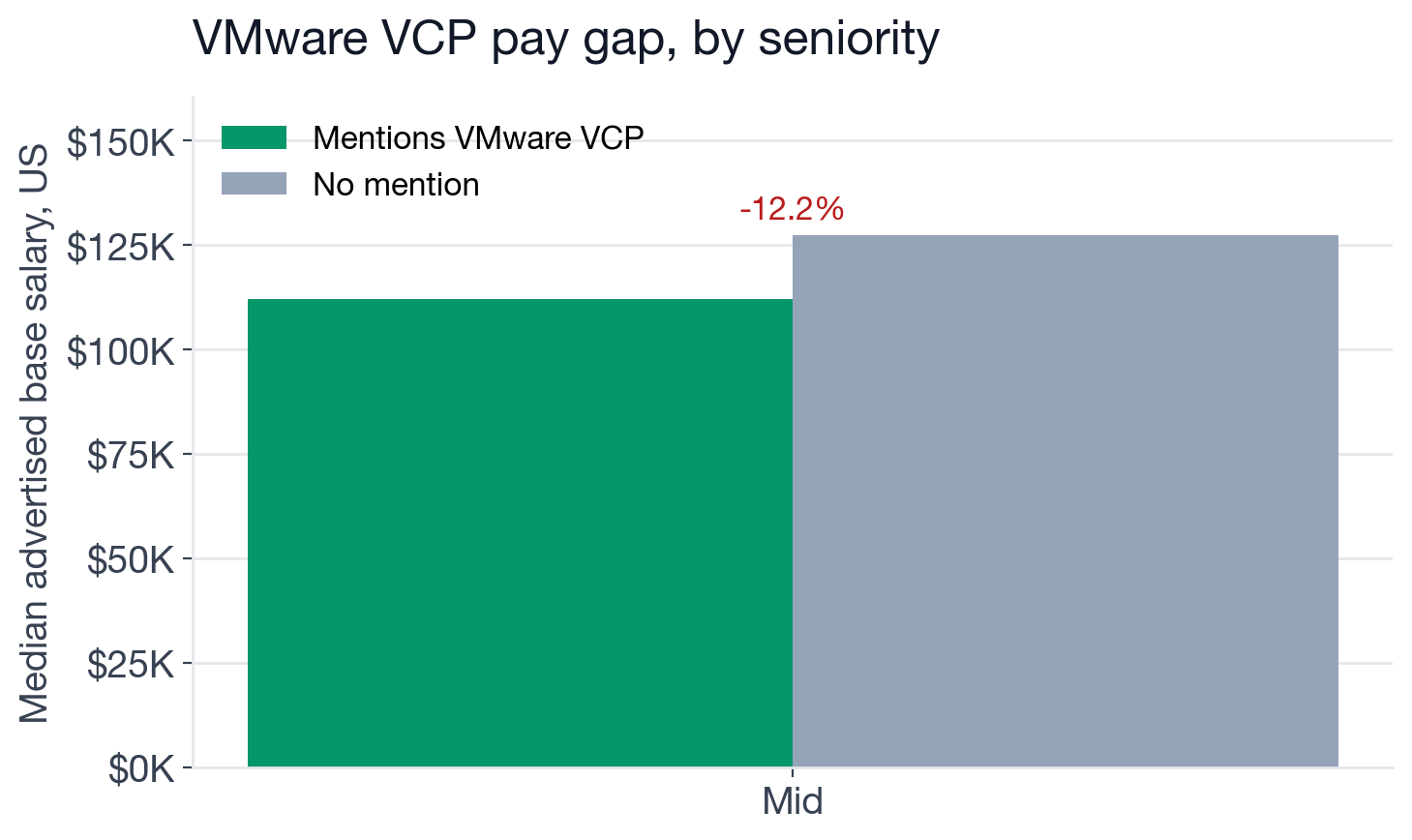 Mid-level is the only band with enough VCP-mentioning postings to compare directly, and it shows roughly the same discount as the overall dataset.
Some of that gap is seniority mix, though not much of it. VCP-mentioning postings skew slightly toward mid-level (66.7% vs. 61.0% for the rest of the scope) and away from the highest-paying staff band (5.7% vs. 11.1%), which would tend to widen the gap in aggregate. Worth flagging: seniority in this dataset is inferred from title keywords and defaults to mid-level when a title carries no explicit level word, which is true of roughly half the sampled VCP-mentioning titles ("Systems Administrator," "Platform Engineer," and similar bare titles). That means the measured mid-level share is probably somewhat inflated and the true entry and staff tails, including the 0% entry figure above, are probably a bit less extreme than shown. Since the aggregate delta (-11.5%) and the mid-level-only delta (-12.2%) land so close together, composition isn't doing much extra work here: the discount shows up whether or not you control for level, a more straightforward pattern than certifications elsewhere in this series where the aggregate number is either much worse or much better than what any single seniority band actually shows.
Is VMware VCP Demand Just a Government-Contractor Story?
| Employer | Postings mentioning VCP |
|---|---|
| Leidos | 8 |
| CACI International | 6 |
| General Dynamics Information Technology | 6 |
| Peraton | 5 |
| Ensono | 4 |
| Nakupuna Companies | 2 |
| J5 Consulting | 2 |
| DXC Technology | 2 |
| Cook Children's Health Care System | 1 |
| East Penn Manufacturing | 1 |
Unlike CompTIA Security+ or CISSP, VCP isn't one of the certifications the Department of Defense's 8570/8140 directives require for cybersecurity roles, so its presence in federal and defense hiring here isn't a compliance checkbox. It shows up because federal and defense contractors operate some of the largest on-premises VMware estates in the country and need people who can run them. Leidos, CACI International, General Dynamics Information Technology, and Peraton together account for 25 of the 105 total mentions, about 24%, and Nakupuna Companies and J5 Consulting add a smaller defense-adjacent consulting presence on top of that. Add those six together and federal or defense-linked employers cover roughly 28% of all VCP mentions, a real cluster, not a majority.
The rest of the roster is traditional enterprise IT rather than cloud-native tech: Ensono, a managed hosting and infrastructure-services provider, DXC Technology, a global IT-services firm, Cook Children's Health Care System, a regional hospital system running its own clinical infrastructure, and East Penn Manufacturing, an industrial manufacturer. None of these are the hyperscale, cloud-native companies that tend to set the pay ceiling elsewhere in this four-role scope, which lines up with the salary gap above: VCP concentrates among employers still running and staffing private virtualization infrastructure, not the employers paying the most for cloud-native systems work.
Is VMware VCP a Standalone Credential, or Part of a Bigger Certification Stack?
VCP-mentioning postings ask for more than VMware itself. Linux appears in 64.8% of them, Automation in 63.8%, and general Virtualization language in 58.1%, core skills for running a private-cloud or hybrid-infrastructure estate day to day. Azure shows up in 51.4% and AWS in 37.1%, evidence that VCP holders are increasingly expected to bridge on-premises VMware environments with public cloud rather than stay inside VMware's own stack. Scripting and automation tooling shows up too: PowerShell in 50.5%, Python in 35.2%, and Ansible in 34.3%, alongside Windows Server administration basics like Active Directory (43.8%), DNS (41.0%), and DHCP (33.3%). Even Kubernetes appears in 22.9% of VCP postings, a sign that container orchestration has become part of the baseline expectation for infrastructure roles, VMware-centered or not, rather than something confined to cloud-native teams alone.
| Skill | Share of VCP postings |
|---|---|
| Linux | 64.8% |
| Automation | 63.8% |
| Virtualization | 58.1% |
| Azure | 51.4% |
| PowerShell | 50.5% |
| Windows Server | 44.8% |
| Active Directory | 43.8% |
| AWS | 37.1% |
| Ansible | 34.3% |
On the certification side, CompTIA Security+ is the most common pairing, appearing in 37.1% of VCP-mentioning postings, well ahead of RHCSA (21.0%), Azure Administrator Associate AZ-104 (14.3%), and CCNA (13.3%). That mix, a broad security baseline plus Linux and Windows administration certifications rather than a stack of other virtualization-specific credentials, fits a generalist systems-administration profile more than a narrow VMware-specialist track.
| Certification | Co-occurs with VCP |
|---|---|
| CompTIA Security+ | 37.1% |
| RHCSA | 21.0% |
| Azure Administrator Associate (AZ-104) | 14.3% |
| CCNA | 13.3% |
| RHCE | 12.4% |
| CCNP | 12.4% |
| MCSE | 11.4% |
Deciding Whether VMware VCP Belongs on Your Study List
If you already hold VCP, or you're deciding whether to pursue it, the data points toward a narrow but real use case. It's a stronger signal for Systems Engineer and Systems Administrator roles at organizations still running on-premises or hybrid VMware infrastructure, federal contractors, managed hosting providers, healthcare systems, and manufacturers among them, than it is for DevOps Engineer roles built around cloud-native pipelines, where it barely registers at all. Given how rarely it's required outright (17.2% of classified mentions), treat it as a credential that rounds out a broader systems-administration resume rather than one that gates an application.
To close the gaps VCP alone won't cover, automation, scripting, and the multi-cloud skills these postings increasingly expect, InterviewStack's interactive courses build that foundation, and the Question Bank has focused drilling on Linux administration, PowerShell, and infrastructure automation topics. Once you've targeted a specific role, a mock interview will surface the gaps a certification line alone doesn't reveal. To see what's actually open right now, browse active openings across all four roles in this scope, or narrow to Systems Engineer and Systems Administrator postings specifically, where three in four VCP mentions actually live. For a broader read on what each role demands beyond this one certification, see what Systems Engineer postings and Systems Administrator postings ask for overall, or what DevOps Engineer postings look like if you're weighing a move toward cloud-native infrastructure work instead.
FAQ
Q. Does VMware VCP certification help you get hired in systems engineering roles?
VMware VCP appears in only 0.74% of postings across Systems Engineer, Systems Administrator, Cloud Engineer, and DevOps Engineer roles (105 of 14,216 analyzed), and even where it appears, it's usually preferred (82.8% of classified mentions) rather than required (17.2%). It functions as a differentiator layered on top of core infrastructure skills, not a credential that gates who gets an interview.
Q. Which roles actually ask for VMware VCP the most?
Systems Engineer and Systems Administrator combine for 75% of every VCP mention (79 of 105). Systems Engineer postings name VCP about 7 times as often as DevOps Engineer postings (1.22% vs. 0.17%), even though DevOps Engineer is the largest role pool in this scope at 5,161 postings.
Q. Do postings that mention VMware VCP pay more?
No. Postings that mention VCP advertise a median US base salary of $122,275, 11.5% below the $138,100 median for other postings in the same four-role scope. At mid-level, the only seniority band with enough VCP-mentioning postings to compare directly, the gap is a similar 12.2% ($112,000 vs. $127,500). This is a correlation with which employers and roles ask for VCP, not a measure of what the certification itself is worth.
Q. Is VMware VCP usually required or just preferred?
Preferred, by a wide margin. Of the 58 VCP mentions specific enough to classify, 82.8% read as preferred and only 17.2% read as a hard requirement. A further 47 mentions, 44.8% of all 105, don't specify either way.
Q. Which companies are actually hiring for VMware VCP skills?
Federal and defense IT contractors, including Leidos, CACI International, General Dynamics Information Technology, and Peraton, account for roughly 28% of all VCP mentions, reflecting the large on-premises VMware estates many government agencies still run. The rest spans managed hosting providers, traditional enterprise IT services firms, healthcare systems, and manufacturers, not the hyperscale, cloud-native employers that set the pay ceiling elsewhere in this role scope.
Q. What other certifications and skills pair with VMware VCP?
CompTIA Security+ is the most common co-occurring certification, appearing in 37.1% of VCP-mentioning postings, ahead of RHCSA (21.0%) and Azure Administrator Associate AZ-104 (14.3%). On the skills side, Linux (64.8%), Automation (63.8%), and Azure (51.4%) all appear in more than half of VCP postings, showing that VCP holders are expected to work across on-premises and public-cloud environments, not just VMware's own stack.
Q. Is VMware VCP worth pursuing in 2026?
The data can't answer that in dollar terms, VCP-mentioning postings pay less, not more, within this role scope, but it does show real, if narrow, demand: 105 active postings ask for it, concentrated almost entirely in Systems Engineer and Systems Administrator roles rather than cloud-native DevOps work. It's a credible signal for someone targeting on-premises or hybrid infrastructure roles at enterprises and government contractors, and a weak one for someone targeting cloud-native or DevOps-heavy teams.
Where VMware VCP Fits in an Infrastructure Career in 2026
VMware VCP isn't disappearing from hiring, but it isn't spreading into cloud-native infrastructure work either. It sits where it always has, running and maintaining on-premises and hybrid virtualization environments, and the postings that ask for it, mostly at federal contractors, managed-hosting firms, and traditional enterprise IT shops, pay less than the cloud-forward roles elsewhere in this same four-role scope. That isn't a verdict on the exam or the skills it certifies; it's a description of who is still buying VMware infrastructure at scale in September 2026, and who isn't. For a candidate deciding where to point a study budget, that distinction, on-premises systems work versus cloud-native pipeline work, matters more than the certification's name.
Topics
Ready to practice?
Put what you've learned into practice with AI mock interviews and structured preparation guides.