
AWS Is Asked for Everywhere, but Mostly as a Preference
AWS (Amazon Web Services) is named in 32,164 of 155,726 active tech postings (20.7%) on the InterviewStack.io job board over the 90 days to November 12, 2026, and that share has not moved: 20.7%, 20.8% and 20.2% across the three 30-day windows. Comparing postings within the same role and seniority, US advertised base pay is 4.9% higher on average where AWS is asked for, but the gap points up in 39 role-and-level groups and down in 22, so there is no single premium to quote.
That is the short answer to whether AWS is worth learning: yes for breadth, with two catches. When a posting spells out how much it wants AWS, 6 in 7 mentions are "preferred" rather than "required." And the pay picture depends on your role and level, not on the tool alone. We looked at every active posting across 39 roles, with skills extracted from the descriptions and synonyms collapsed.
Key Findings
- AWS appears in 32,164 of 155,726 postings (20.7%), and every one of the 39 roles tracked has at least one posting that asks for it.
- The share is flat: 20.7%, 20.8% and 20.2% in the three 30-day windows.
- DevOps Engineer postings ask for AWS most often (49.3%), ahead of Cloud Engineer (41.7%) and Full-Stack Developer (41.6%).
- Software Engineer supplies the most postings (8,173), a quarter of all AWS demand (25.4%).
- Among 7,080 mentions with required or preferred wording nearby, 14.4% are required and 85.6% preferred.
- Within the same role and level, US advertised base pay is 4.9% higher on average where AWS is asked for, positive in 39 groups and negative in 22 of 76.
- Entry-level titles are 3.0% of AWS postings versus 7.0% of postings without it.
- Google Cloud (3.6x lift), Terraform (3.3x) and Azure (3.0x) are the strongest pairings.
Who Asks for AWS? Infrastructure Roles by Habit, Software Engineers by Volume
The roles that treat AWS as standard are not the roles that supply the most postings. Roughly half of DevOps Engineer postings ask for it, versus a quarter of Software Engineer postings, yet Software Engineer is the biggest source of AWS demand simply because there are so many of those jobs.
For a job seeker the split matters. If you are aiming at DevOps, Cloud, Data or Site Reliability work, AWS is close to a default expectation in 2 out of 5 postings or more. If you are a Software Engineer, it is a common plus rather than the norm. At the other end, Product Manager (3.5%), QA Engineer (4.2%) and Data Analyst (7.2%) postings rarely name it, so the skill is not a general-purpose résumé line.
| Role | Postings asking for AWS | Share of the role's postings |
|---|---|---|
| Software Engineer | 8,173 | 25.1% |
| Data Engineer | 2,549 | 40.1% |
| DevOps Engineer | 2,391 | 49.3% |
| Full-Stack Developer | 2,012 | 41.6% |
| Cybersecurity Engineer | 1,698 | 36.4% |
| Engineering Manager | 1,565 | 22.7% |
| AI Engineer | 1,213 | 30.7% |
| Solutions Architect | 1,209 | 28.0% |
| Cloud Engineer | 1,148 | 41.7% |
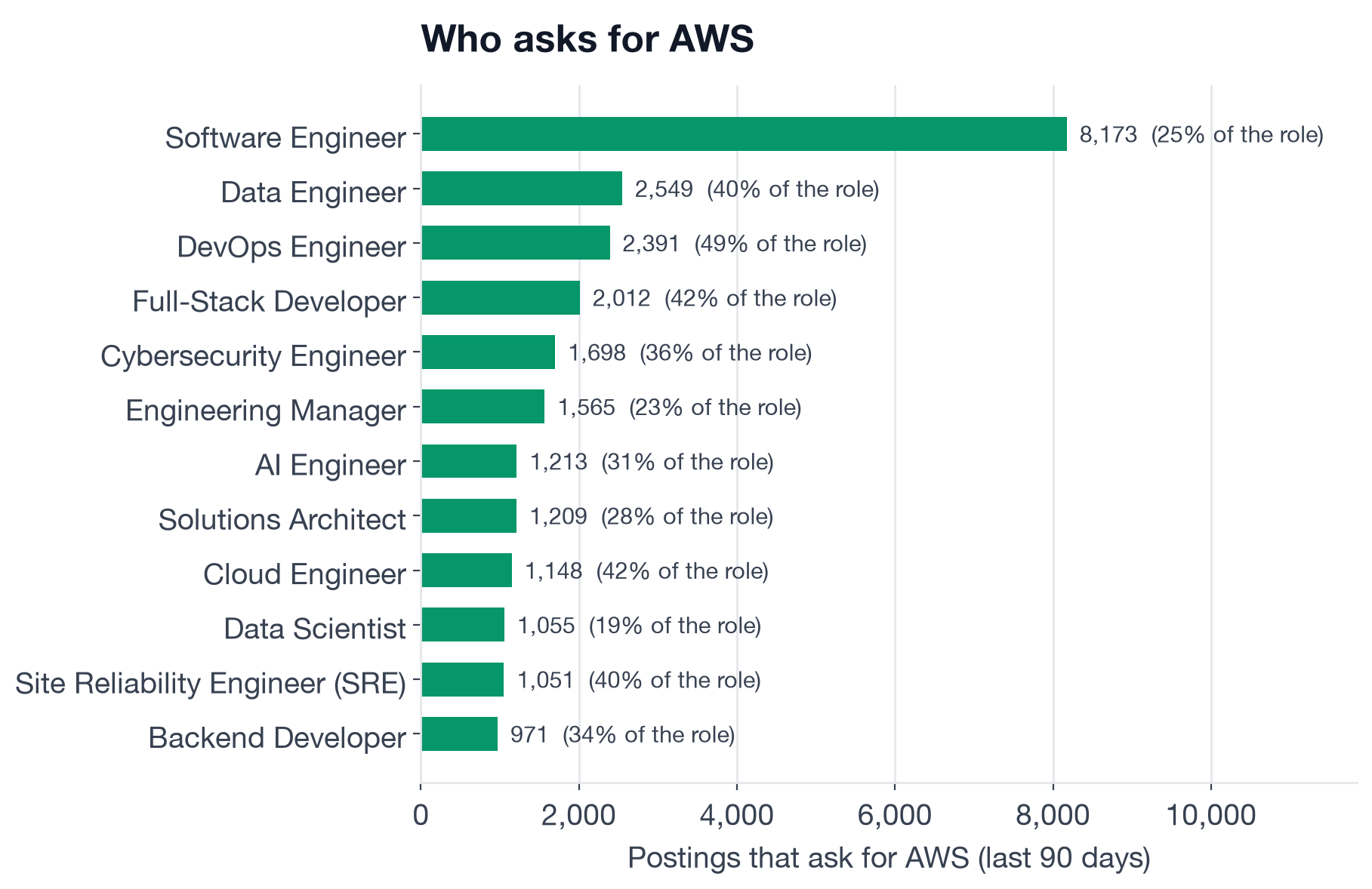
The chart separates volume from habit: the biggest bars are not the roles where AWS is most standard. For role-level detail see our skills posts for Software Engineers, Data Engineers and DevOps Engineers.
Is AWS Required or a Nice-to-Have?
Mostly a nice-to-have, and that should lower the stakes of not having deep AWS experience on day one. Of the 7,080 AWS mentions where nearby wording says required or preferred, 14.4% are required and 85.6% are preferred. Only 22% of all mentions carry that wording, so read the split as indicative rather than exact.
AWS postings also lean senior. Entry-level titles are 3.0% of AWS postings versus 7.0% of postings without it, and senior and staff titles are 47.8% versus 35.7%. Seniority is inferred from title keywords, and titles with no level word default to mid-level, so true entry-level and senior shares are both likely under-counted. Treat the gap as directional: AWS is usually asked for alongside experience, not in place of it. The surrounding skills read like an operations toolkit: CI/CD (43.1% of AWS postings), automation (40.4%), monitoring (35.0%) and observability (25.2%).
Does AWS Come With Higher Pay? It Depends on Your Level
The honest answer is "sometimes, and mostly at mid-level." The comparison here is within the same role and seniority, US advertised base pay only, on postings that disclose it. Equity and bonus are not in postings, so total compensation at larger employers is higher than these numbers. This is a correlation in advertised pay, not evidence that learning AWS raises an offer.
Averaged across 76 role-and-level groups that cover 96.5% of AWS postings, postings that ask for AWS advertise 4.9% more base pay. But the gap is up in 39 groups and down in 22. The upside is concentrated in mid-level groups:
- Solutions Architect, mid-level: $177,000 with AWS versus $142,400 without (+24.3%).
- Systems Engineer, mid-level: $151,800 versus $130,000 (+16.8%).
- Network Engineer, mid-level: $138,400 versus $119,700 (+15.6%).
- Cybersecurity Engineer, mid-level: $160,000 versus $143,254 (+11.7%).
- Software Engineer, mid-level: $169,050 versus $151,475 (+11.6%).
- Data Engineer, mid-level: $144,750 versus $130,585.50 (+10.8%).
The groups listed here are the largest by AWS posting volume, not all 76.
Then the picture turns. For Software Engineers the gap shrinks with level: +0.4% at senior ($184,700 versus $184,000) and -4.5% at staff ($206,900 versus $216,556.50). Senior Full-Stack Developer postings that ask for AWS advertise 14.5% less ($157,500 versus $184,162.50), and mid-level Site Reliability Engineer postings advertise 11.0% less ($111,280 versus $125,000; both medians are low for SRE work, which suggests the role label also captures some non-software reliability jobs, so treat this cell with caution). Senior Data Engineer is about flat (-1.3%). Mid-level Full-Stack and Cloud Engineer postings are also flat, within 1% either way.
So "AWS comes with higher pay" is true for a mid-level Solutions Architect and false for a senior Full-Stack Developer. The data does not explain why the Full-Stack and SRE cells go the other way, and we will not guess. What it supports is narrower: the advertised-pay gap is widest for mid-level architecture, systems and security roles, and thin or negative for senior software roles.
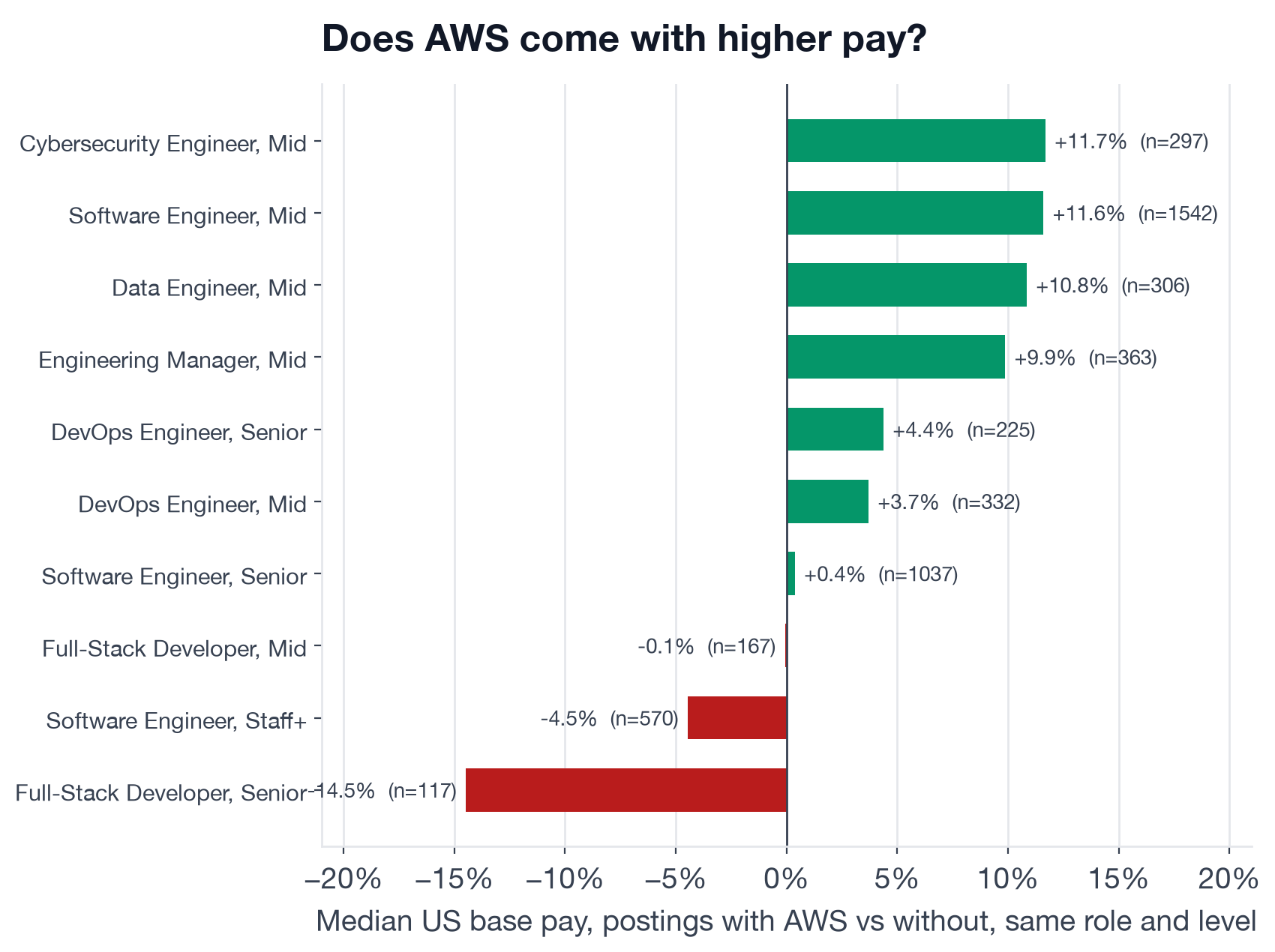
The chart shows the US base salary gap inside each role and seniority group, which is the only fair way to compare, because a raw with-versus-without gap mostly reflects which jobs ask for AWS.
What Should You Learn With AWS? Rank by Lift, Not Share
The tools that appear most often next to AWS are not the ones most tied to it. Python shows up in 52.4% of AWS postings, but Python appears next to almost everything (lift 1.7x). Lift, the share among AWS postings divided by the share across all postings, is the better guide to a real pairing.
By lift, the strongest pairings are other clouds and infrastructure tooling:
- Google Cloud (3.6x lift, 31.9% of AWS postings) and Azure (3.0x, 45.3%): AWS postings frequently name another cloud, so multi-cloud familiarity is a visible, if often optional, expectation.
- Terraform (3.3x, 22.9%): the infrastructure-as-code tool is the most natural next step. See our Terraform demand and pay analysis.
- Docker (2.7x) and Kubernetes (2.7x, 31.5%): containers are part of the same stack, not a separate specialty.
- Kafka (2.7x), PostgreSQL (2.6x) and Jenkins (2.5x): the data-streaming, database and CI layer that sits under many AWS-hosted systems.
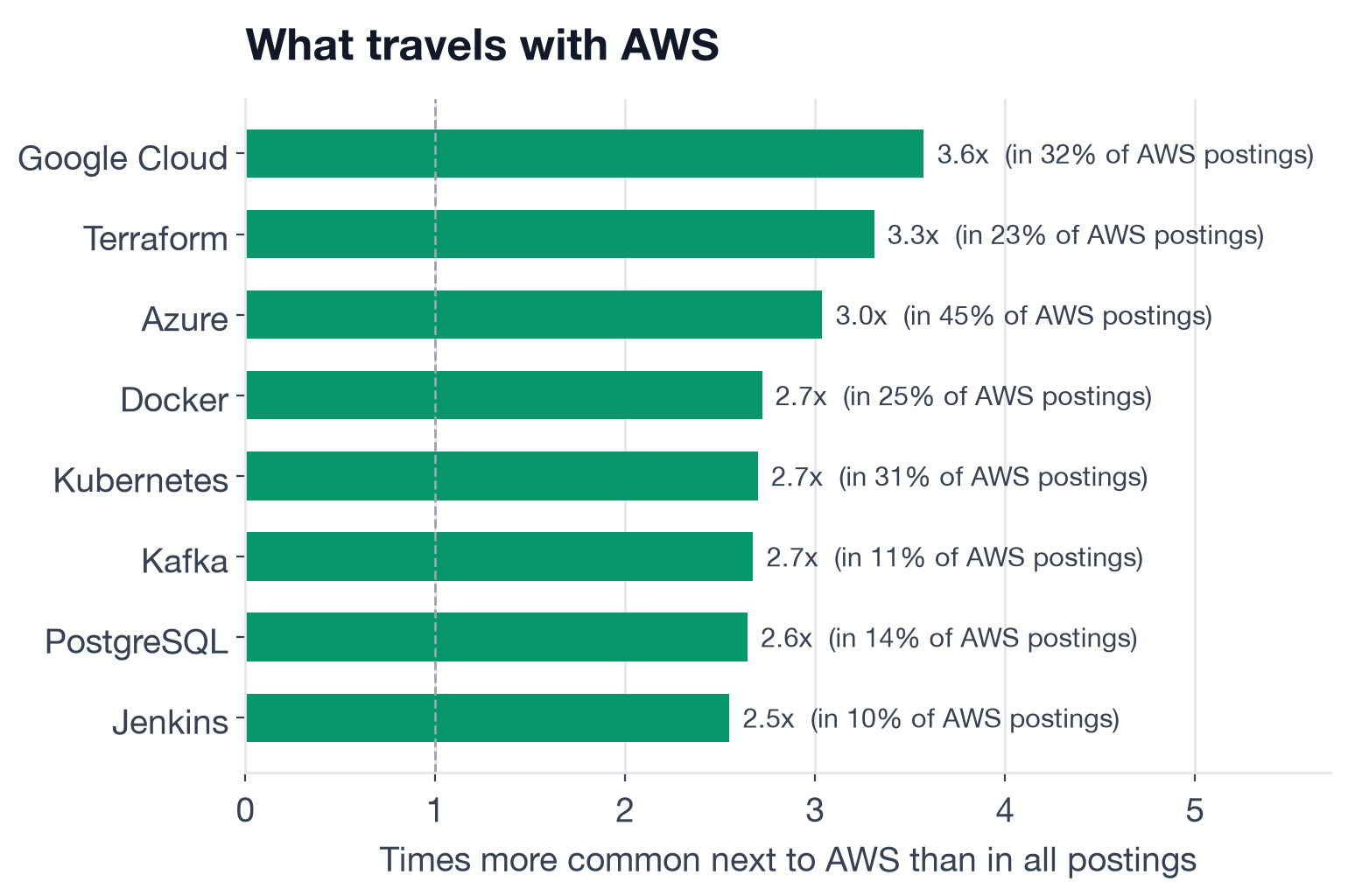
The ranking by lift says the best second skill after AWS is Terraform or Kubernetes, not another general-purpose language. If you already have Python, see how it behaves in our Python demand and pay analysis.
Who Hires for AWS? The Vendor Itself, Then Federal Contractors
Amazon is the largest single source by a wide margin, with 2,445 distinct openings that name AWS, which is expected because AWS is Amazon's own product line. After Amazon the list is dominated by a recognizable cluster: government and defense IT contractors. Booz Allen Hamilton (216 distinct openings), Leidos (173), CACI International (130), Peraton (130), General Dynamics Information Technology (112) and Accenture Federal Services (100) account for six of the top 15 labels.
The rest of the list is large consultancies and enterprises: PricewaterhouseCoopers (231), Cognizant (170), Citi (134), Databricks (120), DXC Technology (113), UnitedHealth Group (111) and Cisco (about 218 combined across two labels, which we treat as approximate). If you want AWS work outside a pure tech company, federal contracting is the clearest route the data shows. Counts are distinct openings (employer and normalized title), so multi-location reposts do not inflate them.
How to Use This in Your Job Search
Start from the role, not the tool. Check how standard AWS is for the role you want in the table above, then decide how deep to go. For DevOps, Cloud and Data Engineering, expect it to come up. For most other roles, treat it as a plus.
Practice it where it will be tested. AI mock interviews let you rehearse cloud architecture and infrastructure questions with feedback, and the Question Bank has focused drills on cloud, containers and infrastructure topics. If you are building foundations before you specialize, our interactive courses cover the underlying systems concepts. To see how employers describe the work, browse the job board and read a few postings for your target role, and explore related roles on the roles index.
FAQ
Q. How many job postings ask for AWS in 2026?
AWS (Amazon Web Services) appears in 32,164 of 155,726 active tech postings (20.7%) on the InterviewStack.io job board over the 90 days to November 12, 2026, across all 39 roles tracked. The share was flat at 20% to 21% in each 30-day window.
Q. Is AWS required or just a nice-to-have in job postings?
Mostly a nice-to-have. Among the 7,080 AWS mentions where nearby wording says required or preferred, 14.4% are required and 85.6% are preferred. Only about 1 in 5 mentions carries that wording, so treat the split as indicative.
Q. Do postings that ask for AWS advertise higher pay?
Not consistently. Comparing the same role and seniority, US advertised base pay is 4.9% higher on average for postings that ask for AWS, but the gap is positive in 39 role-and-level groups and negative in 22 of 76. It is a correlation, not a price tag.
Q. Which roles ask for AWS the most?
By volume, Software Engineer leads with 8,173 postings. By how standard it is inside the role, DevOps Engineer (49.3%), Cloud Engineer (41.7%), Full-Stack Developer (41.6%), Data Engineer (40.1%) and Site Reliability Engineer (39.6%) ask for it most often.
Q. What should you learn alongside AWS?
The strongest pairings by lift are Google Cloud (3.6x), Terraform (3.3x), Azure (3.0x), Docker (2.7x), Kubernetes (2.7x) and Kafka (2.7x). Python appears in 52% of AWS postings but it appears next to almost everything.
Q. Can you get an entry-level job with AWS skills?
AWS postings skew senior. Entry-level titles are 3.0% of AWS postings versus 7.0% of postings without it, while senior and staff titles are 47.8% versus 35.7%. Seniority is inferred from title keywords and untagged titles default to mid-level, so treat it as directional.
Where to Start
AWS is a broad, durable expectation, not a gate: a fifth of tech postings name it, most of them as a preference, and the advertised pay gap is real at mid-level in architecture and systems roles but disappears or reverses for senior software roles. Learn it in the context of your target role, pair it with Terraform or Kubernetes, and let the postings for that role tell you how deep to go.
Topics
Ready to practice?
Put what you've learned into practice with AI mock interviews and structured preparation guides.