
Azure Is in 1 in 7 Postings, and Most Same-Role Comparisons Show No Pay Edge
Azure (Microsoft's cloud platform) is asked for in 23,469 of the 158,723 active postings on the InterviewStack.io job board over the last 90 days (14.8%, about 1 in 7), and demand is flat: 14.0% of postings first seen 61-90 days ago, 15.2% of those first seen in the last 30 days. On pay, postings that ask for Azure advertise lower US base salary than comparable postings without it in 41 of 67 same-role, same-level comparisons (weighted gap -5.6%), so the skill is widely wanted but is not a consistent premium.
That second finding is the one most "is Azure worth learning" articles skip. We compare each posting only against postings for the same role and seniority, because comparing Azure postings against the whole board mostly measures job mix. Employers also mostly treat Azure as something to have, not something to hire for: 87% of the classifiable mentions (about 22% of all mentions) say preferred. Think of it as the cloud equivalent of a driver's license for infrastructure and data roles: expected, rarely the thing that sets the price.
Key Findings
- Azure appears in 23,469 of 158,723 postings (14.8%) across 37 roles, last 90 days to mid-November 2026.
- Demand is flat: 14.0%, 14.4%, then 15.2% across the three 30-day windows (a 1.2-point move).
- Cloud Engineer (42.9% of postings), Cloud Architect (39.7%), Data Engineer (34.2%), and DevOps Engineer (33.5%) ask for it most.
- Software Engineer supplies the most postings by volume (4,731, or 20.2% of all Azure demand) but only 14.3% of that role asks for Azure.
- Of 5,274 mentions with classifiable wording, 86.9% are preferred and 13.1% are required.
- Within the same role and level, the weighted US base pay gap for postings that ask for Azure is -5.6% across 67 cells: 41 lower, 16 higher.
- Among the 19 largest cells, the deepest dips are mid-level Software Engineer (-17.2%), senior Full-Stack Developer (-15.3%), and senior Software Engineer (-11.7%).
- Azure DevOps (lift 4.4), Google Cloud (4.3), and PowerShell (3.8) are its most over-represented companions.
- Microsoft (418 distinct openings), PricewaterhouseCoopers (321), and Cognizant (195) lead the employer list.
Who Asks for Azure? Cloud Roles by Habit, Software Engineers by Volume
Azure is a default for cloud and data infrastructure roles and a minority requirement for general software engineering. In a Cloud Engineer posting it shows up 43% of the time; in a Software Engineer posting 14% of the time. Software Engineers still account for the largest slice of all Azure demand simply because there are so many of them (33,136 postings in the corpus).
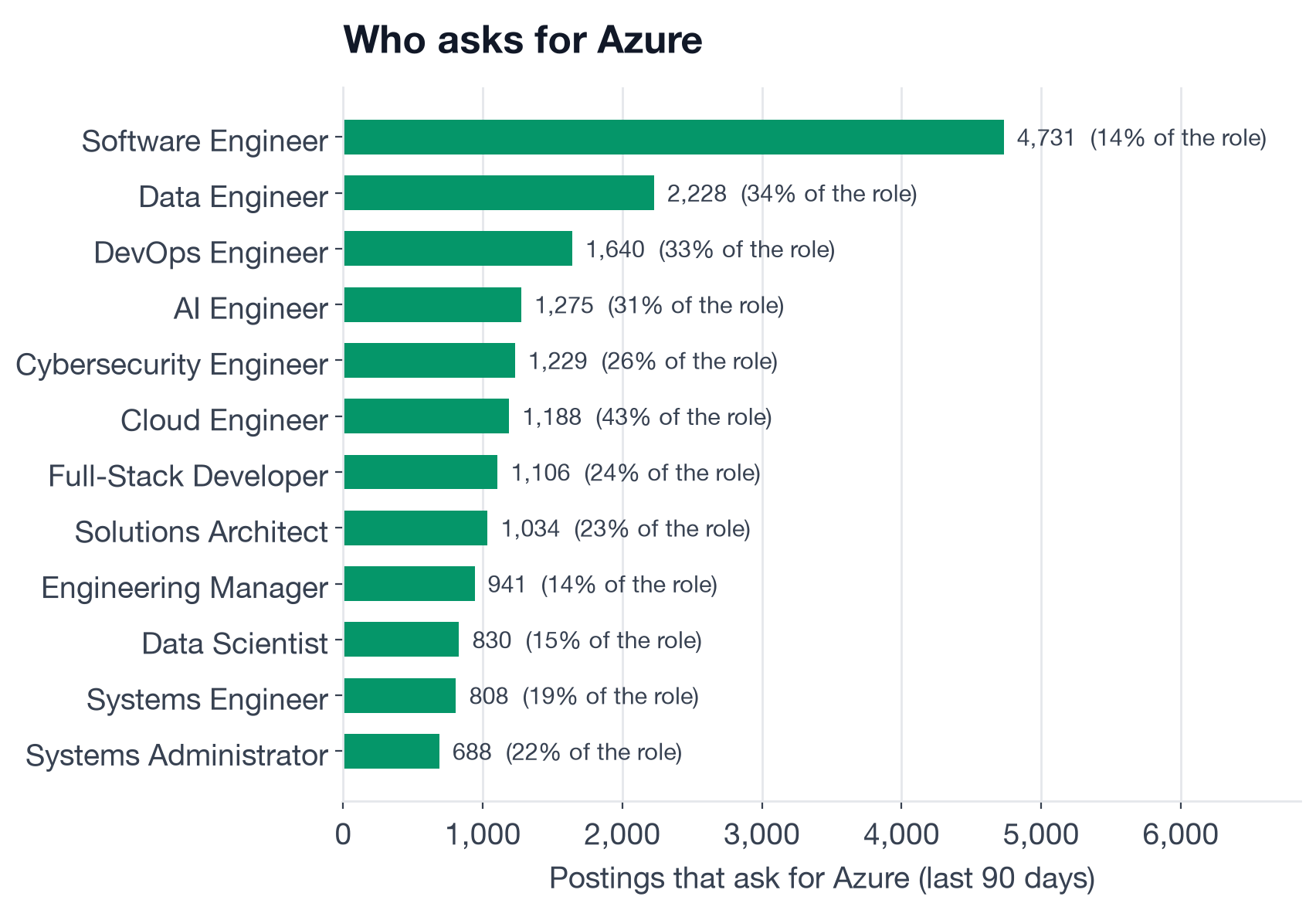
The chart separates the two ways to read "who asks": volume (where the jobs are) versus habit (where Azure is standard). If you are choosing a role to aim at, habit tells you how likely a given posting is to ask for it.
| Role | Postings asking for Azure | Share of that role's postings |
|---|---|---|
| Software Engineer | 4,731 | 14.3% |
| Data Engineer | 2,228 | 34.2% |
| DevOps Engineer | 1,640 | 33.5% |
| AI Engineer | 1,275 | 31.1% |
| Cybersecurity Engineer | 1,229 | 25.7% |
| Cloud Engineer | 1,188 | 42.9% |
| Full-Stack Developer | 1,106 | 23.6% |
| Solutions Architect | 1,034 | 23.0% |
| Cloud Architect | 671 | 39.7% |
For the full skill picture in the biggest roles, see our posts on Software Engineer skills, Data Engineer skills, and DevOps Engineer skills. Cloud-first readers should also read Cloud Engineer skills and Solutions Architect skills.
Azure postings also skew senior. Entry-level is 3.1% of Azure postings versus 6.6% of postings without it, while senior is 30.9% versus 23.4%. Seniority here is inferred from title keywords, and titles with no level word default to mid-level, so treat the exact split as approximate. The direction suggests that early-career candidates will find fewer Azure postings aimed at them.
Is Azure Required or a Nice-to-Have?
Where the wording is clear, it is mostly a nice-to-have. Among the 5,274 mentions where the wording near the word Azure could be classified, 4,582 (86.9%) were preferred and 692 (13.1%) were required. That covers about 22% of all mentions; the rest carry no clear wording or the mention could not be located in the description. Our classifier also lets "preferred" win ties, so the required share is likely understated; read this as a directional split.
The practical reading: among postings with clear wording, not knowing Azure is rarely stated as a hard requirement. A cloud-literate candidate (any major cloud) with strong fundamentals clears most of these bars, which is also why the pairings below matter more than the tool alone.
Does Azure Come With Higher Pay? Mostly Not
Postings that ask for Azure advertise lower base pay than their same-role, same-level peers in most cells, and among the largest cells the ones that go up do so by single digits. These numbers are US advertised base salary only, from postings that disclose it; equity and bonus are not included. The comparison covers 67 role-and-level cells with at least 15 salaries on each side, which together account for 94.3% of Azure postings (22,133).
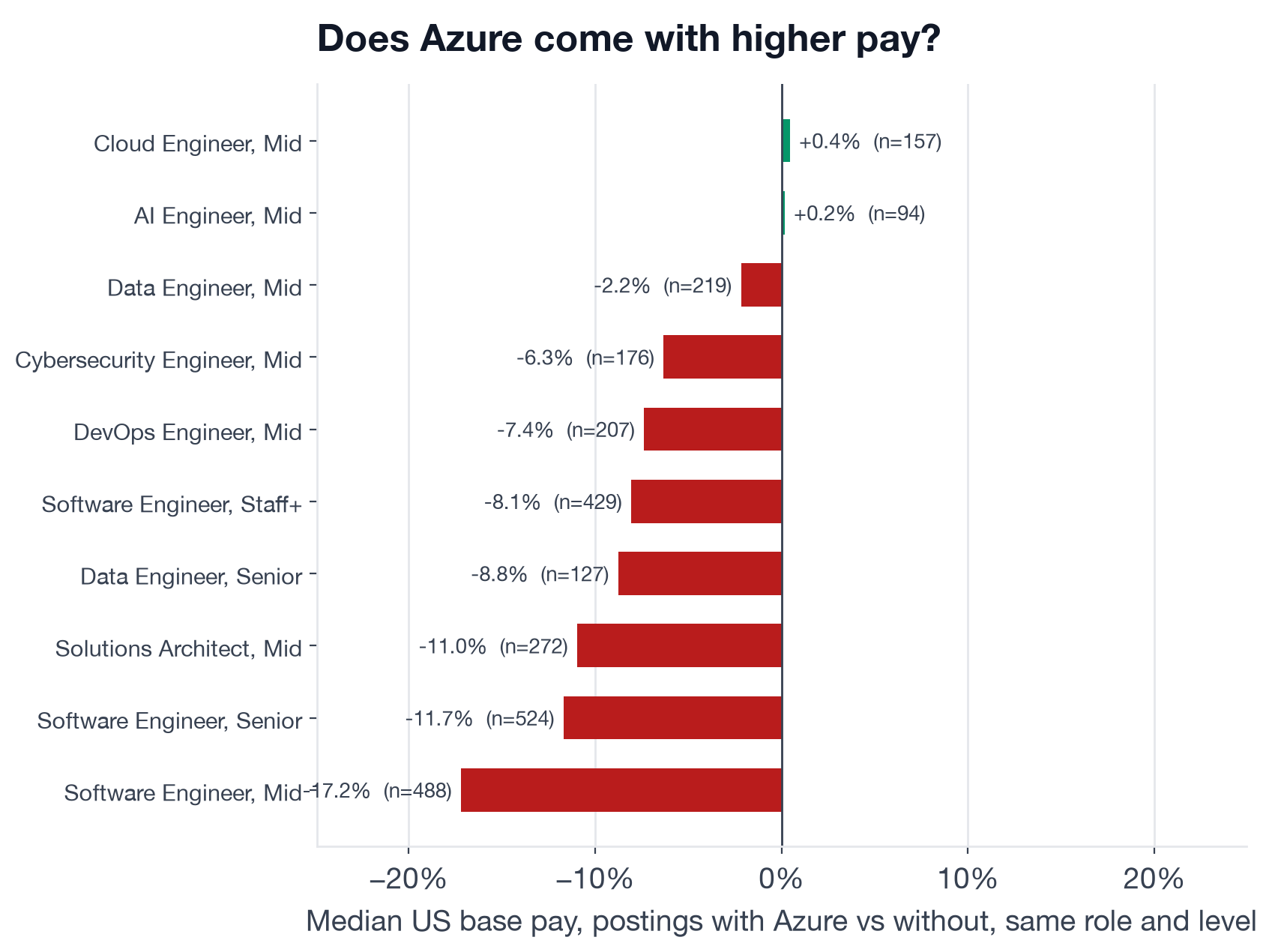
The chart and table show US base salary gaps for the largest cells only (the 67 cells are not all displayed); positive bars are the exception. Of 67 cells, 41 are lower, 16 are higher, and 10 are neither, for a weighted gap of -5.6%. This is correlation: the data shows what employers advertise, not what Azure does to anyone's salary, and it does not explain why the gaps run the way they do.
| Role and level | With Azure (median) | Without Azure (median) | Gap | Salaries (with / without) |
|---|---|---|---|---|
| Software Engineer, mid-level | $140,000 | $169,050 | -17.2% | 488 / 4,665 |
| Software Engineer, senior | $162,500 | $184,000 | -11.7% | 524 / 2,968 |
| Software Engineer, staff | $200,000 | $217,525 | -8.1% | 429 / 1,882 |
| Solutions Architect, mid-level | $140,000 | $157,225 | -11.0% | 272 / 521 |
| Data Engineer, senior | $150,000 | $164,400 | -8.8% | 127 / 308 |
| Data Engineer, mid-level | $135,000 | $138,000 | -2.2% | 219 / 486 |
| DevOps Engineer, mid-level | $132,000 | $142,500 | -7.4% | 207 / 410 |
| Cloud Engineer, mid-level | $142,400 | $141,763 | +0.4% | 157 / 298 |
| Cloud Architect, mid-level | $173,000 | $172,860 | +0.1% | 116 / 167 |
| Data Scientist, mid-level | $145,250 | $140,000 | +3.8% | 90 / 699 |
Two patterns are worth stating plainly. First, for software engineers the gap is largest at mid-level and narrows toward staff, so "Azure comes with higher pay" is not supported by this data for the biggest group of readers. Employer mix and location, which this comparison does not control for, may account for part of the gap. Second, the roles where Azure is most standard (Cloud Engineer and Cloud Architect) are flat, not lower: when everyone in the role is expected to know it, the postings that mention it are not distinguishable on pay. The few cells that point the other way among the largest comparisons are small, topping out at mid-level Data Scientist at +3.8%.
What Should You Learn With Azure? Rank by Lift, Not Share
The most useful companions are the tools that appear with Azure far more often than they appear anywhere else. AWS is in 62% of Azure postings, but AWS is everywhere (lift 3.0). Azure DevOps (Microsoft's CI/CD and project tooling) is in only 12% of them, but at lift 4.4 it is the strongest pairing, with Google Cloud close behind at 4.3.
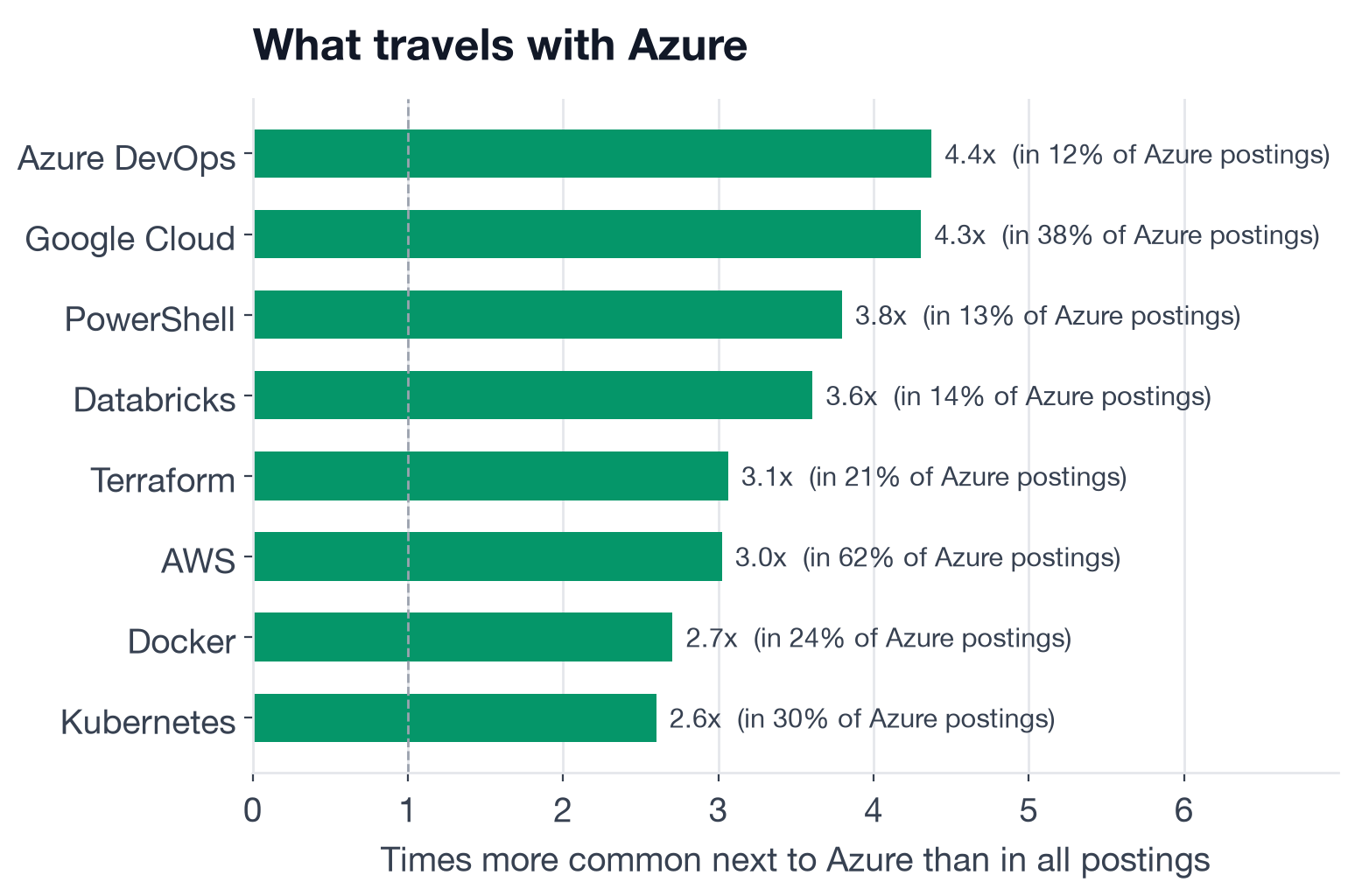
One caution: Azure DevOps is a Microsoft product whose name contains "Azure", so some of its lift is built into the naming rather than being a true skill pairing. The ranking tells you what an Azure job looks like. It is multi-cloud (38% of Azure postings also list Google Cloud, 62% list AWS), it is infrastructure-as-code and containers (Terraform at lift 3.1, Docker 2.7, Kubernetes 2.6), and it has a Windows and data-platform flavor (PowerShell 3.8, Databricks 3.6, C# 2.2).
| Tool | Share of Azure postings | Lift |
|---|---|---|
| Azure DevOps | 11.6% | 4.4 |
| Google Cloud | 38.1% | 4.3 |
| PowerShell | 12.9% | 3.8 |
| Databricks | 14.4% | 3.6 |
| Terraform | 20.8% | 3.1 |
| AWS | 62.0% | 3.0 |
| Docker | 24.4% | 2.7 |
| Kubernetes | 30.2% | 2.6 |
Python (51%) and SQL (34%) are present in plenty of these postings but at lift 1.6 and 1.9, so they are table stakes rather than a signal. Among general skills, CI/CD (45% of Azure postings), Automation (45%), and Monitoring (38%) lead. For a deeper look at how the leading cloud compares, see our AWS skill demand and pay analysis.
Who Hires for Azure? Microsoft First, Then Consultancies and Federal Contractors
The employer list reads as services and contractors, not product companies. Microsoft leads with 418 distinct openings that mention Azure, which is expected from the vendor itself. After that come IT services and consulting firms: PricewaterhouseCoopers (321), Cognizant (195), Accenture (110), DXC Technology (106), and Kyndryl (102). Federal contractors are the second cluster: Booz Allen Hamilton (136), Leidos (124), General Dynamics Information Technology (86), and CACI International (75). UnitedHealth Group (177, listed as Uhg in our data) and Databricks (105) round out the top tier.
Counts are distinct openings (employer by normalized title), so multi-location reposts do not inflate them. They are approximate, and the roster covers a small slice of all Azure postings, so no single employer accounts for more than a few percent of demand. Tool detection reads the extracted skills column, and a spot check of titles shows a minority of mentions sitting in loosely related roles (for example hardware quality or maintenance titles), so treat the counts as directional. If you want to work with Azure, these are the organizations where it is a standing part of the stack. We cannot say from this data whether the pay pattern above is related to the employer mix, so we do not claim it.
How to Use This in Your Job Search
Treat Azure as a baseline cloud skill to be conversant in, not a differentiator to chase for salary. If you are targeting Cloud, DevOps, or Data Engineer roles, expect it to come up, and learn it alongside Terraform and a second cloud. Browse current cloud and infrastructure openings to see how often it appears in the roles you want.
To prepare, practice with AI mock interviews on cloud and infrastructure scenarios, drill the specifics in the Question Bank, and build the foundations with our interactive courses. If you are aiming at a consultancy or contractor, our company preparation guides cover how those firms interview.
FAQ
Q. How many job postings ask for Azure in 2026?
23,469 of 158,723 active postings (14.8%) on the InterviewStack.io job board mention Azure, across 37 of the 39 roles we track. The share was 14.0% for postings first seen 61-90 days ago and 15.2% for those first seen in the last 30 days, which is essentially flat.
Q. Which roles ask for Azure most often?
Cloud Engineer (42.9% of postings), Cloud Architect (39.7%), Data Engineer (34.2%), and DevOps Engineer (33.5%) ask for it most often as a share of the role. Software Engineer is the largest single source of demand by volume, with 4,731 postings, but Azure appears in only 14.3% of them.
Q. Is Azure required or just preferred?
Mostly preferred. Where the posting wording near the mention could be classified (5,274 of 23,469 mentions), 86.9% said preferred or nice-to-have and 13.1% said required. Most mentions carry no clear wording, so treat the split as a signal, not a census.
Q. Do postings that ask for Azure advertise higher pay?
Mostly no. Comparing postings with and without Azure inside the same role and seniority level (US advertised base pay, 67 cells), the weighted gap is -5.6%, with 41 cells lower, 16 higher, and 10 neither. Among the largest cells, the exceptions are small: Cloud Engineer mid-level (+0.4%), Cloud Architect mid-level (+0.1%), AI Engineer mid-level (+0.2%), and Data Scientist mid-level (+3.8%).
Q. What should you learn alongside Azure?
Rank by lift, not share. Azure DevOps (lift 4.4), Google Cloud (4.3), PowerShell (3.8), Databricks (3.6), Terraform (3.1), and AWS (3.0) are the most over-represented companions. Python and SQL appear in half or a third of Azure postings but at low lift because they appear everywhere.
Q. Who hires for Azure?
Microsoft leads with 418 distinct openings that mention Azure, followed by PricewaterhouseCoopers (321), Cognizant (195), UnitedHealth Group (177), Booz Allen Hamilton (136), and Leidos (124). The list is dominated by IT consultancies and federal contractors, not product companies.
Where to Start
Learn Azure because 1 in 7 postings mention it and, where the wording is clear, most call it a plus, not because it moves your offer. Pair it with Terraform and a second cloud, and put your negotiating weight on the role, the level, and the fundamentals, which is where the pay differences in this data actually sit.
Topics
Ready to practice?
Put what you've learned into practice with AI mock interviews and structured preparation guides.