
CRISC's Largest Single Employer Accounts for Just 4 of 179 Mentions
No. Across 9,040 active postings for Information Security Analyst, Cybersecurity Engineer, and Security Architect roles on the InterviewStack.io job board over the trailing 90 days, the single busiest employer asking for CRISC, Certified in Risk and Information Systems Control, ISACA's risk-management credential, accounts for just 4 of the certification's 179 mentions. Widen the lens to the top 12 employers combined and they still cover only about 17% of every CRISC mention in the dataset.
That's a genuinely scattered employer base: a Swiss pharmaceutical company, a Canadian bank, a Swiss digital-banking vendor, a Spanish telecom's cybersecurity arm, a US defense contractor, and the Dutch arm of a Big Four consultancy all sit within a mention or two of each other near the top of the list. CRISC also splits unevenly by role: Security Architect postings ask for it at more than three times the rate of Cybersecurity Engineer postings, and almost none of the classified mentions treat it as a hard requirement. None of that fits a credential a single sector mandates; it fits a credential that shows up wherever an organization, of almost any kind, has formal risk decisions someone needs to own.
Key Findings
- CRISC appears in 1.98% of postings across three roles, Information Security Analyst, Cybersecurity Engineer, and Security Architect (179 of 9,040 active postings analyzed over 90 days).
- No single employer accounts for more than 4 of those 179 mentions, and the top 12 employers combined cover only about 17.3% of all mentions.
- Security Architect postings mention CRISC at 3.59%, about 3.6 times Cybersecurity Engineer's 1.00% rate; Information Security Analyst sits at 2.70% but supplies 62% of all mentions because it's the largest role in scope.
- Of the mentions specific enough to classify, just 4.0% call CRISC a hard requirement (roughly 1 in 25); 96.0% call it preferred, and another 80 mentions (44.7% of all 179) don't specify either way.
- CRISC-mentioning postings advertise a $146,863 median US base salary versus $140,000 without it, a 4.9% gap, but none of the four seniority bands has enough CRISC-mentioning postings to confirm the gap holds at any specific level.
- That pooled 4.9% hides a much larger gap within Information Security Analyst specifically (62% of all CRISC mentions), the only role with enough of its own with-CRISC salary sample to report: $144,630 vs $101,450 without CRISC, a 42.6% difference (n=33).
- CISSP appears alongside 90.5% of CRISC mentions, and CISM alongside 78.2%.
- Risk Management is the most common associated skill, appearing in 58.7% of CRISC-mentioning postings.
CRISC Hiring Is Spread Across Industries, With No Single Cluster
The top 12 employers that mention CRISC most often cover just 31 of the certification's 179 mentions, 17.3% of the total. That's not because the list is short on variety: it spans pharmaceuticals, banking, fintech software, identity and security vendors, technology, consulting, telecom, government-focused IT services, and aerospace, with no two companies from the same narrow slice of the economy claiming more than a couple of mentions apiece.
| Employer | CRISC-Mentioning Postings |
|---|---|
| Roche | 4 |
| Deloitte Netherlands | 3 |
| Royal Bank of Canada | 3 |
| Crealogix | 3 |
| Entrust | 3 |
| Auxis | 3 |
| 2 | |
| VC3 | 2 |
| Peraton | 2 |
| Nagarro | 2 |
| Space Exploration Technologies Corp. | 2 |
| Telefónica Tech | 2 |
Roche (pharmaceuticals), Royal Bank of Canada (banking), Crealogix (banking software), Entrust (identity and security), Peraton (defense), Telefónica Tech (a telecom's cybersecurity arm), Google (technology), VC3 (IT and cybersecurity services for local governments and businesses), and Space Exploration Technologies Corp. (aerospace) span nine distinct industries. The closest thing to a cluster is a loose consulting and IT-services group, Deloitte Netherlands, Auxis, and Nagarro, and even that accounts for only 8 of the 31 top-12 mentions. Whatever CRISC signals to an employer, it isn't tied to one industry or one type of company.
Why Does Cybersecurity Engineer Lag So Far Behind on CRISC?
Because CRISC measures a different competency than the one Cybersecurity Engineer postings usually test for. Security Architect mentions CRISC in 3.59% of its postings (26 of 724), Information Security Analyst in 2.70% (111 of 4,114), and Cybersecurity Engineer in just 1.00% (42 of 4,202). Weighted against each role's share of the overall posting pool, Security Architect over-indexes 1.81x, Information Security Analyst 1.36x, and Cybersecurity Engineer under-indexes to 0.50x, about half its expected share. Security Architect postings name CRISC roughly 3.6 times as often as Cybersecurity Engineer postings do, and Information Security Analyst about 2.7 times as often.
| Role | Postings Scanned | CRISC Mentions | Mention Rate | Over-Index | Baseline Pay (No CRISC) |
|---|---|---|---|---|---|
| Security Architect | 724 | 26 | 3.59% | 1.81x | $176,800 |
| Information Security Analyst | 4,114 | 111 | 2.70% | 1.36x | $101,450 |
| Cybersecurity Engineer | 4,202 | 42 | 1.00% | 0.50x | $162,325 |
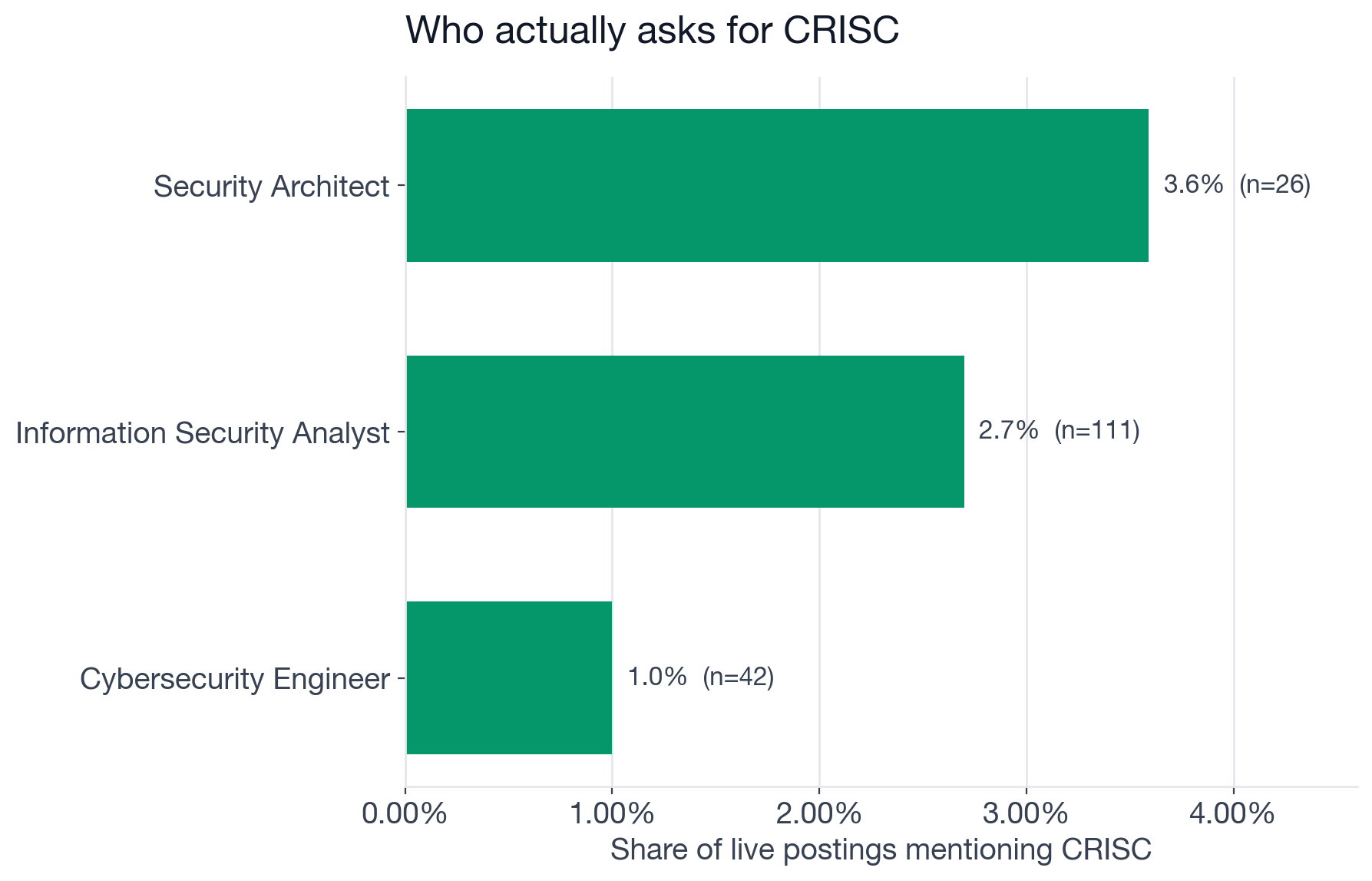
Pay tier doesn't explain the split. Security Architect, the role that over-indexes most, also has the highest baseline pay in scope ($176,800). But Information Security Analyst, the second-highest over-indexer, has the lowest baseline pay ($101,450), and Cybersecurity Engineer, which under-indexes the most, sits in the middle on pay ($162,325). A pay-driven pattern would put the two ends of the pay scale on the same side of the over-index line; here the highest-paying and lowest-paying roles both over-index while the middle-paying one lags furthest behind.
The more plausible read is functional: CRISC is built around identifying, assessing, and governing IT risk. Security Architect and Information Security Analyst postings both involve risk-facing work as a matter of course, designing controls against a stated risk tolerance, or documenting and assessing risk directly, while Cybersecurity Engineer postings more often describe implementing and operating controls someone else has already specified. That's a plausible fit for the pattern, not something this dataset can test directly. (The "Security Architect" label in this dataset also picks up some adjacent governance titles, security directors and ISSOs alongside hands-on architects; if that population is real here, it would if anything make the role lean more toward risk-facing work, not less, so it doesn't change the read above.)
How Rarely Does a CRISC Mention Actually Require the Credential?
Rarely: about 1 in 25. Of CRISC's 179 mentions, 99 use wording within 160 characters of the mention specific enough to classify as required or preferred; the other 80 (44.7% of all mentions) don't specify either way. Within the classified group, just 4 (4.0%) state CRISC as a required qualification, and 95 (96.0%) call it preferred.
| Count | Share | |
|---|---|---|
| Required | 4 | 4.0% of classified |
| Preferred | 95 | 96.0% of classified |
| Unspecified | 80 | 44.7% of all mentions |
That lopsided split fits the employer picture above. A certification a specific contract or regulator mandates for a named seat tends to show up as a flat requirement far more often than this. CRISC reads more like a credential employers list to signal that risk-management experience is welcome, not one that gates the role.
CRISC's Pay Gap Can't Be Pinned to Any Seniority Level
CRISC-mentioning postings across these three roles advertise a median US base salary of $146,863, 4.9% above the $140,000 median for postings in the same roles that don't mention it (equity, bonus, and other compensation aren't disclosed in postings and aren't part of this comparison; sample sizes are n=47 with CRISC, n=3,131 without). Break the postings out by seniority level and every band, entry, mid-level, senior, and staff, falls short of the 25-posting floor this analysis requires to report a with-CRISC median; the closest, mid-level, has only 22.
| Seniority Level | Without CRISC (Median US Base) | With CRISC (Median US Base) | Sample With CRISC |
|---|---|---|---|
| Entry | $80,450 (n=71) | Not reportable | n=1 |
| Mid-level | $117,500 (n=2,041) | Not reportable | n=22 |
| Senior | $169,000 (n=604) | Not reportable | n=17 |
| Staff | $177,000 (n=415) | Not reportable | n=7 |
That means the 4.9% aggregate can't be attributed to a specific level, and part of it is very likely composition rather than a real premium at any level. CRISC-mentioning postings skew slightly more senior overall (mean seniority level 1.46 vs 1.39) and have almost no entry-level presence (1.1% vs 3.1% for non-CRISC postings). (Seniority here is inferred from title keywords, and a posting with no explicit level word defaults to mid-level, which compresses this measured spread; roughly a third of this dataset's sampled titles, "Security Control Assessment Specialist" or "Cyber Security Auditor," for instance, carry no explicit level marker, so the true senior skew in a credential that generally assumes existing risk-management experience is plausibly larger than 1.46 vs 1.39 suggests, not smaller.) Entry-level postings pay far less than any other band ($80,450 versus $117,500 to $177,000 for the rest), so a group with almost none of them will show a higher pooled median than a comparison group that includes them, even before considering whether CRISC carries any premium of its own. Treat the $146,863 figure as descriptive of which postings mention CRISC, not as what the certificate itself pays.
The seniority breakdown isn't the only place a role-level comparison is possible, though. Of the three roles in scope, only Information Security Analyst has enough of its own with-CRISC salary sample to report on its own (n=33; Security Architect and Cybersecurity Engineer have just n=2 and n=12, both too small to report). Within Information Security Analyst, the gap is much larger than the pooled figure: $144,630 with CRISC versus $101,450 without, a 42.6% difference. Information Security Analyst is both the lowest-paying of the three roles without CRISC and the role supplying 62% of every CRISC mention, so pooling it with Security Architect's and Cybersecurity Engineer's much higher baseline pay pulls the blended $146,863 down toward Information Security Analyst's own pay scale, well below what a same-role comparison shows. Read the 42.6% figure the same way as the 4.9% one: correlational, not controlled for seniority within the role, and specific to Information Security Analyst, not Security Architect or Cybersecurity Engineer.
CRISC Rarely Travels Without CISSP, CISM, or CISA
Almost never alone. CISSP appears alongside 90.5% of CRISC mentions, CISM alongside 78.2%, and CISA alongside 65.4%, meaning a large majority of CRISC-mentioning postings also ask for at least one other ISACA-family or governance-heavy credential.
| Certification | Share of CRISC-Mentioning Postings |
|---|---|
| CISSP | 90.5% |
| CISM | 78.2% |
| CISA | 65.4% |
| CCSP | 15.6% |
| CompTIA Security+ | 12.8% |
| CEH | 4.5% |
A posting naming CRISC alongside three or four other advanced security certifications usually isn't asking a candidate to hold all of them. It reads more like a menu of acceptable governance credentials for the same senior seat than a stacked checklist. CISSP, CISM, and CISA postings are each far more common individually than CRISC, so a listing is more likely treating CRISC as one of several acceptable options than as an extra requirement layered on top.
On the skills side, the top associated terms lean toward the risk-management core the exam is built around: Risk Management (58.7% of CRISC-mentioning postings), Risk Assessment (45.3%), Monitoring (36.9%), Cloud Security (29.1%), Security Architecture and Incident Response (24.0% each), and Automation (22.3%). That's a governance-and-oversight skill profile, not a hands-on tooling one.
Turning the CRISC Numbers Into a Study and Search Plan
If you're weighing CRISC against CISSP or CISM, the honest read is that employers rarely force a choice: 90.5% of CRISC-mentioning postings already accept CISSP too, so holding more than one of these credentials widens which postings will take you seriously rather than acting as a hard gate on any single one. Given how thin the required-vs-preferred signal is (just 4.0% of classified mentions), don't assume a posting that lists CRISC is closed to you without it; treat it as a plus, not a filter.
The skill profile above, Risk Management, Risk Assessment, Monitoring, and Cloud Security, is a more direct study guide than the exam blueprint alone. Practice with AI mock interviews that simulate risk-assessment and governance scenarios rather than certification trivia. The Question Bank is a fast way to drill the specific risk and compliance topics that show up repeatedly in CRISC-adjacent postings, and if your foundations in security architecture or cloud security need work first, InterviewStack's interactive courses cover the underlying concepts these postings actually test for. When you're ready to apply, browse current openings across all three scoped roles, or filter directly to Security Architect postings that ask for Risk Management.
FAQ
Q. What percentage of postings ask for CRISC?
CRISC appears in about 2% of postings (179 of 9,040) across three roles, Information Security Analyst, Cybersecurity Engineer, and Security Architect, analyzed over a 90-day window on the InterviewStack.io job board.
Q. Does one company or industry drive CRISC hiring?
No. The single busiest employer in this dataset accounts for just 4 of 179 CRISC mentions, and the top 12 employers combined, spanning pharma, banking, fintech software, security vendors, technology, consulting, telecom, government-focused IT services, and aerospace, make up only about 17% of all mentions. CRISC demand is spread thin rather than concentrated in one sector.
Q. Which roles ask for CRISC most often?
Security Architect, by rate: it mentions CRISC in 3.59% of its postings, about 3.6 times Cybersecurity Engineer's 1.00% rate. Information Security Analyst sits in between at 2.70%, but contributes the most raw mentions (111 of 179, 62%) simply because it's the largest of the three roles in scope.
Q. Is CRISC usually required or just preferred?
Preferred, overwhelmingly. Of the mentions specific enough to classify, 96.0% call CRISC preferred and just 4.0% call it required, meaning roughly 1 in 25 classified mentions treats it as mandatory. Another 80 mentions (44.7% of all 179) don't specify either way.
Q. Do CRISC-mentioning postings pay more?
A little, in aggregate, though that pooled figure hides a bigger gap in one role: CRISC-mentioning postings advertise a median US base salary of $146,863 versus $140,000 for postings in the same three roles that don't mention it, a 4.9% gap (n=47 with CRISC, n=3,131 without). None of the four seniority bands has enough CRISC-mentioning postings on its own to confirm the gap at a specific level, and CRISC postings skew slightly more senior overall, so composition likely explains part of the difference. The one role with enough of its own with-CRISC salary sample to check on its own, Information Security Analyst (62% of all CRISC mentions), shows a 42.6% gap ($144,630 vs $101,450, n=33), well above the pooled figure.
Q. What other certifications usually appear alongside CRISC?
CISSP, overwhelmingly: it co-occurs in 90.5% of CRISC-mentioning postings. CISM (78.2%) and CISA (65.4%) follow, so a CRISC mention is rarely the only ISACA-family or governance credential a posting asks for.
Q. What is CRISC, and who issues it?
CRISC stands for Certified in Risk and Information Systems Control, a risk-management credential issued by ISACA that focuses on identifying, assessing, and governing IT risk, distinct from CISA's audit focus and CISM's security-management focus.
What a CRISC Mention Is Actually Telling You
Put the pieces together and CRISC reads as a credential about a kind of judgment, not a kind of job. No employer or industry drives its demand, it shows up far more often in roles that own risk decisions than in roles that implement someone else's, it's rarely a hard requirement, and its salary premium is too thin a slice of data to pin to any specific seniority level. If your work already involves assessing or governing risk, whether as a Security Architect, an Information Security Analyst, or in an adjacent governance role, CRISC is a credible way to formalize that experience. If your day-to-day is implementation and operations, the numbers here don't make a strong case for chasing it first.
Topics
Ready to practice?
Put what you've learned into practice with AI mock interviews and structured preparation guides.