
Design Researcher's Top Skill Prices Below UI Designer's Baseline
At the median, Design Researcher out-earns UI Designer by $13,400 (Design Researcher's own $120,900 base against UI Designer's $107,500, both US-only). That looks like a clean case for switching titles, until you check which skill actually drives most Design Researcher postings. Instructional Design, the single most common named skill on Design Researcher listings at 39.8% of postings, prices at $86,200, which is $21,300 below what a typical UI Designer earns, not above it. We pulled every active listing for both roles from the InterviewStack.io job board as of September 2026, 978 UI Designer postings and 483 Design Researcher postings, with skills extracted and normalized the same way the live filters work. The two roles share only 28% of their top-30 skill sets (a Jaccard overlap of 0.28), so this isn't two flavors of one job. It's two different jobs whose pay comparison depends entirely on which Design Researcher listing you're reading.
| UI Designer | Design Researcher | |
|---|---|---|
| Median US base salary | $107,500 | $120,900 |
| Active postings | 978 | 483 |
| Top skill | Figma (57.8%) | Instructional Design (39.8%) |
| Remote share | 28.5% | 36.6% |
| Entry-level share | 7.9% | 3.1% |
Key Findings
- UI Designer posts 978 active listings versus 483 for Design Researcher, a 2.02x volume gap.
- Design Researcher's median US base salary is $120,900 versus $107,500 for UI Designer, a $13,400 (11.1%) gap in Design Researcher's favor.
- Instructional Design, Design Researcher's single most common named skill (39.8% of postings), prices at $86,200: $21,300 below UI Designer's own baseline.
- Design Researcher's genuine research skills price far above either baseline: User Experience at $171,300 (+$50,400 over Design Researcher's own median), User Research at $166,200 (+$45,300), Usability Testing at $164,500 (+$43,600).
- Design Systems shows the widest split of any shared skill: 34.7% of UI Designer postings versus 6.4% of Design Researcher postings, a 5.4x gap. Figma is close behind at 57.8% vs. 11.4% (5.1x).
- The two roles share just 28% of their top-30 skill sets (Jaccard overlap coefficient 0.28).
- Design Researcher's entry-level share is 3.1%, less than half UI Designer's 7.9%.
- Design Researcher skews more remote (36.6% vs. 28.5%) and more US-based (46.6% vs. 28.8%) than UI Designer.
What Each Job Actually Involves
UI Designer's job is easy to describe from its skill list alone: take a product spec and turn it into a shippable interface, using Typography, Wireframes, Adobe Creative Suite, Interaction Design, HTML, and CSS along the way.
Design Researcher is harder to pin down from the title. One posting means recruiting participants, running usability sessions, and turning findings into product recommendations. Another means building corporate training curricula and eLearning modules, with almost no product-research work at all. Both get filed under "Design Researcher" on the same job board. Our deep dive into Design Researcher postings found a $60,600 pay gap between those two tracks; the numbers below show the same fracture from the UI Designer side.
Which Skills Do Both Roles Actually Require?
Thirteen skills clear 5% frequency in both roles' postings, but only two are genuinely balanced regardless of which title a listing uses: User Research (14.8% UI Designer, 15.5% Design Researcher) and Product Design (9.8% vs. 8.1%). Everything else splits hard toward one side. Figma is 5.1 times as common in UI Designer postings (57.8% vs. 11.4%), and Design Systems is 5.4 times as common (34.7% vs. 6.4%). Storytelling and Project Management run the other way, roughly 1.7x and 2.1x more common in Design Researcher postings.
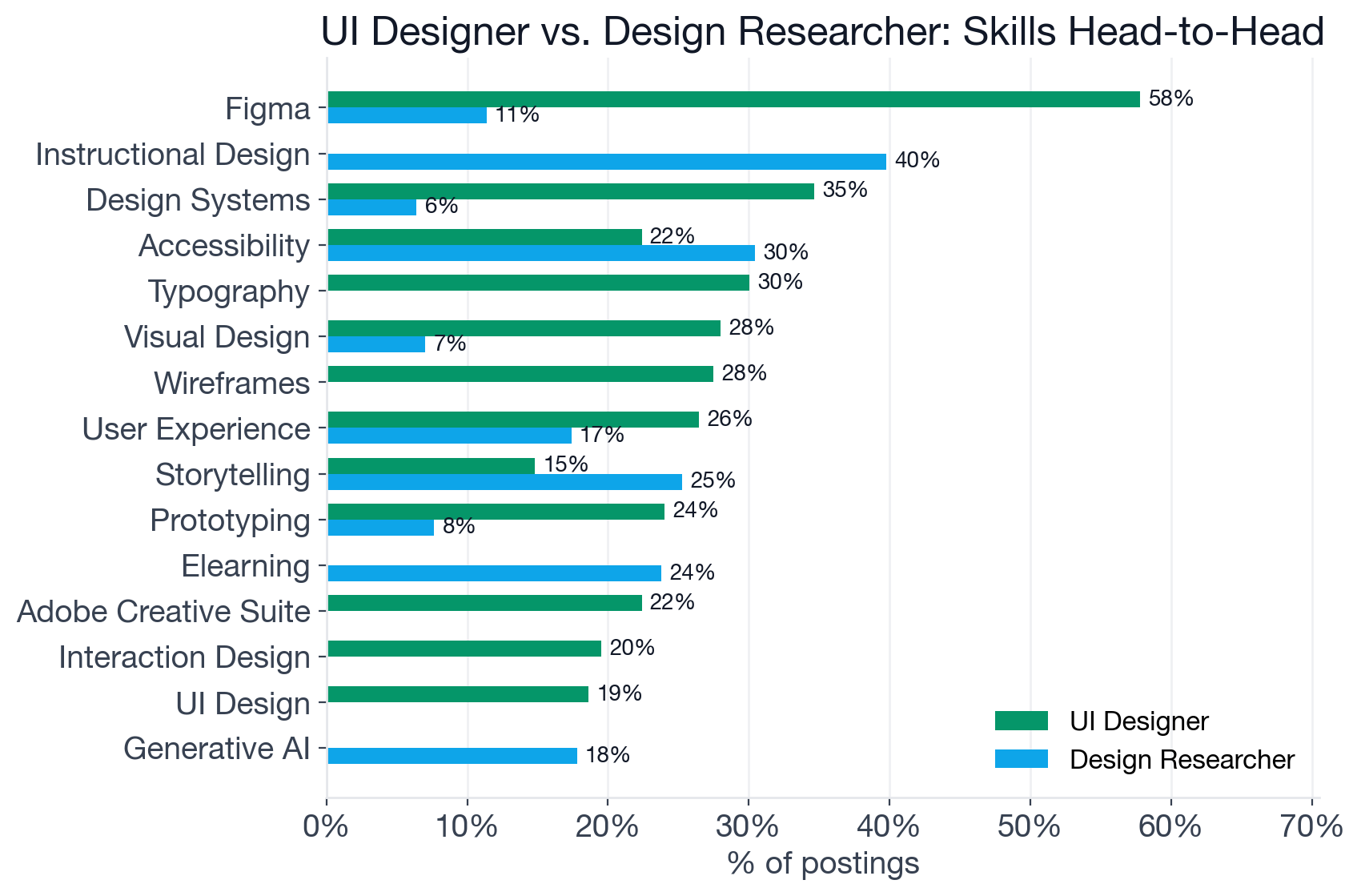 Top skills across both roles. User Research and Product Design are the closest thing to a true bridge; Figma and Design Systems split hard toward UI Designer.
The near-parity on User Research is the real surprise: the skill most people associate with "Design Researcher" shows up at almost the same rate in UI Designer postings. It isn't what separates the two roles; which tier of research skill a posting actually names is, and that's what drives the salary story below.
One Cluster vs. Two: The Exclusive Skill Lists
UI Designer's exclusive skills (8%+ of its postings, under 5% of Design Researcher's) form one coherent cluster: Typography (30.1%), Wireframes (27.5%), Adobe Creative Suite (22.4%), Interaction Design (19.5%), UI Design (18.6%), HTML (16.4%), CSS (14.8%), User Flows (14.5%), Information Architecture (11.9%), and Branding (11.0%). All ten describe production or craft work.
Design Researcher's exclusive list splits into two clusters. Instructional Design (39.8%), Elearning (23.8%), Blended Learning (16.8%), and Andragogy (12.6%, adult-learning theory) anchor a corporate learning-design track, not a research one; our full breakdown of Design Researcher postings covers this split in depth. Generative AI (17.8%), Machine Learning (14.5%), and LLMs (12.4%) also sit in Design Researcher's exclusive list; UI Designer has none in its top 30. That's a naming gap, not a usage gap: Figma's 2026 State of the Designer report puts generative-AI adoption at 72% among designers broadly, and the Designer Fund and Foundation Capital's AI in Design Report 2026 found weekly AI use as high as 91%. A 2025 Wiley study, reported via CleverX, separately found 84% of researchers already use AI in their work. All of that runs far above what either role's postings state outright. Design Researcher postings name AI because synthesizing interview data with an LLM is now a screened-for research skill; UI Designer postings fold the same tool into "using Figma" instead.
Does Design Researcher Really Out-Earn UI Designer?
Not always, and that's the point. These are US-only base salaries: equity, bonus, and sign-on aren't disclosed in postings, so total comp at top employers runs higher for both roles. On the surface, Design Researcher's $120,900 median beats UI Designer's $107,500 by $13,400 (11.1%). But that aggregate blends two very different pay tables.
| Skill | Design Researcher median | vs. Design Researcher's own baseline | vs. UI Designer's baseline |
|---|---|---|---|
| User Experience | $171,300 | +$50,400 | +$63,800 |
| User Research | $166,200 | +$45,300 | +$58,700 |
| Usability Testing | $164,500 | +$43,600 | +$57,000 |
| Accessibility | $132,000 | +$11,100 | +$24,500 |
| Project Management | $87,400 | -$33,500 | -$20,100 |
| Instructional Design | $86,200 | -$34,700 | -$21,300 |
| Elearning | $86,200 | -$34,700 | -$21,300 |
Postings that name genuine research skills clear UI Designer's baseline by $57,000 to $63,800. Postings that name Instructional Design (39.8% of listings), Elearning (23.8%), or Project Management (13.7%) instead sit $20,100 to $21,300 below UI Designer's own median. UI Designer's own toolkit prices more evenly: its core production skills (Figma, Accessibility, Visual Design, UI Design) all sit exactly at its $107,500 baseline, table stakes with no premium either way, while Product Design (+$33,400, n=35), User Experience (+$17,500, n=43), and Design Systems (+$12,500, n=57) are its real differentiators. One wrinkle on UI Designer's own side: Wireframes (27.5% of postings) prices $16,500 below its own baseline, the same "widely required skill prices below baseline" pattern Design Researcher shows with Instructional Design.
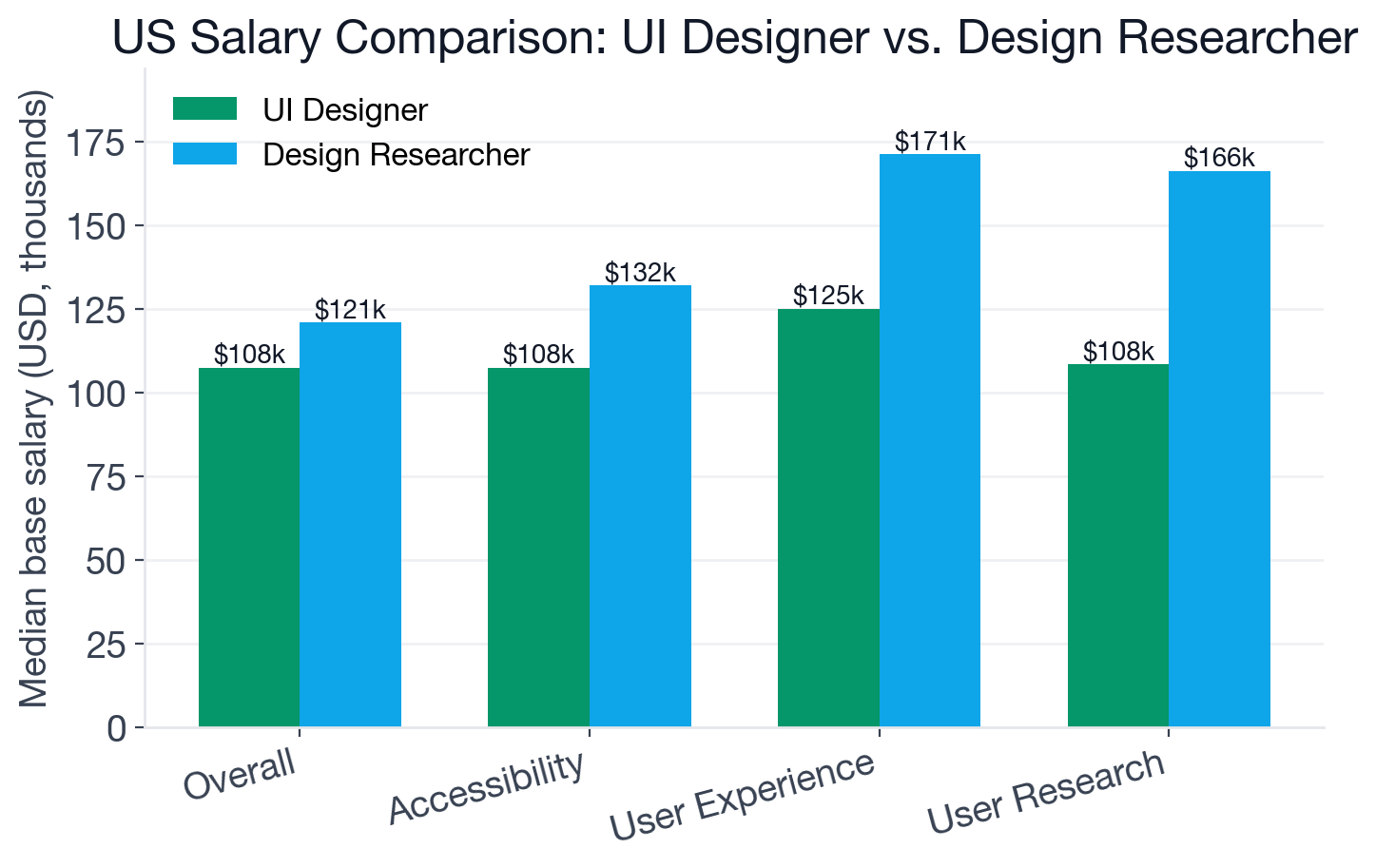 Median US base salary. Base only; equity and bonus excluded.
Who Has the Easier Path In, and Where Are the Jobs?
UI Designer offers roughly double the openings, 978 active postings against 483 for Design Researcher, a 2.02x gap, and a meaningfully wider door: 7.9% of UI Designer postings are explicitly entry-level, 2.5 times Design Researcher's 3.1%. Design Researcher also skews more senior overall (34.4% senior-plus-staff versus UI Designer's 25.1%), consistent with a role that leans on either deep research credentials or the tenure that corporate learning-design hiring tends to reward.
Design Researcher is also more remote-friendly and more US-concentrated: 36.6% remote versus UI Designer's 28.5%, and 46.6% US-based versus 28.8%. UI Designer's non-US demand spreads more widely, across Germany, India, Canada, and the UK.
Matching Your Strengths to the Right Title
Choose UI Designer if you:
- Want the larger market, roughly double the open roles and a more accessible entry point (7.9% vs. 3.1%)
- Want a coherent, tool-defined job: Figma, Wireframes, and Design Systems describe one visual-production role, not a hidden second track
- Are comfortable with the ceiling sitting in strategy-adjacent skills (Product Design, User Experience) rather than the core toolkit itself
Choose Design Researcher if you:
- Have a genuine background in usability testing, user research, or UX methods, and can confirm a posting actually tests for them
- Are comfortable with a smaller, more senior-skewed, more remote-friendly market
- Want the ceiling that comes from research skills specifically: User Experience, User Research, and Usability Testing each clear UI Designer's median by $57,000 or more
How to Use This in Your Job Search
For UI Designer roles, invest beyond baseline Figma fluency: Product Design and Design Systems carry the real premiums, and our UI Designer skills deep dive breaks down the full tier structure. Rehearse portfolio walkthroughs with AI mock interviews before a screen.
For Design Researcher openings, read the skill list before the title. A posting built around Instructional Design or Elearning is the learning-design track; one built around Usability Testing or User Research is the track that pays like specialized research work. If you're also weighing UX Designer against Design Researcher, that comparison found a much smaller, near-parity gap. Drill research methodology through the question bank before you apply.
FAQ
Q. What's the salary difference between UI Designer and Design Researcher in 2026?
Design Researcher's median US base salary is $120,900 (n=155 postings with US salary disclosed) versus $107,500 for UI Designer (n=153), a $13,400 (11.1%) gap in Design Researcher's favor. Both figures are base salary only; equity, bonus, and sign-on aren't disclosed in postings, so total comp at top employers runs higher for both roles.
Q. Does Design Researcher always pay more than UI Designer?
No. The aggregate gap hides a split inside Design Researcher's own numbers. Postings naming genuine research skills, User Experience ($171,300), User Research ($166,200), or Usability Testing ($164,500), clear UI Designer's $107,500 baseline by $57,000 or more. Postings naming Instructional Design or Elearning, Design Researcher's most common skills by frequency, price at $86,200, about $21,300 below what a typical UI Designer earns.
Q. How much do UI Designer and Design Researcher overlap in required skills?
Not much: the two roles share just 28% of their top-30 skill sets (a Jaccard overlap coefficient of 0.28). Thirteen individual skills clear a 5% frequency threshold in both roles, and the two most evenly shared are User Research (14.8% UI Designer, 15.5% Design Researcher) and Product Design (9.8% vs. 8.1%).
Q. Which role has more job openings?
UI Designer, by roughly 2 to 1: 978 active postings versus 483 for Design Researcher as of September 2026.
Q. Which role is easier to break into?
UI Designer. Its entry-level share is 7.9% of postings versus 3.1% for Design Researcher, 2.5 times higher. Design Researcher also skews more senior overall, 34.4% senior-plus-staff versus UI Designer's 25.1%.
Q. Do UI Designer or Design Researcher postings require AI skills?
Explicitly, only Design Researcher's do: Generative AI appears in 17.8% of its postings, Machine Learning in 14.5%, and LLMs in 12.4%, none of which clear UI Designer's top-30 skill list at all. That gap is mostly about naming, not usage. Figma's 2026 State of the Designer report found 72% generative-AI adoption among designers broadly, and the Designer Fund and Foundation Capital's AI in Design Report 2026 found weekly AI use as high as 91%. A 2025 Wiley study, reported via CleverX, separately found 84% of researchers already use AI in their work. All of that runs far above what either role's postings state outright.
Read the Skill List Before You Compare the Paycheck
UI Designer and Design Researcher look like a clean trade: fewer, higher-paying roles on one side, more accessible ones on the other. The real picture is messier. Design Researcher's $13,400 median lead evaporates, and reverses, the moment a posting is built around Instructional Design instead of Usability Testing or User Research. Before you chase the bigger number, check which Design Researcher job is actually being offered. Browse open UI Designer or Design Researcher roles on InterviewStack.io.
Topics
Ready to practice?
Put what you've learned into practice with AI mock interviews and structured preparation guides.