
Docker Is a Background Skill: Common, Flat Over Time, and Mostly Preferred Where the Wording Is Clear
Docker is named in 15,190 of the 154,524 active postings on the InterviewStack.io job board (9.8%), counted over the 90 days to 21 November 2026, and the share barely moved across the window: 10.2%, 9.6% and 9.9% for the oldest, middle and latest 30 days. Where the wording is clear enough to classify, 9 in 10 mentions are in preferred language, and postings that name Docker list about 4.4% less base pay than comparable postings without it, though that average hides comparisons that go the other way.
Docker (the tool that packages an application and its dependencies into a portable container) shows up in postings for 36 of the 39 roles we track, which is why the useful question is which roles treat it as standard. We counted a posting as naming Docker when the skills extracted from its description include it; nearly all of those (99.6%) also name it in the description text itself. This is a snapshot of one job board, not a trend line, and a mention rate says how often employers write the word, not how much of the work involves it.
Key Findings
- Docker is named in 9.8% of 154,524 active postings (15,190), flat across three 30-day windows (10.2%, 9.6%, 9.9%).
- Postings in 36 of 39 roles name it; Software Engineer is the biggest group (4,983 postings, 32.8% of Docker postings).
- It is most standard in DevOps Engineer postings (35.6%), Backend Developer (29.3%) and Full-Stack Developer (29.1%), and nearly absent from Product Manager (0.2%).
- Of 5,014 postings where wording could be classified, 90.1% say preferred and 9.9% say required.
- Within the same role and title level, US posted base pay is 4.4% lower on average for postings naming Docker (24 of 49 comparisons lower, 18 higher).
- Kubernetes appears in 67.7% of Docker postings, 5.3 times its rate across the board; Jenkins (5.1x) and GitLab (4.7x) follow.
- Citi has the most distinct Docker openings on the board (198), and 6 of the top 14 employers are defense or government contractors.
Who Asks for Docker? Software Engineers by Volume, DevOps by Habit
Software Engineer postings supply the most Docker demand because there are so many of them, but DevOps Engineer postings are where the skill is closest to standard: 35.6% name it, against 13.2% of Software Engineer postings. Backend Developer (29.3%) and Full-Stack Developer (29.1%) sit between the two. If your target role is one of those four, Docker appears often enough in postings to be worth knowing; if it is Data Analyst (0.7%) or Product Manager (0.2%), it is rarely named.
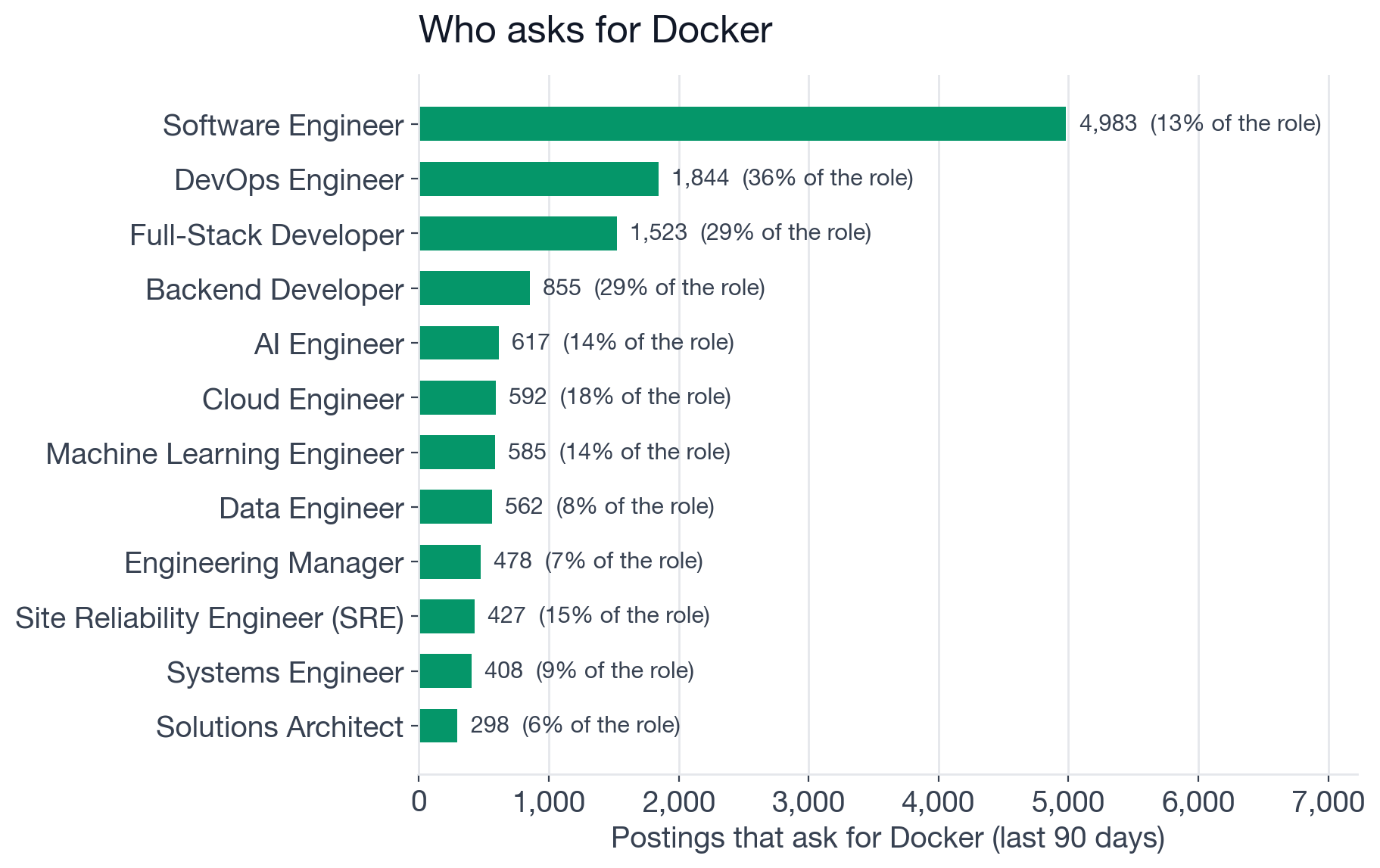
Share of each role's postings that name Docker, over the 90 days to 21 November 2026.
| Role | Postings naming Docker | Share of that role's postings |
|---|---|---|
| Software Engineer | 4,983 | 13.2% |
| DevOps Engineer | 1,844 | 35.6% |
| Full-Stack Developer | 1,523 | 29.1% |
| Backend Developer | 855 | 29.3% |
| AI Engineer | 617 | 14.0% |
| Cloud Engineer | 592 | 18.4% |
| Machine Learning Engineer | 585 | 14.2% |
| Data Engineer | 562 | 8.0% |
For deeper role detail, see our skills posts for Software Engineer, DevOps Engineer and Backend Developer. About 1 in 7 AI Engineer and Machine Learning Engineer postings names Docker (14.0% and 14.2%).
Postings that name Docker skew a little more senior than the rest of the board: 31.2% are senior titles against 24.7% without it, and 3.4% are entry titles against 5.0%. Seniority here is read from title keywords, and titles with no level word default to mid-level, so treat these as rough.
Is Docker Required or a Nice-to-Have?
Mostly a nice-to-have, among the postings where the wording can be read. We looked at the language within 160 characters of the first mention: 497 postings use required wording and 4,517 use preferred wording, which is 9.9% and 90.1% of the 5,014 we could classify. The remaining 10,121 mentions had no clear required or preferred wording nearby, so this split speaks for about a third of Docker postings, not all of them.
Because required wording is only about 1 in 10 of the postings we could classify, there is little evidence here for treating Docker as a gate, though we cannot say how the other two-thirds of mentions are worded. Postings also leave assumed skills unnamed, and we cannot see how employers screen, so the mention rate does not tell you how much hands-on container work a job involves or how it is weighed.
Does Docker Come With Higher Pay? Not Consistently
Postings that name Docker list lower base pay on average once you compare like with like, but the gap points in both directions and we have not measured why. The comparison below uses US advertised base salary only, from postings that disclose it, and does not include equity or bonus. Within each role and title level, we compare postings that name Docker with postings that do not, then weight each comparison by how many Docker postings sit in it. Across 49 comparisons (covering 93.5% of Docker postings), 18 are higher, 24 are lower, and the weighted result is 4.4% lower. Title level is read from title keywords.
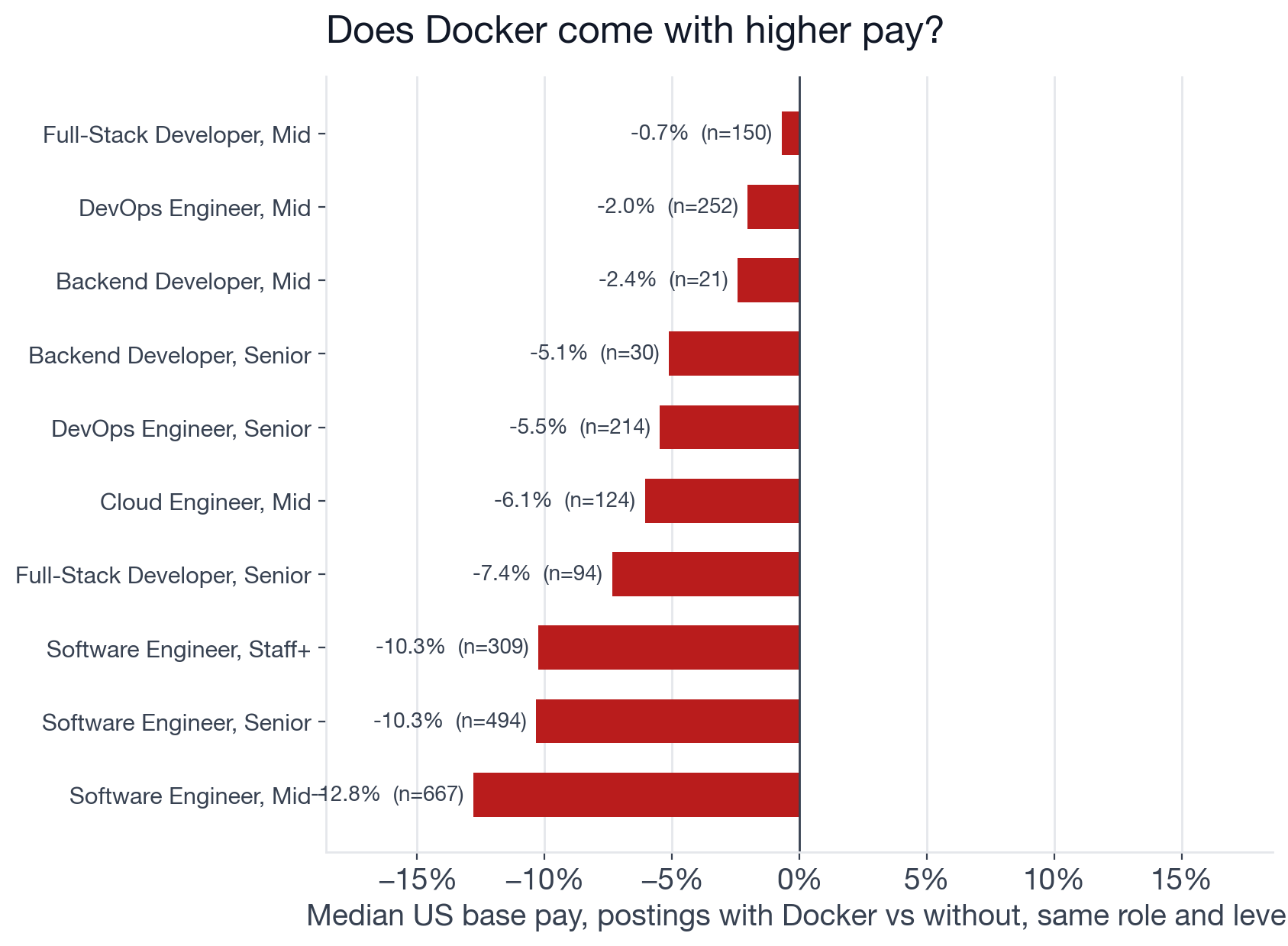
US posted base pay, postings with Docker versus without, within the same role and title level. The chart shows only the ten comparisons with the most Docker postings, all of which are lower. The table below is a selection of 10 of the 49 comparisons, chosen to show both directions; it leaves out the Full-Stack, Cloud Engineer and Backend Developer comparisons, which are all lower.
| Role and title level | With Docker (median US base) | Without Docker | Difference | Postings with / without |
|---|---|---|---|---|
| Software Engineer, mid-level | $147,400 | $169,050 | 12.8% lower | 667 / 4,699 |
| Software Engineer, senior | $165,000 | $184,000 | 10.3% lower | 494 / 3,196 |
| Software Engineer, staff | $192,500 | $214,500 | 10.3% lower | 309 / 2,330 |
| DevOps Engineer, senior | $146,500 | $155,000 | 5.5% lower | 214 / 257 |
| DevOps Engineer, mid-level | $139,000 | $141,900 | 2.0% lower | 252 / 368 |
| DevOps Engineer, staff | $192,500 | $185,000 | 4.1% higher | 79 / 215 |
| Data Engineer, mid-level | $148,500 | $135,200 | 9.8% higher | 65 / 667 |
| Site Reliability Engineer, mid-level | $130,000 | $115,000 | 13.0% higher | 38 / 390 |
| Systems Engineer, mid-level | $158,300 | $135,000 | 17.3% higher | 98 / 870 |
| Software Engineer, entry | $115,425 | $88,400 | 30.6% higher | 60 / 526 |
Two things follow. First, a reader who is a mid-level, senior or staff Software Engineer, the largest group of Docker postings, will find that postings naming Docker list less than those that do not, so "postings that name Docker list higher pay" does not hold for them. Second, a reader aiming at entry Software Engineer, mid-level Systems Engineer, mid-level SRE or mid-level Data Engineer will find the opposite. These are medians of advertised ranges, not what any individual is paid, and the Software Engineer comparisons carry the most weight in the 4.4% figure. We did not test whether the employer, industry or city explains any of these differences, so none of them should be read as what Docker is worth.
What Should You Learn Alongside Docker?
Kubernetes is the pairing to take seriously: two-thirds of Docker postings (67.7%) also name it, about 5.3 times how often it appears across the whole board. We rank by lift here, not raw share, because AWS (55.8% of Docker postings) and Python (60.7%) are named everywhere and say little about what travels with Docker specifically. Their lifts are 2.5 and 1.8.
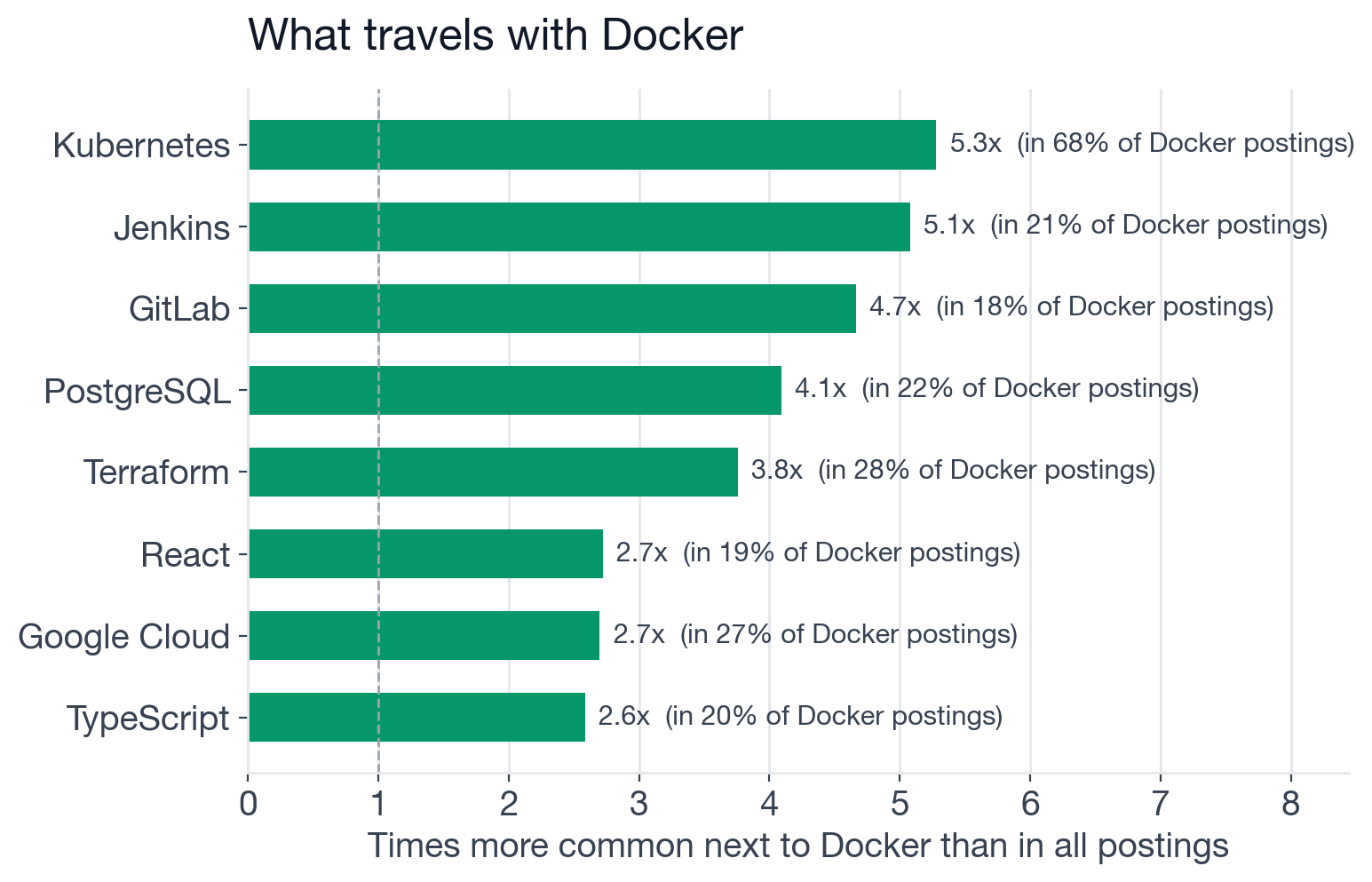
Co-occurring tools among postings that name Docker, ranked by how much more often they appear than across all postings.
After Kubernetes, the strongest pairings are CI tooling and infrastructure: Jenkins (21.1% of Docker postings, lift 5.1), GitLab (18.1%, 4.7), PostgreSQL (21.7%, 4.1) and Terraform (28.5%, 3.8). That shape is a delivery pipeline, with code built in CI, packaged in a container, provisioned with infrastructure as code and run on an orchestrator. Our posts on Kubernetes and Terraform cover those two in the same format.
Among general skills, CI/CD appears in 65.6% of Docker postings, monitoring in 40.4% and automation in 43.7%. Only 27.0% carry the "containerization" concept tag, so many postings name the tool without the concept word.
Who Has the Most Docker Openings?
The employers with the most distinct Docker openings lean toward large enterprises, consultancies and defense or government contractors rather than consumer software companies. By distinct openings (not repeated postings of the same job), Citi has 198, Accenture 133, Cisco about 129 once its two labels ("Cisco" at 66 and "Cisco Systems, Inc." at 63) are merged, and Booz Allen Hamilton 122. UnitedHealth Group (91), Leidos (84), NVIDIA (82), Thales (75), CACI International (75), Northrop Grumman (74), PricewaterhouseCoopers (70), Cognizant (69), SpaceX (65) and General Dynamics Information Technology (63) complete the list.
Booz Allen, Leidos, CACI, Northrop Grumman, GDIT and Thales make 6 of the 14 distinct employers, and Accenture, PwC and Cognizant add three consultancies. Counts are approximate, since the same employer can appear under different labels, and this is a list of who has openings on our board, not who hires most across the market. We have not tested whether this employer mix explains the pay comparisons above.
How to Use This in Your Job Search
Match Docker's weight to your target role. For DevOps, backend, full-stack and cloud roles it is named often enough to be worth showing concretely, with a project that builds and runs a containerized service. For data and product roles it can wait.
- Show it, don't just list it. Because most classifiable Docker mentions are preferred wording, a small containerized project on your resume can show more than a keyword. Practice explaining image layers, networking and how you would debug a failing container with AI mock interviews.
- Add one neighbor, in lift order. Kubernetes first, then a CI tool (Jenkins or GitLab) or Terraform, depending on the postings you are targeting.
- Do not read the pay table as a reason to skip it. For senior Software Engineers, postings naming Docker list less than those that do not, and we did not test why; the case for Docker is that many roles name it, not that it raises an offer.
- Drill the surrounding topics in the Question Bank, and build foundations through our interactive courses.
- Check live demand yourself on the InterviewStack.io job board before you commit study time.
FAQ
Q. How many job postings ask for Docker in 2026?
15,190 of 154,524 active postings on the InterviewStack.io job board name Docker (9.8%), counted over the 90 days to 21 November 2026. The share was flat across the window: 10.2% for postings first seen 61 to 90 days ago, 9.6% for 31 to 60 days and 9.9% for the last 30 days. Postings in 36 of the 39 roles we track name it.
Q. Is Docker required or just preferred?
Where we could read the wording near the mention, it is mostly a plus: of 5,014 postings that could be classified, 90.1% put Docker in preferred language and 9.9% in required language. The other 10,121 mentions had no clear required or preferred wording nearby, so the split covers about a third of Docker postings.
Q. Which roles ask for Docker most?
Software Engineer postings are the largest group, at 32.8% of all Docker postings (4,983), but only 13.2% of Software Engineer postings name it. It is most standard in DevOps Engineer postings (35.6%), then Backend Developer (29.3%) and Full-Stack Developer (29.1%). It is almost absent from Product Manager (0.2%) and Data Analyst (0.7%) postings.
Q. Do postings that name Docker list higher pay?
Not on balance. Comparing US posted base pay for postings with and without Docker inside the same role and title level, 24 of 49 comparisons are lower and 18 higher, with a weighted gap of 4.4% lower. Software Engineer mid, senior and staff comparisons are 10% to 13% lower; entry Software Engineer (30.6% higher), mid-level Systems Engineer (17.3%) and mid-level Site Reliability Engineer (13.0%) are higher. The reasons are not measured.
Q. What should you learn alongside Docker?
Kubernetes is the clearest pairing: 67.7% of Docker postings also name it, about 5.3 times its rate across the whole board. Jenkins (5.1 times), GitLab (4.7 times), PostgreSQL (4.1 times) and Terraform (3.8 times) are the next strongest pairings. AWS and Python are named in more Docker postings but are common everywhere.
Q. Which employers have the most Docker openings?
By distinct openings, Citi leads with 198, followed by Accenture (133), Cisco (about 129 once its two labels are merged) and Booz Allen Hamilton (122). Six of the 14 employers in the top list are defense and government contractors, so the list leans toward that kind of employer rather than toward consumer tech.
Where This Leaves You
Docker is a common, steady background skill: named in about 1 in 10 postings, in closer to 3 in 10 for DevOps, backend and full-stack roles, and as a plus wherever the wording is clear enough to read. Learn it for the roles that expect it, pair it with Kubernetes and a CI tool, and treat the posted-pay comparison as a mixed picture rather than a reason for or against.
Topics
Ready to practice?
Put what you've learned into practice with AI mock interviews and structured preparation guides.