
Postgres Is a Common Backend Ask, Not a Software Engineering Default
PostgreSQL was named in 8,388 of the 153,215 active postings on the InterviewStack.io job board in the 90 days to November 28, 2026 (5.5%, about 1 posting in 18), and its share held roughly flat across that window. Within the same role and seniority level, US postings that name it advertise about 2.4% less base pay on a weighted average, with 14 of 26 comparisons pointing up and 11 pointing down, so there is no single pay story for the tool.
Where it matters is the kind of job. PostgreSQL (the open-source relational database most engineers call Postgres) is named in nearly 1 in 4 Backend Developer and Full-Stack Developer postings, against about 1 in 12 Software Engineer postings. If you build application backends, it is written into the posting often enough to treat as a common ask. If you are aiming at a general software engineering role, it is one line among many. The counts come from the skills extracted from each posting and measure how often employers write PostgreSQL into a posting, not how many teams run it.
Key Findings
- 8,388 of 153,215 active postings (5.5%) name PostgreSQL, across 35 of 39 roles (90 days to Nov 28, 2026).
- PostgreSQL is named in 23% of Backend Developer postings (679) and 23% of Full-Stack Developer postings (1,302), against 8% of Software Engineer postings.
- Software Engineer still supplies the most PostgreSQL postings: 3,270, or 39% of the total.
- Within the same role and level, US postings naming PostgreSQL list about 2.4% less base pay on a weighted average; 14 of 26 groups point up and 11 point down.
- Mid-level Software Engineer postings naming PostgreSQL list a median $150,000 base, against $169,050 for those that do not (365 and 5,001 salaries).
- Senior and staff Data Engineer postings naming it list medians of $175,500 and $209,000, about 11% above same-level postings without it.
- Of the 1,951 mentions with nearby required or preferred wording, 85% say preferred and 15% say required.
- Among the 15 most common companion tools, MySQL is the strongest pairing: in 22% of PostgreSQL postings against 2.3% of all postings (9.5x lift).
Which Roles Write PostgreSQL Into Their Postings?
Two numbers matter for each role: how often that role's postings name PostgreSQL, and how much of PostgreSQL's total demand the role supplies. They tell different stories.
| Role | Postings naming PostgreSQL | Share of that role's postings | Share of all PostgreSQL postings |
|---|---|---|---|
| Backend Developer | 679 | 23% | 8% |
| Full-Stack Developer | 1,302 | 23% | 16% |
| Site Reliability Engineer (SRE) | 196 | 10% | 2% |
| DevOps Engineer | 534 | 10% | 6% |
| Data Engineer | 655 | 8% | 8% |
| Software Engineer | 3,270 | 8% | 39% |
| Engineering Manager | 330 | 7% | 4% |
| Frontend Developer | 124 | 6% | 1% |
| Cloud Engineer | 124 | 5% | 1% |
| Test Automation Engineer | 40 | 5% | 0.5% |
| AI Engineer | 202 | 4% | 2% |
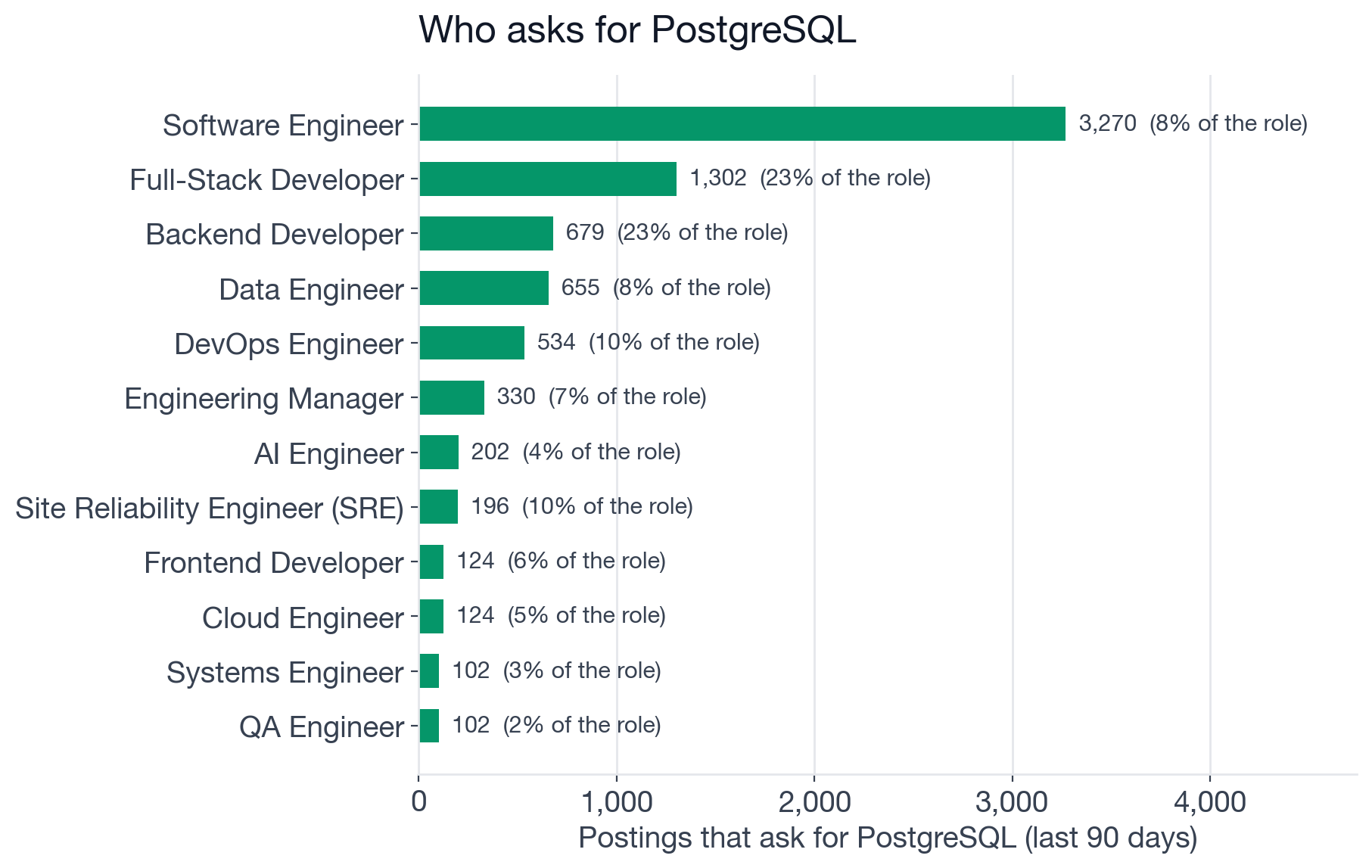
Postings that name PostgreSQL, by role, in the 90 days to November 28, 2026; the figure in brackets is the share of that role's postings.
Software Engineer dominates by volume only because it is the biggest role on the board: 92% of its postings do not name PostgreSQL. The roles where Postgres is a regular part of the posting are Backend and Full-Stack Developer. Together with Software Engineer, those three supply about 3 in 5 PostgreSQL postings. Our Backend Developer skills breakdown, Full-Stack Developer skills post and Software Engineer skills post show where it sits next to the rest of each role's asks.
The infrastructure roles are a second, smaller pocket: about 1 in 10 DevOps and SRE postings name it. Data Engineer postings name it in 8% of cases, the same rate as Software Engineer. Our Data Engineer skills post shows what else those postings ask for.
PostgreSQL postings also lean senior. About 34% carry a senior title, against 25% of postings that do not name it, and 2.8% carry an entry-level title against 4.7%. Level is read from title words, and titles with no level word count as mid-level, so treat these as rough shares.
Do PostgreSQL Postings List Higher Pay Within the Same Role and Level?
Not consistently, and on balance slightly less. The comparison uses US advertised base pay only, from postings that disclose a range, and excludes bonus and equity. It pairs postings with and without PostgreSQL inside the same role and seniority level, in groups with at least 15 salaries on each side. There were 26 such groups, covering 86% of PostgreSQL postings (7,196). Weighted by how many PostgreSQL postings each group holds, the gap is about -2.4%; 14 groups point up and 11 point down.
The direction depends on the role. In the developer roles that supply most of the demand, the larger groups point down:
| Role and level | With PostgreSQL (median US base) | Without | Difference |
|---|---|---|---|
| Software Engineer, entry | $117,000 | $90,450 | +29.4% |
| Software Engineer, mid-level | $150,000 | $169,050 | -11.3% |
| Software Engineer, senior | $175,000 | $184,000 | -4.9% |
| Software Engineer, staff | $210,000 | $214,500 | -2.1% |
| Full-Stack Developer, mid-level | $143,853 | $150,942 | -4.7% |
| Full-Stack Developer, senior | $176,500 | $171,289 | +3.0% |
| Full-Stack Developer, staff | $184,325 | $203,650 | -9.5% |
| Backend Developer, mid-level | $147,500 | $152,000 | -3.0% |
| Backend Developer, senior | $198,250 | $185,596 | +6.8% |
| Backend Developer, staff | $223,500 | $212,500 | +5.2% |
For data, infrastructure and management roles, 6 of these 9 groups point up:
| Role and level | With PostgreSQL (median US base) | Without | Difference |
|---|---|---|---|
| Data Engineer, mid-level | $130,000 | $140,000 | -7.1% |
| Data Engineer, senior | $175,500 | $158,355 | +10.8% |
| Data Engineer, staff | $209,000 | $187,500 | +11.5% |
| DevOps Engineer, mid-level | $150,000 | $140,800 | +6.5% |
| DevOps Engineer, senior | $159,150 | $150,420 | +5.8% |
| DevOps Engineer, staff | $194,500 | $193,950 | +0.3% |
| Site Reliability Engineer, senior | $178,750 | $162,500 | +10.0% |
| Engineering Manager, mid-level | $199,000 | $217,550 | -8.5% |
| Cloud Engineer, mid-level | $118,207 | $143,853 | -17.8% |
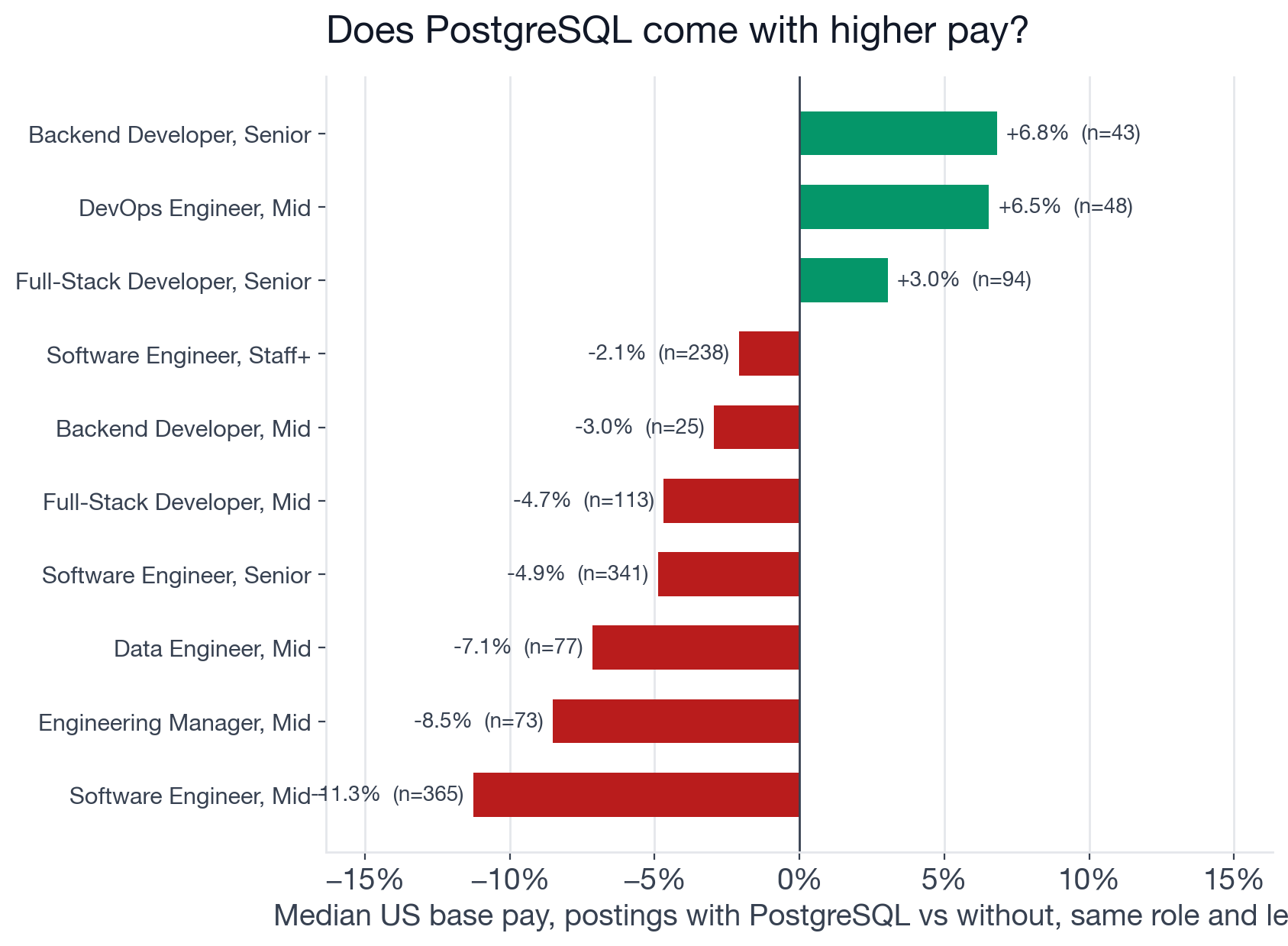
Difference in median US base salary between postings that name PostgreSQL and those that do not, within the same role and level, for the ten groups holding the most PostgreSQL postings.
The groups that carry the weighted average are the Software Engineer ones: mid-level alone holds 1,352 PostgreSQL postings, and it points down by 11.3%. That is why the overall figure is slightly negative even though more groups point up than down. If you are a senior or staff Data Engineer, a mid-level or senior DevOps Engineer, or a senior SRE (a small sample), postings that name PostgreSQL sit above same-level postings that do not. If you are a mid-level Software Engineer or Full-Stack Developer, they sit below. Several rows rest on fewer than 30 salaries on the PostgreSQL side and are best read as a direction only: Backend Developer mid-level (25) and staff (27), DevOps Engineer staff (25), senior Site Reliability Engineer (26), and mid-level AI Engineer (18 salaries, +8.2%, not in the tables). The entry-level Software Engineer gap of +29.4% rests on 39 salaries with PostgreSQL and is the least typical row in the set.
These figures are an association between postings, not a measure of what the skill is worth. The two sides of each comparison come from different employers, which may account for much of each gap; that is not measured, and we do not know why the gap runs one way in one role and the other way in the next. The narrower, useful reading: a posting that names PostgreSQL is not, by that fact, a better-paying posting for your role and level.
Do Employers Require PostgreSQL or Just Prefer It?
Where the posting says, mostly prefer. Of 1,951 mentions with required or preferred wording within about 160 characters, 283 (15%) were requirements and 1,668 (85%) were preferred. We counted "preferred" whenever both kinds of wording appeared nearby.
That split covers 1,951 of the 8,388 PostgreSQL postings, a little under a quarter. Most mentions (6,419) sit in a skill list with no qualifying wording. The data does not say how a hiring team weighs a preferred skill, so the practical reading is modest: PostgreSQL is rarely written as a hard gate, and the postings that name it usually name it next to other tools.
Which Tools Pair Most Strongly With PostgreSQL?
Among the 15 tools that appear most often in PostgreSQL postings, ranked by lift (how much more often a tool appears next to PostgreSQL than across all postings), the strongest companions are another relational database, a streaming platform and a backend runtime. Less common tools outside that list were not ranked.
| Tool | Share of PostgreSQL postings | Share of all postings | Lift |
|---|---|---|---|
| MySQL | 22.1% | 2.3% | 9.5 |
| Kafka | 24.2% | 4.7% | 5.1 |
| Node.js | 18.4% | 3.8% | 4.8 |
| Docker | 39.3% | 10.1% | 3.9 |
| React | 29.4% | 7.8% | 3.8 |
| TypeScript | 31.9% | 8.5% | 3.7 |
| Kubernetes | 40.5% | 13.0% | 3.1 |
| Python | 53.4% | 35.5% | 1.5 |
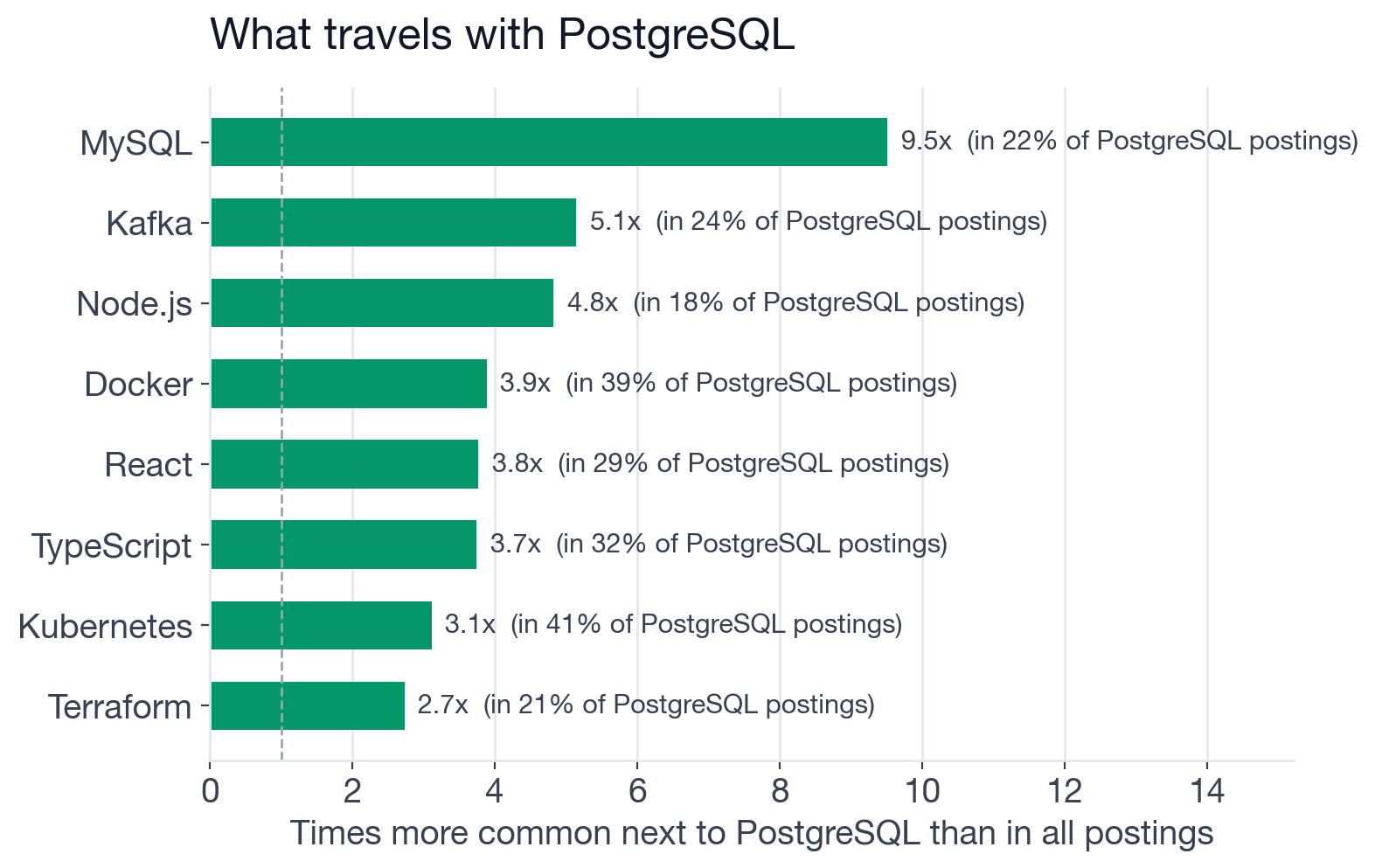
Tools ranked by how many times more often they appear in PostgreSQL postings than in all postings; the bracket gives the share of PostgreSQL postings that name each one.
MySQL is the clearest signal. It appears nearly ten times more often next to PostgreSQL than on the board as a whole, which suggests postings often name relational database engines as a set (relational databases show up as a concept in 20% of PostgreSQL postings). For a learner, that points to relational design and SQL as the transferable part, more than one engine's syntax. Kafka (an event-streaming platform used to move data between services) and Node.js point at backend service work. Docker, React and TypeScript at a lift near 4 describe the typical full-stack posting; our Docker and TypeScript posts cover both from their side.
Python shows the opposite case. It is in more than half of PostgreSQL postings, but it is in more than a third of all postings too, so its lift is only 1.5. The same goes for AWS (lift 2.3) and Azure (lift 1.7): common, but not specific to Postgres work. Generic SQL is tagged in only 44% of PostgreSQL postings (lift 2.1), so many postings name the engine without also listing the language. Our SQL demand and pay post looks at SQL across every role.
The non-tool skills named in PostgreSQL postings say the same thing: they include CI/CD (50%), APIs (37%), observability (32%), code review (32%) and microservices (21%). This is service-building work, with the database as one part of it.
A Bank, Consultancies and Defense Contractors Lead a Spread-Out Employer List
Ranked by distinct openings (repeat postings of the same job collapsed), the employers naming PostgreSQL most are:
| Employer | Distinct openings naming PostgreSQL |
|---|---|
| Citi | 76 |
| Cisco (two labels combined) | about 55 |
| SpaceX | 49 |
| Accenture | 44 |
| Leidos | 43 |
| Cognizant | 38 |
| PwC | 37 |
| Microsoft | 36 |
| UnitedHealth Group | 31 |
| General Dynamics Information Technology | 30 |
Two clusters stand out. Defense, aerospace and government contractors (SpaceX, Leidos, General Dynamics Information Technology, and Thales with 28) are the largest. Consultancies and IT services firms (Accenture, Cognizant, PwC) are the second. Citi, a bank, leads the list on its own. Supabase (a hosted backend platform built on PostgreSQL) also appears with 27, as do Motorola Solutions (28) and Okta (27).
The bigger point is how spread out the demand is. Citi, the largest, has 76 distinct openings (78 postings), under 1% of the 8,388 PostgreSQL postings; the top 15 labels add up to about 550 distinct openings. Counting distinct openings matters here: Accenture's 44 openings were posted 222 times across locations, which would otherwise put it at the top of the list. With the 15 largest accounting for about 550 of 8,388 postings, PostgreSQL is asked for by many employers in small numbers, not by a handful of large ones. It also means the two sides of each pay comparison above are drawn from different sets of employers; this data does not say how much of each gap that explains.
What a Backend Candidate Should Take From This
- If you are aiming at backend or full-stack roles, show PostgreSQL work on your resume. About 1 in 4 of those postings name it. Where postings say, it is usually preferred rather than required, so frame it as relational database skill: schema design, indexing, queries you have tuned.
- Learn it as relational design plus a backend stack, not as one engine's syntax. Among its most common companions, MySQL, Kafka and Node.js sit next to PostgreSQL far above their usual rate, which suggests postings list database engines as a set and expect the database inside service work. Our Question Bank lets you drill database and backend interview questions by topic.
- Do not read a Postgres-heavy posting as a pay signal. Within the same role and level, it points up for senior data and infrastructure roles and down for mid-level software engineering. Compare a posted range against the role and level, not the skill list.
- Practice explaining your database choices out loud. Indexing, transactions and schema trade-offs come up in backend and system design rounds as a conversation. An AI mock interview lets you rehearse that, and our interactive courses help with the foundations.
Current openings across every role are on the InterviewStack.io job board.
FAQ
Q. How many job postings ask for PostgreSQL in 2026?
8,388 of 153,215 active postings on the InterviewStack.io job board (5.5%) named PostgreSQL in the 90 days to November 28, 2026, across 35 of the 39 roles we track. The share moved from 6.0% to 5.5% to 5.3% across the three 30-day windows, a change too small to call a trend.
Q. Which roles ask for PostgreSQL most often?
Backend Developer (23%, 679 postings) and Full-Stack Developer (23%, 1,302 postings) name PostgreSQL most often, then Site Reliability Engineer and DevOps Engineer (10% each). Software Engineer supplies the most PostgreSQL postings (3,270, or 39% of the total) but names it in only 8% of its own postings.
Q. Is PostgreSQL required or a nice-to-have in job postings?
Where the wording near the mention says which it is, 85% of PostgreSQL mentions are preferred and 15% are required (1,951 classified mentions). Most mentions, 6,419 of 8,388, sit in skill lists with no such wording, so the split covers a little under a quarter of the postings.
Q. Do job postings that ask for PostgreSQL list higher pay?
Not consistently. Comparing US advertised base pay within the same role and seniority level, postings that name PostgreSQL list about 2.4% less on a weighted average, with 14 of 26 groups pointing up and 11 pointing down. The large Software Engineer groups at mid, senior and staff level point down; senior and staff Data Engineer, mid-level and senior DevOps Engineer, and senior Site Reliability Engineer groups point up. This is a correlation in advertised pay, not what knowing PostgreSQL earns anyone.
Q. What should you learn alongside PostgreSQL?
Among the 15 tools that appear most often next to PostgreSQL, ranked by lift, MySQL is the strongest pairing (in 22% of PostgreSQL postings against 2.3% of all postings, lift 9.5), then Kafka (lift 5.1) and Node.js (lift 4.8). Docker, React and TypeScript each sit at a lift near 4. Python is in 53% of PostgreSQL postings but has a lift of only 1.5, because it is common everywhere.
Q. Which employers post the most openings that ask for PostgreSQL?
Citi has the most distinct openings naming PostgreSQL (76), then SpaceX (49), Accenture (44) and Leidos (43). Cisco appears under two labels with about 55 between them. The list mixes a bank, consultancies, defense and aerospace firms, and big tech, and even the largest, Citi, accounts for under 1% of PostgreSQL postings.
Postgres in a 2026 Learning Plan
PostgreSQL is worth learning if you want to build application backends: nearly 1 in 4 backend and full-stack postings name it, and the tools around it (MySQL, Kafka, Node.js) describe service-building work. It is not a pay marker. Same-role, same-level comparisons split nearly evenly, and come out slightly negative on a weighted average. Learn it as your relational database, show what you built with it, and let the role you target decide how much weight it carries.
Topics
Ready to practice?
Put what you've learned into practice with AI mock interviews and structured preparation guides.