
Incident Response Belongs to One Role, Not Both
Security Architect and Digital Forensic Examiner share 40% of their top skill sets by our overlap measure, a moderate number that suggests two adjacent, swappable specialties. They aren't. The one skill that statistically ties them together, Incident Response, shows up in 93.3% of Digital Forensic Examiner postings and just 20% of Security Architect postings, a 4.7x gap, the least evenly shared skill in the comparison despite ranking first by average frequency. We compared every active posting for both roles on the InterviewStack.io job board as of September 2026, 1,100 Security Architect and 778 Digital Forensic Examiner listings, with skills, salary, seniority, and location extracted from each. Base salaries here are US-only and exclude equity, bonus, and sign-on, which aren't disclosed in postings; real total compensation at top employers likely runs higher.
| Security Architect | Digital Forensic Examiner | |
|---|---|---|
| Median US base salary | $184,000 | $137,500 |
| Active postings | 1,100 | 778 |
| Top skill | Security Architecture (65.2%) | Incident Response (93.3%) |
| Remote share | 15.4% | 16.3% |
| Entry-level share | 1.9% | 3.3% |
Key Findings
- Security Architect earns a $184,000 median US base salary versus $137,500 for Digital Forensic Examiner, a $46,500 (33.8%) premium (n=239 and n=219).
- The two roles' top-30 skill sets overlap 40% (Jaccard), but Incident Response, their highest-average-frequency shared skill, splits 93.3% (Digital Forensic Examiner) to 20% (Security Architect), a 4.7x gap.
- Risk Management (26.5% vs 25.3%) and Vulnerability Management (17.0% vs 16.1%) are the two most evenly shared skills between the roles.
- Security Architecture, Security Architect's own defining skill, prices at exactly the role's $184,000 baseline; Incident Response does the same for Digital Forensic Examiner at $137,500. Neither role's namesake skill earns a premium on its own.
- Automation prices in opposite directions: +$36,500 on Digital Forensic Examiner's own data (n=48) but -$7,400 on Security Architect's (n=75).
- Security Architect has 1,100 active postings versus 778 for Digital Forensic Examiner, a 1.41x volume advantage.
- Digital Forensic Examiner skews more onsite (51.2% vs 43.0%) and less hybrid (26.6% vs 36.5%); remote share is nearly identical (16.3% vs 15.4%).
- Neither role lists an explicit AI or GenAI skill in its top 30, even as cybersecurity practitioners' AI use jumped from 50% to 78% in a year (SANS, 2026).
What These Two Titles Actually Involve
Security Architect is a design job. The work happens before an incident: writing reference architectures, drawing zero-trust network boundaries, setting identity and access policy, and negotiating with engineering teams about what constraints a new system has to live inside. Browse live Security Architect openings for a sense of the day-to-day.
Digital Forensic Examiner is a reconstruction job. The work starts after something has already happened: a breach, a policy violation, a legal hold. Examiners preserve evidence that survives legal scrutiny, pull artifacts from disks, memory, and logs, and hand investigators a defensible timeline of what occurred and who touched what. Check Digital Forensic Examiner openings; where Security Architect tries to prevent the incident, this role explains it after the fact.
One data caveat worth flagging upfront: postings tagged Digital Forensic Examiner on the job board span a broader population than narrowly-titled evidence examiners alone, pulling in Incident Response, SOC, and security-operations-management titles that share the same reactive, post-breach discipline. Very few of the sampled titles use the word "forensic" outright, and the "digital forensics" skill itself ranks 19th of the role's own top 30, well behind Incident Response, Monitoring, and SIEM. The skill and salary figures below describe that broader DFIR-adjacent population, not a narrowly-titled examiner population in isolation.
Which Skills Do Both Roles Actually Need?
Both roles show up reliably in Risk Management (26.5% of Security Architect postings, 25.3% of Digital Forensic Examiner postings) and Vulnerability Management (17.0% vs 16.1%), the two most evenly balanced skills in the comparison. Whichever role you're coming from, these two transfer close to one-for-one.
Incident Response is a different story. It ranks first among shared skills by average frequency (56.7%) only because Digital Forensic Examiner's 93.3% pulls the average up; on Security Architect's side it's a modest, unremarkable skill at 20%. Security Operations and Cloud Security show a mirror-image pattern in opposite directions: Cloud Security leans toward Security Architect (40.3% vs 15.7%), Security Operations leans toward Digital Forensic Examiner (41.4% vs 16.3%).
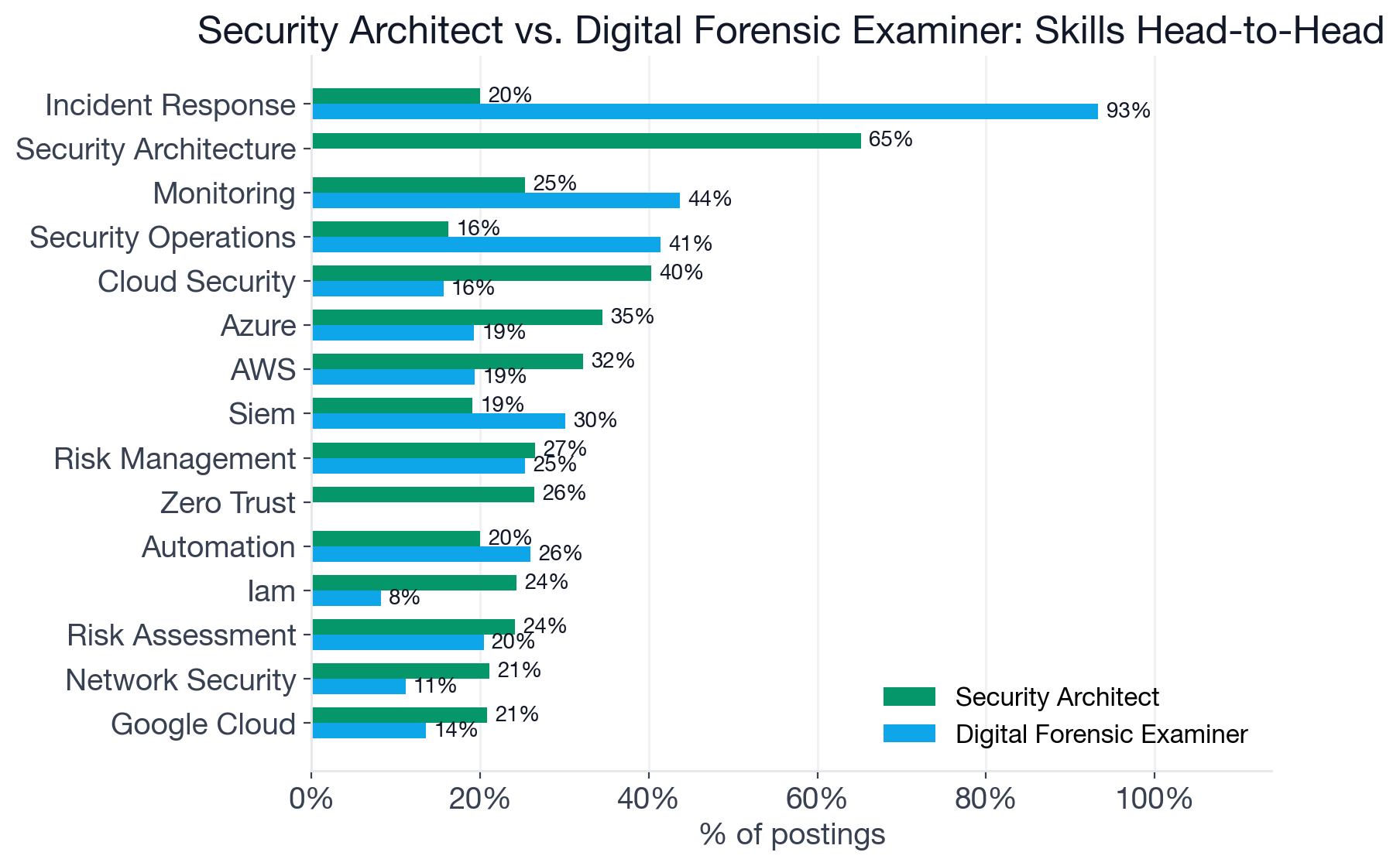 Risk Management and Vulnerability Management are the two skills genuinely shared at similar rates; most of the rest of this chart leans hard toward one role or the other.
For the full skill breakdown behind each role, see the Security Architect skills deep dive and the Digital Forensic Examiner skills deep dive.
Where Each Role's Skill Set Pulls Away
Security Architect's exclusive skills (meaningful frequency in Security Architect postings, negligible in Digital Forensic Examiner's) read like a design vocabulary: Zero Trust (26.5%), Threat Modeling (18.4%), Encryption (17.4%), Application Security (15.3%), Identity and Access Management (15.1%), DevSecOps (13.6%), and Kubernetes (10.1%).
Digital Forensic Examiner's exclusives read like an on-the-ground investigative toolkit: Threat Intelligence (20.2%), Linux (19.9%), Windows (19.4%), Incident Management (15.8%), Threat Hunting (15.7%), Digital Forensics itself (15.6%), Malware Analysis (11.7%), Splunk (11.6%), and PowerShell (10.4%). Even Digital Forensics, the skill literally named after the role, shows up in only 15.6% of its own postings, well below Incident Response's 93.3%: postings describe the day-to-day response work far more often than they use the formal specialty term.
Neither role's top-30 skill list includes an explicit AI, GenAI, or machine learning skill. Read alone, that would suggest AI is irrelevant to either job today. It isn't: SANS Institute found cybersecurity practitioners' AI use jumped from 50% to 78% in a single year. Separately, the Cloud Security Alliance found generative AI now runs in 77% of security stacks even though only 37% of security leaders report a formal AI policy governing it, a responsibility gap that lands squarely on Security Architect's desk. On the forensics side, Magnet Forensics' State of Enterprise DFIR Report found AI use in digital investigations more than tripled, from 20% in 2024 to 68% in 2026. Employers aren't writing AI into these postings because the work doesn't touch it; they're assuming it's already part of how the work gets done.
Which Role Actually Pays More, and by How Much?
Security Architect earns a $184,000 median US base salary (n=239) against $137,500 for Digital Forensic Examiner (n=219), a $46,500 gap (33.8%).
The more interesting finding sits underneath the headline number: neither role's own namesake skill earns a premium. Security Architecture prices at exactly Security Architect's $184,000 baseline (n=163); Incident Response prices at exactly Digital Forensic Examiner's $137,500 baseline (n=207). Knowing the thing the job is named after is table stakes on both sides, not a differentiator.
The real premiums sit elsewhere. On Security Architect's own data, Regulatory Compliance adds $30,100 (n=25) and Security Operations adds $8,800 (n=39). On Digital Forensic Examiner's own data, Automation is the single largest premium in the whole table at +$36,500 (n=48), followed by Threat Intelligence (+$21,000, n=30) and EDR (+$20,500, n=25). Automation is worth flagging: it's a shared skill that prices in opposite directions, +$36,500 for Digital Forensic Examiner against -$7,400 for Security Architect (n=75).
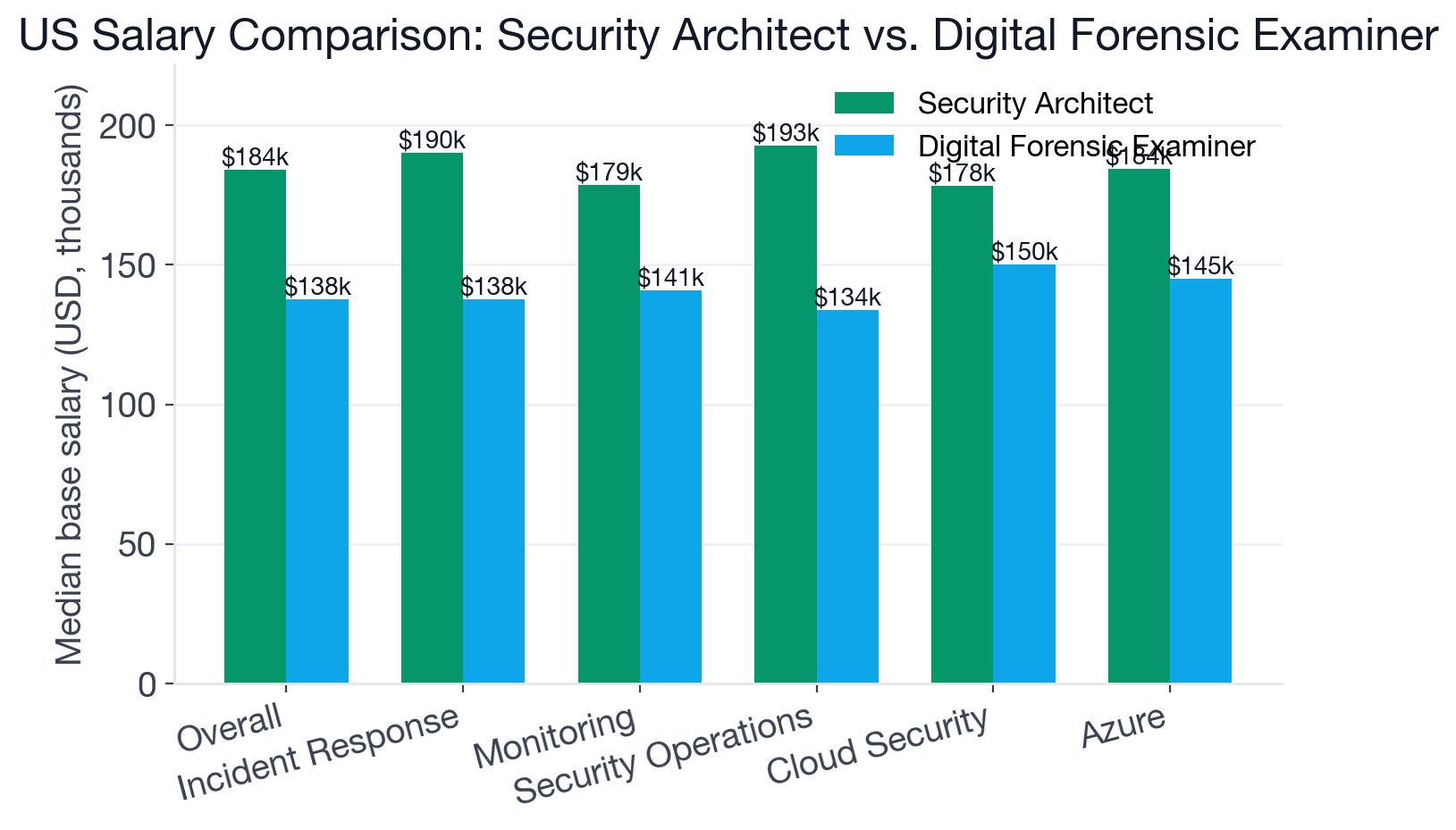 Security Architect's premium holds even after accounting for the skills both roles share; Automation is the clearest example of a skill that pays opposite ways depending on which title is attached to it.
Which Role Is Easier to Land in 2026?
Security Architect has more open roles, 1,100 versus 778 for Digital Forensic Examiner, a 1.41x volume advantage, and a larger footprint outside the US (33.5% US-based vs. Digital Forensic Examiner's 45.8%, with a notable India presence at 13.4% vs. 5.7%).
Neither role is easy to break into cold. Entry-level postings are just 1.9% of Security Architect listings and 3.3% of Digital Forensic Examiner listings; both roles are overwhelmingly mid-level and above (Security Architect: 62.8% mid, 20.7% senior, 14.5% staff; Digital Forensic Examiner: 61.3% mid, 21.3% senior, 14.0% staff). Take the mid/senior/staff split as a floor rather than a precise read: seniority is inferred from title keywords, and a bare title like "Security Architect" carries no explicit seniority modifier even though the role conventionally implies years of experience, so postings without one default to mid_level and likely understate Security Architect's true senior/staff share. The near-zero entry-level rate on both sides is the more reliable signal, and it points the same direction regardless: Digital Forensic Examiner isn't a junior on-ramp to Security Architect, it's a parallel specialty with its own entry bar.
Work mode is where the roles genuinely diverge. Remote share is nearly identical (15.4% vs 16.3%), but Digital Forensic Examiner is markedly more onsite (51.2% vs 43.0%) and less hybrid (26.6% vs 36.5%), likely a function of the physical evidence-handling and chain-of-custody demands that come with forensic work.
Which Should You Choose?
Choose Security Architect if you:
- Want to design and govern systems before they ship rather than investigate them after something breaks, using Zero Trust, Threat Modeling, and Identity and Access Management as your daily toolkit.
- Already work in cloud and IAM, since Security Architect's exclusive skills lean cloud-native (Kubernetes, DevSecOps, Encryption) rather than OS-level forensics.
- Want the higher pay ceiling ($184,000 median, 33.8% above Digital Forensic Examiner) and a larger pool of open roles (1.41x).
Choose Digital Forensic Examiner if you:
- Want reactive, investigative work where Incident Response is close to the entire job (93.3% of postings), alongside Malware Analysis, Threat Hunting, and root-cause work.
- Are comfortable in an OS-level, on-the-ground toolkit (Linux, Windows, PowerShell, Splunk) rather than cloud architecture diagrams.
- Don't mind a more onsite-heavy market (51.2% onsite) tied to evidence handling and chain of custody, in exchange for a stronger concentration of US-based roles (45.8%).
If Penetration Tester is also on your shortlist, see how it stacks up against Security Architect and against Digital Forensic Examiner. Whichever path you pick, practice with AI mock interviews calibrated to the role, or drill specifics like incident timelines and zero-trust design with our question bank.
FAQ
Q. Which pays more, Security Architect or Digital Forensic Examiner?
Security Architect earns a median $184,000 US base salary (n=239) versus $137,500 for Digital Forensic Examiner (n=219), a $46,500 (33.8%) premium. Both figures are base salary only; equity and bonus are not disclosed in postings.
Q. Do Security Architect and Digital Forensic Examiner share the same skills?
Their top-30 skill sets overlap 40% by Jaccard similarity, but the overlap is uneven. Incident Response, the single most in-demand shared skill by average frequency, appears in 93.3% of Digital Forensic Examiner postings versus just 20% of Security Architect postings, a 4.7x gap, making it the least evenly shared skill on the list despite ranking first.
Q. Is Digital Forensic Examiner a junior version of Security Architect?
No. Entry-level postings are near-zero for both roles (1.9% vs 3.3%), the most reliable signal here, and it says Digital Forensic Examiner is a distinct specialty track, not an entry rung on the way to Security Architect. Reported mid/senior/staff shares also look nearly identical (mid-level 62.8% vs 61.3%, senior 20.7% vs 21.3%, staff 14.5% vs 14.0%), but treat that split as a floor rather than a precise read: seniority is inferred from title keywords, and postings without an explicit modifier default to mid_level. A bare title like "Security Architect" carries no such modifier even though the role conventionally implies years of experience, so Security Architect's true senior/staff share is likely understated relative to what's shown.
Q. Which role has more open positions?
Security Architect has more active postings, 1,100 versus Digital Forensic Examiner's 778, a 1.41x ratio.
Q. Do Security Architect or Digital Forensic Examiner jobs require AI skills?
Neither role lists an explicit AI, GenAI, or machine learning skill in its top 30 skills. That reflects what employers write into job requisitions, not what practitioners actually use. Cybersecurity practitioners' AI use jumped from 50% to 78% in a year (SANS Institute, 2026), and AI use in digital forensic investigations specifically rose from 20% in 2024 to 68% in 2026, per Magnet Forensics' State of Enterprise DFIR Report.
Q. Which role is more remote-friendly?
Remote work rates are almost identical, 15.4% for Security Architect and 16.3% for Digital Forensic Examiner. The real difference is hybrid versus onsite: Security Architect is 36.5% hybrid and 43.0% onsite, while Digital Forensic Examiner is 26.6% hybrid and 51.2% onsite, likely reflecting the physical evidence-handling and chain-of-custody demands of forensic work.
Q. What's the clearest skill signal that separates the two roles?
Security Architecture itself is Security Architect's defining skill (65.2% of postings) and doesn't clear the threshold to appear in Digital Forensic Examiner's top 30 at all. Digital Forensic Examiner's defining cluster, Malware Analysis (11.7%), Threat Hunting (15.7%), and Digital Forensics itself (15.6%), is equally absent from Security Architect's top 30.
A 40% Overlap Score Doesn't Mean 40% of the Job Transfers
On paper, Security Architect and Digital Forensic Examiner look like adjacent jobs: a 40% skill overlap, similar seniority mixes, both built on a shared cybersecurity foundation. In practice, the work splits cleanly into design versus investigation, and even the skill that nominally ties them together, Incident Response, means something completely different on each side (93.3% of the job for one role, 20% for the other). Match the role to the kind of work you actually want, prevention or reconstruction, before you match it to the overlap score. Browse live Security Architect postings or Digital Forensic Examiner postings on InterviewStack.io.
Topics
Ready to practice?
Put what you've learned into practice with AI mock interviews and structured preparation guides.