
Only Three Skills Show Up in Both Roles' Top 30
Technical Product Manager and UI Designer sit near each other on an org chart and almost nowhere else. Comparing the two roles' top 30 skills from active postings on the InterviewStack.io job board, the Jaccard overlap comes out to 0.05, near the floor this kind of comparison can produce. Only three skills clear a 5% frequency bar in both: User Experience, Agile, and Project Management.
That near-total split doesn't translate into wildly different market size. Technical Product Manager runs 1,164 active postings against UI Designer's 988, a modest 1.18x edge. What it does translate into is pay: Technical Product Manager carries a $153,900 median US base salary against $107,500 for UI Designer, a $46,400 gap. Two jobs this disconnected in daily skill demands, priced this far apart, is the real story here.
| Technical Product Manager | UI Designer | |
|---|---|---|
| Median US base salary | $153,900 | $107,500 |
| Active postings | 1,164 | 988 |
| Top skill | Product Management (52.7%) | Figma (57.3%) |
| Remote share | 36.2% | 28.4% |
| Entry-level share | 2.0% | 8.2% |
Key Findings
- Skill overlap between the two roles is a Jaccard coefficient of 0.05; only User Experience, Agile, and Project Management clear a 5% frequency floor in both.
- Technical Product Manager's median US base salary is $153,900 (n=306) versus $107,500 for UI Designer (n=153), a $46,400 (43.2%) gap.
- Postings run close in volume: 1,164 Technical Product Manager vs 988 UI Designer, a 1.18x ratio.
- LLMs, Technical Product Manager's own AI signal skill (18.0% of postings), prices $21,900 below the role's baseline salary (n=25).
- Figma, UI Designer's top skill at 57.3% of postings, prices at exactly the role's baseline, a $0 premium (n=77); Wireframes (27.4%) prices $16,500 below baseline (n=30).
- UI Designer's entry-level share (8.2%) is roughly 4x Technical Product Manager's (2.0%).
- UI Designer postings run 49.1% onsite versus 32.9% for Technical Product Manager, while Technical Product Manager offers more remote work (36.2% vs 28.4%).
What These Two Jobs Actually Look Like Day to Day
A Technical Product Manager spends the week in the seams between engineering and the business: reviewing API contracts, weighing scalability trade-offs, writing the roadmap doc that tells an eng team what to build next quarter. The output is usually a decision or a spec, handed to engineers to execute. A UI Designer spends the week in Figma, producing the interface itself: wireframes, component states, interaction flows, and the design-system rules that keep a product visually consistent. The output is the artifact users actually touch. One role translates technical trade-offs into direction; the other builds the thing people see.
Where Do These Skill Stacks Actually Diverge?
Technical Product Manager's top skills read like an engineering-adjacent job: Product Management itself (52.7% of postings), APIs (35.6%), Monitoring (23.5%), Product Strategy (21.3%), and LLMs (18.0%). UI Designer's top skills read like a production toolkit: Figma (57.3%), Design Systems (34.5%), Typography (29.9%), Visual Design (27.9%), and Wireframes (27.4%). These lists don't just fail to overlap, they describe different kinds of work: reasoning over systems and roadmaps versus shipping the visual and interaction layer directly.
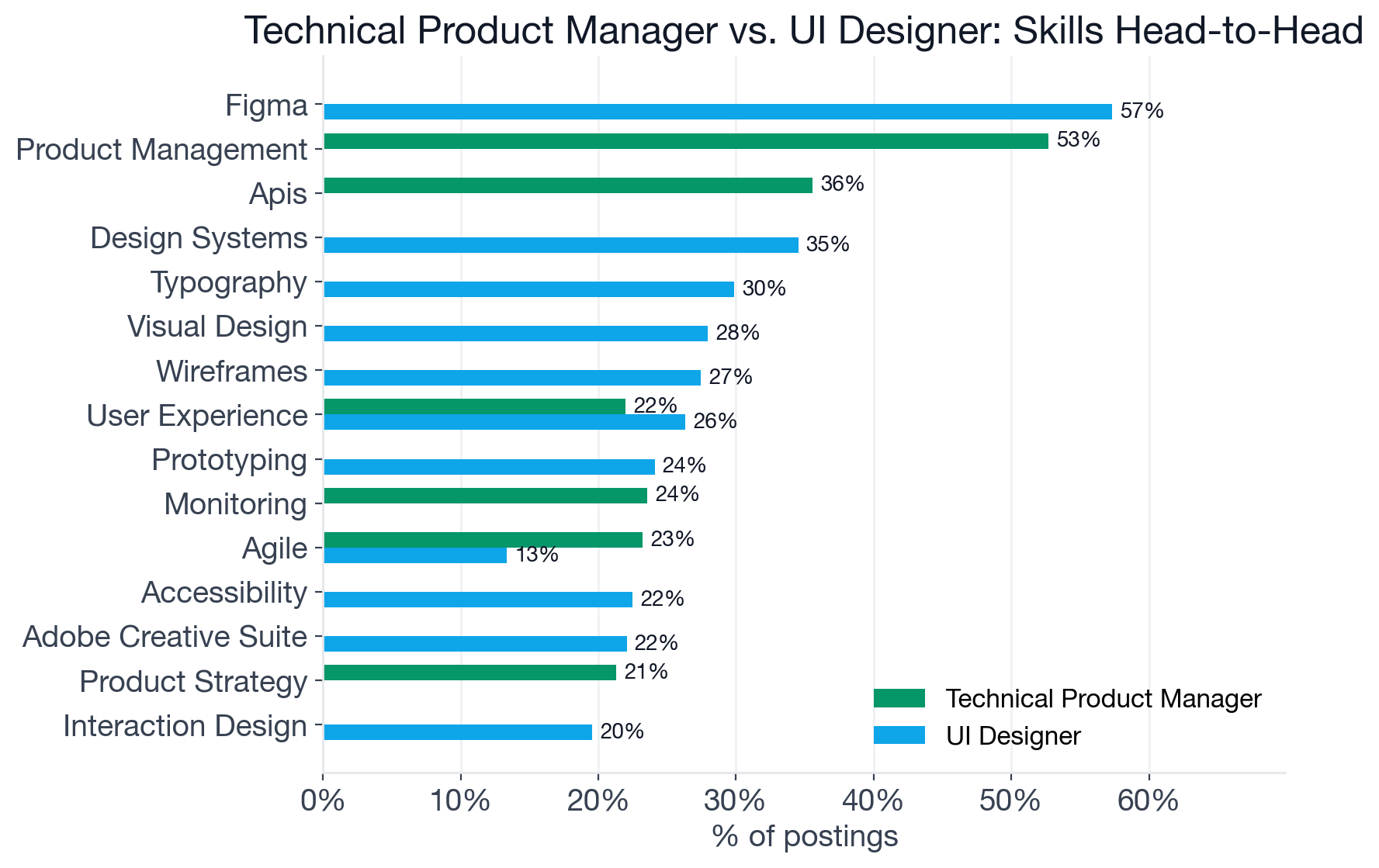 Skill demand barely overlaps: Technical Product Manager's list is dominated by APIs, monitoring, and strategy; UI Designer's by Figma, design systems, and typography.
Even the strongest shared skill doesn't mean the same thing on both sides. User Experience shows up in 22.0% of Technical Product Manager postings and 26.3% of UI Designer postings, but a TPM treats it as a stakeholder concern to reason about, while a UI Designer treats it as the artifact they personally produce. Agile (23.2% / 13.4%) and Project Management (7.6% / 6.5%) round out the only genuine bridge between the two roles, and none of the three clears a majority on either side.
LLMs is the one AI signal in either role's top 30, present in 18.0% of Technical Product Manager postings (Machine Learning 8.3%, Generative AI 5.8%); UI Designer has none. Read literally, that makes TPM the AI-forward role. It's more likely a naming gap than a usage gap: Figma's 2026 State of the Designer survey puts generative-AI adoption among designers at 72%, above the 51% Stack Overflow reports for developers generally, and a 2026 product-management statistics roundup puts product professionals' AI usage at 94% daily-or-often. A "Technical Product Manager" posting increasingly means own an AI-powered product, so LLMs gets named; a UI Designer's AI tool use gets folded into "Figma" and never earns its own line. For more on each role's AI exposure, see How AI Is Changing Technical Product Manager and How AI Is Changing UI Designer.
Which Role Pays More?
Among US postings, where wage-transparency laws produce more consistent salary disclosure, Technical Product Manager carries a $153,900 median base salary (n=306) against $107,500 for UI Designer (n=153), a $46,400 gap (43.2%). Equity, bonus, and sign-on aren't disclosed in job postings, so total compensation at top employers on either side runs higher than these figures.
The gap isn't explained by either role's most common skill. Product Management itself (52.7% of Technical Product Manager postings) adds a modest $8,600 over baseline (n=189), but the rest of the role's high-frequency skills price flat to negative: APIs (35.6%) sits $3,900 below baseline (n=81), Monitoring (23.5%) is the same, $3,900 below (n=26), and LLMs prices $21,900 below baseline (n=25), the steepest discount in the table. The real premiums sit in scope, not execution: Go To Market (+$14,100, n=34), Product Strategy (+$13,500, n=77), User Experience (+$13,500, n=47), and Scalability (+$9,400, n=34).
UI Designer runs the same pattern at a smaller scale. Figma, the role's most common skill at 57.3% of postings, prices at exactly the $107,500 baseline, a $0 premium (n=77). Visual Design (27.9%), Accessibility (22.5%), and UI Design itself (18.7%) all land at that same $0 mark. Wireframes, UI Designer's 5th most common skill (27.4%), prices $16,500 below baseline (n=30), the steepest discount in UI Designer's table (Technical Product Manager's LLMs discount, $21,900 below its own baseline, is steeper still). The premiums instead sit in Product Design (+$33,400, n=34, the largest single premium in either table), Design Systems (+$12,500, n=57), and the two shared skills, User Experience (+$12,300, n=42) and Agile (+$10,000, n=31).
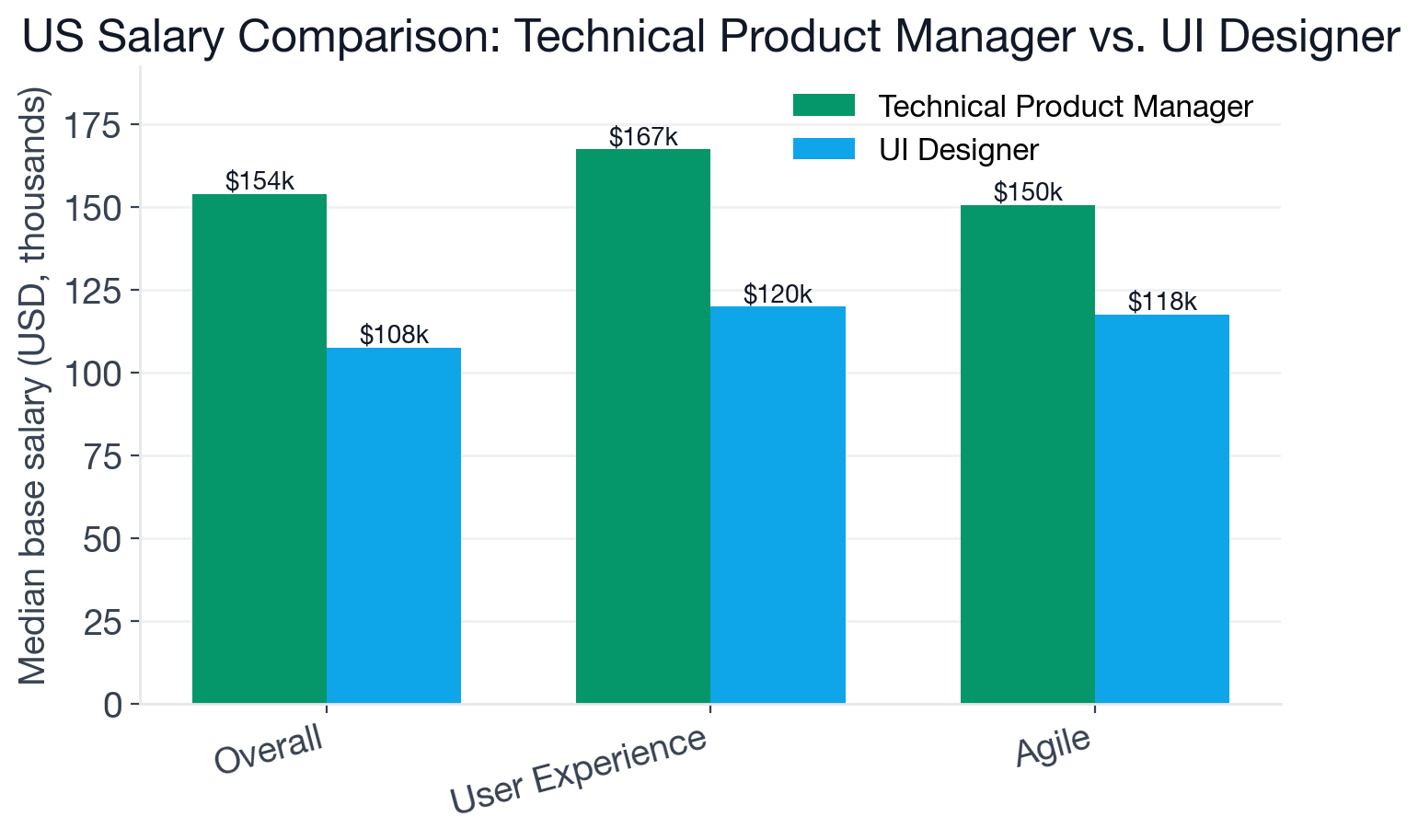 On both sides, the tool used every day prices at or below the role's own baseline; the premium sits in scope and strategy skills instead.
Same shape shows up twice: the daily production tool, APIs and Monitoring for one role, Figma and Wireframes for the other, doesn't move pay. The judgment layer sitting above it does.
Who Has an Easier Path In?
Technical Product Manager (1,164 postings) and UI Designer (988) run close enough in size that volume shouldn't decide the choice. Seniority is where the two roles really split for a newcomer: UI Designer postings are 8.2% entry-level (n=81), about 1 in 12, while Technical Product Manager's entry-level share is 2.0% (n=23), practically nonexistent, with 69.3% of postings sitting at mid-level and assuming prior PM or engineering experience before "technical" gets attached to the title. UI Designer's entry-level share runs roughly 4x Technical Product Manager's.
Work mode splits the other way: UI Designer runs 49.1% onsite against 32.9% for Technical Product Manager, which offers more remote flexibility (36.2% vs 28.4%). UI Designer postings are also more globally distributed, only 28.5% US-based versus 44.8% for Technical Product Manager, with real volume in Germany, India, the Philippines, Brazil, and Mexico, consistent with visual production work moving to lower-cost markets more easily than roadmap-adjacent work. Two caveats on this pull. First, a single employer, Bjak, a Southeast Asia-based fintech posting largely remote roles across several product verticals (AI Finance, AI Neobank, AI Investing, and similar), accounts for 17.2% of Technical Product Manager's distinct postings; that's enough to shape the skill, geography, and seniority mix reported above more than a typical single employer would, though it's less clear whether it moves the $153,900 US salary figure specifically, since Bjak's postings skew non-US. Second, both roles' underlying title samples carry some adjacent-role noise, aerospace and hardware "Technical Designer" titles bleeding into Technical Product Manager, retail visual-merchandising and marketing-design titles bleeding into UI Designer, though each role's core skill signature (APIs and product strategy for one, Figma and design systems for the other) stays intact despite that noise.
Which Role Should You Choose?
Choose Technical Product Manager if you:
- Want to sit at the intersection of engineering and business, translating APIs, system design, and scalability trade-offs into a roadmap rather than producing the interface yourself
- Already have a technical background (SQL, system design, software engineering), since the role's exclusive skills reward that fluency over visual craft
- Can accept a thin on-ramp (2.0% entry-level share) in exchange for a $46,400 higher median and stronger remote availability
Choose UI Designer if you:
- Want to own the visual and interaction layer directly: Figma, wireframes, prototyping, and design systems are the daily toolkit, not a translation layer
- Are earlier in your career: UI Designer's entry-level share is roughly 4x Technical Product Manager's, in a job market close enough in size (988 postings) that it isn't a niche path
- Are willing to start below Technical Product Manager's baseline unless you push toward Product Design or Design Systems ownership, where the real premiums sit
How to Use This in Your Job Search
If Technical Product Manager's mix of APIs, system design, and product strategy fits, browse current openings or filter for Product Strategy-heavy roles. If UI Designer's Figma-and-design-systems toolkit fits better, check open roles or postings that name Design Systems ownership. For the full skill breakdown of each role on its own, see Technical Product Manager Skills Companies Want in 2026 and UI Designer Skills Companies Want in 2026.
Either path benefits from deliberate practice. Practice with AI mock interviews tuned to the role you're targeting, drill the specific competencies (stakeholder management for Technical Product Manager, portfolio storytelling for UI Designer) in the question bank, and use interactive courses to build whichever foundation, technical fluency or design-systems thinking, actually moves pay.
FAQ
Q. Do Technical Product Manager and UI Designer roles share any skills?
Barely. The two roles' top-30 skill sets overlap at a Jaccard coefficient of just 0.05, and only three skills clear a 5% frequency floor in both: User Experience (22.0% of Technical Product Manager postings, 26.3% of UI Designer postings), Agile (23.2% / 13.4%), and Project Management (7.6% / 6.5%). Everything else that defines either role, APIs and Product Strategy for Technical Product Manager, Figma and Design Systems for UI Designer, is exclusive to one side.
Q. Which pays more, Technical Product Manager or UI Designer?
Technical Product Manager. The median US base salary is $153,900 (n=306) versus $107,500 for UI Designer (n=153), a $46,400 gap (43.2%). These are base salaries only; equity, bonus, and sign-on are not disclosed in job postings.
Q. Is UI Designer easier to break into than Technical Product Manager?
Yes, by a wide margin. UI Designer postings are 8.2% entry-level (n=81), while Technical Product Manager entry-level postings make up just 2.0% (n=23), roughly a 4x gap. Technical Product Manager postings assume prior PM or engineering experience far more often.
Q. Do Technical Product Managers actually need AI skills?
Job postings suggest so more than UI Designer postings do: LLMs appears in 18.0% of Technical Product Manager postings, with Machine Learning (8.3%) and Generative AI (5.8%) also present, while UI Designer has no AI skill in its top 30. But that gap likely measures which postings explicitly say own an AI product, not who uses AI day to day. Survey data shows real-world adoption is high on both sides regardless: Figma's 2026 State of the Designer survey puts generative-AI adoption among designers at 72%, and a 2026 product-management statistics roundup puts product professionals' AI usage at 94% daily-or-often, both well above the 51% Stack Overflow reports for developers generally.
Q. Which role offers more remote work?
Technical Product Manager. 36.2% of Technical Product Manager postings are remote versus 28.4% for UI Designer. UI Designer runs far more onsite (49.1% vs 32.9% for Technical Product Manager).
Q. Which role has more active job postings?
Technical Product Manager, but not by much. There are 1,164 active Technical Product Manager postings versus 988 for UI Designer, a 1.18x ratio, not a meaningful volume advantage either way.
Q. Does Figma experience increase UI Designer salary?
No. Figma appears in 57.3% of UI Designer postings but prices at exactly the role's $107,500 baseline, a $0 premium (n=77). The real premiums sit in Product Design (+$33,400, n=34) and Design Systems (+$12,500, n=57), scope-level skills rather than the core production tool.
These Are Two Different Careers, Not Two Levels of One
A 5% skill overlap means almost nothing you learn on one job transfers cleanly to the other. This isn't a junior/senior split inside one discipline; it's two disciplines that happen to sit near each other on an org chart. The $46,400 salary gap reflects that Technical Product Manager sits closer to the engineering and business decisions a company treats as scarce, not that UI Designer work takes less skill. Pick based on which list, technical translation or visual craft, describes the work you actually want to be doing five years from now, not the paycheck alone.
Topics
Ready to practice?
Put what you've learned into practice with AI mock interviews and structured preparation guides.