
Linux Is in 1 Posting in 8, and Its Pay Gap Points Both Ways
Linux appears in 17,301 of the 145,069 active postings on the InterviewStack.io job board (11.9%, in the 90 days to 18 November 2026), across 37 of the 39 roles we track, and the share is similar across three 30-day windows (12.1%, 12.2%, 11.7%). Postings that name it advertise US base pay 0.5% higher on average than comparable postings without it, which is close to zero, and that average hides 27 role and level cells that go up and 28 that go down.
So "is Linux worth learning" has two honest answers. For systems administration, systems engineering, SRE and embedded work, it is named in about a third to 4 in 10 postings. In the first three, plus Network Engineer, the gaps are positive in the largest groups we can see (titles with no level word); for Embedded Developer they are slightly negative (-2.3% with no level word, -4.4% senior). For a Software Engineer or Cybersecurity Engineer, it is an optional extra, and the gaps in the largest groups lean the other way (except at entry-level Software Engineer). We compare postings inside the same role and seniority because the whole-board comparison mostly measures which jobs happen to name Linux.
Key Findings
- 17,301 postings (11.9% of 145,069) name Linux, across 37 of 39 roles.
- The share was 12.1%, 12.2% and 11.7% across the three 30-day windows: similar.
- 40.9% of Embedded Developer postings name it (992 of 2,423), versus 15.5% of Software Engineer postings.
- 76.5% of mentions with clear wording say preferred; 23.5% say required (4,400 classified mentions).
- Same-role, same-level US base pay gap: +0.5% weighted average across 60 cells, up in 27 and down in 28.
- Systems Administrator postings with no level word in the title advertise a median of $115,024 with Linux versus $98,000 without (+17.4%).
- Staff Software Engineer postings with it advertise $193,715 versus $214,600 without (-9.7%).
- Bash (22.8% of Linux postings, 5.0 times its normal rate) and Ansible (16.8%, 4.7 times) are the strongest pairings.
Which Roles Name Linux Skills Most Often?
Linux is named far more often in operations and low-level roles than in application roles. Around 4 in 10 Embedded Developer, Systems Engineer and Systems Administrator postings name it, and roughly a third of DevOps and SRE postings do.
Software Engineer is where the raw volume sits, with 5,112 postings or 29.5% of all Linux demand. That is a size effect: it is the biggest role on the board, and only about 1 in 6.5 of its postings names Linux.
| Role | Postings naming Linux | Share of that role's postings |
|---|---|---|
| Software Engineer | 5,112 | 15.5% |
| DevOps Engineer | 1,633 | 33.4% |
| Systems Engineer | 1,626 | 38.5% |
| Systems Administrator | 1,161 | 38.1% |
| Embedded Developer | 992 | 40.9% |
| Site Reliability Engineer (SRE) | 852 | 31.8% |
| Cybersecurity Engineer | 779 | 16.6% |
| Cloud Engineer | 717 | 26.0% |
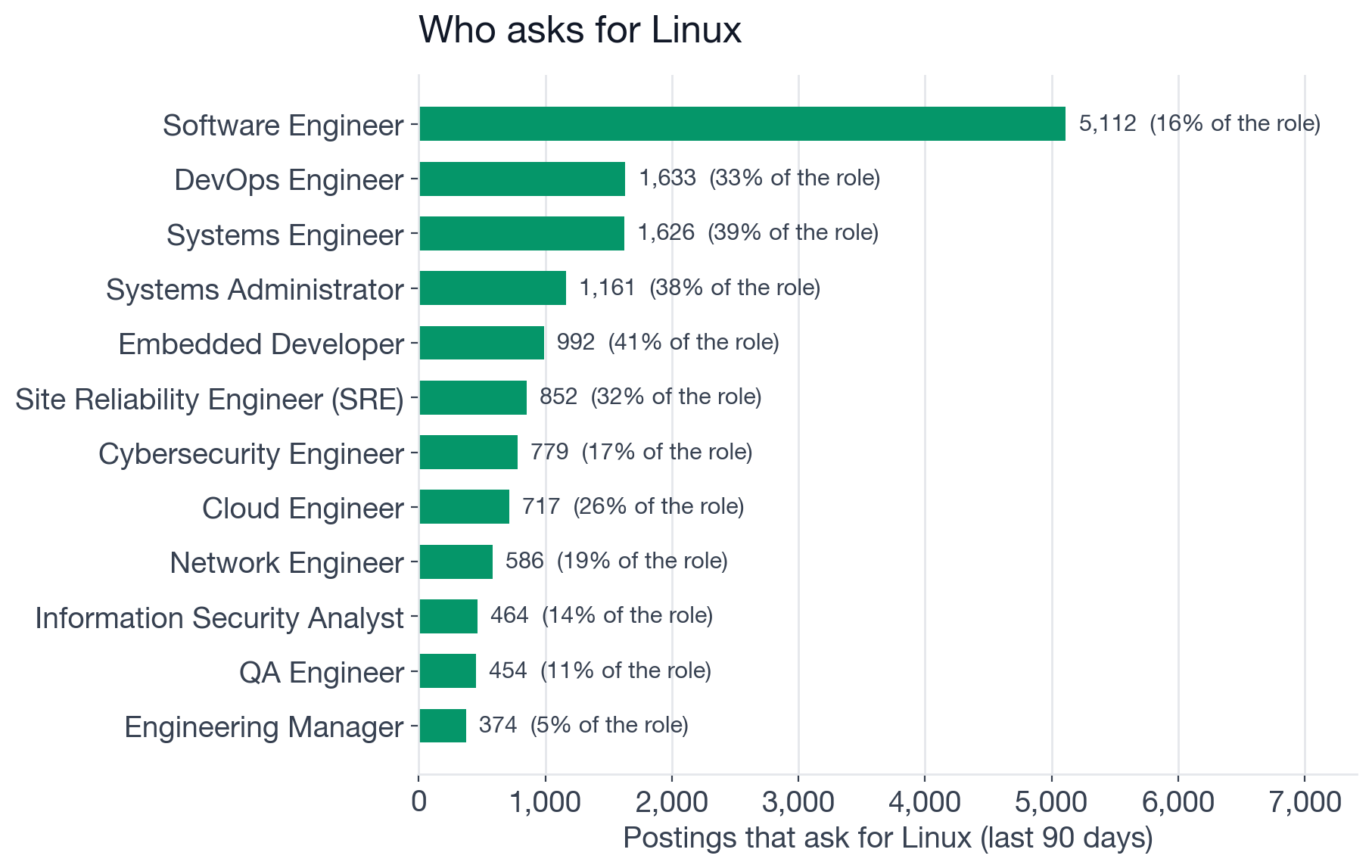
The chart separates two kinds of bar: the tall ones are big generalist roles, the high-share ones are infrastructure and hardware-adjacent roles. If one of those paths is yours, our skills posts for Systems Administrator, Systems Engineer, DevOps Engineer, Site Reliability Engineer and Embedded Developer show the rest of the stack around it. Cybersecurity Engineer and Network Engineer postings also name Linux regularly (see the roles index).
Is Linux Required or a Nice-to-Have?
Where the wording is clear, Linux is far more often listed as preferred than required: 76.5% preferred against 23.5% required. That is among 4,400 classified mentions, about a quarter of the 17,301. The other 12,901 either carry no required or preferred wording near the mention or could not be located in the text, so treat the split as a subset.
We cannot see why employers word it this way. A posting that does not name Linux is not evidence that the work avoids it, since the match depends on what the posting lists.
Does Linux Change Pay Within the Same Role?
Among the largest role-and-level groups, posted pay for postings that name Linux is higher for Systems Administrator, Systems Engineer, SRE and Network Engineer (each in the no-level-word group shown below) and lower for most Software Engineer levels and for Cybersecurity Engineer, with no single answer for the tool as a whole. This section uses US advertised base pay only: the midpoint of the posted range, on postings that disclose one. Equity and bonus are not in it.
Each comparison below puts postings with and without Linux in the same role and the same seniority level (read from title words; titles with no level word default to a mid-level bucket, labelled "no level word" below), so a Systems Administrator is compared with a Systems Administrator. Across 60 such cells covering 93.6% of Linux postings, the weighted gap is +0.5%; the table shows the largest cells.
| Role and level | With Linux (median) | Without (median) | Gap |
|---|---|---|---|
| Systems Administrator, no level word | $115,024 | $98,000 | +17.4% |
| Systems Engineer, no level word | $142,350 | $125,000 | +13.9% |
| Software Engineer, entry-level | $97,638 | $87,360 | +11.8% |
| Site Reliability Engineer, no level word | $124,000 | $114,750 | +8.1% |
| Network Engineer, no level word | $137,050 | $126,800 | +8.1% |
| Software Engineer, no level word | $155,205 | $167,075 | -7.1% |
| Software Engineer, staff | $193,715 | $214,600 | -9.7% |
| Cybersecurity Engineer, no level word | $135,000 | $158,000 | -14.6% |
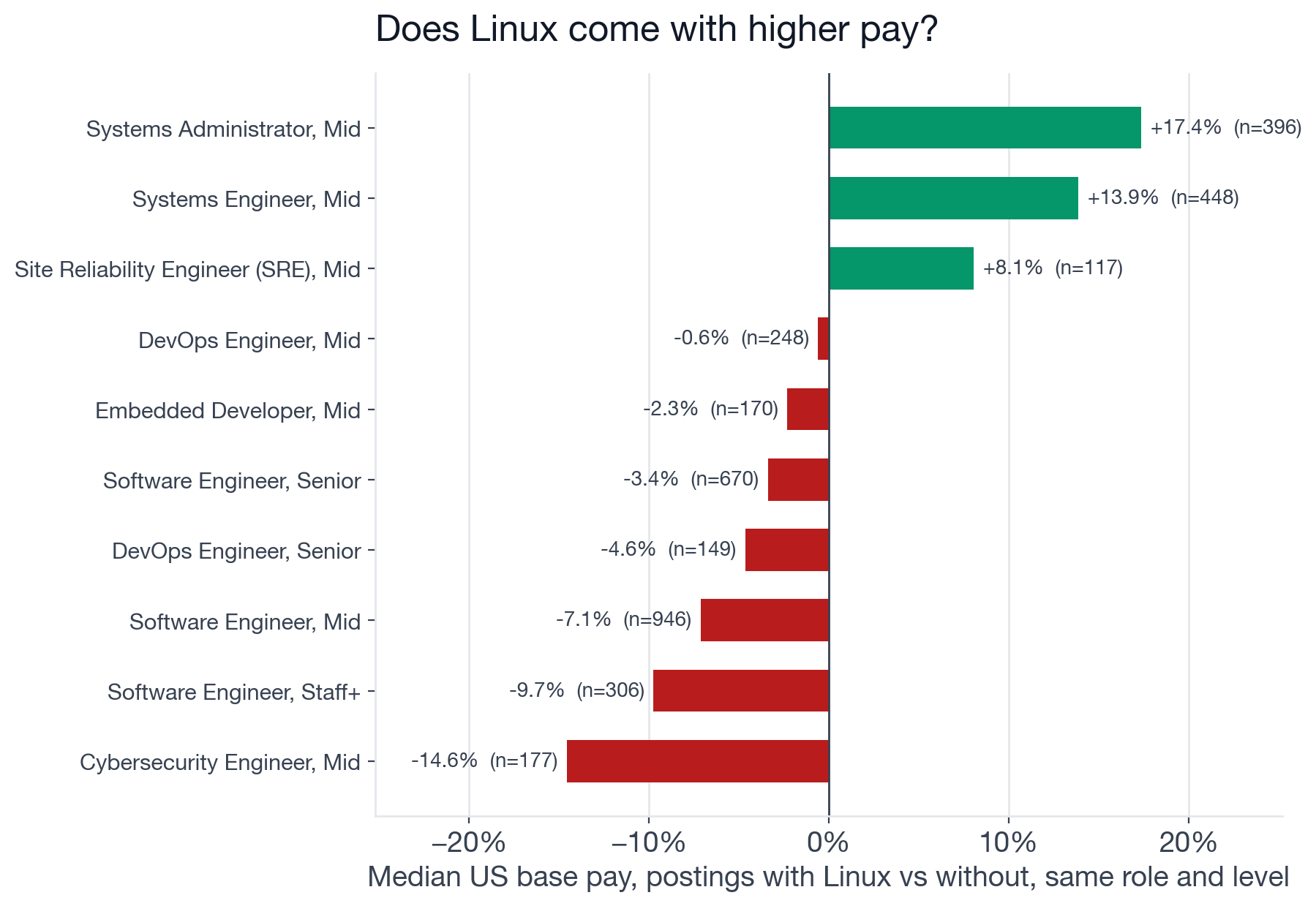
The chart shows the gap by role and level, US base pay only. Software Engineer postings with Linux sit below their no-Linux peers with no level word (-7.1%), senior (-3.4%) and staff (-9.7%), but above them at entry level. DevOps is close to even with no level word (-0.6%) and lower at senior (-4.6%). We have no measurement that explains why the cells split this way; it describes advertisements, which differ in employer and team as well as in what they name. None of it shows that learning Linux changes what an employer offers, and a reader in a down cell would be wrong to read the table as "Linux costs you money" either.
Which Skills Should You Learn Alongside Linux?
The pairings worth knowing are the ones that appear with Linux far more than they appear anywhere else, which are scripting and configuration tools rather than the big clouds. Bash (22.8% of Linux postings) shows up 5.0 times as often as it does across the whole board, and Ansible (16.8%) 4.7 times. PowerShell (3.0 times) is a reminder that many Linux postings sit in mixed estates: 26.8% of Linux postings also name Windows.
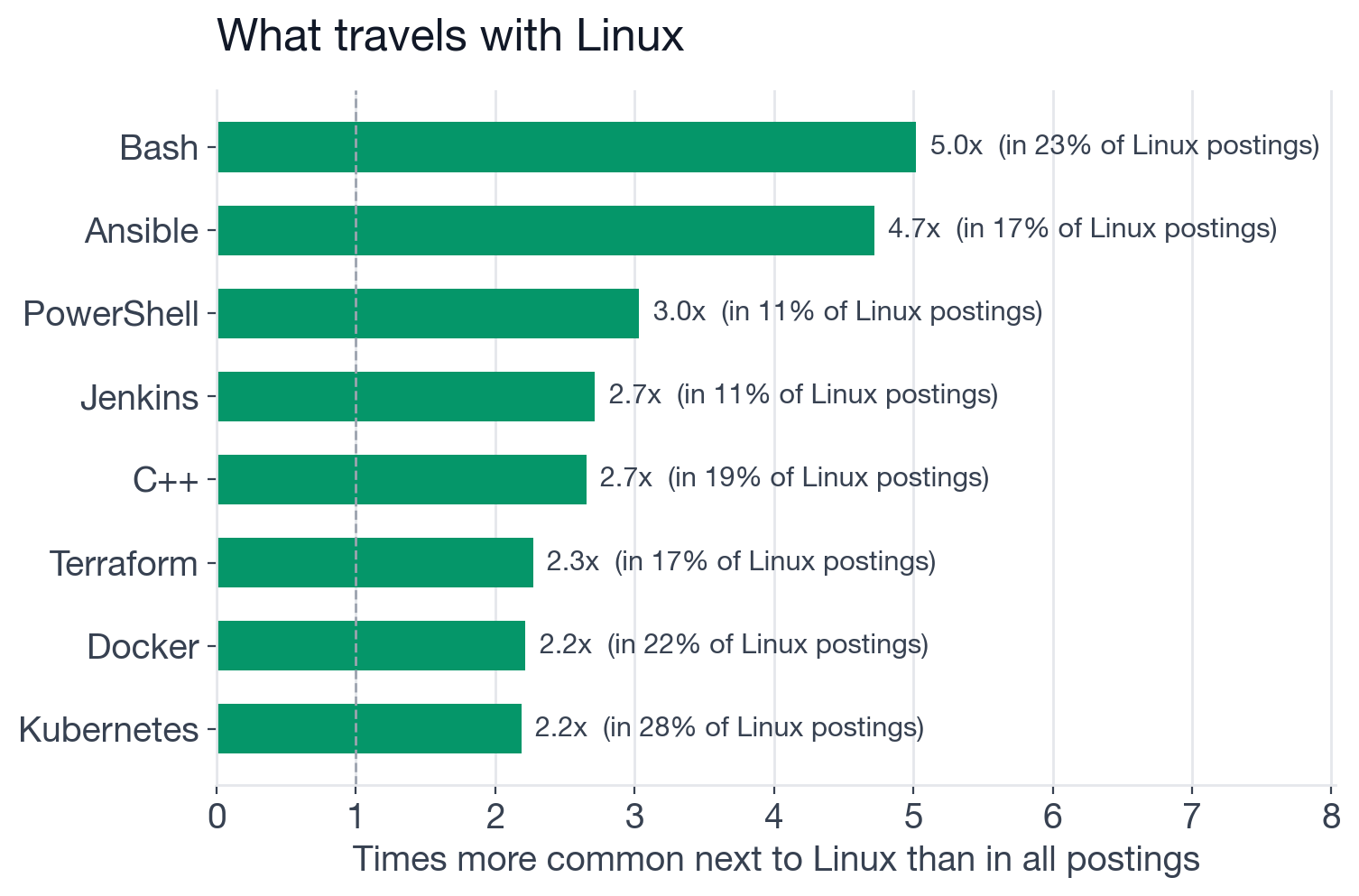
The chart ranks by lift, not raw share. Python is in 56.9% of Linux postings but also in a third of all postings, so it separates little (1.7 times). AWS looks like a pairing and is mostly an everywhere skill (1.3 times). Lower down, C++ (2.7 times) is consistent with the embedded and systems-programming roles, and Jenkins, Terraform, Docker and Kubernetes (each 2.2 to 2.7 times) with the DevOps path, though we did not measure the pairings role by role. For the container and infrastructure-as-code side, see our posts on Kubernetes and Terraform.
Which Employers Name Linux Most Often?
Among employers on our board, the most distinct openings that name Linux sit at large technology and defense employers, and the defense and federal contracting cluster is the part that stands out. Amazon (624 openings) and NVIDIA (328) lead. We leave out one employer whose count we could not corroborate. Next come Leidos (170), Northrop Grumman (167), Qualcomm (160), Booz Allen Hamilton (150), RTX (145), AMD (133), CACI International (127), General Dynamics Information Technology (115), Thales (113) and Peraton (108). Cisco appears under two labels that together total roughly 230.
Eight of the 13 distinct employers in the list (Leidos, Northrop Grumman, Booz Allen, RTX, CACI, General Dynamics IT, Thales and Peraton) are defense or government contractors, and Qualcomm, AMD, NVIDIA and Cisco are chip and network hardware makers. It describes the employers on our board, not who hires most, and counts are approximate.
What Should You Do With This if You Are Choosing a Path?
Match the advice to the role you are aiming at, because the data only supports a different answer for each.
- Operations, systems, SRE or embedded paths: treat Linux as a resume line you expect to defend. It is named in 3 to 4 postings in 10 for these roles, and you should be ready to talk through shell work, services and troubleshooting. Our Question Bank is a place to drill shell and troubleshooting questions.
- Software or security paths: Linux is a useful extra, not a differentiator the pay data backs. Mention it where you actually use it.
- Pair it deliberately: Bash first, then Ansible or the container and infrastructure-as-code tools if you are heading toward DevOps.
- Read the posting, not the keyword: judge each posting by what it asks for and how it words it.
You can browse current openings on the job board and see which roles it tracks in the roles index.
FAQ
Q. How many job postings ask for Linux in 2026?
17,301 of 145,069 active postings on the InterviewStack.io job board (11.9%) name Linux, across 37 of the 39 roles we track, in the 90 days to 18 November 2026. The share was 12.1%, 12.2% and 11.7% across the three 30-day windows.
Q. Is Linux required or just preferred?
Mostly preferred where the wording is clear. Of the 4,400 mentions with required or preferred wording nearby, 76.5% read preferred and 23.5% read required. The other 12,901 mentions carry no such wording nearby, so the split describes a subset of the postings, not all of them.
Q. Do postings that ask for Linux advertise higher pay?
Not consistently. Comparing postings with and without Linux inside the same role and seniority (US advertised base pay), the weighted average gap is +0.5% across 60 cells, up in 27 and down in 28. Systems Administrator postings with no level word in the title advertise a median of $115,024 with Linux versus $98,000 without it; staff Software Engineer postings advertise $193,715 versus $214,600. This is a correlation, not proof that Linux changes pay.
Q. Which roles ask for Linux most often?
Embedded Developer (40.9% of 2,423 postings), Systems Engineer (38.5% of 4,222), Systems Administrator (38.1% of 3,045), DevOps Engineer (33.4% of 4,884) and Site Reliability Engineer (31.8% of 2,683). Software Engineer is the largest source in absolute terms (5,112 postings, 29.5% of all Linux postings) but only 15.5% of Software Engineer postings name it.
Q. What should you learn alongside Linux?
Bash and Ansible are the strongest pairings. Bash appears in 22.8% of Linux postings (5.0 times its rate across the board) and Ansible in 16.8% (4.7 times). PowerShell (3.0 times), C++ (2.7 times), Jenkins (2.7 times), Terraform (2.3 times), Docker (2.2 times) and Kubernetes (2.2 times) also pair above their normal rate. Python is in 56.9% of Linux postings but is common everywhere (1.7 times).
Q. Which employers on the board post the most Linux openings?
Among employers on our job board, Amazon (624 distinct openings) and NVIDIA (328) lead, followed by Leidos (170), Northrop Grumman (167), Qualcomm (160), Booz Allen Hamilton (150) and RTX (145). Defense and government contractors fill eight of the 13 employers in the top list, a clear cluster alongside chip and networking hardware makers. This describes our board, not the whole market.
Where Does That Leave You?
Linux is named often in operations and embedded work and much less elsewhere, and not a reliable marker of higher posted pay in either place. Decide by the role you want and learn the scripting and automation tools that travel with it.
Topics
Ready to practice?
Put what you've learned into practice with AI mock interviews and structured preparation guides.